Artifact · Inscription
Sargon II and a Dignitary in the Palace at Khorsabad (Louvre AO 19873–19874)
An object record bringing together its image, metadata, rights, and context.
- Timeline
- From 721 BCE to 705 BCE
- Region
- Mesopotamia
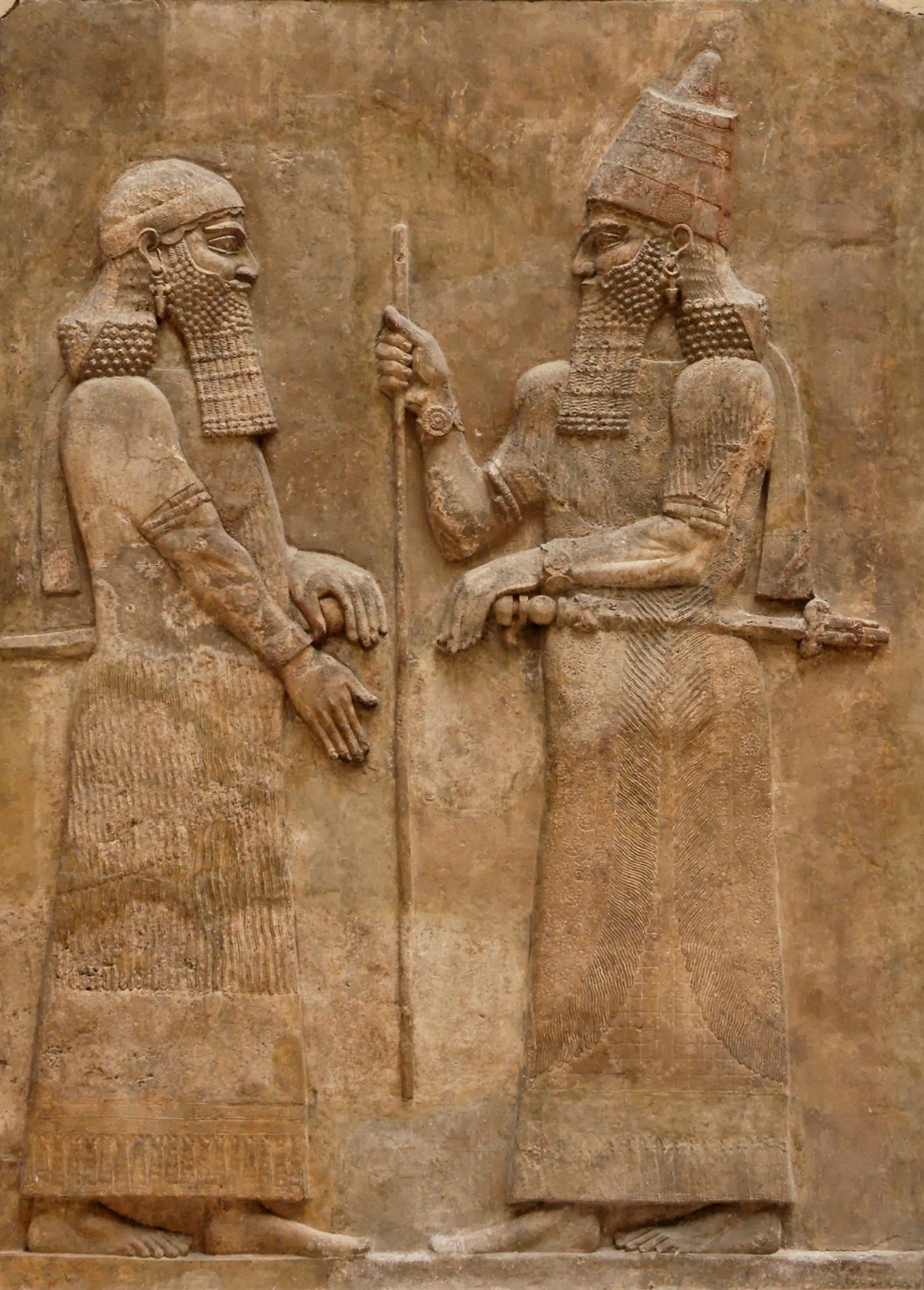
A carved wall panel from Khorsabad shows Sargon II facing a bearded court dignitary. Their headgear and jewellery mark differences of rank. Traces of paint and an inscription on the back preserve details of how the panel was made and installed.
Estimated reading time: 3 min Published Last reviewed:
Share article
Photograph
Photograph by Jastrow, via Wikimedia Commons. Public domain.
Sargon II on the right and a high court dignitary on the left, on the palace relief from Khorsabad
Image sourceObject details
- Title
- Sargon II and a Dignitary in the Palace at Khorsabad (Louvre AO 19873–19874)
- Timeline
- From 721 BCE to 705 BCE
- Region
- Mesopotamia
- Rights
- Public domain
Text
Introduction
An Assyrian king and a bearded dignitary stand face to face on a gypsum-alabaster wall relief. The king on the right is Sargon IISargon IISargon II was an Assyrian king of the late eighth century BCE; ORACC dates his reign about 721–705 BCEGlossary · Click to read the explanation, identifiable by his high tiara and the long, staff-shaped sceptre in his hand. The panel stood on Facade L in Courtyard I of his palace at Khorsabad, the ancient city of Dur-Sharrukin in northern IraqIraqIraq is a modern country encompassing much of ancient MesopotamiaGlossary · Click to read the explanation. The Louvre keeps it under the inventory numbers AO 19873 and AO 19874 and dates it to Sargon's reign, 721–705 BCE. [1][2][3]
Two figures at court
Both men wear fringed robes, carry swords and have pendant earrings and bracelets. Their headgear sets them apart. The king wears a tall, truncated-cone tiara. The man on the left wears an ornamented band with ribbons. His garments and a rosette bracelet also signal high rank. The French Ministry of Culture presents Crown Prince Sennacherib as one possible identification for this figure. The Louvre describes him as a dignitary. [1][2]
The figures' profiles stand out against a plain background. Areas such as the king's left shoulder and right arm project farther from the stone than much of the rest of his body. The difference in depth gives volume to the figure. Fine cuts describe the curls of the hair and beard, garment ornament and the jewellery. Surviving red on the king's tiara and white at his eye indicate that colour also helped define the image. The full extent of the original paint is uncertain. [1][2][4]
A wall facing a palace courtyard
The Louvre gives the relief's measurements as 330 cm high, 230 cm wide and 33 cm thick. A slab of this kind, set upright at the base of a wall, is called an orthostat. At Khorsabad, the panels lined lower parts of brick walls. Archaeologists found traces of fastenings at the tops of panels in the palace. The carved face looked out toward the courtyard. Courtyard I adjoined a group of apartments in the palace's residential sector. [1][2][3][4][6]
The back carries a Neo-Assyrian inscription written in cuneiformCuneiformWriting with wedge-shaped signs, developed from Mesopotamian recording traditions and used for several languages from the third millennium BCE.Glossary · Click to read the explanation. The Louvre cites the nineteenth-century catalogue of Adrien Prévost de Longpérier for a count of 20 lines. The French Ministry of Culture also records AkkadianAkkadianAn ancient East Semitic language written in cuneiform from the third millennium BCE; its varieties include Babylonian and Assyrian, and it served in international diplomacy.Glossary · Click to read the explanation inscriptions on the backs of palace slabs. The front showed the king and a member of his court. The writing on the reverse faced the wall once the panel stood in place. The Louvre also holds a negative plaster impression of the inscription on AO 19874, catalogued as AOmg 93 and dated to about 1850. [1][4][7]
From Khorsabad to the Louvre
Paul-Émile Botta's mission excavated the relief in 1843–1844. The painter Eugène Flandin documented the palace's architecture and carvings, including Facade L. Botta also arranged for the inscriptions to be copied. These records preserve views of the reliefs in relation to the palace walls, in addition to the individual objects brought to France. [1][5]
The Louvre records the relief as acquired through a division of the finds after excavation. It displays it in the Cour Khorsabad, alongside other architectural sculptures from the city. The differences in dress and regalia show how the palace reliefs made distinctions of rank visible. [1][2][6]
Quick answers
Who is shown on the relief?
Sargon II stands on the right. The man on the left is a high dignitary. His proposed identification as Sennacherib is uncertain. [1][2]
Where did the relief stand?
It stood on Facade L in Courtyard I of the palace at Khorsabad, ancient Dur-Sharrukin. [1][2][3]
Was the relief painted?
The Louvre records red on the king's tiara and white at his eye. The extent of the original colour is uncertain. [1][4]
Where is the relief today?
It is in the Louvre's Cour Khorsabad under the inventory numbers AO 19873 and AO 19874. [1][6]
References and notes
- Musée du Louvre, “Orthostate,” AO 19873 and AO 19874 Object description, inscriptions, dimensions, materials, dates, findspot, acquisition and display. The museum attributes the count of 20 lines to Longpérier, no. 607. Return to the text ↑
- French Ministry of Culture, “The Sargon Relief,” Khorsabad Sections on the king and the dignitary, relief style and elaborate dress. Facade L, Courtyard I, the suggestion of Sennacherib and the carved details. Return to the text ↑
- French Ministry of Culture, “The Palace,” Khorsabad Section on the bitanu, or residential sector. Courtyards I and VI and their relationship to the rest of the palace. Return to the text ↑
- French Ministry of Culture, “Executing the Reliefs,” Khorsabad Sections on gypsum alabaster, the installation of slabs, the Akkadian inscriptions on their backs and surviving paint. Return to the text ↑
- French Ministry of Culture, “Paul-Émile Botta’s Discovery,” Khorsabad Sections on the first excavations and associated illustration of Facade L. Work by Botta and Flandin and documentation of the reliefs and inscriptions. Return to the text ↑
- Musée du Louvre, “The Palace of Sargon II,” Cour Khorsabad The courtyard, its display of reliefs and the section on palace decorations. Identifies the panel showing Sargon II and a high dignitary. Return to the text ↑
- Musée du Louvre, “Moulage,” AOmg 93 Catalogue description, inscriptions, materials and date. A negative plaster impression of the inscription on the reverse of AO 19874. Return to the text ↑
Archive records may be reviewed and refined as better evidence or sources become available. Suggest a correction
Suggest a correction · Suggest a source for this record
Cite this record
IL Archive, «Sargon II and a Dignitary in the Palace at Khorsabad (Louvre AO 19873–19874)», https://ilarchive.com/en/artifacts/sargon-ii-dignitary-relief-ao19873
Continue reading