Artifact · Inscription
The Kition Stele of Sargon II (Berlin VA 968)
An object record bringing together its image, metadata, rights, and context.
- Timeline
- From 707 BCE to 705 BCE
- Region
- Anatolia and the eastern Mediterranean
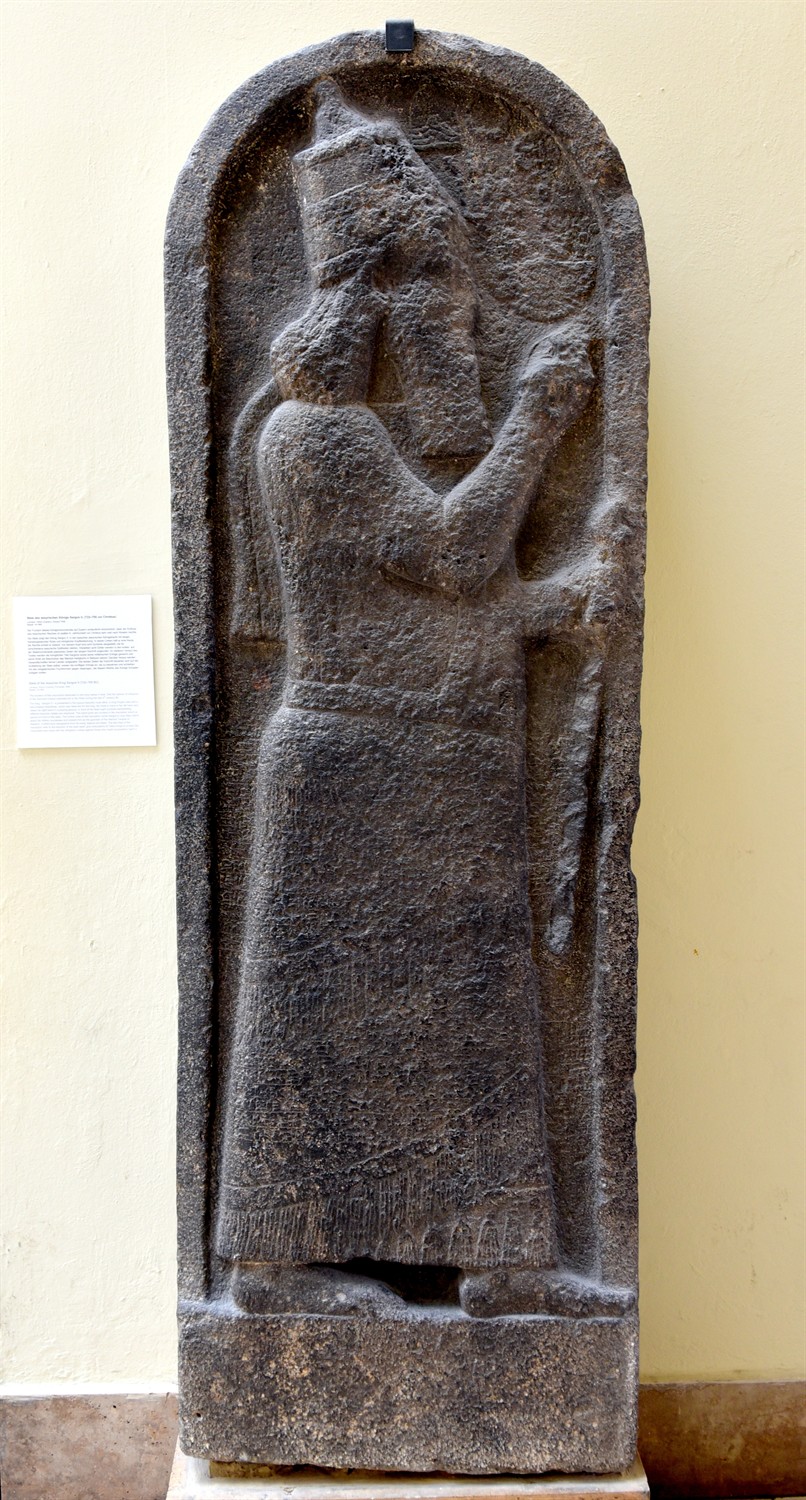
A basalt stele found on Cyprus shows an Assyrian king before eight divine emblems. Its inscription says seven rulers sent gifts to Babylon and asks future kings to preserve the monument.
Estimated reading time: 4 min Published Last reviewed:
Share article
Photograph
Photograph by Osama Shukir Muhammed Amin FRCP(Glasg), via Wikimedia Commons, CC BY-SA 4.0. Cropped on Commons and resized.
The front of Sargon II’s basalt stele from Kition, now in the Vorderasiatisches Museum in Berlin (VA 00968). The king’s raised hand faces the divine emblems above the inscription
License · Image sourceObject details
- Title
- The Kition Stele of Sargon II (Berlin VA 968)
- Timeline
- From 707 BCE to 705 BCE
- Region
- Anatolia and the eastern Mediterranean
- Rights
- CC BY-SA
Text
Introduction
The basalt stele of Sargon IISargon IISargon II was an Assyrian king of the late eighth century BCE; ORACC dates his reign about 721–705 BCEGlossary · Click to read the explanation from Kition, now Larnaca on Cyprus, brings the image and voice of an Assyrian king to the eastern Mediterranean. The king raises his right hand before a group of divine emblems. In the inscription below and around him, he recalls gifts sent to BabylonBabylonBabylon is an ancient city in central present-day Iraq, south of BaghdadGlossary · Click to read the explanation by seven rulers from a district of Cyprus. Today the stone belongs to the Vorderasiatisches Museum in Berlin, inventory VA 00968. [1][2][5]
The king and the divine emblems
The block is about 2.09 metres high and has a rounded top. A relief shows the king in profile, wearing a long fringed robe and royal headdress. He holds a mace in his left hand and raises his right in prayer. Eight emblems occupy the space before his head. Karen Radner identifies them as the horned crown of Ashur, the crescent of Sin, the star of IshtarInanna / IshtarA prominent Mesopotamian goddess whose Sumerian name Inanna became associated with Akkadian Ishtar across diverse traditions. She was associated with desire, war, royal authority and Venus, while local forms and genealogies varied among texts.Glossary · Click to read the explanation, the lightning fork of Adad, the spade of MardukMardukBabylon’s leading god, worshipped at Esagil and elevated in the Akkadian Enūma eliš. His symbols include a spade and mušḫuššu dragon. His earliest origins remain obscure; Nibiru is no evidence of a planetary homeland.Glossary · Click to read the explanation, the stylus of Nabu, seven dots for the Sebettu and the winged sun disk of ShamashShamashMesopotamian god of the sun and justice, shown before Hammurabi on an eighteenth-century BCE stele preserved in the Louvre.Glossary · Click to read the explanation. [1][2]
The opening lines invoke these same deities in words. The groups of signs in the image and the order of the names in the text differ. The invocation describes the Seven as going ahead of the gods and supporting the king in battle. The movement of the raised hand and the position of the emblems make the encounter legible even where the cuneiformCuneiformWriting with wedge-shaped signs, developed from Mesopotamian recording traditions and used for several languages from the third millennium BCE.Glossary · Click to read the explanation is difficult to read. [1][2]
The text and the visit to Babylon
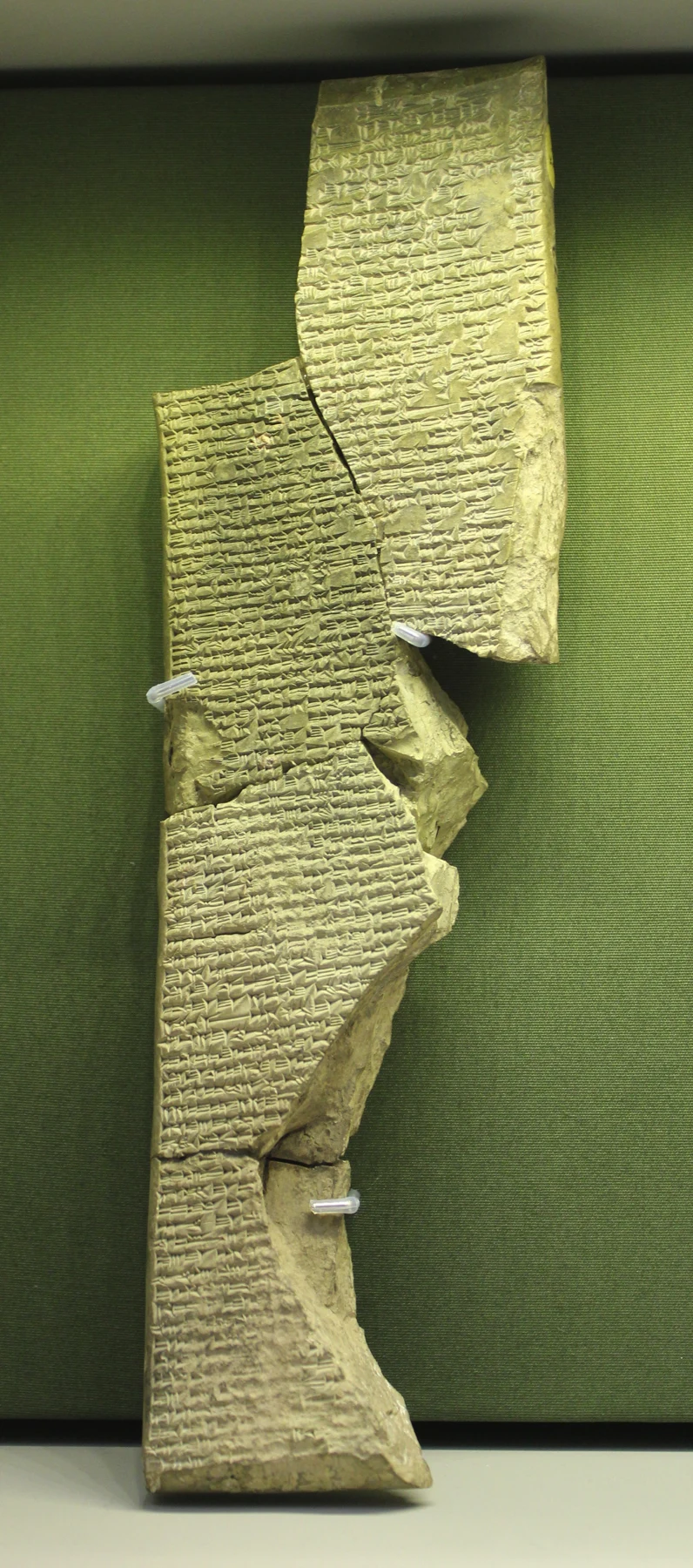
The AkkadianAkkadianAn ancient East Semitic language written in cuneiform from the third millennium BCE; its varieties include Babylonian and Assyrian, and it served in international diplomacy.Glossary · Click to read the explanation inscription continues from the front onto the two sides. It gives Sargon’s titles, surveys his campaigns and portrays him as a protector of the sanctuary of MardukMardukBabylon’s leading god, worshipped at Esagil and elevated in the Akkadian Enūma eliš. His symbols include a spade and mušḫuššu dragon. His earliest origins remain obscure; Nibiru is no evidence of a planetary homeland.Glossary · Click to read the explanation at BabylonBabylonBabylon is an ancient city in central present-day Iraq, south of BaghdadGlossary · Click to read the explanation. It describes an embassy from DilmunDilmun: Ancient Gulf Land and Literary SettingDilmun was an ancient Gulf trading land with a major archaeological centre in Bahrain and connections to eastern Arabia and Failaka. This entry separates boats, burials and kings from the literary purity and fresh water of Enki and Ninhursaga, and tests the limits of comparison with Eden.Glossary · Click to read the explanation in the eastern sea and sets beside it the approach of seven kings from Ya’, a district of Adnana, the Assyrian name here for Cyprus. The inscription names silver, gold and ebony and boxwood furnishings among the gifts sent to Babylon. It presents the rulers’ actions as homage to Sargon. [1][2][5]
The stele records Sargon’s third year as king of Babylon, corresponding to 707 BCE. Radner treats this as the earliest possible year for the monument and argues that it was probably erected then. She connects the gifts with an earlier episode involving Sargon, the ruler of TyreTyreTyre is a city on the coast of present-day southern Lebanon and an important ancient Phoenician centerGlossary · Click to read the explanation and the kings of Cyprus, on the basis of a reconstructed passage in the Khorsabad Annals. Anna Cannavò questions that reconstruction and distinguishes the Assyrian presentation of homage from the possible diplomatic motives of the local rulers. The stele gives the court’s account of the gifts. The nature and duration of Assyrian involvement on the island remain debated. [2][5]
Where the monument stood
The inscription connects the erection of the stele with a mountain named Baʿal-harri. Damage leaves the exact relation between the installation and the mountain open to interpretation. Radner proposes the area of Mount Stavrovouni and considers a site facing the mountain possible. The location where the stone was originally set up is uncertain. [2][5]
The end of the inscription asks a future ruler to read the monument, praise the gods, anoint the stone and make offerings. It warns against moving it or erasing Sargon’s name and calls upon the gods named on the monument and the gods of the sea. The final lines treat the inscribed stone as a dedication entrusted to future rulers. [1][2]
The discovery and the stone in Berlin
Accounts differ about the discovery. Radner gives 1844 and associates the find with Bamboula near the ancient harbour. Robert S. Merrillees dates it to October 1845 or shortly before, drawing on nineteenth-century reports and the accession record. His comparison of the local landmarks points toward the vicinity of Phaneromeni, although he leaves the exact findspot open. The museum records the purchase at Larnaca in 1846 and the stele’s arrival in Berlin in 1848. [2][3][4]
A slab was sawn from the back to make the monument easier to transport. The cut removed ends of lines on one side and beginnings on the other. Radner reports that the location of the detached part is unknown. The photograph shows the original frontal relief in Berlin. A replica is documented in Larnaca. [1][2]
Quick answers
When was the Kition stele made?
The inscription mentions 707 BCE, Sargon’s third year as king of Babylon. Radner considers that year the most likely date for its erection. [2]
Where is the original stele?
It belongs to the Vorderasiatisches Museum in Berlin, inventory VA 00968. It was found at Larnaca, ancient Kition, on Cyprus. [1][3][4]
What do the seven dots represent?
In Radner’s reading, they stand for the Sebettu, the divine Seven invoked in the opening lines of the inscription. [1][2]
What does the inscription say about the Cypriot rulers?
It says that seven kings of Ya’, a district of Adnana, sent gifts to Sargon in Babylon. Their reasons and the ensuing political relationship remain matters of interpretation. [2][5]
References and notes
- Anja Fügert, “Stele Sargons II. aus Larnaka (Kition), Zypern,” Vorderasiatisches Museum, Staatliche Museen zu Berlin, VA 00968 Object record and description. Basalt, royal costume and gesture, eight divine symbols, layout of the ancient text and the final injunctions. Return to the text ↑
- Karen Radner, “The Stele of Sargon II of Assyria at Kition: A Focus for an Emerging Cypriot Identity?,” in Interkulturalität in der Alten Welt, Philippika 34, Harrassowitz, 2010, pp. 429–449 Pp. 429–434, find history, figure 1, divine emblems, loss of text and dating. Pp. 434–442, the Babylonian delegation, the relation with Tyre, Mount Baʿal-harri and the final injunctions and curses. Return to the text ↑
- Robert S. Merrillees, “Studies on the Provenances of the Stele of Sargon II from Larnaca (Kition) and the Two So-Called Dhali (Idalion) Silver Bowls in the Louvre,” Cahiers du Centre d’Études Chypriotes 46 (2016), pp. 349–386 P. 349, discovery and accession. Pp. 356–358, comparison of nineteenth-century accounts and landmarks, proposed area near Phaneromeni and the Berlin accession record. Return to the text ↑
- Barbara Helwing, “A Short History of the Vorderasiatisches Museum,” catalogue text for Liam Gillick: Filtered Time, Staatliche Museen zu Berlin, 2023 P. 1, the museum’s purchase of the stele in Larnaca in 1846 and its arrival in Berlin in 1848. Return to the text ↑
- Anna Cannavò, “Cyprus and the Near East in the Neo-Assyrian Period,” Kyprios Character, National Hellenic Research Foundation Discussion of the Kition stele and its left side, lines 28–42. Homage and diplomatic gifts, the limits of the evidence for tribute, and note 26 on the disputed reading of the Khorsabad Annals. Return to the text ↑
Archive records may be reviewed and refined as better evidence or sources become available. Suggest a correction
Suggest a correction · Suggest a source for this record
Cite this record
IL Archive, «The Kition Stele of Sargon II (Berlin VA 968)», https://ilarchive.com/en/artifacts/sargon-ii-kition-stele-va968
Continue reading