Site
The Middle Bronze Age Gate at Tel Dan
- Timeline
- From 1800 BCE to 1701 BCE
- Region
- The Levant
Three mudbrick arches once spanned a single passage into the Canaanite city of Laish. The inhabitants buried the gate within an earthen rampart. The covering protected a rare example of Bronze Age construction.
Estimated reading time: 4 min Published Last reviewed:
Share article
Text
Introduction
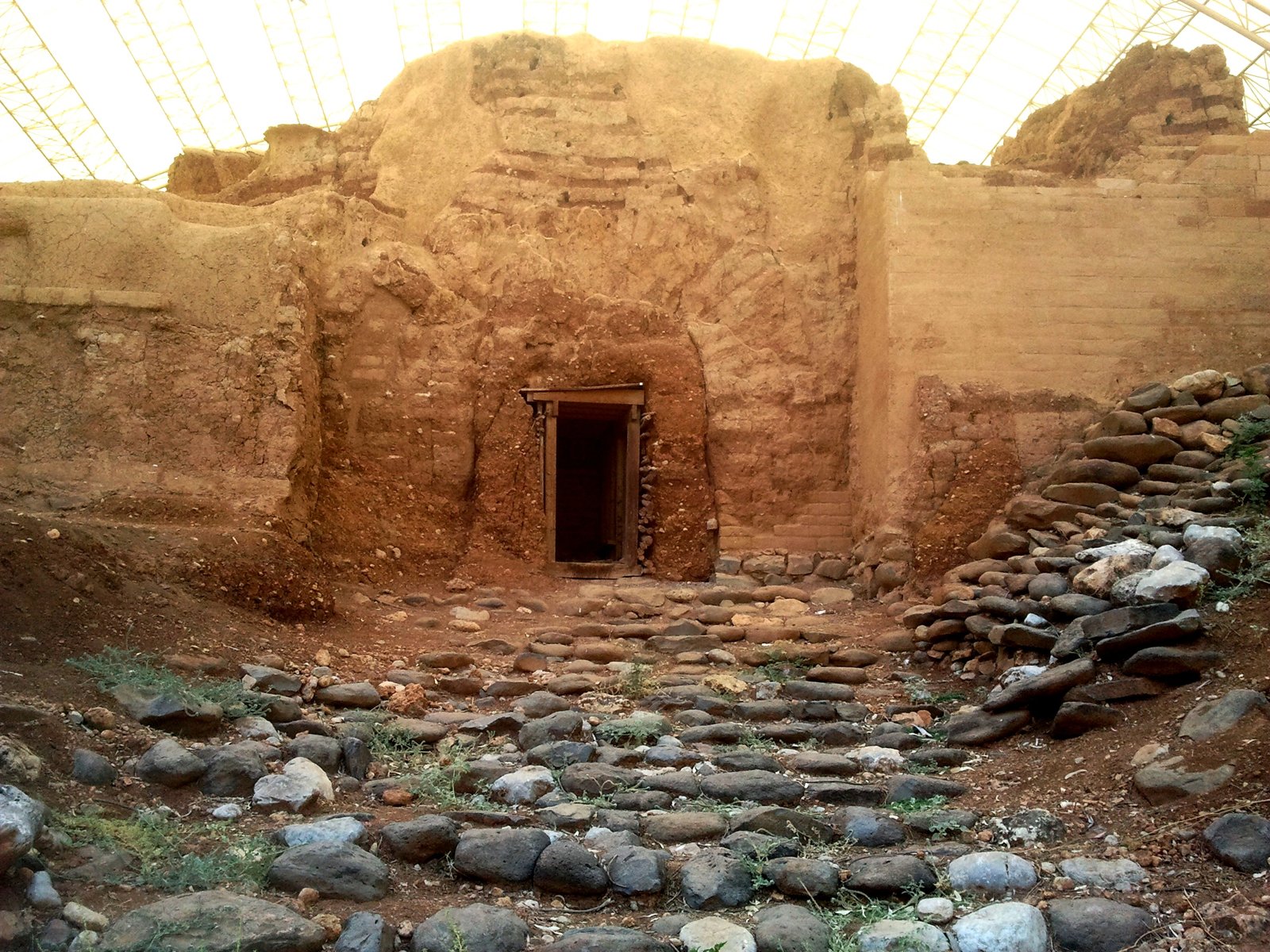
The Middle Bronze Age gate at Tel Dan stands within an earthen rampart of the Canaanite city of Laish, near the Dan Spring in the southern LevantThe LevantThe Levant is a regional name for lands along the eastern MediterraneanGlossary · Click to read the explanation. Three arches of sun-dried mudbrick span its passage at successive points. The excavation project assigns the gatehouse to Stratum XI, in the eighteenth century BCE. The exposed eastern façade reveals the scale of the building, while ancient burial within the rampart explains why so much of its earthen structure survived. [1][2][3][5]
The passage through the rampart
The gatehouse formed part of the city’s earthworks. In his study of Middle Bronze Age architecture, Robert S. Homsher gives the structure’s overall dimensions as 15.45 metres wide and 13.5 metres deep, with a passage about 10.5 metres long. The excavation recorded the façade, the rooms and the walls that define the passage. The brickwork stood about seven metres high in its best-preserved part. [1][2][3][4]
Two projecting towers flanked a recessed entrance. Stone steps led up to the arch at the eastern end of the passage. Another arch stood inside the gatehouse and the third at the western end. The piers that carried the middle arch helped divide the interior into four chambers. In the surviving layout, the arches mark three points on a route through one building. [2][3]
How the bricks form an arch
The mudbrick was dried in the sun. Rosa Frances’s structural study describes three concentric courses of brick in each arch. The joints in the curved part angle toward the centre of the arch. The curve allows the masonry to carry weight in compression, transferring it toward the piers on either side. The engineering study places the gate around the middle of the eighteenth century BCE. [2][5]
The survival of all three arches gives evidence for the use of this construction on a monumental scale. The UNESCO committee’s 2011 working document describes a span of about 2.5 metres and notes that some bricks make partial use of the wedge shape associated with arch masonry. The combination of a clear span, three layers and the surviving passage makes it possible to study the arches in their original architectural setting. [2][5]
Buried in antiquity, protected after excavation
Frances explains that the gate was used for a relatively short time before people packed its passage with earth and buried it. The building became part of the enlarged defensive embankment. The earth protected the mudbrick surfaces until excavation. Avraham Biran led the excavation project from 1966 and published an account of the discovery of the monumental gate in 1981. That publication is an early report from a sequence of excavation seasons, with further work at the gate through 1985 as recorded by Frances. [1][2][6]
Exposure after excavation brought a new conservation problem. Rain and weathering can erode sun-dried brick. The archaeological authorities covered the middle arch and western side again with earth for protection and placed a shelter over exposed portions. The roof in the photograph belongs to that modern protection, and the brick gateway and stone approach below it show the ancient entrance. [2][4][5]
The reserve calls the Bronze Age structure the Abraham Gate or Canaanite Gate. The excavation project’s dating derives from its archaeological layer. The site also preserves later gate complexes. The excavators place those in the Iron Age, centuries after the building of the triple-arched gate. [1][4]
Quick answers
When was the Middle Bronze Age gate at Tel Dan built?
The excavators place it in the eighteenth century BCE. Rosa Frances’s study dates it to around the middle of that century. [1][2]
Why is it called the triple-arched gate?
Three mudbrick arches stood one after another along the same passage. The eastern, middle and western arches belonged to one gatehouse. [2][3]
How did so much mudbrick survive?
The inhabitants filled and buried the gate within the city’s earthen rampart. The earth protected the bricks until excavation exposed them. [2]
Is this the gate called the Abraham Gate?
Yes. The reserve uses Abraham Gate as another name for the Middle Bronze Age Canaanite Gate. [4]
References and notes
- Donald Scott, A Study of Ramparts in Dan during the Bronze and Iron Age, master’s dissertation, University of South Africa, 2021 Pp. 51–52, start of Biran’s excavations in 1966. Pp. 75–76, the mudbrick gate and its passage. Pp. 79–80, the later Iron Age gates. Pp. 88–89, the gate and ramparts in Stratum XI. Return to the text ↑
- Rosa Frances, “The three-arched middle Bronze Age gate at Tel Dan – A structural investigation of an extraordinary archaeological site,” Construction and Building Materials 41 (2013), pp. 950–956 Abstract, Introduction and Description. Mid-eighteenth-century date, successive arches, radial brick courses, burial of the gate, years of excavation and protective measures after exposure. Return to the text ↑
- Robert S. Homsher, Constructing Urbanism: Relating the Construction of Architecture to the Process of Urbanization in the Middle Bronze Age Southern Levant, doctoral thesis, University College London, 2013 Vol. 1, p. 96 and fig. 16. Dimensions of the gate and passage in Area K, layout of piers and chambers, surviving height and integration into the rampart. Return to the text ↑
- Israel Nature and Parks Authority, “Tel Dan Nature Reserve” History and main points of interest. The Dan Spring, Abraham Gate and Canaanite Gate names, mudbrick, height and protective measures. Return to the text ↑
- UNESCO World Heritage Committee, Nominations to the World Heritage List, Addendum, WHC-11/35.COM/8B.Add, 27 May 2011 P. 3, draft decision 35 COM 8B.41, option II, descriptions of the gate, the width of the spans, radial brickwork and conservation of the mudbrick. Return to the text ↑
- Avraham Biran, “The Discovery of the Middle Bronze Age Gate at Dan,” The Biblical Archaeologist 44, no. 3 (1981), pp. 139–144 Publication record and abstract. Biran’s early report about the monumental mudbrick gate at Laish. Return to the text ↑
Suggest a correction · Suggest a source for this record
Cite this record
IL Archive, «The Middle Bronze Age Gate at Tel Dan», https://ilarchive.com/en/sites/tel-dan-middle-bronze-gate
Continue reading