Study
Why Did People Elongate Their Children’s Skulls? From Neolithic Head Shaping to Ubaid Figurines
An extended study of a topic, with evidence and references.
- Timeline
- From 8500 BCE to 4000 BCE
- Region
- The Zagros, Mesopotamia and the Levant
Head-shaping evidence from the Zagros, Jericho and Tell Zeidan, and possible identity, beauty and status motives: what bones establish and how far they explain Ubaid figurine heads.
Share article
Text
Heads shaped in childhood
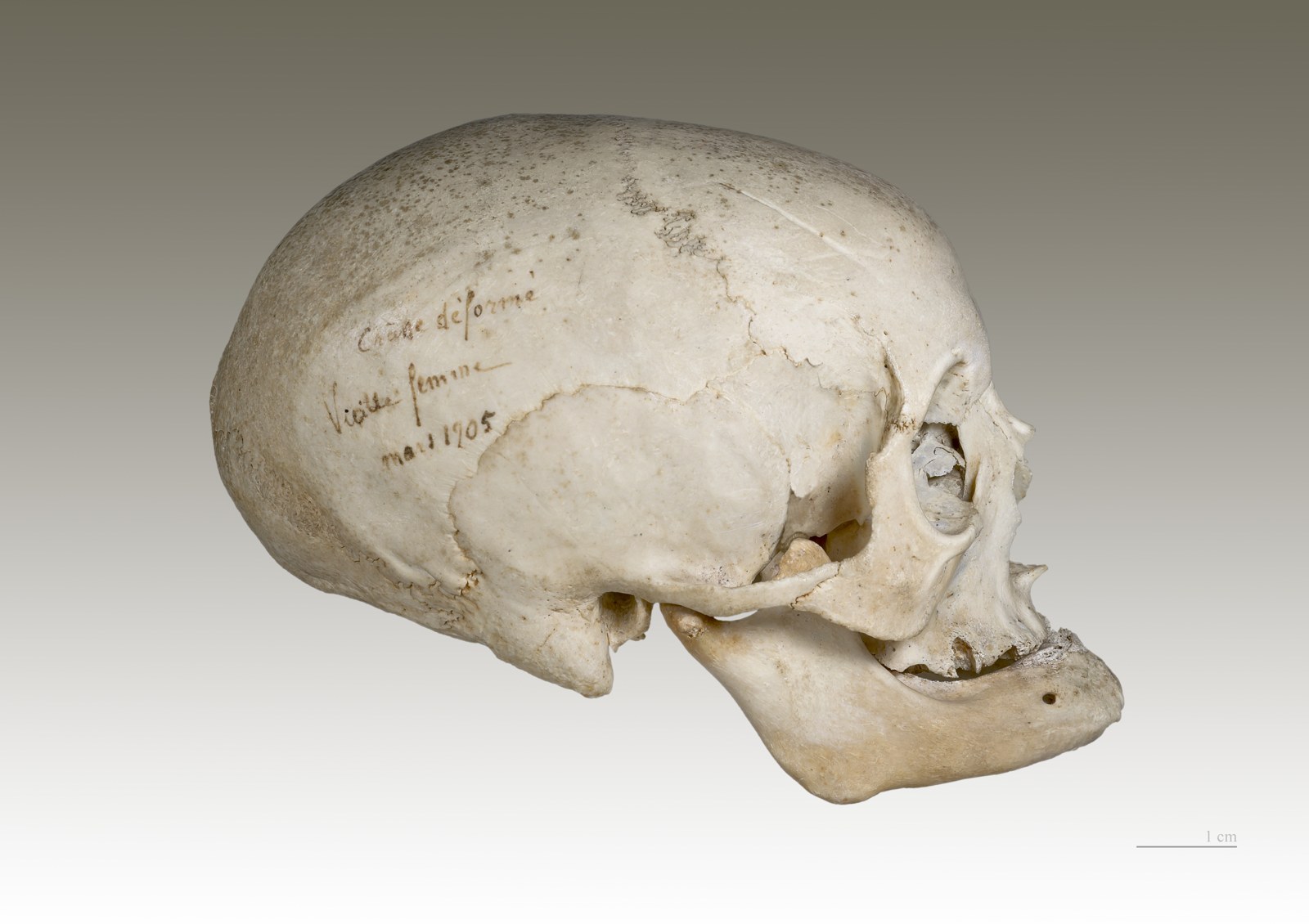
Some skulls recovered from ancient Near Eastern graves are unusually extended backward or upward, or display marked flattening. Where cultural modification has been diagnosed, this was more than inherited variation: growth had been redirected during early childhood. Archaeologists call the practice cranial modificationCranial modificationAlteration of head shape through bodily practices in early childhood, documented in multiple communities. It may relate to affiliation, status or beauty, but an elongated figurine head alone does not prove the subject underwent it.Glossary · Click to read the explanation or head shaping.[1]
The decision began before the child could choose, yet could leave a visible mark into adulthood. Its history predates Sumerian cities and kings: early Neolithic communities practised it long before the UbaidUbaid cultureAn archaeological designation for material traditions originating in southern Mesopotamia with regional diffusion. Broad southern frame c. 6500–3800 BCE; not a known linguistic people, with limits varying by region and phase.Glossary · Click to read the explanation horizon. The social question is therefore harder than the anatomical one. Why did caregivers want this appearance? Was it beautiful, a sign of membership or rank, or connected with something sacred? Evidence establishes the intervention more readily than its meaning. No single explanation covers every community.[1][2]
An intervention before the child can choose
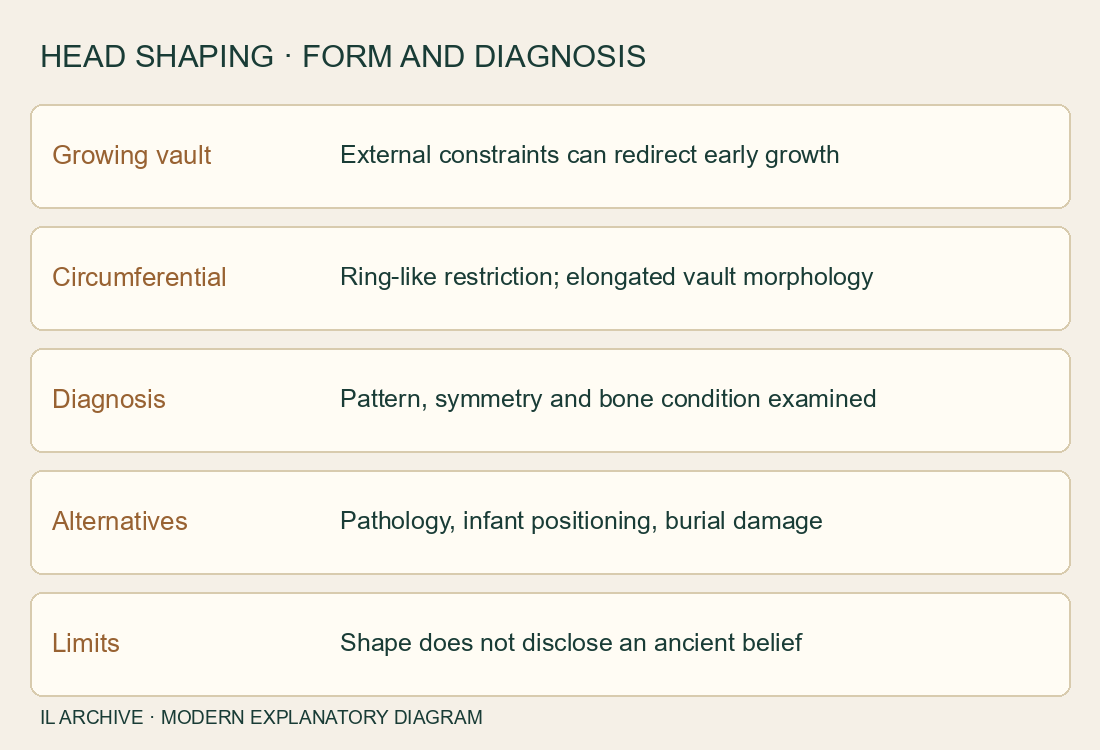
An infant skull is not a finished block of bone. Its elements grow, while sutures allow expansion. External constraints during early growth can therefore change its direction. Historical studies document textiles and bindings, as well as practices involving cradles or rigid surfaces. Outcomes vary: a vault may become flatter, higher or more elongated.[1][5]
Circumferential modificationCircumferential head shapingA pattern of early-growth head shaping associated with circumferential constraint and an elevated or extended vault.Glossary · Click to read the explanation involves a constraint around the vault and can produce upward and backward extension. Nor must growth suddenly “stop” for the shape to persist. Redirected early growth can leave changes visible in an adult skull. The original decision belongs to those caring for the child, rather than to a choice made in adolescence.
Not every flattened skull records an intentional rite
Intentional reshaping must be distinguished from incidental effects of infant positioning, and both from pathology or damage after burial. Some flattening may result from a cradle or care practice without producing a different head being the purpose. Lorentz treats a clear circumferential pattern as stronger evidence of deliberate alteration.[5]
Strangeness alone provides no diagnosis. Researchers examine regularity, symmetry, sutures, bone condition, fractures and context. Burial pressure can distort a skull differently from growth during life. An initially incidental appearance might have become familiar and desirable in some communities, but that remains a possible scenario rather than a demonstrated origin story for every tradition.
Long before the Ubaid horizon
At Tepe Abdul Hosein in western IranIranIran is the modern country containing Shush, ancient SusaGlossary · Click to read the explanation’s Zagros, Kirsi Lorentz studied twelve individuals from eight mortuary contexts. Her 2017 paper describes the Neolithic remains as roughly ten thousand years old, within a ninth-to-eighth-millennium BCE framework.[2]
Five adults had assessable crania. Four showed two-band circumferential modification: three were male and the fourth could not be sexed. The fifth, unmodified individual was female. These are counts of assessable people, not the prevalence among all village inhabitants. The study explicitly warns that the sample cannot establish an exclusively male practice. A culturally shaped head was already possible long before Sumerian urban life.
Ganj Dareh: antiquity still requires careful counts
Ganj Dareh, also in the Zagros, preserves further evidence of head shaping. Daems and Croucher’s 2008 review summarizes an older sample of fourteen modified skulls, citing Meiklejohn and colleagues. A 2021 reassessment of the site instead reports 116 individuals represented by remains ranging from isolated bones to more complete skeletons, and mentions modification of some crania. The older modified-skull count and the later total therefore describe different sets of remains.[1][3]
Chronology also differs from a simple six-century occupation range. The 2021 paper discusses evidence that most levels accumulated over about 200–300 years after approximately 10,100 calibrated years before present, broadly the early eighth millennium BCE, while considering a possible older horizon. The evidence remains early, but dates and sample counts are not interchangeable.
From the Zagros to the Levant
Treatment of the head was not confined to the Zagros, but types and dates vary regionally. At Jericho, Fletcher, Pearson and Ambers published a radiographic study of a plastered skull in 2008. They identified childhood modification that had not dramatically changed the vault. This concerns the examined case, not every Jericho skull.[4]
Two separate actions are visible: modification during life, followed by plaster treatment after death. Their combination invites questions about living identity and remembrance of the dead. It neither makes them one technique nor proves that shaping always anticipated plastering. The authors’ proposed continuity of ritualRitualAn organised or distinguished practice meaningful to a community; it may leave traces, but its form alone does not reveal an associated doctrine.Glossary · Click to read the explanation significance from life to death is an interpretation, not a surviving declaration of the individual’s beliefs.
A head that signals “I belong here”
One broad social explanation is that appearance could mark affiliation. A head is visible, accompanies its bearer and cannot simply be removed like clothing. It may distinguish communities, or people within a community. Researchers therefore consider head shaping a possible means of constructing embodied identityEmbodied identityAffiliation or standing expressed through the body and its practices; an interpretive model requiring independent context.Glossary · Click to read the explanation: affiliation expressed through the body.[1][5]
That capacity does not reveal which identity was involved—a family, local group or social role. Nor does it show that the same morphology meant the same thing elsewhere a millennium later. Testing requires comparison with unmodified individuals, burial locations, dates and grave goods. Bone preserves difference; the name of the group and meaning of membership may remain inaccessible.
An identity assigned before adulthood
An intervention begun in infancy cannot originally be a reward chosen after an adolescent achievement. It can suit an identity assigned early: membership of a household or group, or a role the family anticipates. Lorentz accordingly distinguishes early ascribed identity or status from standing acquired later.[5]
But a skull does not yield a complete inheritance system. A community may change how it understands a person over their lifetime, and a shared appearance might integrate people of different ancestry rather than distinguish one lineage. The practice shows others’ capacity to shape a child’s body and social appearance. Marriage rules, descent and political authority cannot be read directly from the vault.
Was an elongated head beautiful?
Beauty is a plausible motivation. Ethnographic comparisons document preferences unlike those familiar to us; a shaped appearance may become a desirable bodily ideal. Yet a recent or geographically distant comparison provides no statement of Zagros villagers’ tastes. Its value is to widen possibilities, not fill the gap with borrowed testimony.[1]
Beauty itself can be social: a desirable form may resemble relatives or distinguish members of a community. “Aesthetics” and “identity” need not be exclusive explanations. Repeated elongated heads in images may express an ideal, but do not establish that figurinesFigurineSmall three-dimensional representations of people, animals or other beings. Size and appearance alone do not establish a toy, portrait, ritual object or deity; manufacture, discovery context and use require study.Glossary · Click to read the explanation record everyone’s actual appearance or that all communities favoured the same shape.
Was it a mark of status?
Some researchers connect shaping with elites or social differentiation. An infant intervention could suit a status assigned at birth. Demonstrating this requires consistent relationships with independent indicators—graves, goods, diet or residence—while controlling for chronology.[5]
Modified and unmodified individuals do not automatically form rich and poor groups. The contrast might involve affiliation, care or different occupation phases. Lorentz’s 2017 Tepe Abdul Hosein abstract tends to rule out status differentiation for that case, based on her understanding of early Neolithic society. This is an interpretation of a particular sample, not proof that Neolithic communities lacked social differences or that shaping never marked rank elsewhere.[2]
Did men and women have different shapes?
Some samples suggest differences between males and females, but preservation, sex estimation and small numbers make interpretation difficult. Ganj Dareh includes evidence for both sexes; reviews of Ali Kosh report female cases. These do not establish one regional rule.[1]
At Tepe Abdul Hosein the preliminary 2010 table, discussing different patterns and another assessable sample, must not be combined with the 2017 results. The later paper reports three modified individuals estimated as male and a fourth of indeterminate sex—not four males out of four. Even that pattern cannot establish that women were never modified. Estimated skeletal sex also does not, by itself, reveal gender roles or the relative standing of men and women.[2][5]
The possibility of religious meaning
Was shaping a ritualRitualAn organised or distinguished practice meaningful to a community; it may leave traces, but its form alone does not reveal an associated doctrine.Glossary · Click to read the explanation? That is possible in particular contexts, but a practice does not become religious simply because it seems painful or unfamiliar to us. Village life also need not be divided in advance into secular beauty and separate religion: affiliation, care, aesthetics and sacred significance may coexist.
Jericho invites comparison between changes during life and treatment after death. Lorentz also considers bodily appearance as a possible marker of ceremonial or social roles. But bone names no deity, prayer or ceremony. Religious motivation remains a hypothesis to test within a specific context, rather than the default answer to every unfamiliar shape.[4][5]
Were people imitating an ancestor?
A community might want children to resemble an ideal associated with its memory or ancestors. An inherited practice can produce visible continuity across generations. The combination of head shaping and some communities’ attention to skulls and the dead therefore makes an ancestral explanation worth considering.
It does not show that one particular ancestor’s head supplied the model. For the Neolithic cases discussed here, no text states this intention. A modified skull could later acquire mortuary importance without ancestor worship having motivated the initial intervention. Further evidence linking shaping with transmission, representation and remembrance would be needed to turn the possibility into a conclusion.[4]
Or imitating a sacred being?
Exaggerated heads on some figurinesFigurineSmall three-dimensional representations of people, animals or other beings. Size and appearance alone do not establish a toy, portrait, ritual object or deity; manufacture, discovery context and use require study.Glossary · Click to read the explanation may suggest imitation of a sacred being. Yet the argument can become circular: the figurine is assumed divine because of its head, then a human head is explained as imitation of that supposed deity. Neither identity nor the direction of imitation has independent support.
Art may portray a modified human, hairstyle, head covering, ideal figure or symbolic being. “Ophidian” describes a perceived resemblance; it does not document reptilian humanoids. No textual link identifies these figurines as AnunnakiAnunna / AnunnakiCollective designation for gods in Mesopotamian texts, with variable scope and membership; earliest known attestations belong to the late third millennium BCE.Glossary · Click to read the explanation. A sacred identity needs contextual evidence, rather than a modern viewer’s sense that the shape looks strange.[1][8]
Then comes the Ubaid horizon
The Ubaid horizonUbaid cultureAn archaeological designation for material traditions originating in southern Mesopotamia with regional diffusion. Broad southern frame c. 6500–3800 BCE; not a known linguistic people, with limits varying by region and phase.Glossary · Click to read the explanation represents a broad field of interaction rather than one people or uniform religion. Initially a term for a southern Iraqi pottery style, “Ubaid” came to describe related material patterns, phases and regions, especially during the sixth and fifth millennia BCE. Phase boundaries vary with region and classification.[6]
This world contains both skeletal evidence of head shaping and famous figurines with elongated bodies and heads. Contemporaneity does not establish their relationship, but makes comparison historically reasonable. Shaping existed before the Ubaid and appears in some of its wider contexts. Neither a sudden invention nor one bodily appearance or religion shared by everyone using related pottery need be assumed.[5][8]
The Ubaid evidence is not one sample
Lorentz reviews sites including EriduEriduAbu Shahrain in southern Iraq, with a long architectural sequence beginning before writing. Associated with Enki in historical times, which does not establish the sacred being’s identity in its earliest layers.Glossary · Click to read the explanation, Tell Arpachiyah and Değirmentepe. Arpachiyah includes modified and unmodified skulls, with qualifications concerning dates and types. At Değirmentepe she summarizes Özbek’s report of thirteen modified individuals among 31 subadults; that sample cannot support male/female prevalence estimates from skeletal morphology alone.[5]
Eridu’s diagnostic history is complicated. An early report attributed distortion to burial pressure, whereas later readings favoured alteration during life. Lorentz therefore calls for re-examination rather than accepting a comprehensive count from the old report. “All Ubaid people elongated their heads” exceeds this evidence. Each site, sample, morphology and date must retain its own evidential boundaries.
The child from Tell Zeidan
The Tell Zeidan excavation report, published in Chicago’s 2010–2011 annual report, illustrates a child’s skull in Figure 22. Its caption specifies Operation 6, burial 2, and identifies clear signs of deliberate shaping in the elongated form. This is a documented excavation observation, rather than an unattributed circulating image.[7]
The report also mentions an Ubaid painted sherd showing a row of apparently dancing figures whose heads are interpreted as elongated or shaped. Skeletal diagnosis must remain distinct from interpretation of the image. Bone supports an intervention involving this child; an illustrated head admits other artistic explanations. Together they permit comparison, not an anatomical identification of every painted figure. The report does not independently establish the family’s motive or tribal identity.
Does this explain Ubaid figurine heads?
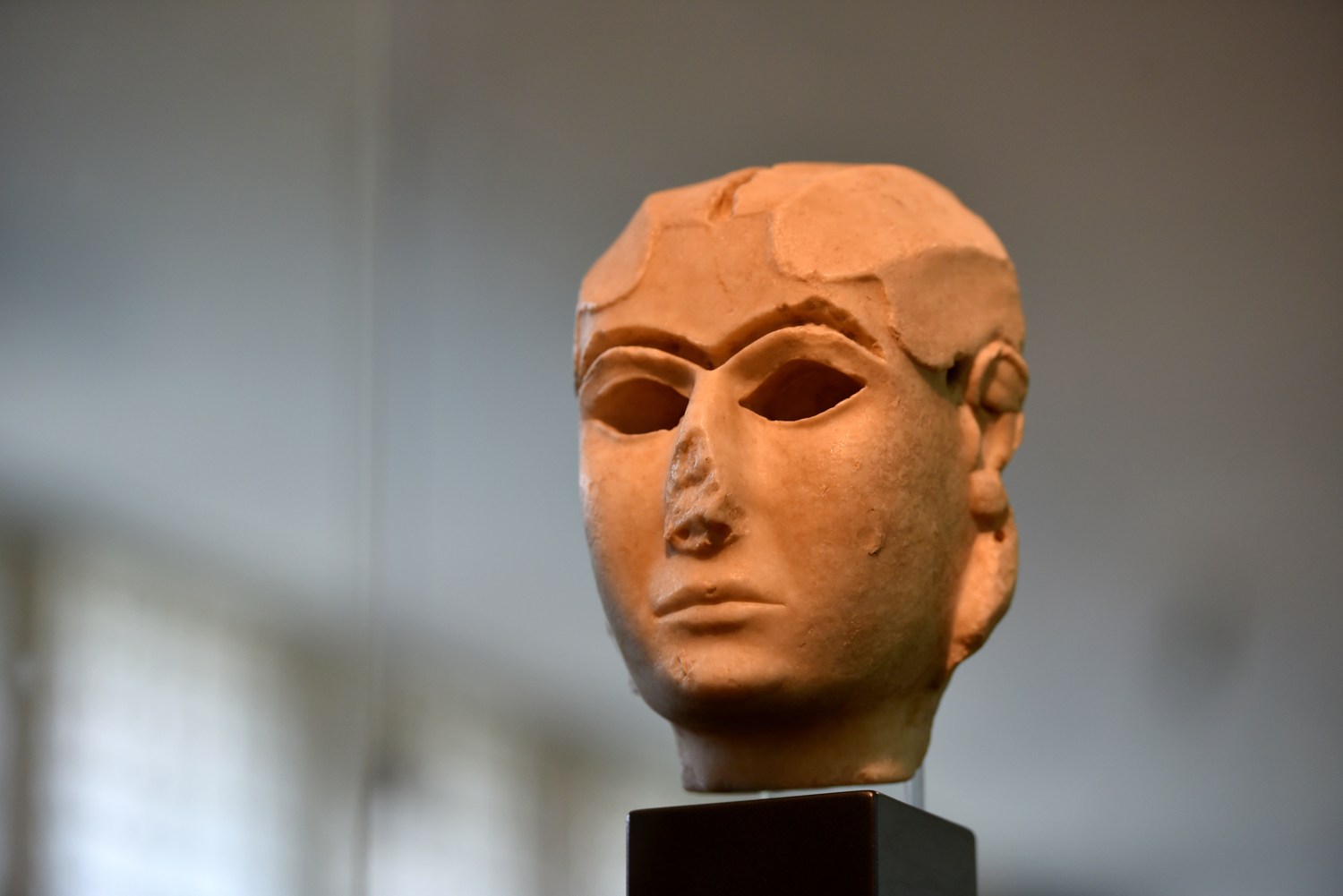
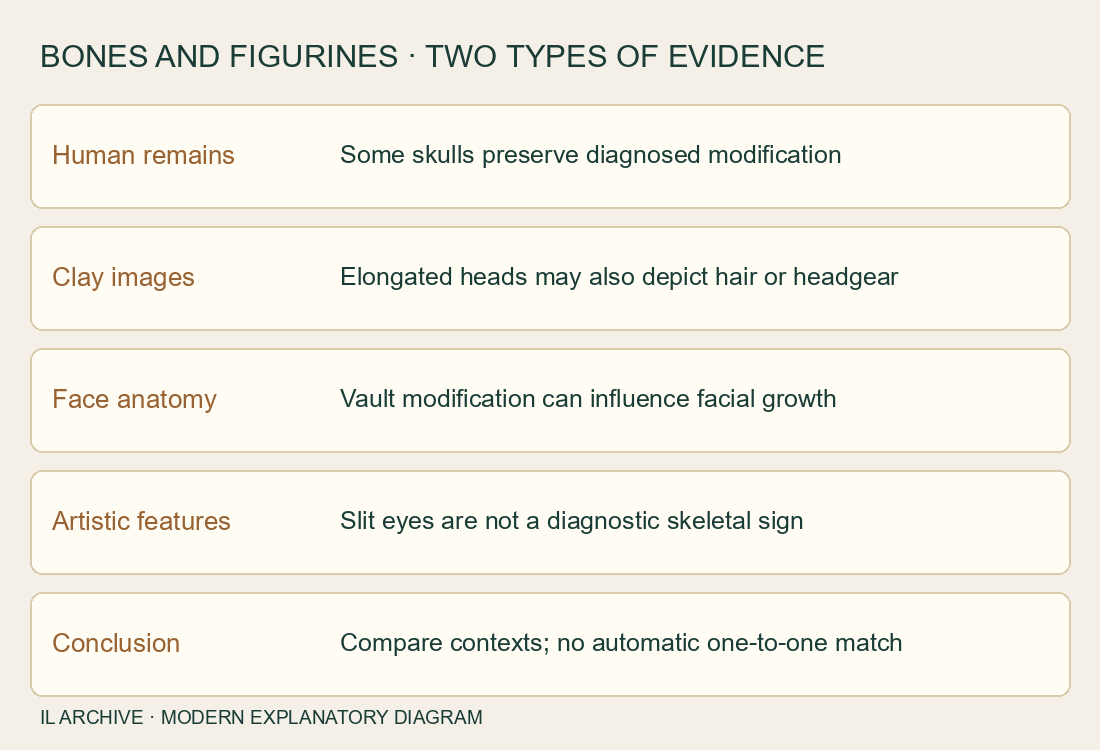
Shaping supplies a possible human explanation for some elongated heads. No additional species need be invented: the bodily practice is already documented regionally. Daems and Croucher compare skeletal remains with bodily imagery while also considering hairstyles, headgear and artistic exaggeration.[1]
Evidence must not be transferred automatically between categories. Diagnosing one skull does not diagnose a figurine from another site, and a figurine cannot establish population prevalence. Comparison becomes stronger with secure dates and locations, reliable skull reconstruction and attention to how the clay head was made. Shaping may explain part of the appearance; it is not a universal key to every Ubaid figurine.
Not every elongated head is a modified skull
A tall black-painted element may be hair, a covering or the represented vault; distinguishing them is sometimes difficult. Art is not always transparent. Its maker may emphasize a sign understood by viewers rather than record human measurements.[1][9]
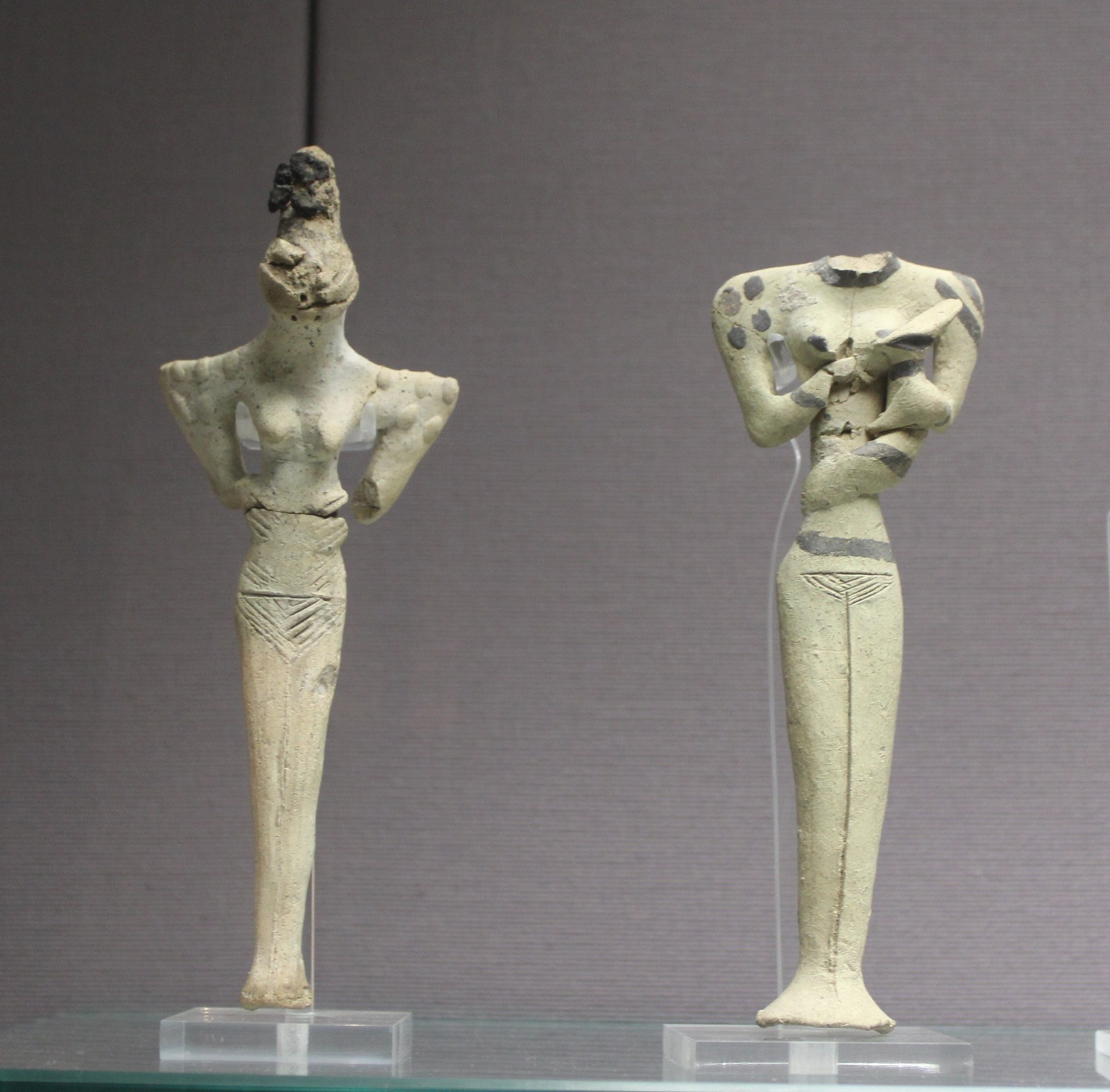
The displayed photograph of two Ur figurines also requires attention to preservation. The woman holding a child at right has lost her own head; the surviving head belongs to the child. It must not be described as the mother’s elongated head or restored imaginatively. Museum numbers, manufacture and context matter more than a sensational label attached to the circulating image. Length alone determines neither sex, divine identity nor a shaping technique.
Ubaid figurines also have an artistic history
Ellen McAdam’s 2024 catalogue of Ur figurines discusses stylistic development: flat rounded faces, different heads or coverings, and forms preceding some angular-shouldered figurines. She compares them with earlier traditions, but calls the identifications tentative. Ur’s sequence is discontinuous and the excavated areas are a limited sample.[9]
This does not permit a simple line in which people increasingly elongated their skulls and art lengthened its heads by the same amount. A manufactured form can change without a corresponding bodily change. Differences in paint, applied clay features and burial or settlement contexts remind us that production and use have histories alongside the question of what appearance an object represents.
Vault shaping does not explain the eyes by itself
Comparative anatomy shows that constraints on the vault can influence cranial-base and facial growth. Ketoff and colleagues’ 2017 study found differences in zygomatic shape among differently modified samples, while acknowledging small-sample limitations.[10]
That does not make a clay slit eye a diagnostic sign of modification. The study concerns skulls from Bolivia and France; it does not reconstruct Ubaid faces. Artistic eyes also depend on modelling, applied elements and paint. Facial anatomy can be affected while represented features still require their own artistic explanation. Those propositions are compatible.
Why exaggerate the eyes and face?
A maker may simplify detail or emphasize what makes a figure recognizable. Features could be conventions, ideals, signs of dress or role, or partly consequences of clay-working technique. Daems challenges the assignment of function from appearance alone: “ophidian” can embed an interpretation in the label before context is examined.[8]
There is no final answer for every object. Findspots, wear, breakage, manufacture and associated finds offer better comparisons. Was it recovered from a specific grave or merely on the surface? An uncontextualized image can prompt a question without answering it. Large or narrow eyes alone establish neither worship, descent nor encounters with another kind of being.
Does an elongated head reveal a different “race”?
Diagnosed cultural modification is an acquired growth effect and cannot, by itself, mark a different biological origin. It may express cultural or social affiliation, but a cultural community is not necessarily genetically closed. People of different ancestry can share one deliberately produced appearance.[5]
This does not imply that all unmodified skulls are identical or that human variation cannot be studied. The practice must be separated from variation, pathology and preservation before drawing conclusions. Likewise, figurine resemblance does not establish another human species. These cases concern what humans did to human bodies and the social meanings of that intervention, rather than evidence of nonhuman creatures.
Was the practice harmful?
The Tell Zeidan report makes a general statement that shaping does not appear to reduce brain size or intelligence. This must be distinguished from examination of the child: the report did not measure the child’s intelligence, and an archaeological skull alone supplies no cognitive test for someone who lived millennia ago. The statement is therefore not decisive proof of harmlessness.[7]
Survival into adulthood does not establish safety in every case; an elongated vault also does not prove neurological injury in every bearer. Skeletal and anatomical effects can be investigated, but lived experience, pain and health outcomes are not all preserved in bone. The point is to respect evidential limits, rather than derive medical reassurance from an ancient practice.
Why invest so much in the head?
The head is central to recognition. It carries hair, ornaments, paint and facial expression, and can display signs of group, role or life stage. A modification persisting through growth can make a social relationship visible without clothing or speech.
This explains the appeal of identity models, not the motive for every case. Beauty, affiliation and distinction may coexist in one sign. Caregivers shaping a child’s appearance also express expectations about the child’s future place. Everyday care thus opens a question about authority over the body: who determines its form, and which relationship is being made durable? Specific answers depend on contexts only partly preserved.[1][5]
Why is there no decisive answer?
A practice need not leave an explanation, and these Neolithic communities left no written testimony about it. Archaeological samples also select what was buried, preserved, discovered, collected and available for examination. Crania may be incomplete, whole collections lost and cemeteries unknown.[5]
Many modified individuals in a sample do not show that all living residents were modified: burial selection may be involved. Few cases likewise do not establish population prevalence. Comparison needs sex and age estimates, chronology and exclusion of postmortem distortion. Knowledge of the intervention can therefore exceed knowledge of its purpose. The gap does not automatically privilege a religious or class-based explanation.
What can be stated at different levels of confidence?
Documented: some Neolithic and later skulls preserve modification acquired during growth; Tepe Abdul Hosein and Ganj Dareh provide early evidence. Counts and diagnoses concern specific samples, not entire populations. Shaping occurs in some Ubaid-related contexts, and the Tell Zeidan report documents a particular case.[1][2][3][5][7]
Interpretively plausible: appearance expressed affiliation, a bodily ideal or social difference. Unresolved: which motive dominated locally, and whether worship, ancestors or inherited rank were involved. Possible: some figurines represent the practice. Unproven: every long-headed figurine portrays a modified skull, or its features establish reptilian beings or specific gods. These distinctions preserve both the value and limits of comparison.[1][8][9][10]
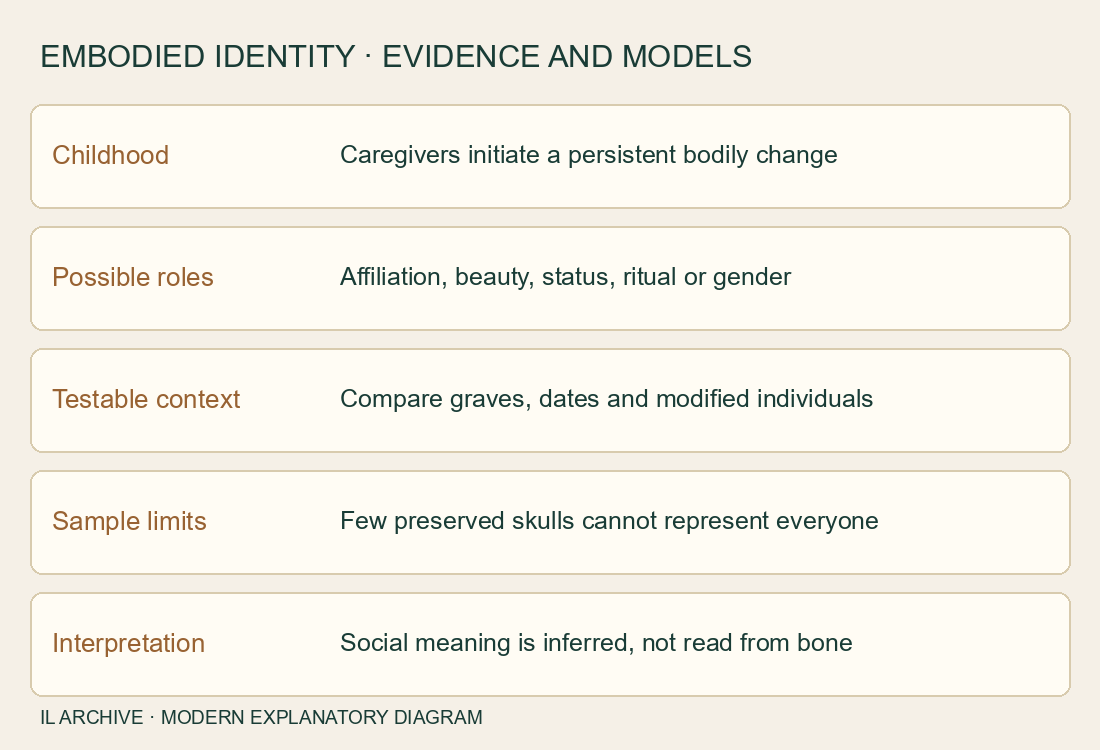
The body made into a sign
These skulls show that early communities could reshape their members’ bodily appearance. A kingdom or writing system was unnecessary for a body to carry an enduring social trace. In diagnosed cases, the head resulted from growth experienced under a practice initiated by others.
Clay images open another window: what did a maker want to display, and how should a body be recognized? Bones and images do not supply identical answers, but careful comparison connects them without erasing their differences. The caregivers’ words and the grown child’s interpretation are lost. What survives is an intervention, imagery attentive to appearance, and questions about beauty, affiliation, authority and memory. The elongated head deserves study as human history, with uncertainty kept visible rather than filled by a ready-made story.
References and notes
- Aurélie Daems & Karina Croucher (2008; updated 2015). Prehistory of Iran: Artificial Cranial Modifications. Encyclopaedia Iranica. Specialist synthesis body: growth, Iranian examples, identity and figurine interpretations. Fourteen modified Ganj Dareh crania belongs to an older sample summarized from Meiklejohn et al.; the original table was not independently examined. Return to the text ↑
- Kirsi O. Lorentz (2017). Marking Identity through Cultural Cranial Modification within the First Sedentary Communities (Ninth to Eighth Millennium BCE) in the Near East: Tepe Abdul Hosein, Iran. International Journal of Osteoarchaeology 27, 973–983. DOI: 10.1002/oa.2609. Publisher abstract only: 12 individuals, eight contexts, five assessable adults; four modified (three males, one indeterminate) and one unmodified female. Not proof of male exclusivity. Full article not read. Return to the text ↑
- Julien Riel-Salvatore, Andrew Lythe & Alejandra Uribe Albornoz (2021). New insights into the spatial organization, stratigraphy and human occupations of the Aceramic Neolithic at Ganj Dareh, Iran. PLOS ONE 16(8), e0251318. DOI: 10.1371/journal.pone.0251318. Selected site, chronology, burial and conclusion passages in the full text: remains representing 116 individuals, some modified crania without a count of fourteen. Most levels span about 200–300 years after 10,100 cal BP, with a possible earlier horizon discussed. Return to the text ↑
- Alexandra Fletcher, Jessica Pearson & Janet Ambers (2008). The Manipulation of Social and Physical Identity in the Pre-Pottery Neolithic: Radiographic Evidence for Cranial Modification at Jericho and its Implications for the Plastering of Skulls. Cambridge Archaeological Journal 18(3), 309–325. DOI: 10.1017/S0959774308000383. Publisher abstract only: radiographic study of a plastered skull and childhood modification. Continuity of living identity and postmortem treatment is the authors’ interpretation, not a result for every Jericho skull. Return to the text ↑
- Kirsi O. Lorentz (2010). Ubaid Headshaping: Negotiations of Identity through Physical Appearance? In R. A. Carter & G. Philip (eds), Beyond the Ubaid, SAOC 63, pp. 125–142. Selected passages, printed pp. 125–131, 134–136, 140–141; Table 9.2 and Figure 9.5 on p. 135 visually inspected. Not the whole chapter. Eridu, Arpachiyah and Değirmentepe samples, intentional/incidental effects and identity models. Preliminary 2010 and 2017 samples kept separate. Return to the text ↑
- Robert A. Carter & Graham Philip, eds (2010). Beyond the Ubaid: Transformation and Integration in the Late Prehistoric Societies of the Middle East. Studies in Ancient Oriental Civilization 63. Book metadata, contents and editorial framing only: pottery style, wider interaction and regional diversity. Not a claim to have read all chapters. Return to the text ↑
- Gil J. Stein (2011). Tell Zeidan. Oriental Institute 2010–2011 Annual Report, especially pp. 136–137, Figures 19 and 22. Introductory pp. 122–123 and selected pp. 136–137. Child photograph, Figure 22, visually examined; Figure 19 caption read for the tentative dancing-head interpretation. General intelligence statement is not a measurement of this child. Return to the text ↑
- Aurélie Daems (2010). A Snake in the Grass: Reassessing the Ever-intriguing Ophidian Figurines. In R. A. Carter & G. Philip (eds), Beyond the Ubaid, SAOC 63, pp. 145–158. Selected opening, morphology, terminology and context passages, not the whole chapter. Reptilian or divine identity must not be built into the label before context is examined; comparison of traditions and forms. Return to the text ↑
- Ellen McAdam (2024). A gazetteer of Ubaid figurines from Ur. In J. N. Postgate & D. C. Thomas (eds), Ur 1922–2022, pp. 49–84. British Institute for the Study of Iraq. PDF introduction, printed pp. 49–51, and discussion, pp. 80–81; not every catalogue entry. Ur sequence is discontinuous and comparisons tentative. U15376/BM 122873 has the mother’s head missing, infant head surviving. Return to the text ↑
- S. Ketoff et al. (2017). Zygomatic bone shape in intentional cranial deformations: a model for the study of the interactions between skull growth and facial morphology. Journal of Anatomy 230(4), 524–531. DOI: 10.1111/joa.12581. Full-text abstract and selected methods, results, discussion and limitations. Bolivian and French skulls, zygomatic effects; neither reconstruction of Ubaid faces nor diagnosis of slit eyes in figurines. Return to the text ↑
Suggest a correction · Suggest a source for this record
Cite this record
IL Archive, «Why Did People Elongate Their Children’s Skulls? From Neolithic Head Shaping to Ubaid Figurines», Edition 1, https://ilarchive.com/en/studies/why-shape-childrens-skulls
Continue reading