Entity · Concept
Cranial modification
A reference page linking a name, group, or concept to the materials that discuss it.
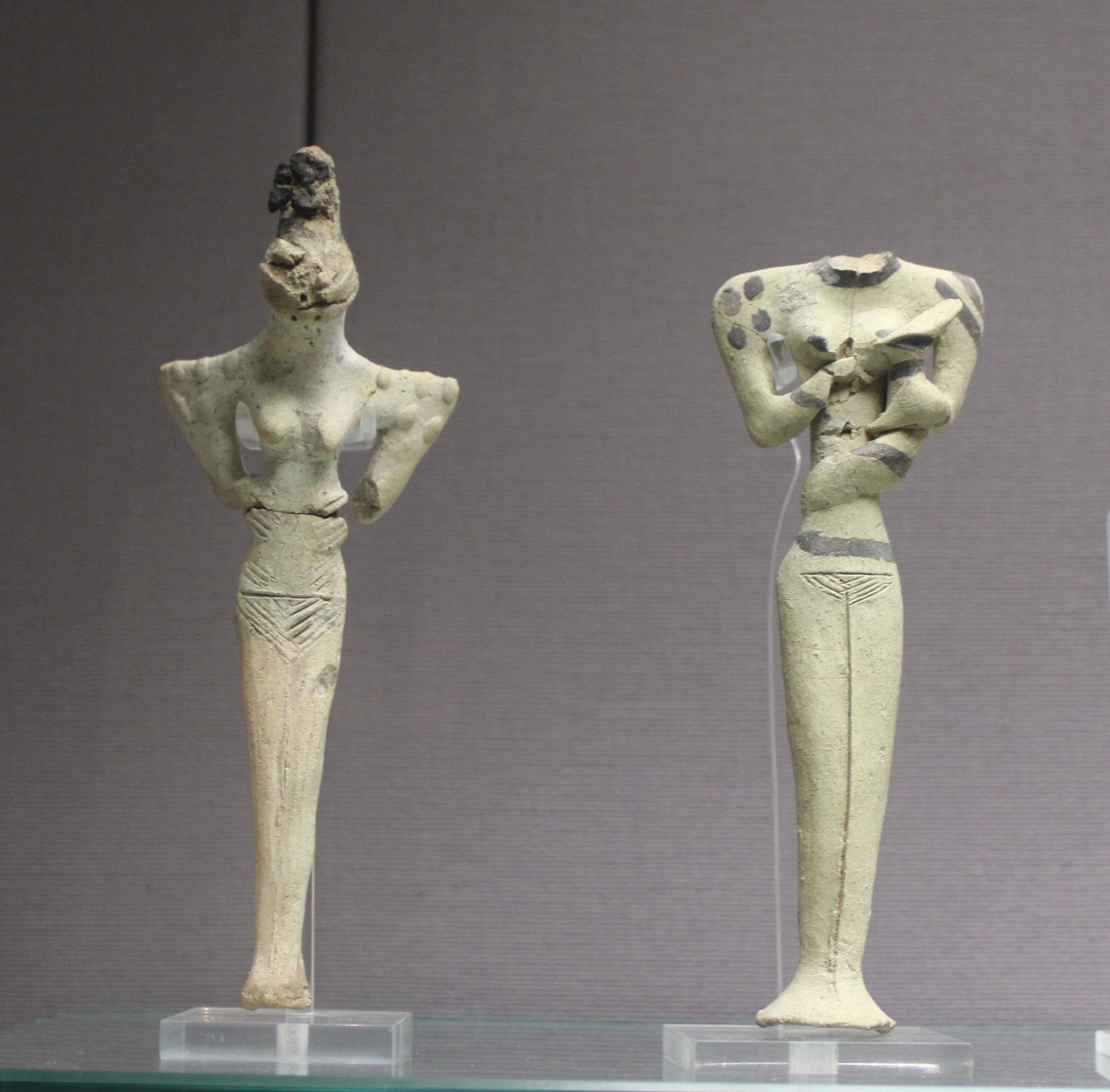
Lasting reshaping of the growing infant cranium, often using bands or boards. Human remains from Iran, Mesopotamia and Anatolia document varied forms, but an elongated figurine head does not establish the practice or its social meaning.
Estimated reading time: 6 min Published Last reviewed:
Share article
Text
Introduction
Cranial modification does not mean removing or altering a skull after death. It describes the reshaping of the cranial vault during early childhood through sustained pressure or particular ways of supporting the head. In some cases, the resulting form survives in skeletal remains centuries later. Identifying the technique, however, does not automatically establish its purpose: social belonging, childcare, ideals of appearance and distinctions between groups may overlap.
This entry separates osteological evidence from elongated heads in art, reviews examples predating the Ubaid cultureUbaid cultureAn archaeological designation for material traditions associated with southern Mesopotamia and its regional connections. The broad southern sequence spans c. 6500–3800 BCE, with regional variation; the label alone identifies neither a people nor a language.Glossary · Click to read the explanation as well as examples within its broader sphere, and explains why a French museum specimen cannot serve as direct evidence for an ancient Mesopotamian practice.
Shaping a growing head, not treating the dead
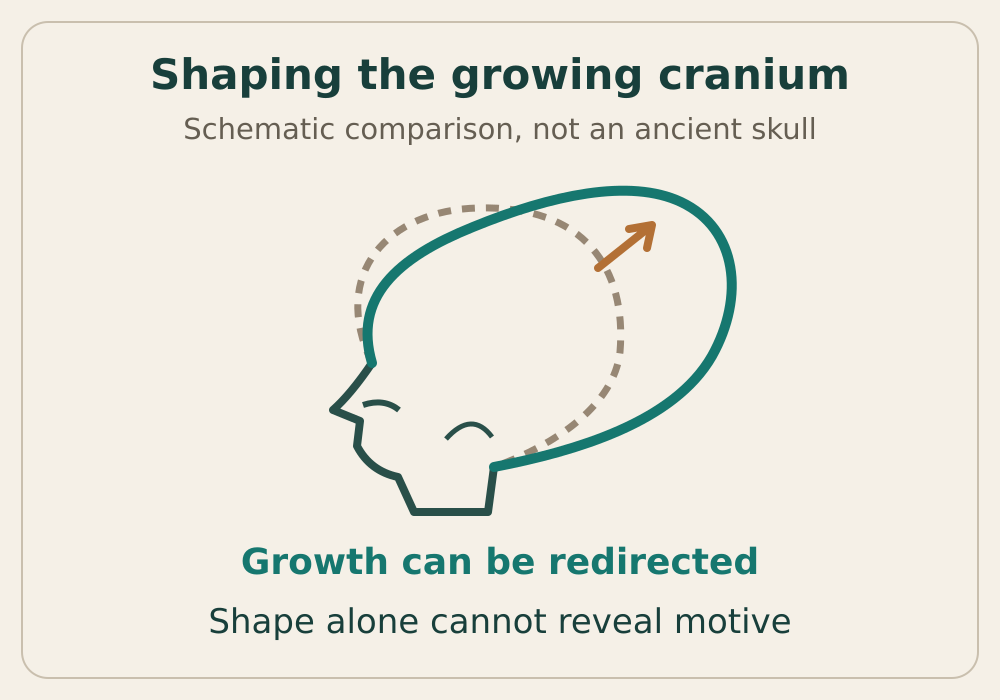
An infant's cranial vault can change shape as its bones grow. In different communities, people have used constricting bands or wrappings, and sometimes boards or other supports, to redirect growth in the early years of life. Once established through growth, the shape remains visible in adulthood. Because infants cannot initiate this process themselves, it reflects choices made by caregivers rather than a later decision by the adult.[1]
Nor does the expression “elongated skull” name a single technique. Researchers distinguish pressure around the head, known as circumferential head shapingCircumferential head shapingA pattern of early-growth head shaping associated with circumferential constraint and an elevated or extended vault.Glossary · Click to read the explanation, which may involve one or two bands, from anterior or posterior flattening potentially associated with boards or habitual positioning. These are not interchangeable categories in historical comparisons.
How can archaeologists identify the practice?
The strongest evidence comes from an actual human cranium studied for its contours, pressure-related changes, preserved bones and sutures, the individual's age, and the burial context. Measurements and three-dimensional shape analysis can distinguish subtle patterns that visual inspection alone may misclassify. Yet abnormal growth caused by disease, positional flattening during infancy, and damage after burial must all be considered: an unusual silhouette is not, by itself, a diagnosis.[2]
Equally, the number of modified crania cannot be turned into a settlement-wide rate without understanding the sample. An excavation may expose only a small portion of a cemetery, and some skulls may be lost or too incomplete to assess. Absence from a small sample does not demonstrate absence from the wider population.
Roots earlier than the Ubaid
Neolithic evidence in IranIranIran is the modern country containing Shush, ancient SusaGlossary · Click to read the explanation's Zagros region, including Ganj Dareh and Tepe Abdul Hosein, predates the widespread material culture usually associated with the Ubaid. In a reassessment published in 2017, Kirsi Lorentz examined remains from twelve people at Tepe Abdul Hosein. Only five adults retained enough cranial bone to evaluate modification. Four displayed two-band circumferential shaping; three of those four could be assessed as male, while the fifth, unmodified individual was assessed as female. These are five assessable adults, not a population census. Lorentz warned against drawing broad conclusions about gender from such a small sample.[3]
Circumferential shaping therefore cannot be described as an Ubaid invention, although its much wider distribution during the fifth millennium BCE remains an important research question.
What do Ubaid-period burials show?
At Tell Arpachiyah in northern IraqIraqIraq is a modern country encompassing much of ancient MesopotamiaGlossary · Click to read the explanation, Lorentz reassessed published cranial data. Her table identifies five modified and four unmodified individuals in the classified Ubaid sample, including males and females. The modified skulls may reflect both one-band and two-band techniques, but these assignments remain preliminary interpretations of drawings and photographs pending direct examination. This selected series must not be presented as a reliable proportion of the whole settlement.[4]
At Değirmentepe in southeastern AnatoliaAnatoliaAnatolia is the region occupying the Asian part of present-day TurkeyGlossary · Click to read the explanation, the review reports a study of 31 individuals, 13 of whom showed head shaping, all recorded among those younger than fifteen. This establishes the practice in another local setting, but neither proves a route of transmission nor a common social meaning across these sites.[4]
Belonging, rank or ideals of appearance?
Lorentz argues that shaping a head differs from circulating a ceramic vessel: pottery can change hands quickly, whereas lasting cranial shape requires care and knowledge over childhood, perhaps passed between generations. She therefore proposes that the diffusion of the technique may point to close social connections, possibly including family movement or marriage across communities. These are interpretive hypotheses, not conclusions read directly from bone shape.[5]
In a particular setting the practice might have expressed group affiliation, standing, or accepted ideals of appearance; meanings could differ elsewhere. Bones alone do not identify a priest, an elite, or a single ethnic “people.” Such claims would require comparisons among contemporary graves, evidence of age, sex, mortuary practices and spatial distribution, and independent evidence for mobility.[5]
Do elongated figurine heads document the practice?
Some small figurinesFigurineA small shaped object depicting a human, animal or abbreviated form, in clay, stone or another medium. Its form alone does not establish its use; manufacture, handling traces and find context matter.Glossary · Click to read the explanation and human depictions from Iran and MesopotamiaMesopotamiaHistorical region associated with the Tigris and Euphrates: Uruk, Ur, Eridu, cuneiform, Sumer, Akkad, Babylon and Assyria, their languages and cults, and the limits of archaeological evidence.Glossary · Click to read the explanation feature extended heads, headgear, or elevated hairstyles. Such images may reflect desired appearances, but they cannot reveal the shape of the cranium beneath hair and coverings. Aurelie Daems and Karina Croucher discuss figurine fragments with distinctive heads from Chogha Mish, while noting that the modified human skull from that site comes from a later archaeological level than the figurine fragments. Resemblance between these forms does not prove that any one figurine portrays a person whose head was reshaped.[6]
An elongated figurine head is equally insufficient grounds for calling the figure nonhuman, divine, or an image of a particular population. Those readings require independent evidence and cannot rest on one facial feature.
A different practice: treating skulls after death
Neolithic communities also retrieved, redeposited or plastered human skullsPlastered skullsHuman skulls whose features were modelled after death with plaster or similar material, sometimes with shell eyes. Distinct from childhood head shaping; they do not by themselves disclose a person’s identity or the community’s beliefs.Glossary · Click to read the explanation. These actions concern the remains of the deceased, not the growth of the head during life. At Göbekli TepeGöbekli TepePre-Pottery Neolithic site near Şanlıurfa with T-shaped pillars and communal buildings. Evidence documents habitation and collective activities alongside a ritual component; the figures’ names are unknown.Glossary · Click to read the explanation, researchers identified fragments from three skulls bearing deep incised grooves, with a drilled perforation on one skull. They interpreted the marks as intentional treatment of bone while debating their function. These fragments do not demonstrate infant head binding or circumferential shaping during their owners' lives.[7]
What does the accompanying photograph show?
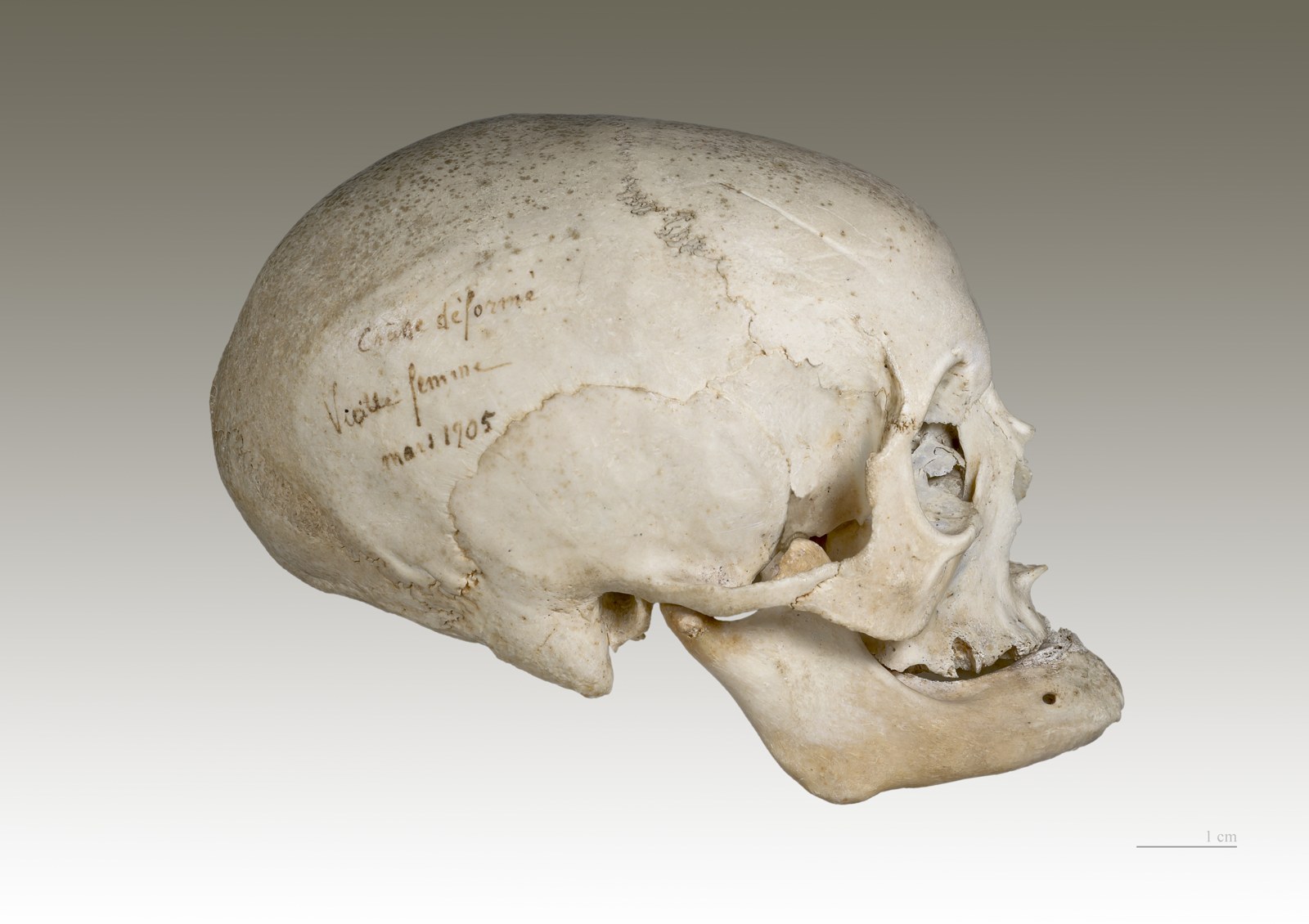
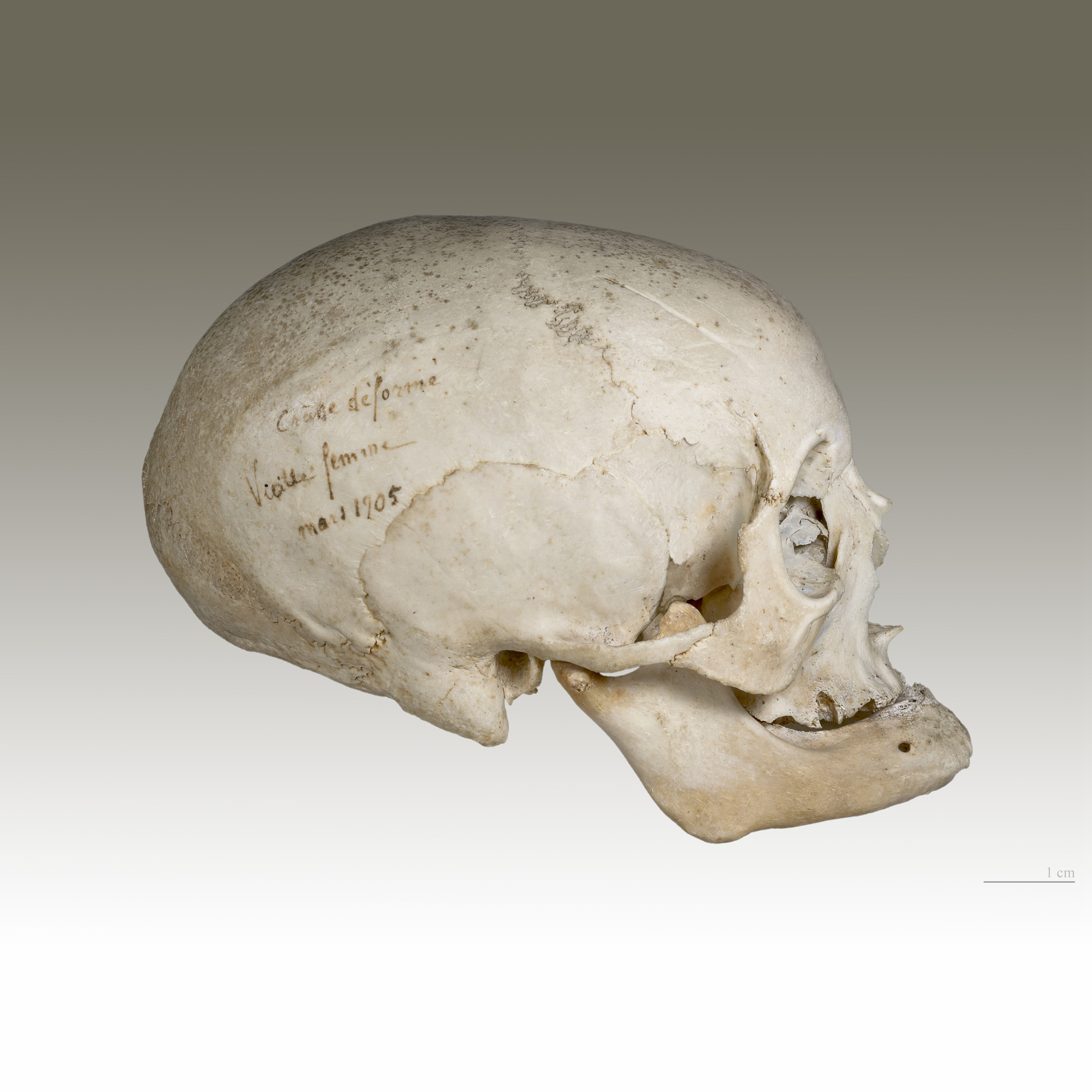
The photograph depicts a skull displaying what is called “Toulouse-type deformation” in the Muséum de Toulouse, inventory number MHNT.ANT.2003.85. The file description records writing on the skull referring to an “old woman — March 1905”; that inscription is not the photograph's date, which is 30 October 2011. The object is kept in France, but the file page does not establish where the skull was found or provide its archaeological date. It demonstrates a visible alteration of head shape; it is not documented evidence from the Ubaid or the ancient Near EastAncient Near EastModern scholarly label for ancient societies of Mesopotamia, the Levant, Anatolia and Iran, sometimes extending to Egypt and other neighbours depending on the study; not one civilization or religion.Glossary · Click to read the explanation.[8]
What remains open?
A well-preserved and securely dated cranium may substantiate head shaping in one person; coherent burial samples can help compare how frequently it occurred. Yet identifying its social meaning, transmission through marriage or exchange, or connection to particular rites demands additional evidence and remains revisable. Specialists call for renewed examination of old collections, combining skeletal measurements with archaeological context and independent dating. The distinctions between bone, artistic representation, and interpretation of identity are essential.[9]
References and notes (9)
- Kirsi O. Lorentz (2010), “Ubaid Headshaping: Negotiations of Identity through Physical Appearance?”, in Beyond the Ubaid, chap. 9, pp. 125–148. Introduction and definitions of techniques, pp. 125–127; consulted the published chapter passages, not the entire volume. Return to the text ↑
- “Reliable Classification of Intentional Cranial Vault Modification and Nonsynostotic Deformational Plagiocephaly Using 3D Geometric Morphometrics” (2021). PubMed abstract only: 52 comparative Chanka crania from Peru and misclassification of subtle shapes; not Near Eastern prevalence data. Return to the text ↑
- Kirsi O. Lorentz (2017), “Marking Identity through Cultural Cranial Modification within the First Sedentary Communities ...: Tepe Abdul Hosein, Iran”, International Journal of Osteoarchaeology 27, pp. 973–983. Publisher abstract only: 12 people, five assessable adults, four modified; explicit caution on gender. Full article not read. Return to the text ↑
- Lorentz (2010), “Ubaid Headshaping”, in Beyond the Ubaid, chap. 9. Tell Arpachiyah and Değirmentepe case reports and table, pp. 129–133; one-/two-band assignments provisional. Return to the text ↑
- Lorentz (2010), “Ubaid Headshaping”, in Beyond the Ubaid, chap. 9. Discussion of distribution, sample limits, identity and proposed transfer of knowledge among families, pp. 134–141; hypotheses, not proof of population movement. Return to the text ↑
- Aurelie Daems and Karina Croucher (2008; updated 2015), “Prehistory of Iran: Artificial Cranial Modifications”, Encyclopaedia Iranica. Full accessible entry, especially figurine fragments from Chogha Mish, relative archaeological levels, and alternative headgear/hairstyle readings. Return to the text ↑
- Julia Gresky et al. (2017), “Modified Human Crania from Göbekli Tepe Provide Evidence for a New Form of Neolithic Skull Cult”, Science Advances 3(6). Open full text: introduction, results, analysis of carvings and perforation; three individuals, no evidence of infant head shaping. Return to the text ↑
- Didier Descouens, “Crane déformé 1905 MHNT.jpg”, museum object MHNT.ANT.2003.85, Wikimedia Commons (photographed 30 October 2011). File page: object identification, inscription “old woman — March 1905”, photographer, date and CC BY-SA 3.0. Not Mesopotamian. Return to the text ↑
- Lorentz (2010), “Ubaid Headshaping”, in Beyond the Ubaid, chap. 9. Methodological argument and competing social interpretations, pp. 138–141; calls for reassessment, chronology and mobility evidence, not one established motive. Return to the text ↑
Suggest a correction · Suggest a source for this record
Cite this record
IL Archive, «Cranial modification», https://ilarchive.com/en/entities/cranial-modification
Continue reading