Entity
Plastered skulls
A reference page linking a name, group, or concept to the materials that discuss it.
- Names
- Neolithic modelled skulls
- Region
- The ancient Levant; later examples from central Anatolia
Neolithic treatments of human skulls, with plaster faces modelled over them, sometimes with shell eyes. The entry explains their making and separates the evidence from ancestor hypotheses and from head shaping during life.
Estimated reading time: 5 min Published Last reviewed:
Share article
Text
Introduction
Why did some Neolithic communities in the Near East model faces onto human skulls? This entry examines the surviving evidence for treatment of the dead, the manufacture of plastered faces, and the places where they were deposited. From Jericho to ‘Ain GhazalAin GhazalNeolithic settlement near Wadi Zarqa and Amman, known for plaster-floored houses, burials and large human sculptures made from lime plaster and reeds. Its pre-pottery and pottery phases are documented; the identities and exact functions of its figures are unknown.Glossary · Click to read the explanation and Yiftahel, it asks what the remains disclose about individuals and what remains hypothetical about ancestors and collective memory.
The skull and the modelled face
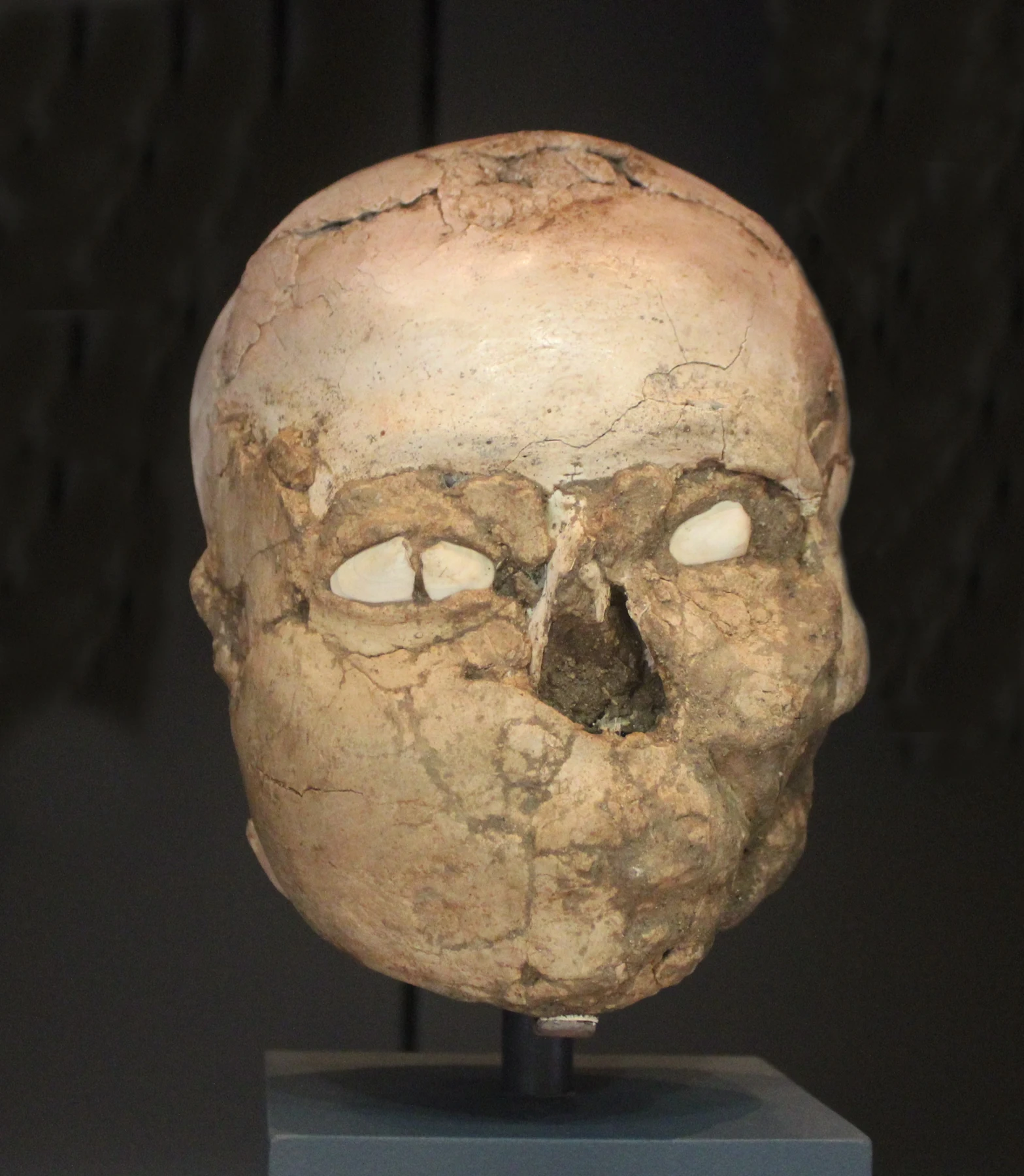
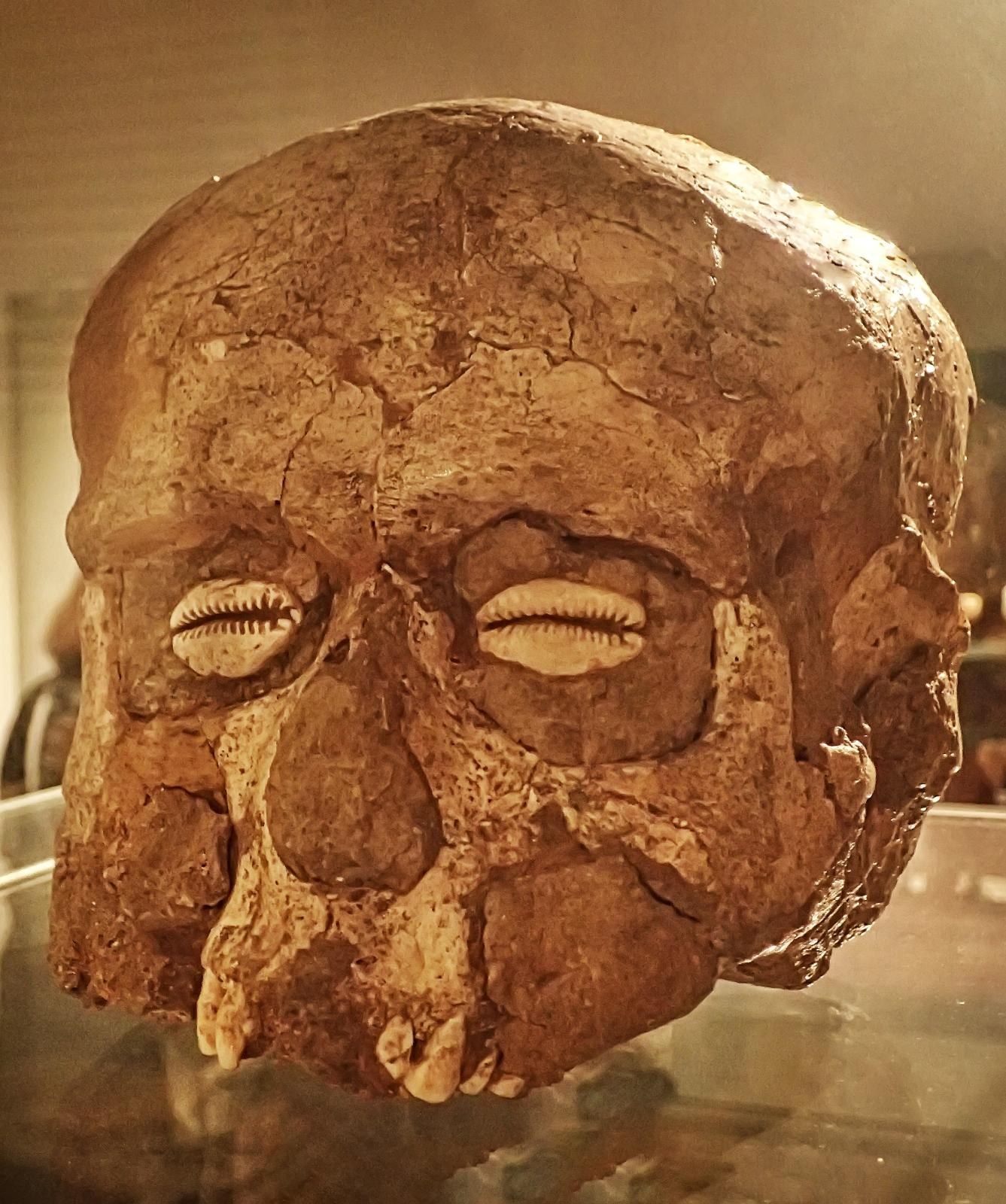
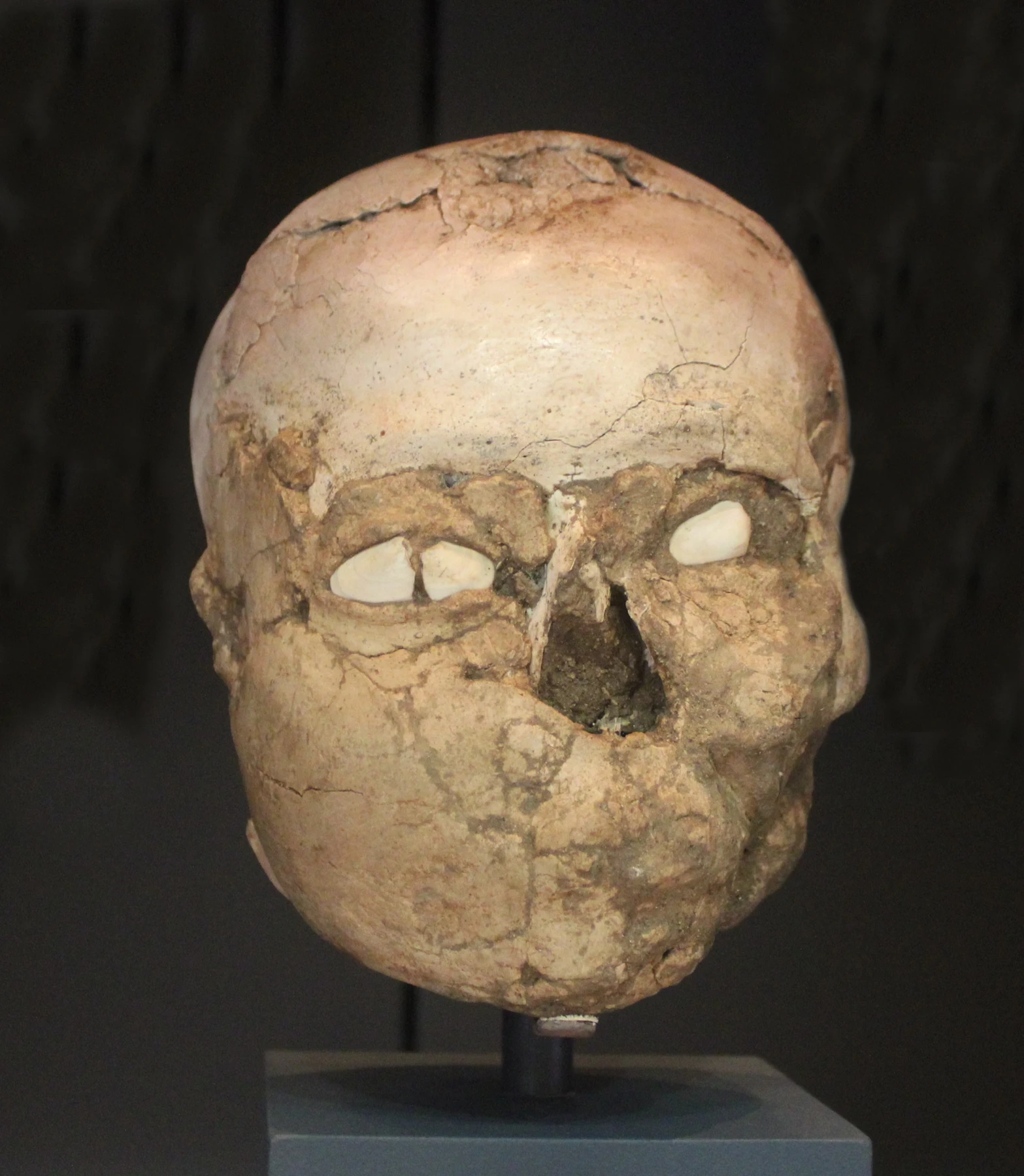
A “plastered skull” is a real human cranium whose features were modelled after death using plaster or similar material. The substance might form a nose, cheeks or lips; eyes could be indicated by shells or plaster, and some examples were painted. These objects are neither masks worn by living people nor modern facial reconstructions. A well-known example in the British Museum was excavated at Jericho/Tell es-SultanJericho / Tell es-SultanArchaeological mound near present-day Jericho in Palestine’s Jordan Valley, preserving early Neolithic settlement and Bronze Age layers.Glossary · Click to read the explanation and has shell eyes. It is one particular object, not a template for every plastered skull.[1]
Sometimes the cranium was detached from the remainder of a body after the soft tissues had decayed, in a sequence related to secondary burialSecondary burialRedeposition of human remains or selected elements after an earlier stage of treatment; established from context, not disarticulation alone.Glossary · Click to read the explanation. Skull removal did not invariably lead to plastering: isolated, undecorated skulls also occur. It is equally important to distinguish material applied after death from deliberate cranial modification in childhoodCranial modificationReshaping a child’s growing cranial vault through pressure or restraint. Techniques and meanings vary; it differs from postmortem skull treatment and cannot be inferred from a figurine alone.Glossary · Click to read the explanation through binding or pressure. The latter changes a growing skull during life; both treatments could occur in the same individual.[2]
Jericho: an identifiable object and a life before plastering
Across the LevantThe LevantThe Levant is a regional name for lands along the eastern MediterraneanGlossary · Click to read the explanation, the best-known examples belong to the Pre-Pottery NeolithicPre-Pottery NeolithicA regional archaeological framework for early settlement, cultivation and animal management in Southwest Asia before the local spread of pottery vessels; its dates and trajectories vary and it implies no common religion.Glossary · Click to read the explanation, especially phase B. Kathleen Kenyon's team discovered a group of seven plastered skulls at Jericho in 1953. One is British Museum registration 1954,0215.1: its mandible was removed, its face shaped with plaster, shells placed in the orbits and a plaster base made to help it stand. The museum assigns this object a broad date range of approximately 8200–7500 BCE. That range applies to the individual object and is not a uniform date for the custom everywhere.[3]
Radiographs, followed by micro-CT investigation of the museum skull, revealed details concealed by its plaster covering. The researchers judged that the remains belonged to a mature adult, probably male, with dental disease and a cranium that had been modified during childhood. They also identified soil packed inside the cranium, probably to support the plastering process. These are clues to one person's bodily history and the making of one object; they do not establish that person's name or religious standing.[2][3]
Related skulls, differing contexts
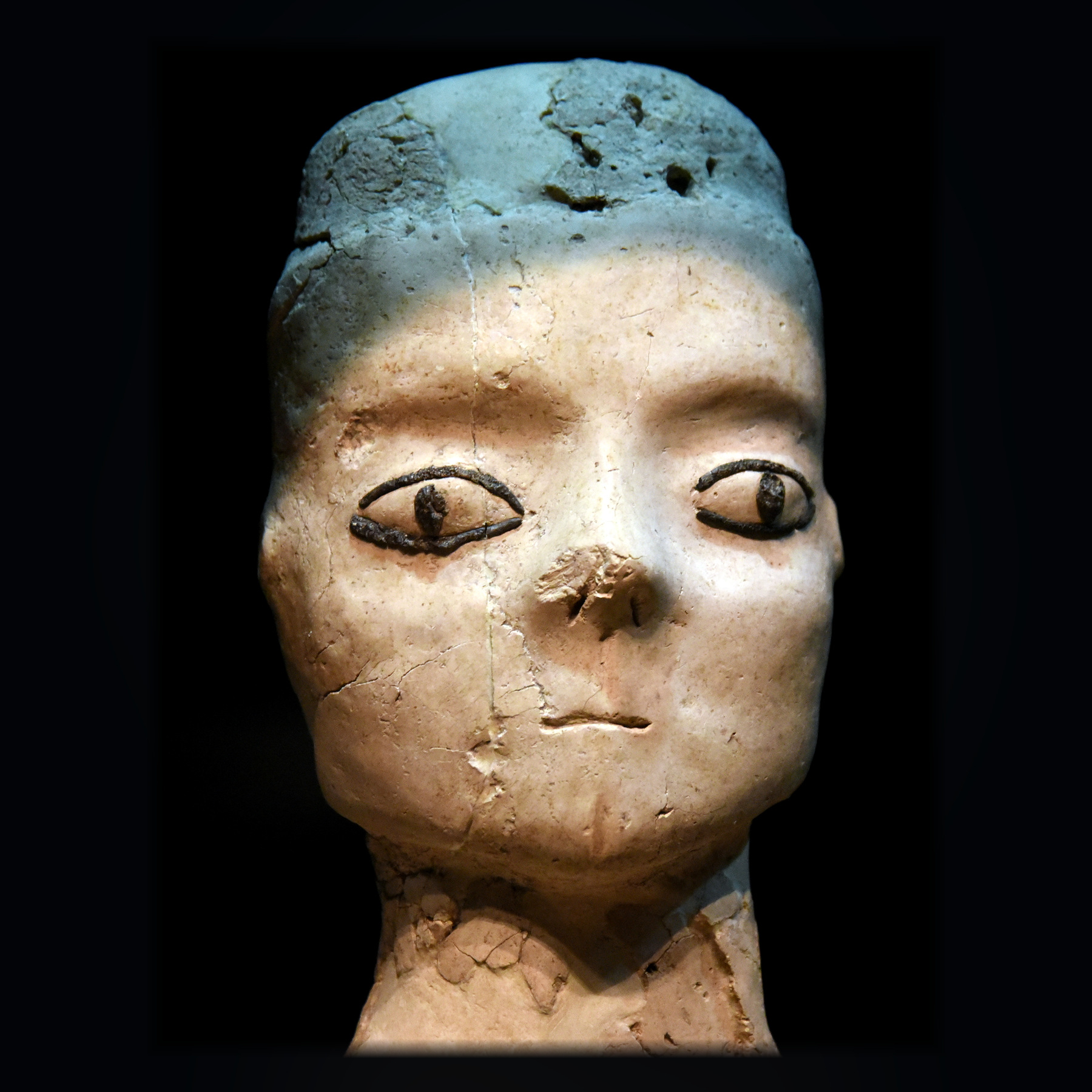
At ‘Ain GhazalAin GhazalNeolithic settlement near Wadi Zarqa and Amman, known for plaster-floored houses, burials and large human sculptures made from lime plaster and reeds. Its pre-pottery and pottery phases are documented; the identities and exact functions of its figures are unknown.Glossary · Click to read the explanation, near present-day Amman in Jordan, skulls were treated in several ways. Three plastered faces were also found buried without the bones they had once covered. In her detailed discussion, Denise Schmandt-Besserat distinguishes plastered and painted remains and describes how preservation and disturbance complicate the reconstruction of deposition. The label “plastered” cannot capture every treatment of the dead at the site.[4]
At Yiftahel in Lower Galilee, three plastered skulls were unearthed together in 2008, facing west. A 2014 study used computed tomography to examine the bones and modelling materials. All three were thought to be adults, possibly two males and one female. The authors stress that age and sex estimates from cranial characteristics are uncertain, especially where plaster hides anatomical features. The objects were damaged and later conserved; photographs after conservation should not be mistaken for their precise condition when excavated.[5]
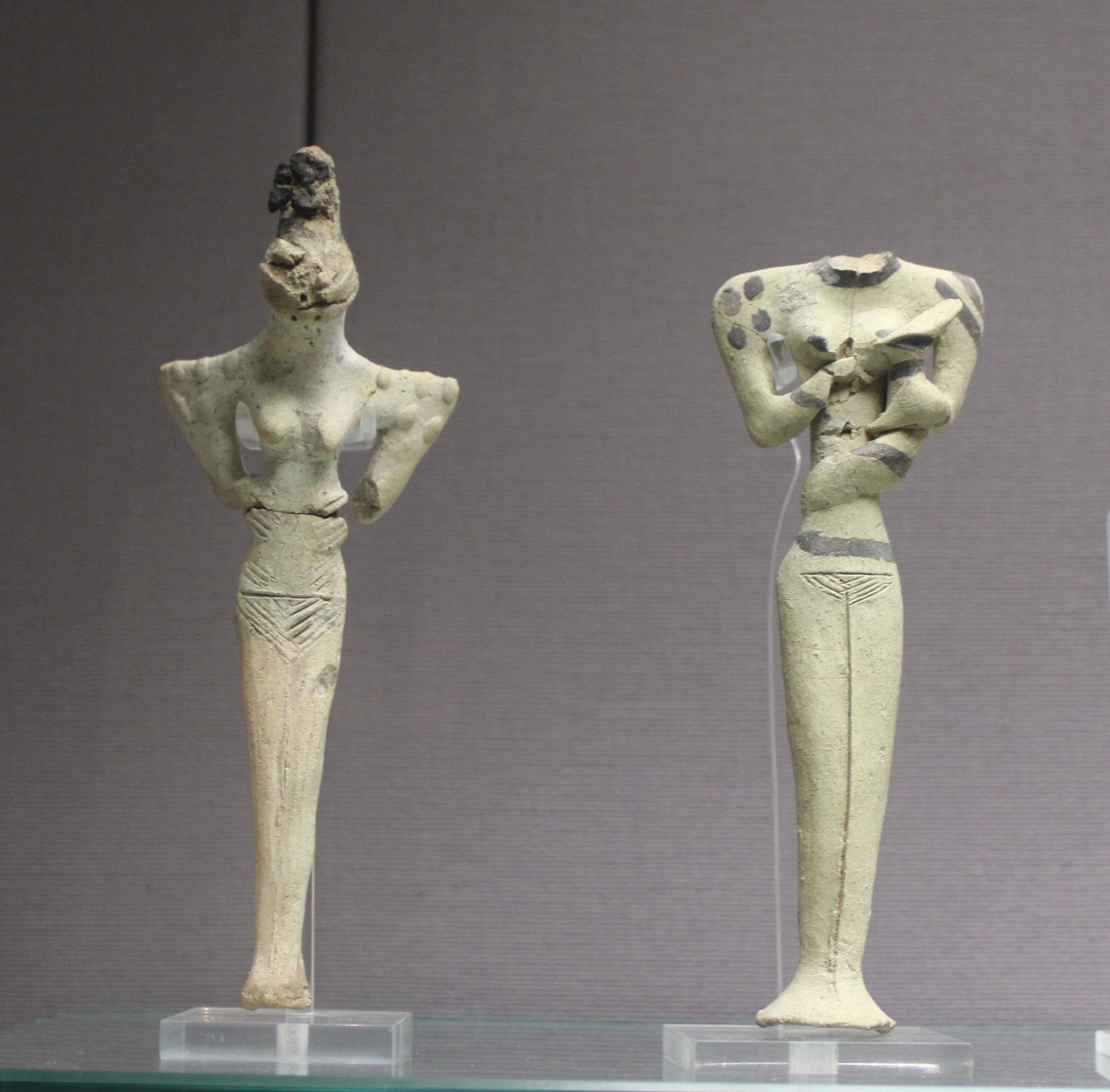
Further finds come from Kfar HaHoresh and Beisamoun in Galilee, Tell Aswad and Tell Ramad in Syria, and later examples in AnatoliaAnatoliaAnatolia is the region occupying the Asian part of present-day TurkeyGlossary · Click to read the explanation. Deposition, orientation, extent of plastering and representation of the eyes vary, as do the dates. They cannot all be collapsed into a single event or a single ritualRitualAn organised or distinguished practice meaningful to a community; it may leave traces, but its form alone does not reveal an associated doctrine.Glossary · Click to read the explanation centre.[4]
Technology and local traditions
Yuval Goren, A. Nigel Goring-Morris and Irena Segal studied six skulls, two each from Jericho, Kfar HaHoresh and Beisamoun. They reported a shared technological background alongside substantial differences between sites and inferred local production. Similar objects may therefore indicate the circulation of knowledge between communities, without identifying one workshop or a demonstrable route of transmission.[6]
A missing mandible or tooth is also not, by itself, proof of intentional tooth extraction after death. Tooth loss during life, damage to the bones and the preparation of the object can all affect what survives. Michelle Bonogofsky challenged earlier arguments that the skulls were designed to resemble elderly men, re-examining assumptions about tooth removal, age and sex. Her work makes it difficult to treat a supposed cult of elderly male ancestors as an established identification of the people represented.[7]
Ancestors and memory: interpretations, not labels for a known rite
Some finds occur in or around burial grounds, houses and collective deposits. That helps explain proposals concerning remembrance of particular people or shared community identity. Yet a modelled face cannot establish whether the person was a biological ancestor, an honoured member of society or someone selected for other reasons. At Köşk Höyük in Anatolia, Bonogofsky documented the mortuary treatment of male, female and child crania, challenging an explanation restricted to high-status elderly men.[8]
The strongest archaeological statements concern what happened: crania were removed or collected, facial features modelled, plaster and shells employed, and the objects stored or deposited in particular settings. Why it happened remains open to hypotheses about kinship, mourning, rank and group identity. Evaluating them requires skeletal evidence, find context and chronology together, not the appearance of the face alone. Some older studies give uncalibrated radiocarbon dates; these figures should not be transferred uncritically into calendar years BCE.[4][5]
The accompanying photograph depicts an ancient plaster face on real human remains from Jericho, in a documented modern photograph. It is neither a portrait made during the person's lifetime nor a modern scientific reconstruction. These are also the remains of actual people, and questions of respectful display and care matter alongside the scientific questions.[1][3]
References and notes (8)
- British Museum, Jericho plastered skull, collection no. 1954,0215.1. Identity and materials checked against the museum’s Google Arts & Culture entry and a curator’s account; the direct collection page returned HTTP 403 during this review. British Museum 1954,0215.1; accession verified via museum Google Arts & Culture presentation; direct catalogue URL inaccessible Return to the text ↑
- Alexandra Fletcher, Jessica Pearson and Janet Ambers, “The Manipulation of Social and Physical Identity in the Pre-Pottery Neolithic,” Cambridge Archaeological Journal 18(3) (2008), 309–325. Publisher’s abstract only: radiographic evidence for childhood modification; paywalled full article not read. CAJ 18(3), 309–325; published abstract ONLY Return to the text ↑
- Alexandra Fletcher, “What lies beneath: new discoveries about the Jericho skull,” British Museum, 3 July 2014: object description, micro-CT, head shaping, dental condition. Consulted via indexed museum text and institutional catalogue mirror; direct page blocked (403). British Museum curatorial blog, 3 July 2014; indexed text, NOT a directly opened full page Return to the text ↑
- Denise Schmandt-Besserat, “The Plastered Skulls,” full-text chapter hosted on the author’s University of Texas page: introduction, ‘Ain Ghazal, site parallels and interpretation examined. The site explicitly labels its bc dates as uncalibrated radiocarbon. Online chapter: opening and sections on Skull 88-1, parallels at other sites, distribution and interpretation; dates note Return to the text ↑
- Viviane Slon, Rachel Sarig, Israel Hershkovitz, Hamoudi Khalaily and Ianir Milevski, “The Plastered Skulls from the Pre-Pottery Neolithic B Site of Yiftahel,” PLOS ONE 9(2) (2014), e89242; online introduction, methods, results, discussion and conclusions read. PLOS ONE 9(2): e89242; HTML: introduction, methods, results, discussion, conclusions Return to the text ↑
- Yuval Goren, A. Nigel Goring-Morris and Irena Segal, “The Technology of Skull Modelling in the Pre-Pottery Neolithic B,” Journal of Archaeological Science 28(7) (2001), 671–690. Publisher abstract and Hebrew University publication record ONLY; restricted full text not read. Journal of Archaeological Science 28(7), 671–690; publisher + university ABSTRACTS ONLY Return to the text ↑
- Michelle Bonogofsky, “Neolithic Plastered Skulls and Railroading Epistemologies,” Bulletin of the American Schools of Oriental Research 331 (2003), 1–10; publisher’s abstract ONLY on assumptions about teeth, age and sex. BASOR 331 (2003), 1–10; publisher ABSTRACT ONLY Return to the text ↑
- Michelle Bonogofsky, “A bioarchaeological study of plastered skulls from Anatolia,” International Journal of Osteoarchaeology 15(2) (2005), 124–135. Wiley ABSTRACT ONLY, including Köşk Höyük findings on men, women and children; first published online in 2004. International Journal of Osteoarchaeology 15(2) (2005), 124–135; Wiley ABSTRACT ONLY Return to the text ↑
Suggest a correction · Suggest a source for this record
Cite this record
IL Archive, «Plastered skulls», https://ilarchive.com/en/entities/plastered-skull
Continue reading