Study
Jericho’s Plastered Skulls: Faces of the Dead and the Limits of Ancestor Interpretation
An extended study of a topic, with evidence and references.
- Timeline
- From 8200 BCE to 6000 BCE
- Region
- The Levant / Jericho
How do faces made over human remains and modern imaging help us understand memory, belonging and treatment of the dead at prehistoric Jericho?
Estimated reading time: 5 min Published Last reviewed:
Share article
Text
Introduction
How did human remains become a face kept by the living? This study examines JerichoJericho / Tell es-SultanArchaeological mound near present-day Jericho in Palestine’s Jordan Valley, preserving early Neolithic settlement and Bronze Age layers.Glossary · Click to read the explanation's plastered skullsPlastered skullsHuman skulls whose features were modelled after death with plaster or similar material, sometimes with shell eyes. Distinct from childhood head shaping; they do not by themselves disclose a person’s identity or the community’s beliefs.Glossary · Click to read the explanation to explore connections between treatment of the dead, memory and belonging in communities that preceded writing by millennia. It explains why researchers interpret them in terms of ancestors and what supports that interpretation.
We begin with the archaeological object, then follow what imaging reveals about the person's life and the work performed on their remains. We compare the face made in antiquity with a modern reconstruction, distinguishing a surviving object from an interpretation of its meaning.
A face of bone and plaster
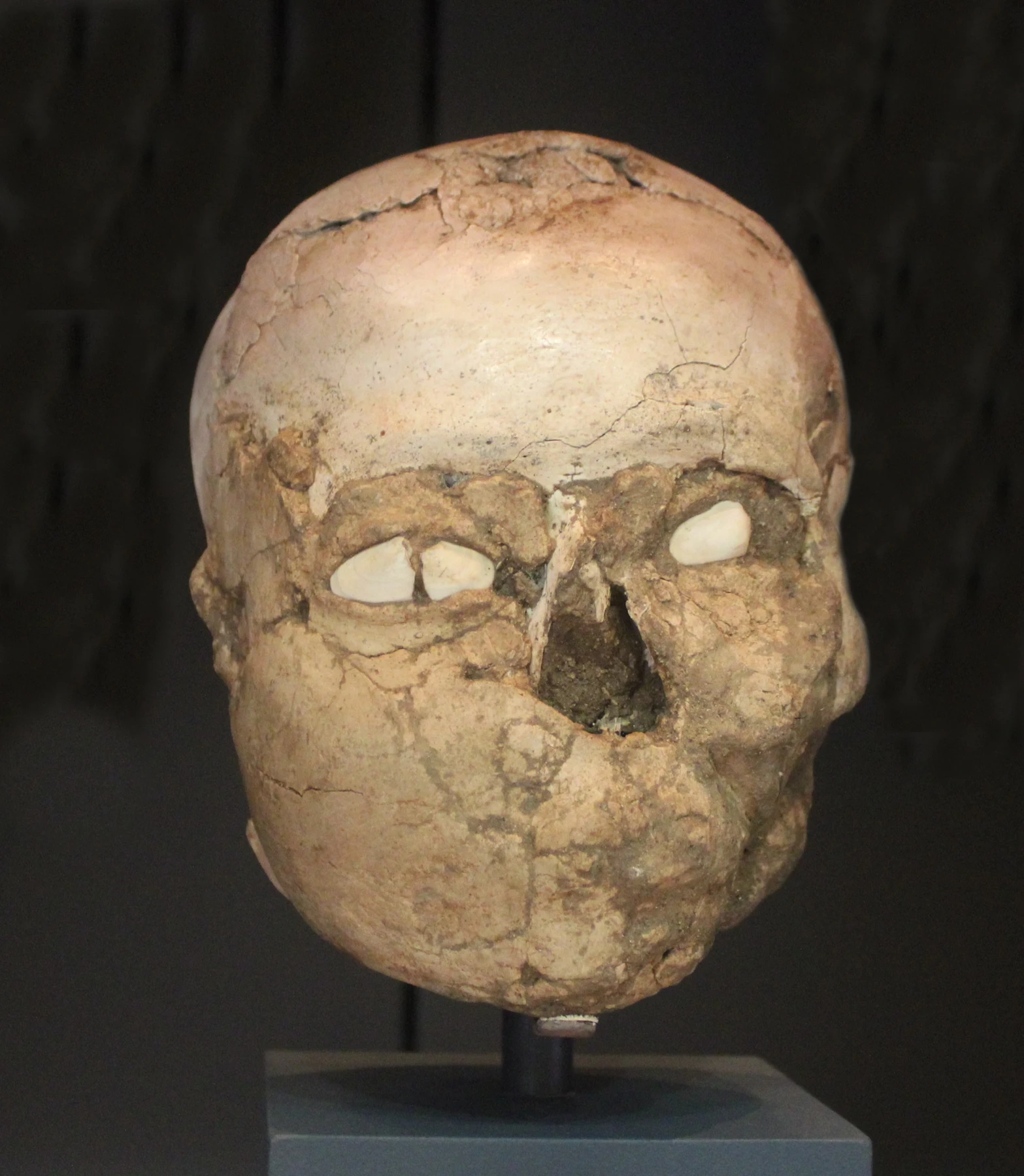
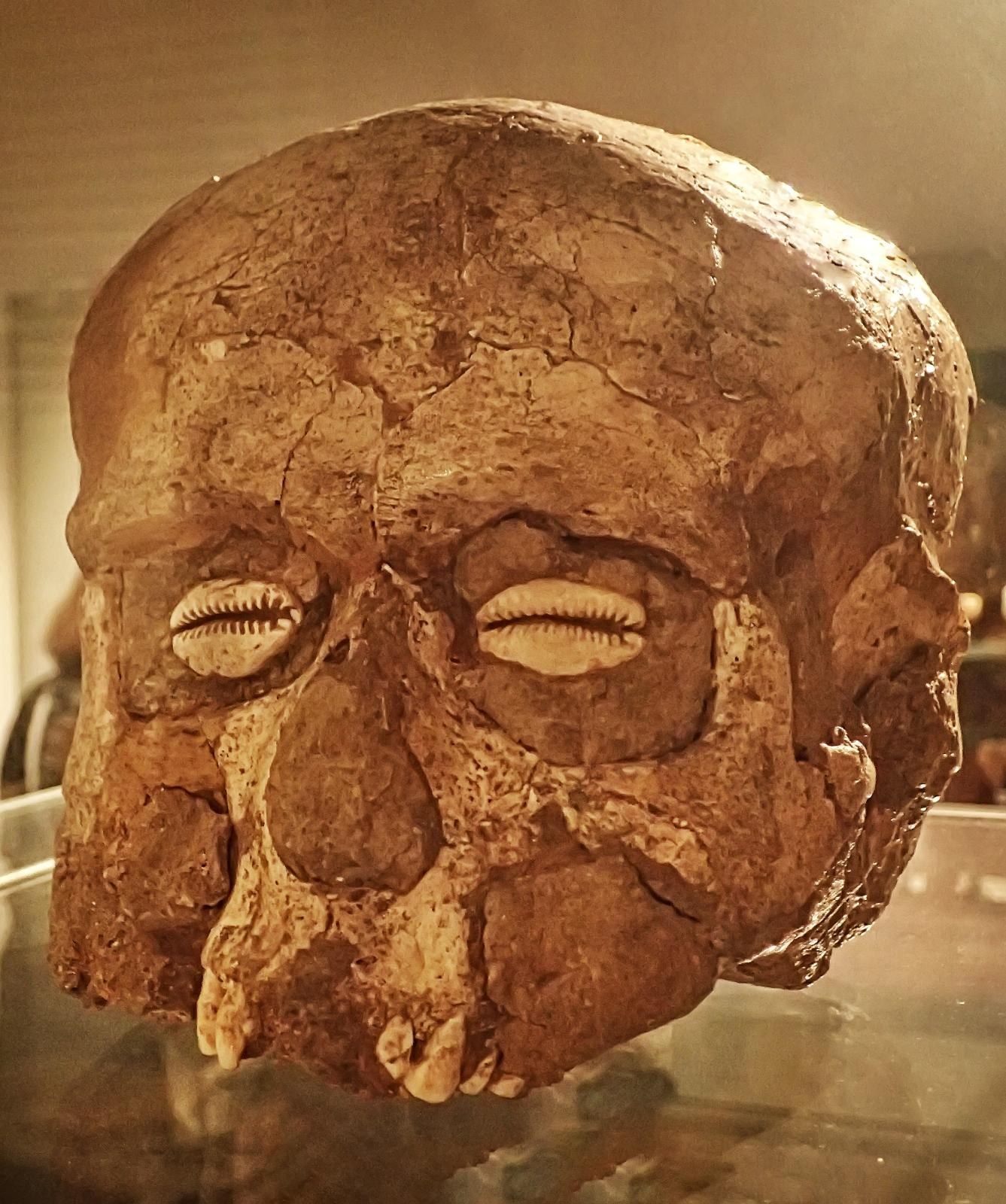
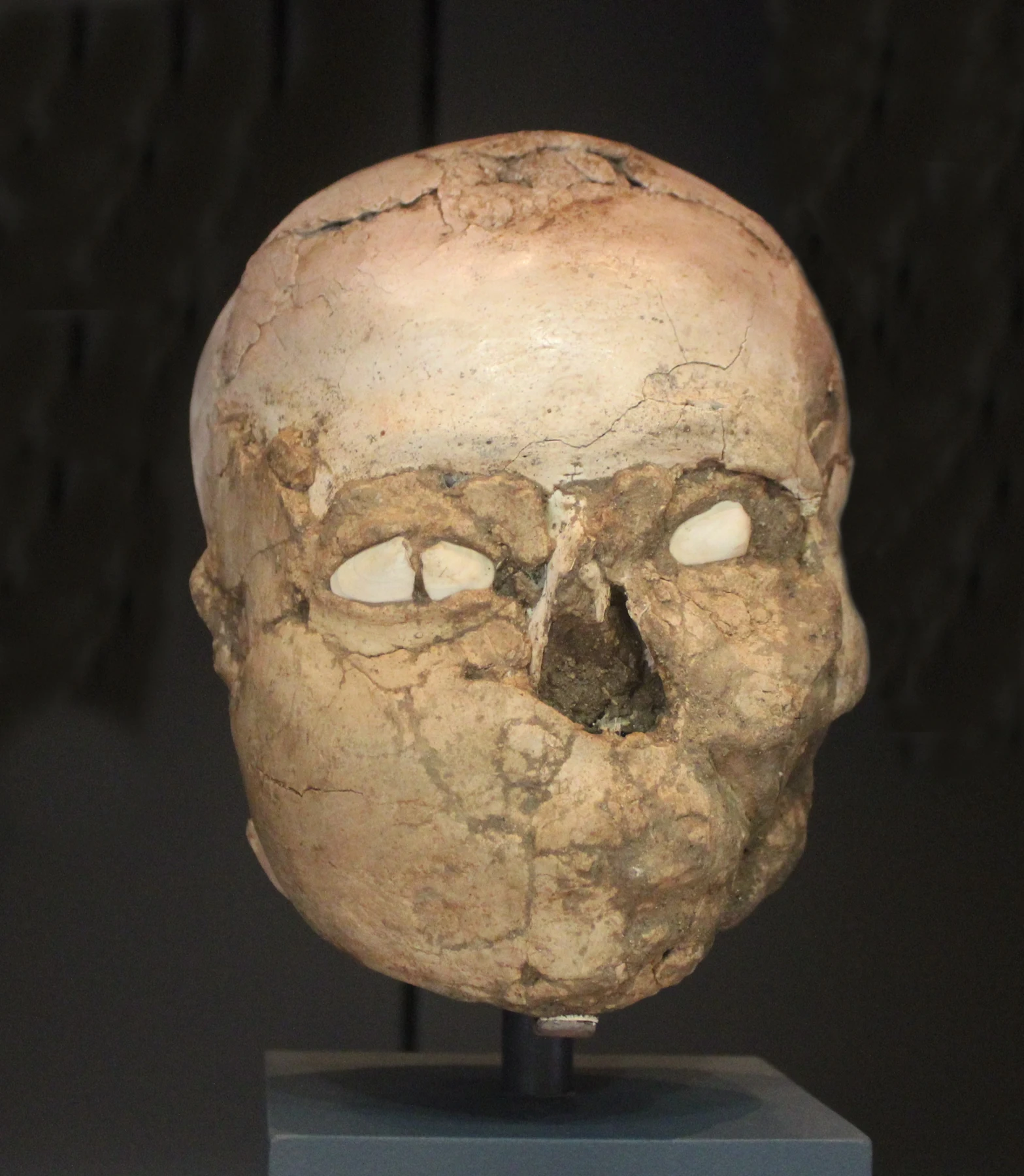
The eyes in the photograph appear open, but they are made from pieces of shell. Beneath the modeled plaster face is an actual human skull. This is a plastered skull: remains incorporated into an image, bringing together the deceased person's body and work performed after their death.[1]
The question extends beyond skill in modeling a face. Why was this person selected? How did their presence relate to the living community? Details of manufacture, the find context and internal examination help us approach these questions.
Jericho and the date of these faces
Jericho / Tell es-Sultan lies in the Jordan Valley, near the present city of Jericho in Palestine. A group of seven plastered skulls was discovered in 1953, including British Museum object 1954,0215.1. The museum's account dates this object to approximately 8200–7500 BCE, within phase B of the Pre-Pottery NeolithicPre-Pottery NeolithicA regional archaeological framework for early settlement, cultivation and animal management in Southwest Asia before the local spread of pottery vessels; its dates and trajectories vary and it implies no common religion.Glossary · Click to read the explanation. This is a range for the exhibited object, not a single date for all the skulls or every phase of the site.[1][3]
The community therefore preceded the kingdoms and biblical narratives associated with Jericho by thousands of years. Buildings, burials and finds provide evidence for this period; the identities of the city's later inhabitants cannot simply be projected back onto it.
Making the dead present
In the skull examined by the museum, the lower jaw was absent and plaster formed a face over parts of the bone. Pieces of shell occupied the eyes, and a base helped the object stand. These steps show selection and care, making it possible to envisage a face kept present among the living. How it was displayed and how long it was retained require further evidence.[1][3]
The discovery of seven skulls together also matters: it places an individual within a collective practice. It does not establish whether the people were biological relatives or shared a particular status. Nor can resemblance to the living face be measured from the plaster surface alone; the maker may have followed conventions for presenting a face as well as the individual's features.
A history beginning in childhood
A study published in 2008, based on radiographic examination of a Jericho skull, identified modification of the cranium during childhood. This is understood as a practice affecting head growth, distinct from the application of plaster after death. Both traces can occur in the same individual.[2]
The authors called for mortuary treatment to be considered alongside practices shaping identity during life. The skull then witnesses a longer history: a body that grew within a community, followed by remains treated by that community after death. A finding about one individual does not mean that every plastered skull underwent the same modification.[2]
Looking beneath the plaster
Computed tomography combines X-ray images to show internal structures in sections. It enabled examination without dismantling the face, an important consideration for an object combining bone, plaster and filling. The museum's examination revealed details of the bone and internal materials that help reconstruct the steps involved in treating the head.[1][3]
This knowledge broadens the question from the face's appearance to its manufacture. Social or ritualRitualAn organised or distinguished practice meaningful to a community; it may leave traces, but its form alone does not reveal an associated doctrine.Glossary · Click to read the explanation purposes are investigated by comparing treatment and find context with other evidence, alongside the imaging results.
Why interpret them as ancestors?
Separating a dead person's head, caring for it and giving it a lasting face support an interpretation connecting the living with their dead and with shared memory. Ancestors have consequently occupied an important place in research. The 2008 study discusses these practices in relation to the formation of identity and boundaries between groups.[2]
An ancestor here might be someone selected by a community as a focus of belonging, rather than a grandparent whose kinship is established. Remembering, honoring and worshipping remain useful distinctions: these acts are not identical, and no texts by the skull makers name their rites. The interpretation draws strength from converging archaeological evidence, while details of belief remain open.
An ancient face and a modern model
In a project displayed at the museum from December 2016, skull imaging, 3D printing and facial approximation techniques produced a modern model. The museum's annual review describes this work, which differs from the plaster face made by the ancient community.[4]
The modern model attempts to estimate a living person's appearance from bone and anatomical knowledge, with assumptions about unpreserved parts. The ancient face witnesses how people chose to present the deceased. Comparing them helps explain differing purposes and evidence, rather than treating either as a definitive image against which to judge the other.
Connected readings
Living above the dead · House and ancestors at Çatalhöyük · Why shape children's skulls?
References and notes (4)
- British Museum, object 1954,0215.1 (big number 127414), with Chapter 8, “Beneath the Surface: Imaging Techniques and the Jericho Skull,” in Regarding the Dead, p. 91. Object dating, the 1953 group and examination context. Catalogue: 1954,0215.1; Regarding the Dead, Chapter 8, p. 91, indexed excerpt. Return to the text ↑
- Alexandra Fletcher, Jessica Pearson and Janet Ambers, “The Manipulation of Social and Physical Identity in the Pre-Pottery Neolithic: Radiographic Evidence for Cranial Modification at Jericho,” Cambridge Archaeological Journal 18(3), 2008, pp. 309–325. The abstract relates childhood head modification to mortuary treatment and identity formation. 18(3), pp. 309–325; authors’ abstract via CiNii/Crossref, bibliography in the University College Cork repository. Return to the text ↑
- Alexandra Fletcher, “What lies beneath: new discoveries about the Jericho skull,” British Museum, 3 July 2014. Object description and dating, imaging results, plaster-face construction and discussion of ancestor interpretations. Institutional account, 3 July 2014; object, imaging and interpretation, indexed main text. Return to the text ↑
- British Museum, Annual Review 2016/17, “The Jericho Skull,” p. 25: display from December 2016, imaging, 3D printing and facial approximation. The University College Cork record also identifies Fletcher’s “Facing the past: the Jericho Skull,” dated 17 January 2017. Annual Review 2016/17, p. 25, project excerpt; metadata of the 17 January 2017 item in the University College Cork repository. Return to the text ↑
Suggest a correction · Suggest a source for this record
Cite this record
IL Archive, «Jericho’s Plastered Skulls: Faces of the Dead and the Limits of Ancestor Interpretation», https://ilarchive.com/en/studies/jericho-plastered-skulls
Continue reading