Study
Living Above the Dead: Subfloor Burial Before Çatalhöyük
An extended study of a topic, with evidence and references.
- Timeline
- From 9400 BCE to 7100 BCE
- Region
- Central Anatolia, with comparisons from the Levant
From Aşıklı and Balıklı to Boncuklu: burial, kinship and building continuity, and the limits of interpretations involving memory, ancestors and the underworld.
Share article
Text
The dead within the history of the house
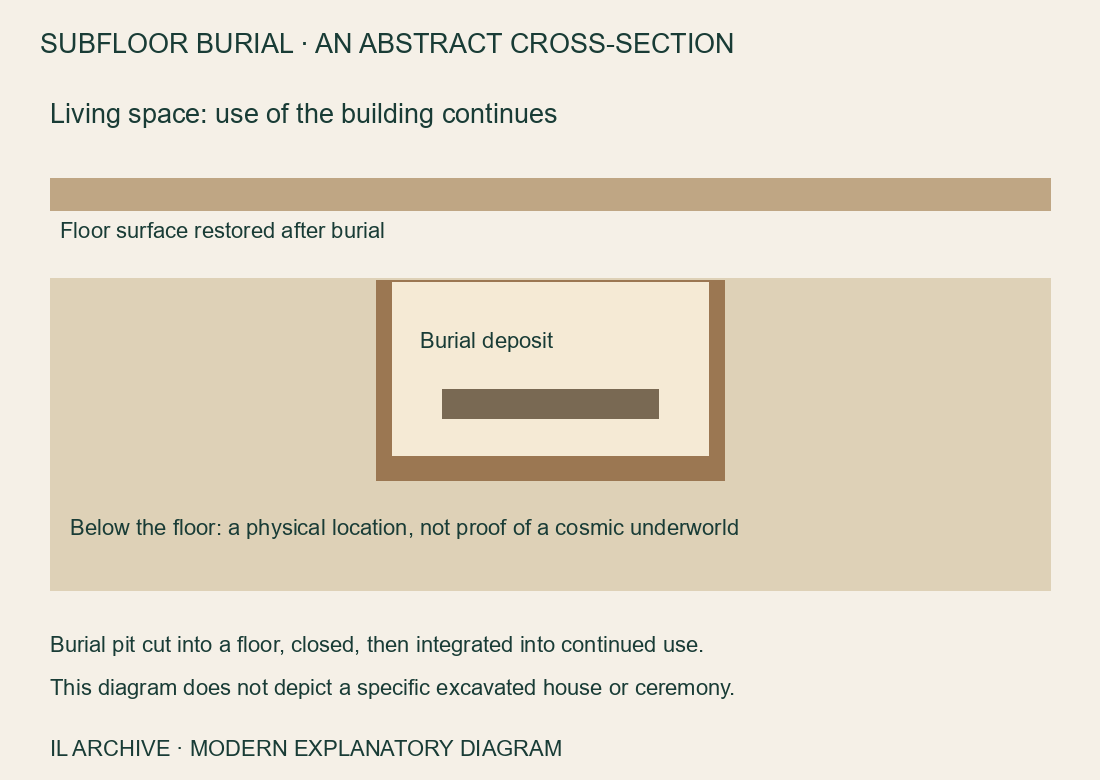
Long before ÇatalhöyükÇatalhöyükA Neolithic site in central Anatolia where domestic houses combined dwelling with burial, symbolism and social memory.Glossary · Click to read the explanation became famous for houses in which the living occupied spaces above their dead, communities in central AnatoliaAnatoliaAnatolia is the region occupying the Asian part of present-day TurkeyGlossary · Click to read the explanation were burying selected people beneath building floors. They opened a pit, deposited a body, closed it and continued to use the building. In some contexts this practice preceded Çatalhöyük by more than a thousand years.
Cooking, sleeping and work could continue in the same house. New inhabitants arrived while earlier bodies remained below. At Aşıklı HöyükAşıklı HöyükA Neolithic Cappadocian settlement with successive buildings and selected subfloor burials.Glossary · Click to read the explanation there were subfloor burials; at BalıklıBalıklıA central Anatolian Neolithic site with floor and wall burials and special skull treatment.Glossary · Click to read the explanation, burials beneath floors and in walls, including separately deposited, pigmented skulls; at Boncuklu HöyükBoncuklu HöyükA Konya Plain Neolithic settlement with oval houses and burials associated with continued building use.Glossary · Click to read the explanation, graves beneath the cleaner part of an occupied house.
These examples connect the house, memory and the dead. They also raise a harder question: did the physical space beneath the living help people imagine a realm of the dead below the earth? The question is legitimate; the answer requires evidence that burial location alone cannot supply.
These cases belong to intramural burialIntramural burialDeposition of the dead within a settlement’s built area; burial beneath a domestic floor is one form.Glossary · Click to read the explanation, burial within a settlement. Burial beneath a domestic floor is one particular form.
Aşıklı Höyük: beneath the floor in the ninth millennium BCE
Aşıklı HöyükAşıklı HöyükA Neolithic Cappadocian settlement with successive buildings and selected subfloor burials.Glossary · Click to read the explanation lies in Cappadocia, central TürkiyeTurkeyTurkey is a modern country including Anatolia and territory in southeastern EuropeGlossary · Click to read the explanation, near the Melendiz River. The 2021 study dates occupation approximately to 8350–7300 BCE. Some deceased individuals were placed, commonly in flexed positions, in pits beneath building floors.[1]
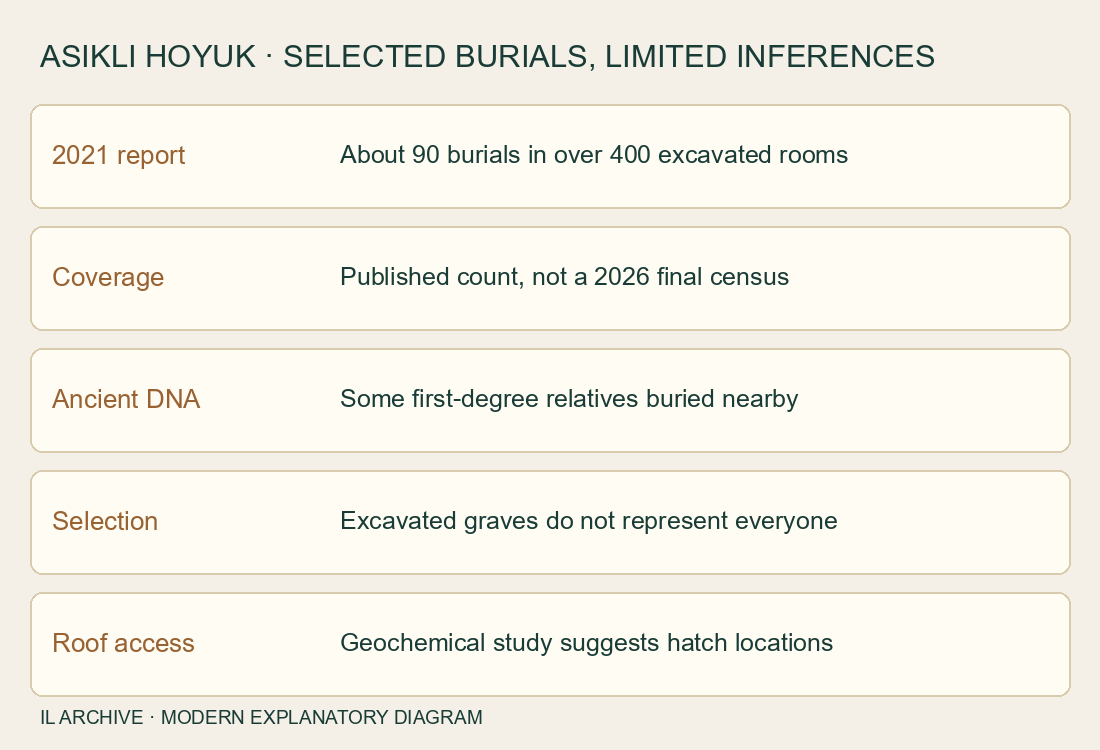
That study reported about 90 burials in more than 400 excavated rooms. This is a published 2021 count, not a final total updated to 2026. Genetic evidence identified pairs of first-degree relatives in the same or neighboring buildings. For the Aşıklı sample, the authors favored sibling relationships, while not excluding parent–offspring relationships.[1]
Here a grave occupied the domestic domain. A deceased person could become part of a building’s history; the burial was covered and occupation continued. This observation does not require an identifiable doctrine: selected people remained connected to the place of the living.
Not everyone was buried beneath a house
Saying that Aşıklı inhabitants buried their dead beneath houses can misleadingly suggest that every deceased person automatically received this treatment. The archaeological numbers do not establish that. About ninety burials against more than four hundred rooms, across centuries of occupation, are fewer than expected if the excavated houses represented all deaths in the community.
Excavation and preservation impose limits, and additional graves may remain undiscovered. Nevertheless, the researchers argue that other factors influenced burial location: the known subfloor dead cannot simply be treated as everyone who lived at the settlement.[1]
Why these people? Genetics supports close kinship in some cases. Special status, household history or other criteria may also have mattered. Other bodies could have received treatment that left little trace or burial beyond the excavated area. Subfloor burial appears to have involved selection; its rules remain uncertain.
Sometimes the house retained knowledge of its dead
An old grave whose location has been forgotten differs from a burial over which people continue to live while knowing its position. At Aşıklı, burial could be inserted into a building’s history, followed by renewed use of the floor. The dead did not necessarily belong to a separate place outside the settlement.
Research on continuity considers how successive buildings and repeated architectural arrangements maintained community life. Duru and Özbaşaran’s 2024 study examines continuity and collective social organization; the accessible indexed abstract and excerpts support this interpretive framework, rather than a demonstrated belief shared by every household.[2]
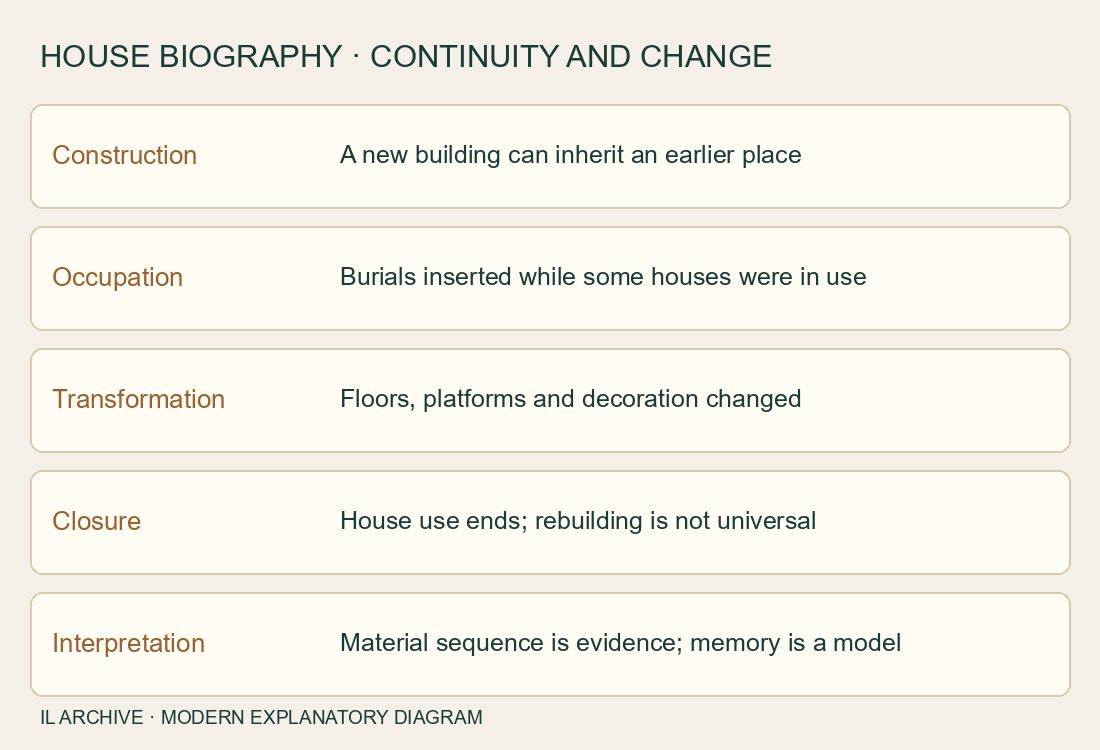
Together with burials, rebuilding can make a house more than walls: it becomes a place with a past. Memory and social continuity are interpretations to test against its physical history.
Living people entered from above, with the dead below
In later Aşıklı phases, architecture became denser, and some rectangular buildings are interpreted as having roof access. Kalkan, Özbaşaran and Özbal’s 2024 study analyzed the geochemistry of five successive floors in one building and proposed possible roof-hatch locations and patterns of use. The abstract examined presents these as research suggestions, rather than preserved openings visible in every structure.[3]
In some cases, therefore, the living entered from above while the dead lay below. Yet no Aşıklı text says that the roof represented heaven or the floor a gateway to a cosmic underworld. The vertical arrangement permits a symbolic question; its inhabitants’ own explanation is not preserved.
Balıklı: beneath floors and within walls
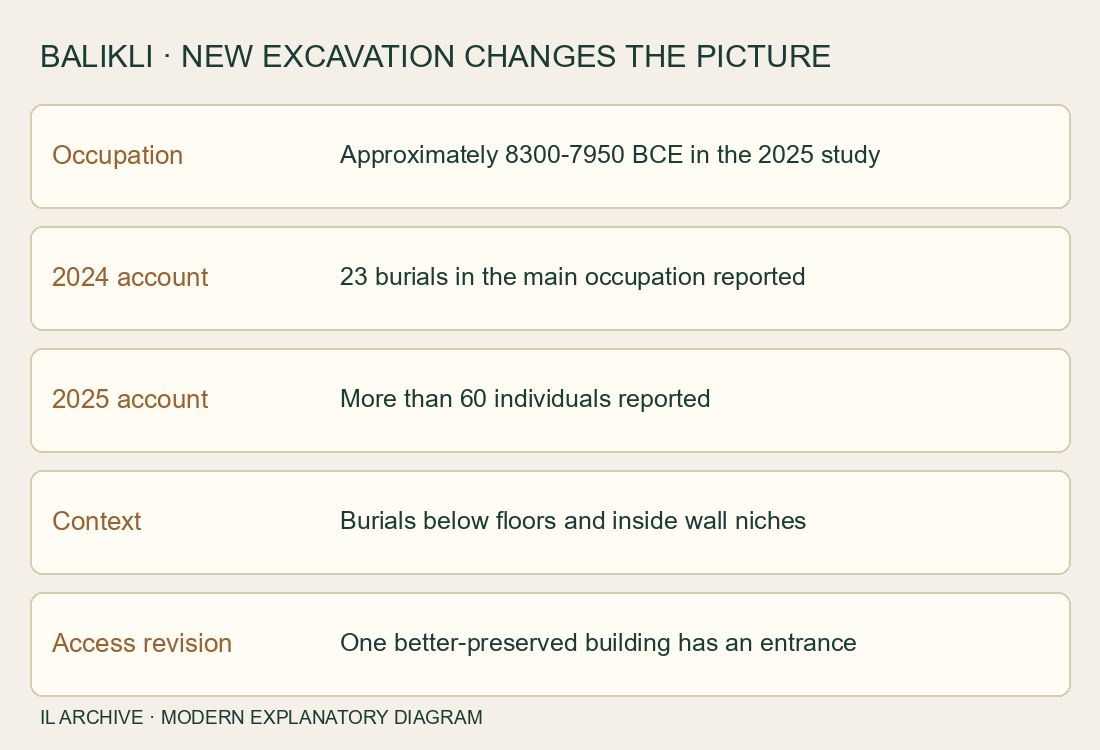
BalıklıBalıklıA central Anatolian Neolithic site with floor and wall burials and special skull treatment.Glossary · Click to read the explanation, about fourteen kilometres northeast of Aşıklı, had a shorter occupation. The 2025 study gives approximately 8300–7950 BCE. Hunting and gathering remained central, alongside limited signs of food production.[5]
The 2024 excavation report described a body beneath the earliest floor of a building, with three pigmented skulls in pits immediately below it. Associated deposits included an ochre/cinnabar lump, obsidian rough-outs and ochred blades, polished stone axes and bone tools. Other burials were placed in horizontal holes dug into building walls.[4]
The deceased could thus occupy the fabric of a building as well as the ground beneath it. The surviving house was a dwelling, but its floors and walls also contained bodies whose significance cannot be reduced to a single explanation.
Further excavation changed the picture at Balıklı
In 2025, Güneş Duru reported more than sixty individuals from the main occupation, with numerous primary and secondary burials in nearly every investigated building. These are excavation reports at different dates, not competing final censuses.[5]
The known Balıklı burials include infants, children, adults and both sexes. Duru contrasts them with a more demographically restricted sample from contemporary early Aşıklı. This comparison concerns those particular phases and excavated areas; it does not describe every Aşıklı burial across its entire history.[5]
Two nearby, partly contemporary communities could practice burial within buildings differently. A shared location does not establish a single Anatolian doctrine.
An important revision to roof access at Balıklı
The 2024 study inferred roof entry from the absence of clear doorways. In 2025, a better-preserved building instead indicated that an eastern projection served as an entrance reached by a few steps.[4][5]
This new observation prevents roof access from being treated as a confirmed general rule for Balıklı. Equally, evidence from one well-preserved structure does not prove that every building had an identical entrance.
Subfloor burial did not require roof entry. The two practices could coexist, but they were not inseparable components of a demonstrated religious system.
Boncuklu Höyük: a ground-level doorway, with burials below
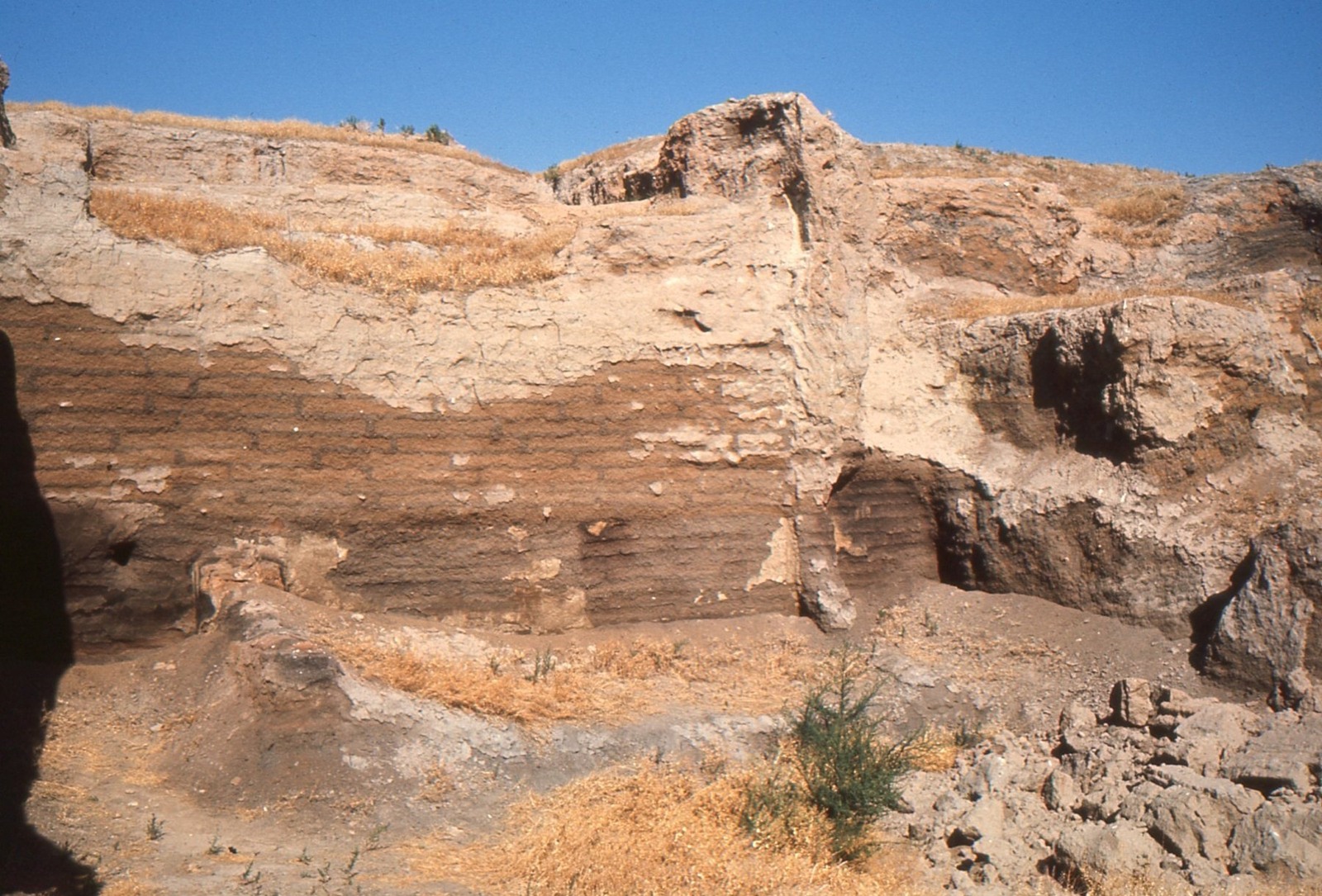
Boncuklu HöyükBoncuklu HöyükA Konya Plain Neolithic settlement with oval houses and burials associated with continued building use.Glossary · Click to read the explanation lies on the Konya Plain, near Çatalhöyük. Its whole occupation must be distinguished from the range of dated deposits studied. The 2018 research examined early and later phases around 8300–8100 and 8100–7800 BCE. The project’s June 2026 publication describes a broader occupation range, approximately 9400–7500 BCE. It would therefore be inaccurate to present 8300 BCE as the definitive beginning of the whole site.[7][10]
The small oval or sub-oval houses had mudbrick walls. The examined introduction of the study of Boncuklu’s earliest ceramics describes evidence of ground-level entrances, unlike Çatalhöyük’s roof access. Domestic burial did not depend on one entrance arrangement.[6]
Primary burials were placed beneath the cleaner house area during occupation, away from the zone more strongly associated with hearths and cooking residues. Buildings were rebuilt in the same locations above earlier houses and dead. “Clean” here describes an archaeological activity distinction; it does not establish sacredness.[1][7]
A ground-level door, an occupied house and bodies beneath its floor together show why entrance from above cannot be a necessary cause of burial below.
Who lay beneath Boncuklu’s floors?
The numbers in the houses described by the 2021 study were modest: usually one to three burials, with a known maximum of five. Some could have belonged to people who used those buildings, although that cannot be assumed for every burial.[1]
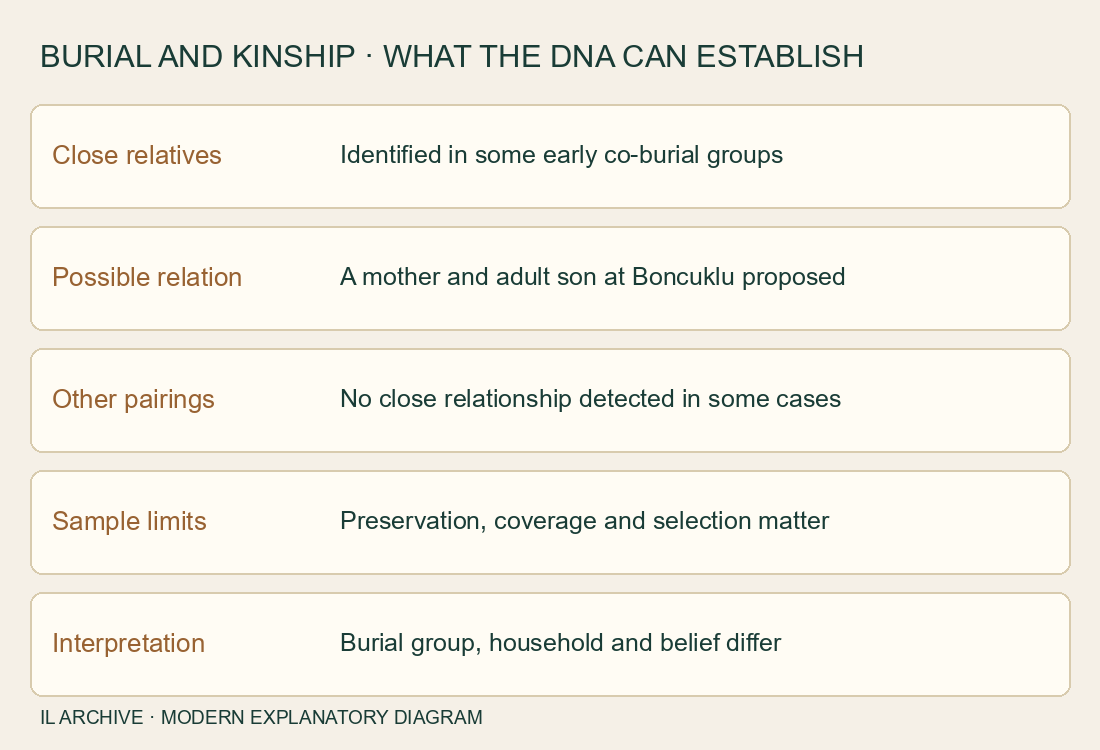
Genetics partly supports close connections. First-degree relatives were identified within the same or successive neighboring buildings, including a possible mother and adult son. Other co-buried individuals had no identified close genetic relationship, including an adult woman and infant sharing a grave.[1]
The archaeological category “household” cannot automatically be translated into a biological family. The sample is limited, and unidentified close kinship does not exclude more distant kin or social ties. Domestic communities may have involved connections beyond blood relationships.
The dead did not always remain complete bodies
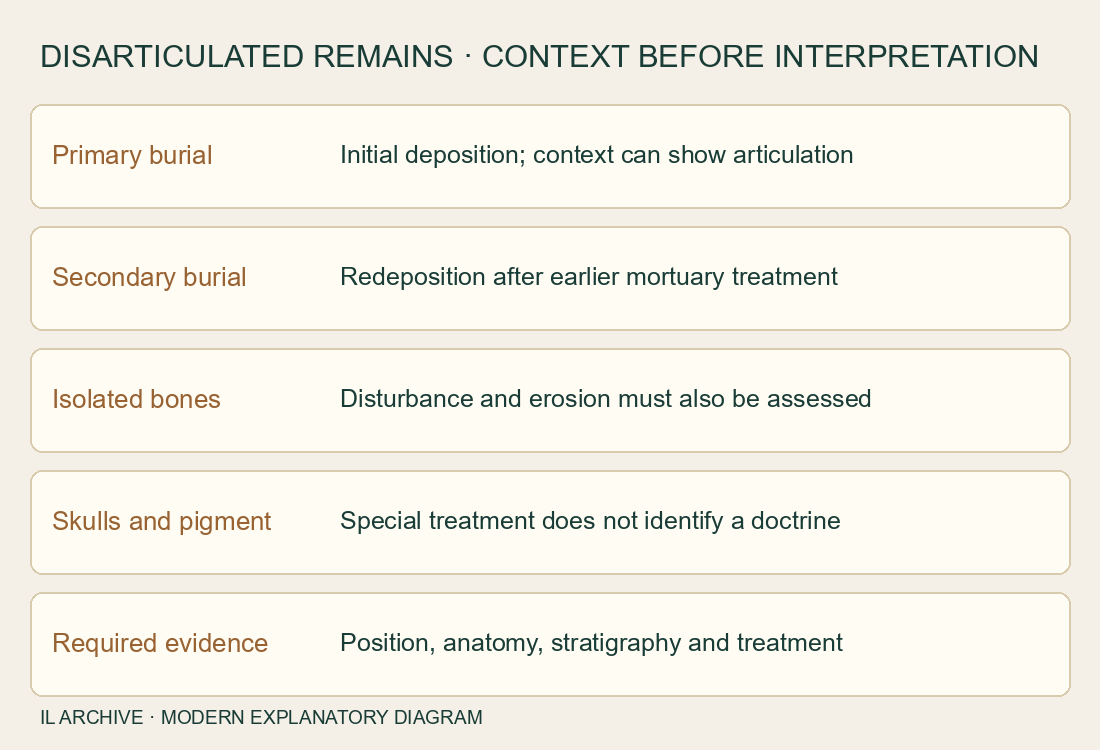
At Boncuklu, the 2021 study describes deliberately disarticulated human remains, including crania, in open spaces between buildings. Some bodies therefore did not remain intact units after death.[1]
Bones could move, skulls could be separated and remains could acquire a new depositional context. Comparable practices across Neolithic Anatolia and the LevantThe LevantThe Levant is a regional name for lands along the eastern MediterraneanGlossary · Click to read the explanation varied: separate skulls, redeposition, pigment and, at some sites, plaster modeling. Similar physical treatment does not establish an identical belief.
The term secondary burialSecondary burialRedeposition of remains after earlier mortuary treatment or deposition, established from context.Glossary · Click to read the explanation requires contextual evidence for redeposition following earlier treatment. It should not be applied automatically to every isolated bone.
Three sites, rather than stages on one road
It is tempting to imagine Aşıklı inventing a practice, Balıklı developing it, Boncuklu transmitting it and Çatalhöyük completing it. The sites partly overlap in time and differ in occupation duration, architecture, spatial arrangements and treatment of the dead.[4][5]
Aşıklı maintained a long building sequence and increasingly dense architecture. Balıklı had a shorter occupation and different construction practices. Boncuklu’s small houses included ground-level access and structured domestic activities.
Regional research emphasizes diverse local choices in the development of settled life. It does not establish a necessary progression from one village to the next. Connecting bodies with domestic architecture was an important option for several communities, expressed differently at each site.
Why beneath a house?
Several explanations are possible. Burial in a household’s place could keep a deceased person within the domain where they had lived. It could also affirm continuity: earlier people lie here, and the present group belongs to this place.
Repeated construction above earlier buildings, alongside the dead below, might link a household’s present with its past. The 2021 study discusses building histories and burial as possible expressions of social continuity and connections between living and dead.[1]
“Ancestor” nevertheless requires care. A buried child or young person is not necessarily a genealogical ancestor of later inhabitants; nor is every deceased person beneath a floor demonstrably sacred. Some dead became part of the house’s history. Their authority over the living, if any, is unknown.
Why were some people selected?
This is among the hardest questions. The known Aşıklı burials do not appear to represent the whole population; Boncuklu houses differ in their burial counts. Kinship, age, sex, social roles, circumstances of death, building history or criteria unknown to us may have influenced placement.
At Aşıklı and Boncuklu, close biological kinship mattered in some sampled cases, without explaining them all.[1]
The evidence cannot uniformly establish a family cemetery, elite burial or sacred ancestors. Selection is a supported interpretation, but its rules could differ between sites and periods. Excavated and genetically tested samples must also be distinguished from entire ancient populations.
Was the head treated differently from the body?
In several Neolithic Near Eastern contexts it was. Balıklı’s 2024 report describes three pigmented skulls beneath another burial. Boncuklu’s 2021 study describes deliberately disarticulated remains, including crania, in external spaces.[4][1]
Plaster facial remodeling is demonstrated, for example, by the Jericho skull in the British Museum: a human cranium with the lower jaw removed and the face remodeled. This Levantine example differs from Balıklı’s pigment treatment and does not turn diverse practices into one ritualRitualAn organised or distinguished practice meaningful to a community; it may leave traces, but its form alone does not reveal an associated doctrine.Glossary · Click to read the explanation.[8]
The head bears the face, and a face relates to personal identity. That observation can generate questions; it does not prove belief in a soul residing in the head or a unified “skull cult.” Treatment is easier to describe than the doctrine behind it.
Was subfloor burial confined to central Anatolia?
No. Examples occur across Anatolia and the Levant during the Pre-Pottery NeolithicPre-Pottery NeolithicA regional term for early Neolithic phases in Southwest Asia before the local spread of pottery; it does not imply an absence of settlement, architecture or cereal processing.Glossary · Click to read the explanation. Differences in grave location, treatment and building history prevent geographic spread from being equated with one religion.
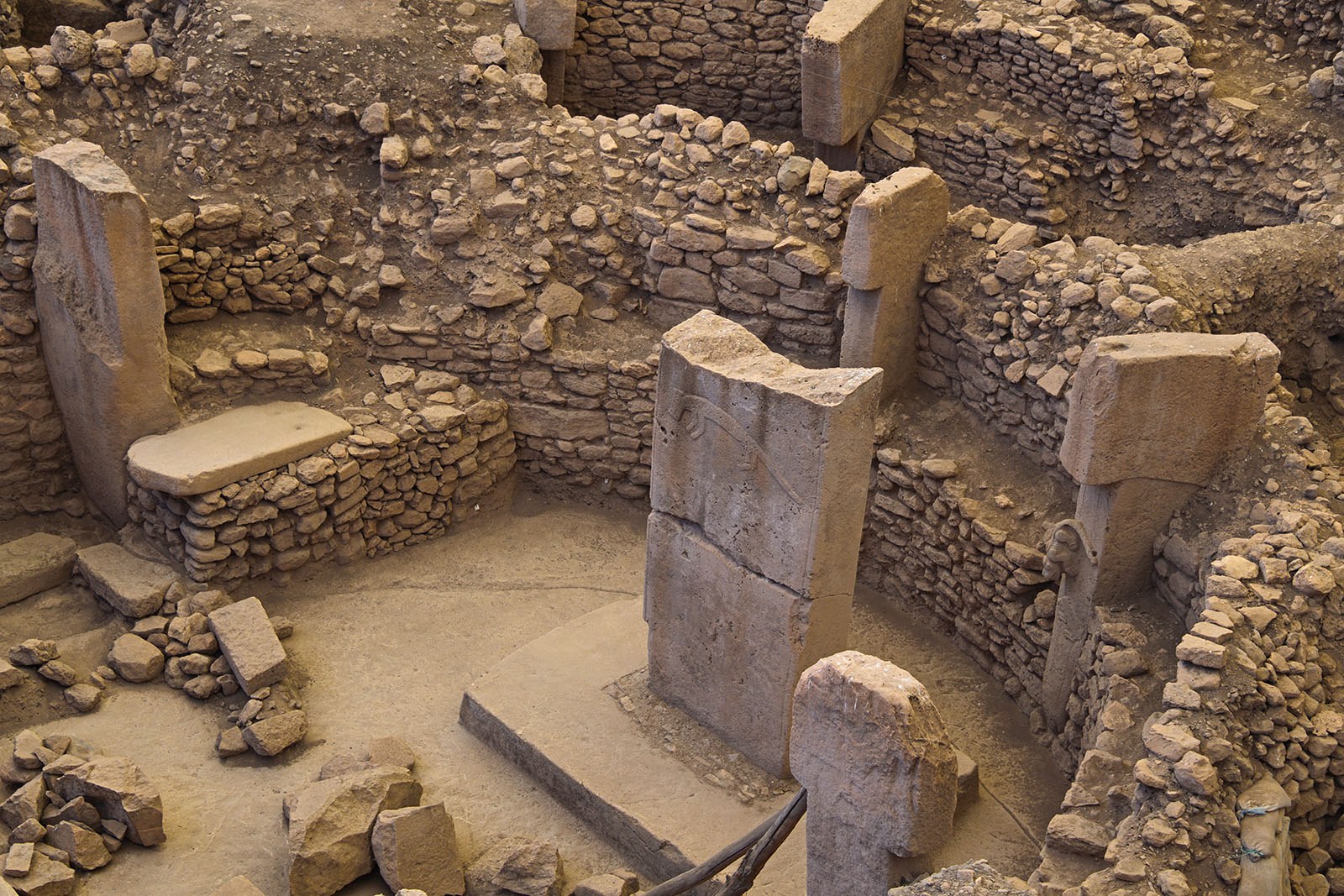
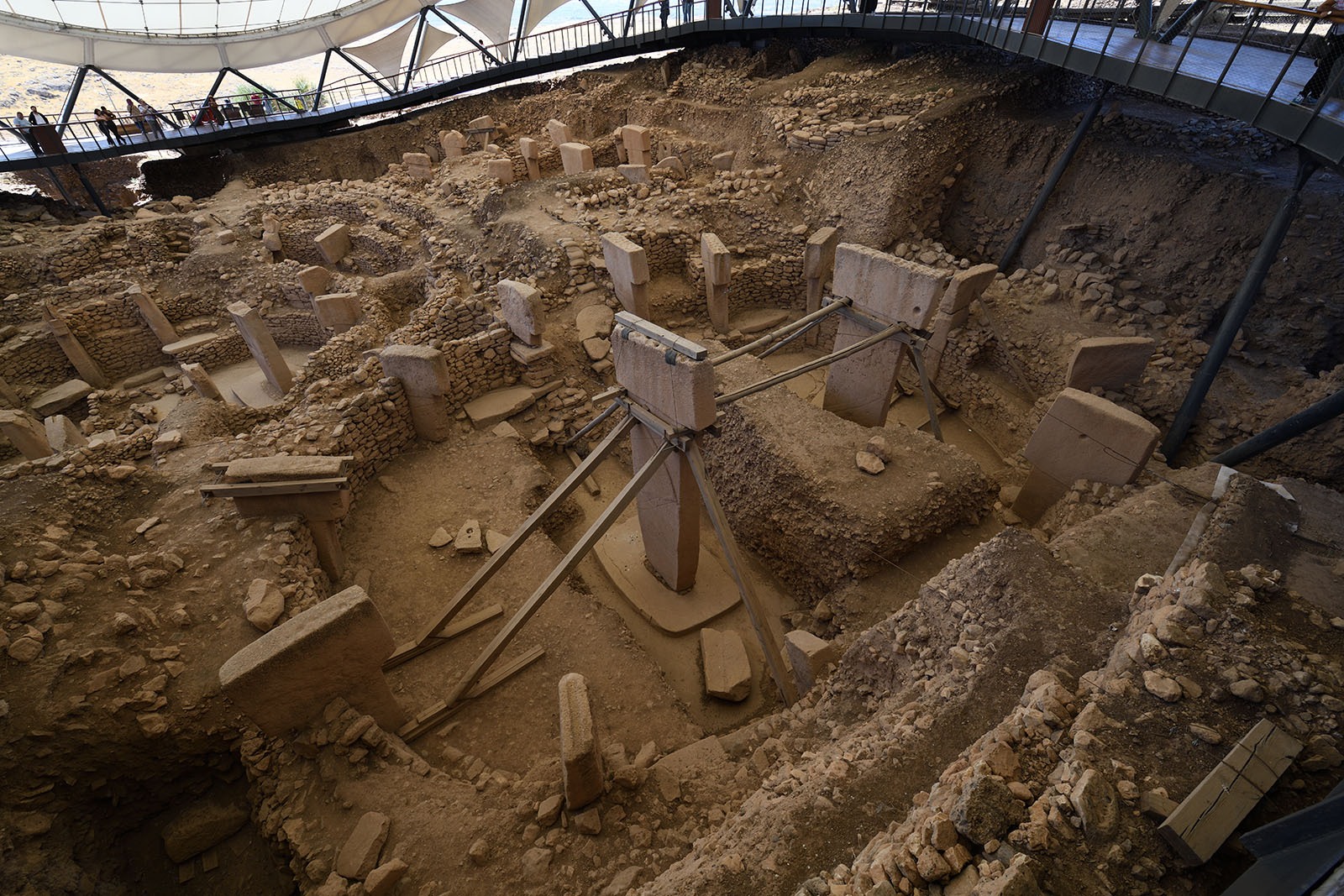
A September 2026 study adds the first two documented intact burials at Göbekli TepeGöbekli TepeA Neolithic site in southeastern Turkey, known for communal buildings and T-shaped pillars; the excavation team describes a settlement with a pronounced ritual component.Glossary · Click to read the explanation, from PPNB contexts approximately 8700–8000 BCE. One collective grave cut the plaster floor of a rectangular building. Scattered human bones had already been known. The study considers erosion as a cause of some bone dispersal alongside the possibility of other mortuary treatment; an isolated bone alone does not demonstrate ritual transfer.[9]
This discovery broadens comparison without establishing that every community understood a grave in the same way.
About a millennium before Çatalhöyük
Burials beneath ÇatalhöyükÇatalhöyükA Neolithic site in central Anatolia where domestic houses combined dwelling with burial, symbolism and social memory.Glossary · Click to read the explanation’s platforms and floors do not mark the beginning of the practice. Boncuklu phases examined in 2018 precede the beginning of Çatalhöyük East, around 7100 BCE, by approximately a thousand years or more.[7]
Comparisons involve cleaner and cooking areas, renewed floors, rebuilding in the same location, incorporation of animal parts in architecture and subfloor burial. The authors propose Boncuklu as one possible direct antecedent of Çatalhöyük’s community, not necessarily its only source.[7]
These similarities do not prove identical communities or the unchanged transmission of every custom. Çatalhöyük elaborated a connection between house and dead with earlier precedents. No obligatory chain links every village in the region.
Did the underworld begin beneath the house floor?
Millennia later, Sumerian and AkkadianAkkadianAn ancient East Semitic language written in cuneiform in Mesopotamia.Glossary · Click to read the explanation texts describe developed ideas about the dead and the netherworld. The examined abstract of “ghosts, MesopotamiaMesopotamiaA historical region associated with the Tigris and Euphrates, home to many societies and civilisations.Glossary · Click to read the explanation” describes ghosts’ residence there after burial and their need for care from living relatives, within historical traditions involving EreshkigalEreshkigalRuler of the underworld in Mesopotamian traditions, exercising authority over death’s realm in the descent narratives.Glossary · Click to read the explanation and Nergal. This textual world postdates the villages considered here.[11]
Could actual burial below ground have helped people imagine a realm of the dead below? It is a reasonable question, not an established history. A study using Conceptual Metaphor Theory for Bronze Age Britain offers a comparison: interpreting mortuary practices through an inverted underworld. Its subject is Britain in the third and second millennia BCE, not Aşıklı or the origins of Sumerian cosmology.[12]
Burial experience can be one source for spatial metaphors. No Neolithic text from these sites describes a cosmic underworld, however, and no evidence sequence establishes transmission from central Anatolia to Sumer. The cognitive possibility remains open; the proposed historical lineage is unproven.
Perhaps the meaning was proximity rather than separation
Domestic burial could keep the deceased close rather than send them to a distant realm. Beneath a sleeping place or beside a wall, a body remained in the intimate domain of the living group.
Melissa Cradic discusses spatial connections between living and dead and household memory using Middle Bronze Age Megiddo. Only her abstract was examined. It is a comparison from a different time and place, rather than direct evidence of Aşıklı beliefs.[13]
Boncuklu’s own evidence—continued building use and attention to burial positions—allows us to investigate living–dead relationships in place. Why were these particular people kept nearby? The material record supplies no single answer.[1]
A house contained two layers of people
A building plan alone does not show the whole community associated with a house containing subfloor graves. Above are people eating, sleeping and speaking; below are silent bodies sharing the same place. Later inhabitants may occupy a building with a past that long precedes their arrival.
Architecture can thus become a material record of generations rather than a written one. Bodies within a place may support belonging and claims to continuity, especially where no written genealogy survives.
This remains a contextual interpretation, not a universal rule or evidence of modern legal property. People could bury beneath houses for several reasons we cannot recover.
Why did life continue above the grave?
Many people today separate domestic and burial spaces, but that separation is not a universal human rule. A body beneath a floor did not necessarily transform a dwelling into a cemetery in the modern sense.
Boncuklu burials occurred while buildings were in use, with continued occupation above them.[1]
Death did not inevitably displace domestic life. The living and the dead could be associated with the same architectural place. That coexistence is the central archaeological phenomenon; its emotional experience cannot be read directly from a floor.
What can be stated with confidence?
Established: subfloor burial at Aşıklı and Boncuklu preceded Çatalhöyük by many centuries, and some buildings remained in use after burial.[1][7]
Probable: Aşıklı’s known burials do not represent the entire population. Mortuary selection is supported, subject to excavation and preservation limits.[1]
Established: treatment varied, including separated or pigmented skulls, primary burial and secondary deposition. These actions do not establish one doctrine.[1][4][5]
Probable in particular contexts: burials and rebuilding contributed to place memory and community continuity. Some dead may have acquired ancestral status; burial alone does not establish ancestor worship.[1][2]
Possible as a cognitive model: burial below ground may help construct an associationShirkAssociating others with God in Quranic discourse; not equivalent to denying God’s existence.Glossary · Click to read the explanation between death and “below.” Historically unproven: that these villages possessed a Mesopotamian-style underworld doctrine or transmitted it directly to later written traditions.[11][12]
Before “below” became another world
Perhaps the key change was that increasing settlement gave the dead a place within an enduring inhabited setting. A mobile group could leave a grave behind; people repeatedly returning to the same houses and rebuilding on the same locations encountered a different relationship with bodies buried there.
That person could become part of a place that outlasted them. Ground was more than a surface crossed by the community: some of it contained earlier people.
This offers a way to investigate settlement’s consequences for memory and sacred significance. It does not establish where an afterlife doctrine began. The material record first reveals an enduring connection between people, buildings and selected dead, before it reveals any named cosmic realm.
References and notes
- Reyhan Yaka et al. (2021). Variable kinship patterns in Neolithic Anatolia revealed by ancient genomes. Current Biology 31(11), 2455–2468.e1–e18. DOI: 10.1016/j.cub.2021.03.050. Aşıklı and Boncuklu results, discussion and STAR Methods site backgrounds read in the full text through Europe PMC. Counts belong to the 2021 report; sampled DNA and proposed relationships do not form a complete population register. Return to the text ↑
- Güneş Duru & Mihriban Özbaşaran (2024). Preserving collectivity through continuity. Archaeological Research in Asia 40, 100555. DOI: 10.1016/j.ara.2024.100555. Indexed publisher abstract and short preview passages only; full paper not read. Architectural continuity, memory and social structure are the authors’ interpretation, not direct access to each household’s beliefs. Return to the text ↑
- Fatma Kalkan, Mihriban Özbaşaran & Rana Özbal (2024). Geochemical Analyses to Make the Invisible More Concrete: Cycles of Building Use and Roof Hatches at the Early Neolithic Site of Aşıklı Höyük. Journal of Field Archaeology 49(5), 301–317. DOI: 10.1080/00934690.2024.2338621. Indexed abstract at the author’s university only: five successive floors and proposed roof-hatch locations. Full paper not read; the abstract does not establish an above/below cosmology. Return to the text ↑
- A. Nigel Goring-Morris et al. (2024). Variation in the development of Neolithic societies atop the Central Anatolian Plateau: recent results from Balıklı. Antiquity 98(401), 1163–1180. DOI: 10.15184/aqy.2024.100. Site, dates, architecture, burials and discussion read. Reports 23 main-occupation burials, pigmented skulls and wall burials. The roof-access inference was revised by a better-preserved building in the 2025 report. Return to the text ↑
- Güneş Duru (2025). Balıklı: On the Edge of Time and Everything. Anatolian Research 32, 1–18. DOI: 10.26650/anar.32.1701248. Published 25 July 2025. PDF pp. 5–9 and 12–15, plus abstract: c.8300–7950 BCE, over 60 individuals, primary/secondary burials and an entrance in one better-preserved building. Aşıklı comparisons concern contemporary phases and excavated areas, not the whole site. Return to the text ↑
- Michela Spataro, Alexandra Fletcher, Caroline R. Cartwright & Douglas Baird. Boncuklu Höyük: the earliest ceramics on the Anatolian plateau. Journal of Archaeological Science: Reports. DOI: 10.1016/j.jasrep.2016.10.011. Author manuscript. Author-manuscript abstract and introduction: successive oval buildings and ground-level entry, contrasted with Çatalhöyük. Entrance differences do not establish different afterlife beliefs. Return to the text ↑
- Douglas Baird et al. (2018). Agricultural origins on the Anatolian plateau. PNAS 115(14), E3077–E3086. DOI: 10.1073/pnas.1800163115. Comparative results, Boncuklu context and supplementary chronology read in the author-repository PDF: clean/cooking zones, burial and building continuity. 8300–7800 BCE covers studied phases; Çatalhöyük East began around 7100 BCE. Return to the text ↑
- British Museum. Regarding the Dead: Human Remains in the British Museum. Selected discussion of the Jericho skull, museum number 127414. Indexed museum-PDF excerpt only, not the full book: Jericho skull 127414, removed jaw and plaster-remodelled facial features. A Levantine comparison, not identical to Balıklı’s pigmented skulls or automatic proof of ancestor worship. Return to the text ↑
- Julia Gresky & Lee Clare (2026). First burials give insights into mortuary rites at Göbeklitepe, Early Neolithic Türkiye. PLOS ONE 21(9), e0358979. DOI: 10.1371/journal.pone.0358979. Published 22 September 2026. Abstract, introduction, collective-burial results and erosion discussion read. First two intact burials, not first known human bones. The collective grave cut a plaster floor; dispersed bones may have multiple causes. Return to the text ↑
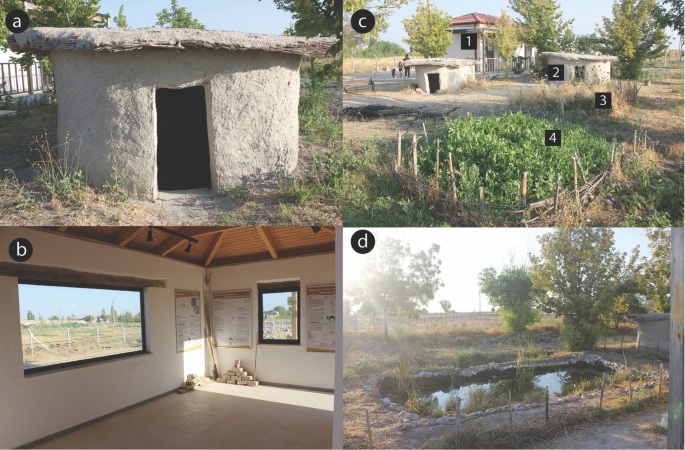
- Steve Chaddock, Andrew Fairbairn, Douglas Baird & Gökhan Mustafaoğlu (2026). Archaeobotanical storytelling in a landscape of the mind: community engagement and education at Neolithic Boncuklu Höyük, Türkiye. Vegetation History and Archaeobotany. DOI: 10.1007/s00334-026-01118-2. Published 4 June 2026. Abstract, introduction, interpretation, replica-house section, Figure 6 and licence read. Whole-site range c.9400–7500 BCE. Figure 6 depicts modern visitor facilities; AF photos, CC BY 4.0, not an excavated house. Return to the text ↑
- Adrian Cornelius Heinrich (2024). ghosts, Mesopotamia. Oxford Classical Dictionary. DOI: 10.1093/acrefore/9780199381135.013.9024. Published 20 November 2024. Publisher abstract only: ghosts, burial, netherworld and family care in historical Mesopotamia. A much later comparison, not proof of direct origins in Neolithic graves. Return to the text ↑
- Rob Wiseman, Michael J. Allen & Catriona Gibson (2021). The inverted dead of Britain’s Bronze Age barrows: a perspective from Conceptual Metaphor Theory. Antiquity 95(381), 720–734. DOI: 10.15184/aqy.2020.193. Abstract, introduction and chronology: British Bronze Age barrows, c.2400–1500 BCE. Spatial metaphor is a comparative tool, not a study proving Neolithic or Mesopotamian netherworld origins. Return to the text ↑
- Melissa S. Cradic (2018). Residential Burial and Social Memory in the Middle Bronze Age Levant. Near Eastern Archaeology 81(3), 191–201. DOI: 10.5615/neareastarch.81.3.0191. Publisher abstract only: Middle Bronze Age Megiddo, periodic reopening of some graves and domestic memory. A later comparison, not direct evidence for Aşıklı or Boncuklu beliefs. Return to the text ↑
Suggest a correction · Suggest a source for this record
Cite this record
IL Archive, «Living Above the Dead: Subfloor Burial Before Çatalhöyük», Edition 1, https://ilarchive.com/en/studies/living-above-the-dead
Continue reading