Study
Göbekli Tepe’s T-Shaped Pillars: Humans, Ancestors or Gods?
An extended study of a topic, with evidence and references.
Hands, dress, abstraction and the central pair: what do Göbekli Tepe’s pillars establish about human form, and what remains open about ancestors and gods? With Urfa Man and the 2025 Karahantepe announcement.
Share article
Dates
Dates have distinct roles. The timeline uses creation, composition or historical coverage, rather than publication or discovery dates.
- Historical coverage
- Approximately From 9600 BCE to 8200 BCE
Text
> Humans, ancestors or gods? Arms and hands strongly support an anthropomorphicAnthropomorphismRepresenting a thing or being with human features, such as arms, hands and dress. The term describes a form, without establishing an ordinary human or divine identity.Glossary · Click to read the explanation reading of some T-shaped pillars. They do not give the depicted beings names or settle whether they were people, ancestors or deities.
At the heart of some of humanity’s earliest monumental stone buildings stands a pair of pillars without faces, eyes or mouths, and without heads carved as we might expect in human statues. Yet some of these pillars have arms, hands and fingers, belts and indications of dress.
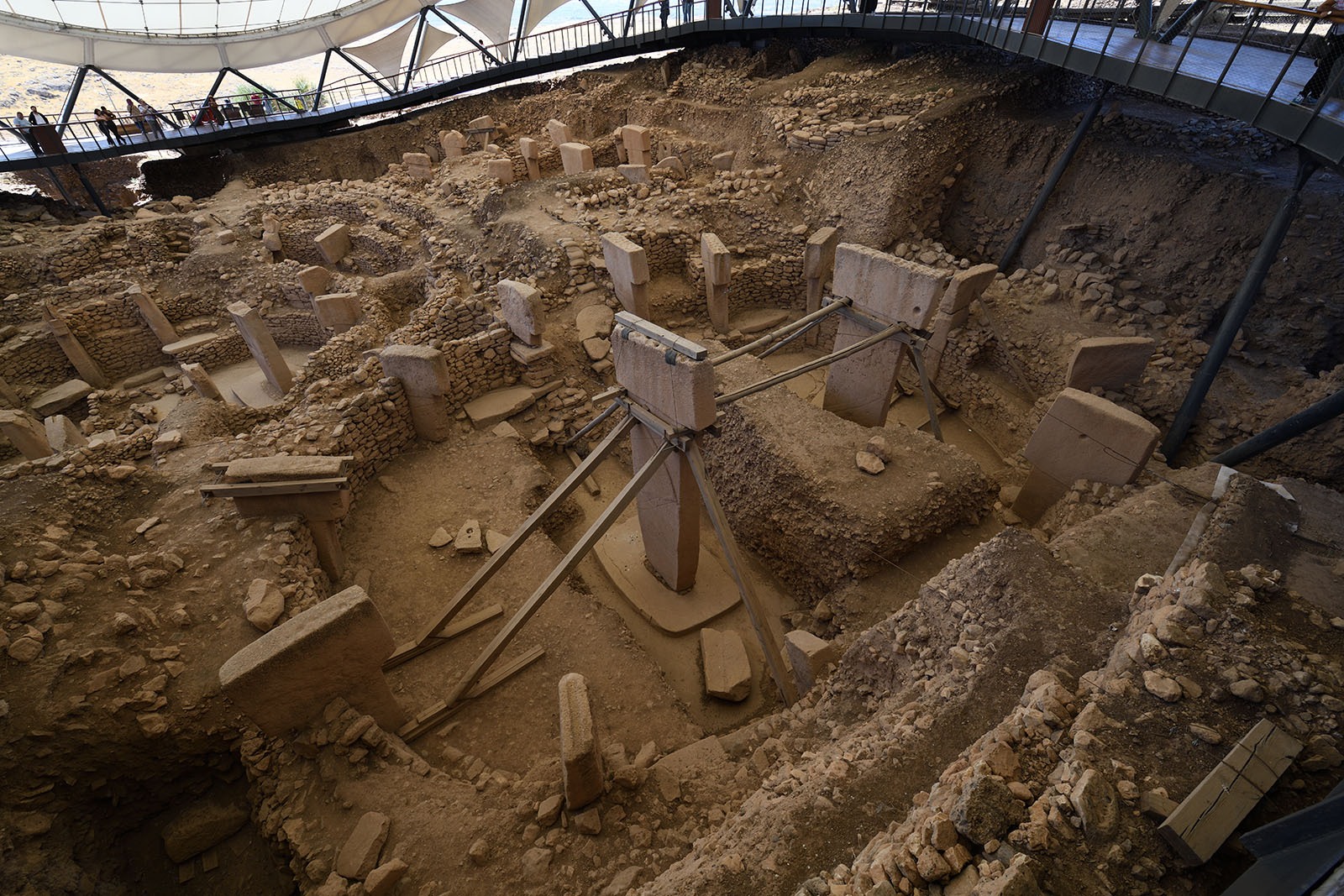
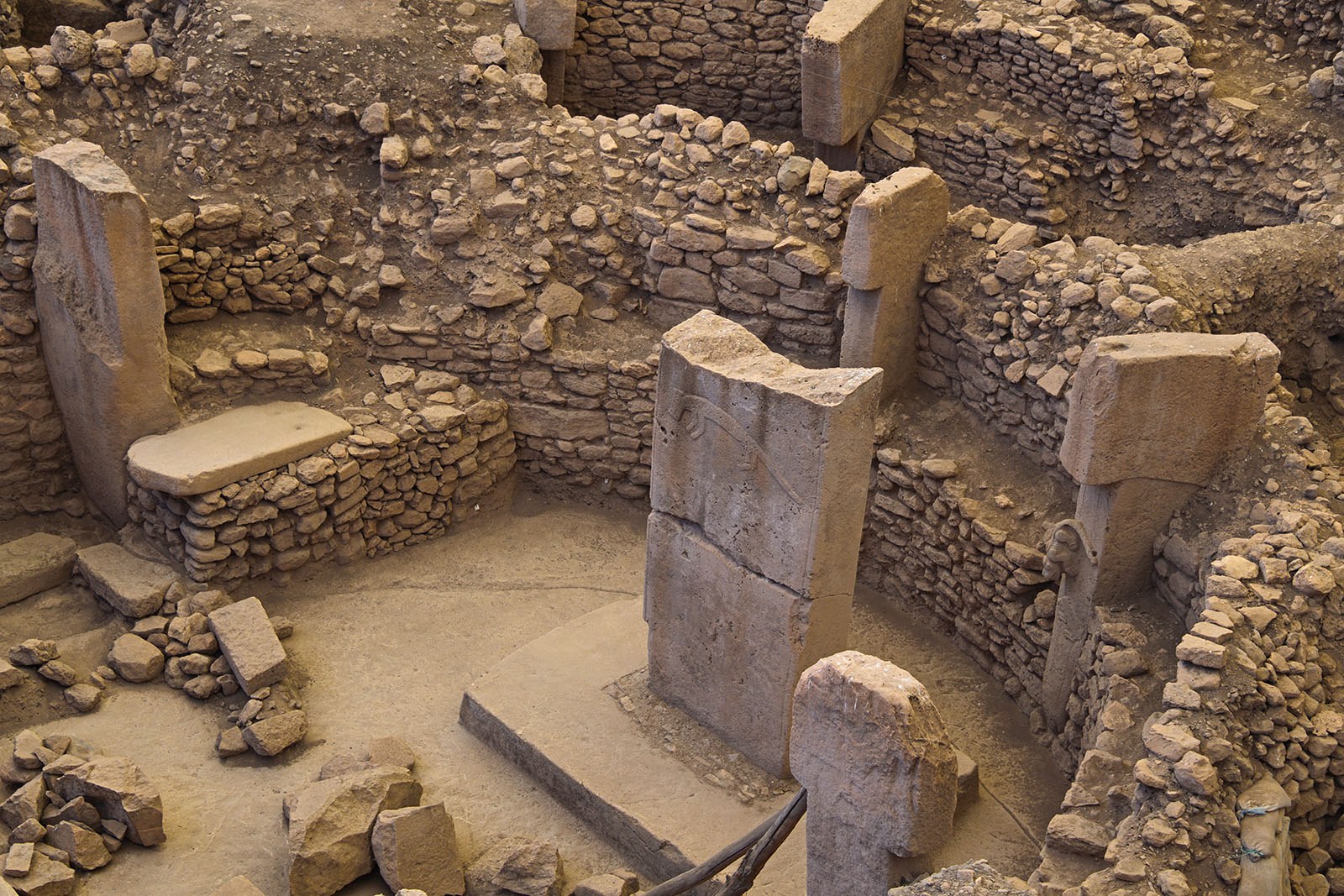
The central pillars of Building D reach about five and a half metres, surrounded by smaller pillars. This is Göbekli TepeGöbekli TepeA Neolithic site in southeastern Turkey, known for communal buildings and T-shaped pillars; the excavation team describes a settlement with a pronounced ritual component.Glossary · Click to read the explanation, near Şanlıurfa in southeastern TürkiyeTurkeyTurkey is a modern country including Anatolia and territory in southeastern EuropeGlossary · Click to read the explanation. UNESCO dates its major stone monuments approximately to 9600–8200 BCE, within the Pre-Pottery NeolithicPre-Pottery NeolithicA regional term for early Neolithic phases in Southwest Asia before the local spread of pottery; it does not imply an absence of settlement, architecture or cereal processing.Glossary · Click to read the explanation.[1]
Who do the pillars represent? People? Ancestors of exceptional standing? Superhuman beings? Gods whose names have not survived? No text answers these questions. But the stone helps distinguish what we can observe from what we imagine.
More than pillars
If the T-shaped pillars were standing stones without additional details, an anthropomorphic interpretation would be weaker. Several, however, bear features difficult to dismiss as arbitrary geometric decoration. The clearest examples are central pillars 18 and 31 in Building D.
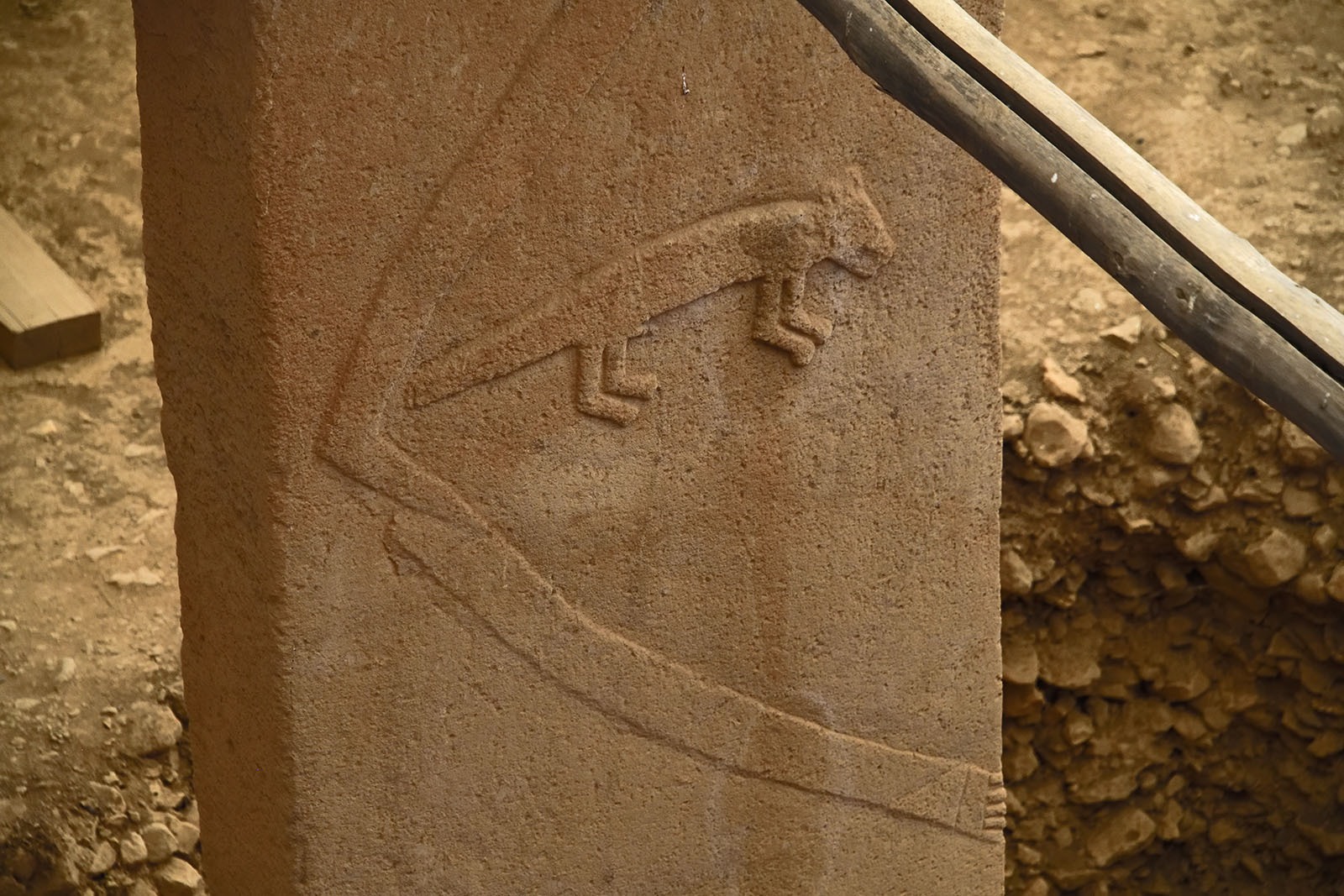
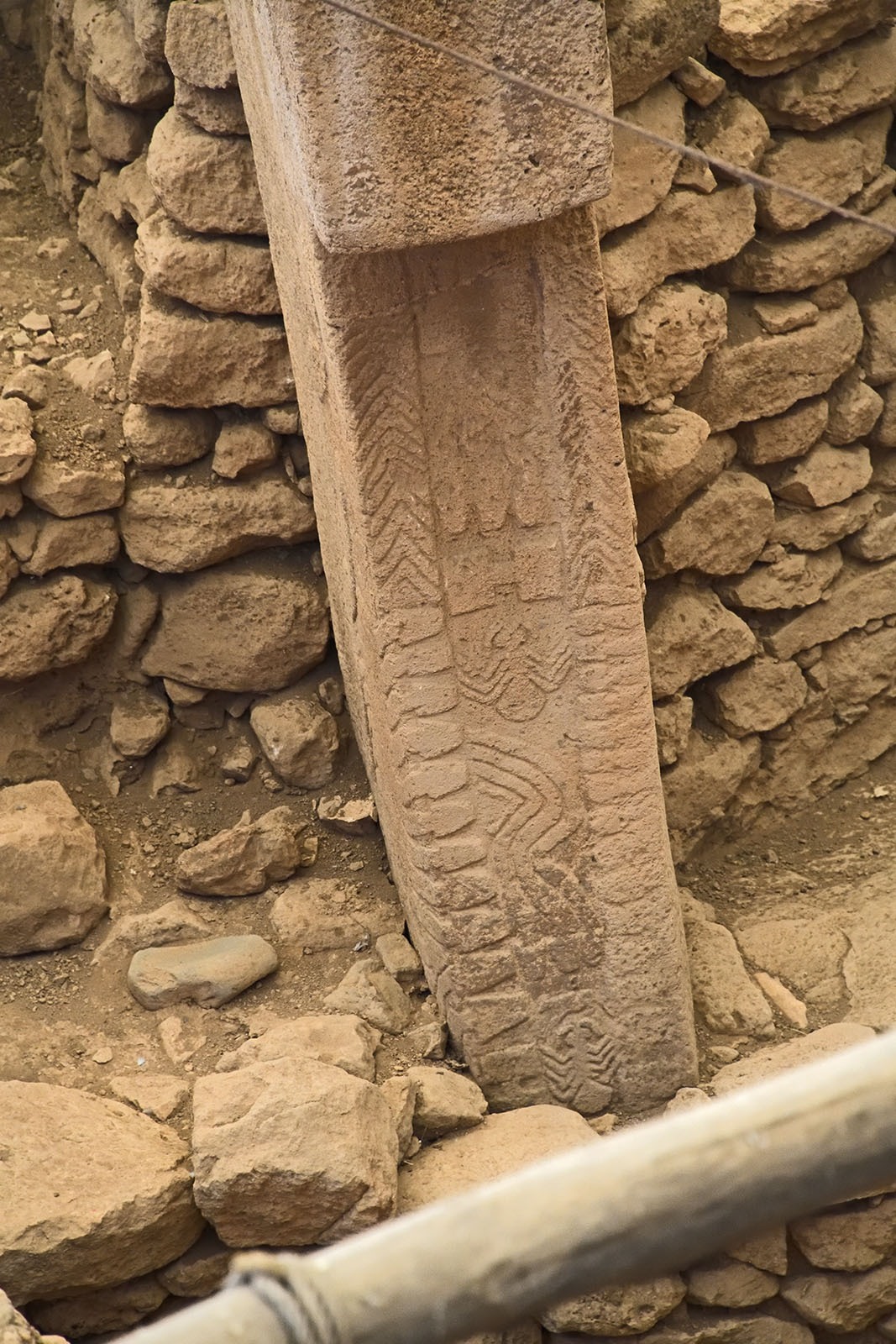
The broad horizontal top is generally interpreted as a head, the vertical shaft as a body. Arms extend down the sides and end in hands at the front. Belts and features interpreted as loincloths or hanging garments are also visible. Gil Haklay and Avi Gopher describe these elements explicitly in their study of architectural planning.[2]
This combination underpins an anthropomorphicAnthropomorphismRepresenting a thing or being with human features, such as arms, hands and dress. The term describes a form, without establishing an ordinary human or divine identity.Glossary · Click to read the explanation reading: bodily features and dress within an abbreviated form, rather than resemblance to the letter T alone.
A body without a face
If the horizontal element is a head, where is its face? Neither central pillar has represented eyes, a nose or a mouth. Yet abstraction goes further: there are no separate legs, nor a naturally detailed chest or neck. The carving preserves arms, hands and dress while recasting much of the body geometrically.
Researchers call these forms anthropomorphic because their human features are clear while the identity of what is represented remains unknown. The term does not establish an ordinary human identity, and it does not establish a divine one.
Urfa Man: a comparison that changes the question
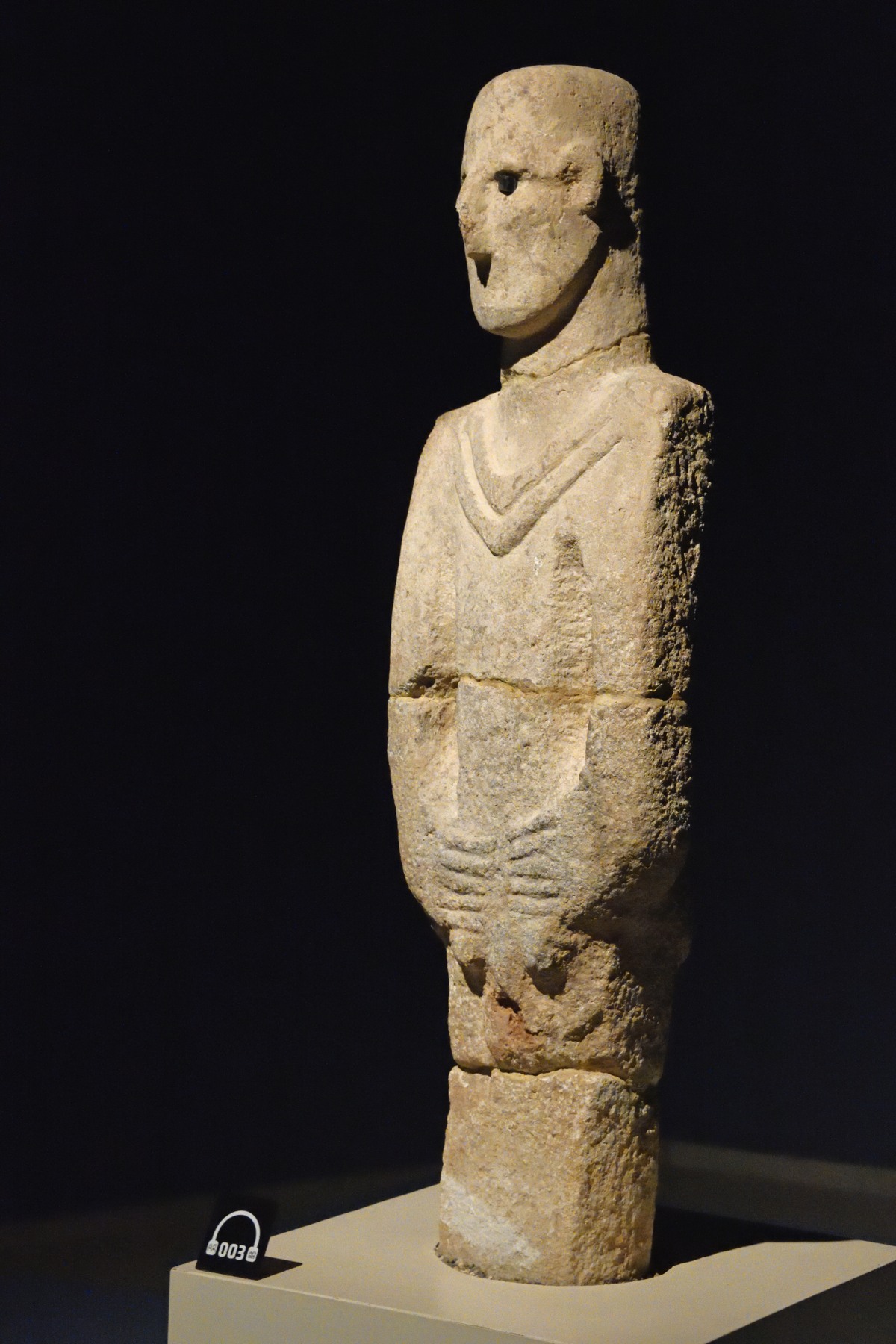
The statue known as Urfa ManUrfa ManA Neolithic human statue from Yeni Mahalle in Şanlıurfa, with a face and obsidian-inlaid eyes but no represented mouth. It was not found at Göbekli Tepe; its original function remains uncertain.Glossary · Click to read the explanation, or the Yeni Mahalle statue, was found during construction work in an area of a Neolithic site within Şanlıurfa itself. It was not found at Göbekli Tepe.
It has a face, nose and ears, with eyes inlaid with black obsidian, but no represented mouth. Nor does it have separate legs: the body ends in a conical extension allowing it to be set upright. The comparison is therefore between different degrees of abstraction, rather than a wholly naturalistic human and a wholly abstract pillar.[3]
Oliver Dietrich associates the Yeni Mahalle context with the Pre-Pottery Neolithic B. That places the statue within the regional Neolithic tradition, without proving it was made at exactly the same time as every Göbekli Tepe pillar.
The comparison demonstrates that the ability to represent facial features existed in the region. More naturalistic human sculptures from Göbekli Tepe itself also support interpreting abstraction as a meaningful stylistic choice.[3][4] They do not, by themselves, explain why it was chosen or establish a shared intention among all artists or communities.
Style does not determine a being’s identity
Why was this abstract form used? Abstraction might relate to the figures’ status, how they were perceived, the architectural element’s function or a shared artistic tradition. Each possibility requires its own evidence.
In a study published in 2025, Marc Verhoeven argues that arms, hands and dress make interpreting the pillars as humans or humanlike beings very likely. He calls them humanoids and examines relationships among images, architecture and animals within a broader interpretive model.[5]
A difference in representational style does not, however, establish a difference in the kind of being depicted. A community can portray the living, the dead and mythical figures in several ways. Visual difference is a starting point for analysis, not a ready answer.
What does the 2026 volume add?
On 15 January 2026, a specialist volume by Oliver Dietrich and Klaus Schmidt, with other contributors, appeared on imagery on the pillars of Buildings A–D, F and H. Its contents explicitly ask whether T-shaped pillars are anthropomorphic representations or image carriers given human attributes. Other chapter titles cover animistic and shamanistic interpretations, territoriality and ancestors.[6]
This reveals the range of questions addressed, not the chapters’ findings. We consulted the publisher’s description and contents; the publisher lists PDF availability for July 2027. We therefore do not attribute detailed conclusions to arguments we have not read.
A face on a T-shaped pillar at Karahantepe
On 6 October 2025, Türkiye’s Ministry of Culture and Tourism announced a T-shaped pillar with a human face at Karahantepe, within the Taş Tepeler project. Its upper section was described as having deep eye sockets and a prominent nose. The announcement presented it as the first example known at that time of a face carved directly on this type of pillar.[7]
This matters for regional comparison: the T-shaped form can bear a face. It does not identify Göbekli Tepe’s pillars or establish that pillars at different sites depicted the same characters. Detailed scientific publication of the find and its context remains essential for conclusions beyond the announcement’s description.
The central pair
Shape is one part of the evidence; position is another. Two large pillars occupy the centre of Building D, surrounded by pillars associated with walls and benches. The research team’s account gives the central pair a height of about 5.5 metres and an estimated weight of 8–10 tonnes each, with surrounding pillars reaching about four metres.[8]
Dietrich describes a hierarchy among the pillars: differences in size and placement, orientation towards the centre, and benches reinforcing an impression of a gathering around the larger pair.[9]
Size and centrality can be observed. A gathering of beings, or ranks among them, is a researcher’s reading of those observations. The visual impression does not establish a documented divine councilDivine councilA representation of divine beings acting as an assembly with authority and differentiated roles.Glossary · Click to read the explanation.
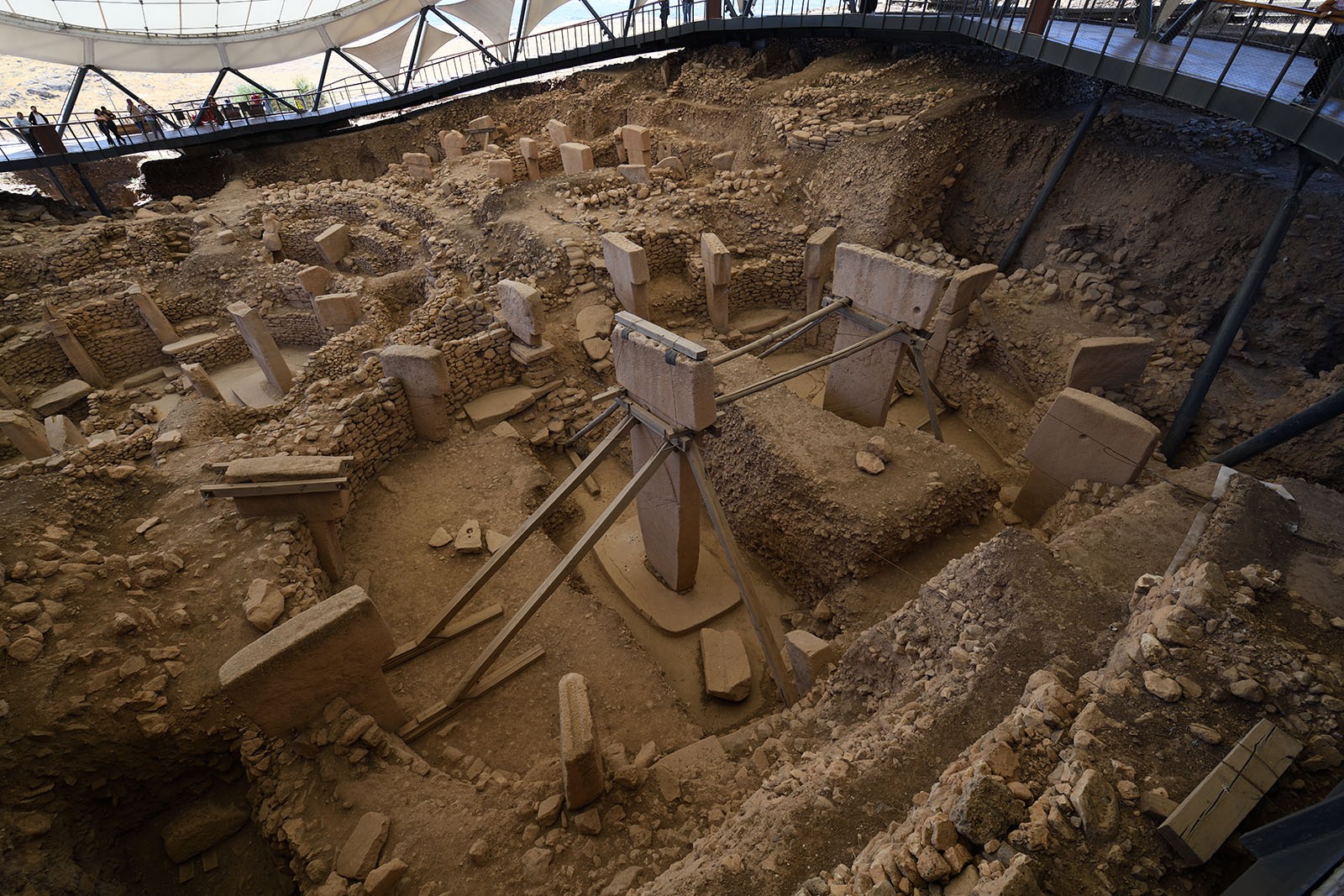
Does size mean authority?
Size and placement make the central pillars more prominent and lend interpretive weight to a special-status hypothesis. Visual prominence, however, is not identical to authority, much less divine authority.
The pair might represent high-status figures, ancestors, mythical beings, symbols of two communities or something outside our modern categories. These alternatives test the limits of interpretation; listing them does not imply that they have equal evidential support.
> We see a larger pair at the centre. The arrangement probably had a meaningful visual effect. It does not reveal the beings’ names or religious authority.
Why two? Architecture and symbolism
The central pair recurs in several major buildings, making its number worth investigating. Does it represent characters in a story, two communities or complementary figures? Might it also relate to architectural organization or support for a possible roof?
There is no final answer. The architectural study discusses the possibility of roofing, while the details of roof reconstruction remain under investigation.[2] We cannot declare the pair exclusively structural, or purely symbolic without a practical function.
An architectural element can carry social or ritualRitualAn organised or distinguished practice meaningful to a community; it may leave traces, but its form alone does not reveal an associated doctrine.Glossary · Click to read the explanation meaning. But the coexistence of function and imagery does not establish a sequence from an ordinary support to a god. That would require a dated history of construction, carving and reuse.
A god and a goddess?
The details of Building D’s central pair do not provide a documented identification as male and female. There is no writing, no surviving names and no demonstrated historical connection linking these figures to deities in later texts.
Calling them a god and a goddess is therefore unproven, as is assigning two specific divine identities or treating the pair as evidence of primordial monotheismMonotheismBelief in a single God as the only deity, rather than merely the highest among several gods.Glossary · Click to read the explanation. The number of pillars does not automatically equal the number of beings worshipped.
A divine interpretation remains open to discussion. The available archaeological record does not turn that possibility into a definitive object identification.
Ancestors: evidence and limits
An ancestral interpretation draws on more than the T-shape. Dietrich discusses smaller, more naturalistic human sculptures, numerous fragmented heads and fragments in building fills near pillars as possible evidence for special treatment of death and human imagery.[4]
This is an interpretation published in 2016. We do not import its older account of an uninhabited sanctuary or assume every fill was a deliberate ritual closure. We use its comparison of images and fragment contexts, while treating infilling processes and deposition dates as separate questions requiring investigation.
A study by Julia Gresky, Juliane Haelm and Lee Clare in 2017 provides more specific evidence: fragments of three human skulls bear intentional grooves, and one has a drilled hole. The researchers discuss special skull treatment, whose meaning might relate to ancestor veneration, display of enemies or another unresolved purpose.[10]
Skull treatment and identifying pillars as representations of those people are different propositions. No demonstrated individual link connects a particular skull and pillar. Ancestors remain a possibility, not a conclusion established simply by the presence of human remains.
Spirits, gods or categories we cannot recover?
The pillars might depict humanlike beings their makers did not regard as ordinary people. They might also depict people presented differently through memory, status or ritual context. Abstraction alone does not decide between these possibilities.
Some recent readings examine relationships among humans, animals and things within broader conceptions of beings and their relationships, rather than assuming fixed divisions between human, animal, spirit and deity.[5] This is an interpretive approach, not a preserved Neolithic creed.
Nor does every conception of a god necessarily require a written name, priests or a myth known to us. The absence of those sources does not disprove gods; it leaves the identification of these pillars as gods unresolved. Equally, their difference from other sculptures cannot prove they do not represent people.
Four levels of knowledge
Confirmed: Some pillars, especially pair 18 and 31 in Building D, bear arms, hands, belts and indications of dress. The pair is larger and centrally placed. These statements describe the objects and their arrangement.
Strongly probable: Together, these elements represent a humanlike form. The layout makes differentiation in status a strong and reasonable interpretation, without identifying the kind of status involved.
Possible: The figures relate to ancestors, mythical or superhuman beings, perhaps gods. These alternatives have different supporting arguments and need comparison rather than selection of the most dramatic label.
Unproven: Specific names, a god-and-goddess pair, a monotheistic doctrine or a direct connection to historical deities attested thousands of years later.
These levels do not diminish the pillars’ value. They locate its strength: an abbreviated body, human details, and differences in size, placement and style. Whether those differences indicate an ancestor, spirit, god or person of special standing remains open.
The pillars do not yet provide an established image of an identifiable god. They preserve an exceptionally early question expressed in stone, whose visible form has survived without the words that once gave it meaning.
Related reading: Göbekli Tepe: Temple or Social Centre? situates the pillars within settlement, architecture and feasting; Before We Knew the Names of Gods explains the limits of inferring religion before writing. Each can be read independently.
References and notes
- UNESCO World Heritage Centre. Göbekli Tepe, property 1572. Description: major stone monuments approximately 9600–8200 BCE; not one date for every pillar. Return to the text ↑
- Gil Haklay & Avi Gopher (2020). Geometry and Architectural Planning at Göbekli Tepe, Turkey. Cambridge Archaeological Journal 30(2), 343–357. DOI: 10.1017/S0959774319000660. Description of pillars 18 and 31, arms, hands and dress; building layout and possible roofing. The study does not establish divine identities. Return to the text ↑
- Oliver Dietrich (2016). The “Urfa Man”. Tepe Telegrams, German Archaeological Institute, 14 October. Yeni Mahalle findspot, facial features and obsidian-inlaid eyes; no represented mouth or separate legs; probable PPNB context. The “oldest” wording is not used as a global judgement. Return to the text ↑
- Oliver Dietrich (2016). Losing your head at Göbekli Tepe. Tepe Telegrams, German Archaeological Institute, 5 May. Comparison of abstract and naturalistic human images and fragmented heads; ancestral hypothesis. Its older settlement and backfill account is not generalized to current research. Return to the text ↑
- Marc Verhoeven (2025). Relationality, Immanence, Hierarchy: The Nature and Culture of Being(s) at Göbekli Tepe. Cambridge Archaeological Journal 35(3), 504–521. DOI: 10.1017/S0959774325000113. Anthropomorphic reading and relations among beings; a modern interpretive model, not a Neolithic text. Return to the text ↑
- Oliver Dietrich & Klaus Schmidt, with contributions (2026). Göbekli Tepe: The Imagery of the Pillars in the Monumental Buildings A–D, F and H. Archaeologica Euphratica. DOI: 10.34780/j669-7s9d. Publisher description and contents only; published 15 January 2026, PDF announced for July 2027. Full chapter arguments were not read and no detailed finding is inferred from their titles. Return to the text ↑
- Türkiye Ministry of Culture and Tourism (2025). Bakan Ersoy Duyurdu! Karahantepe’de İnsan Yüzlü T Biçimli Dikilitaş Bulundu. 6 October. Official announcement dated 6 October 2025; first face on a T-shaped pillar according to the announcement at that time. It does not replace detailed archaeological publication. Return to the text ↑
- Oliver Dietrich (2016). How did they do it? Making and moving monoliths at Göbekli Tepe. Tepe Telegrams, German Archaeological Institute, 3 May. Central pair in D: about 5.5 m and 8–10 tonnes each; perimeter about 4 m. Weights are estimates. Return to the text ↑
- Oliver Dietrich (2016). Göbekli Tepe in images. Tepe Telegrams, German Archaeological Institute, 2 November. Hands and dress, size, centre and orientation as grounds for the researcher’s visual hierarchy reading; not a documented divine council. Return to the text ↑
- Julia Gresky, Juliane Haelm & Lee Clare (2017). Modified human crania from Göbekli Tepe provide evidence for a new form of Neolithic skull cult. Science Advances 3(6), e1700564. DOI: 10.1126/sciadv.1700564. Three modified skulls, grooves and a perforation in one; researchers discuss ancestors or display of enemies. No demonstrated individual skull–pillar link. Return to the text ↑
Suggest a correction · Suggest a source for this record
Cite this record
IL Archive, «Göbekli Tepe’s T-Shaped Pillars: Humans, Ancestors or Gods?», Edition 1, https://ilarchive.com/en/studies/gobekli-tepe-t-pillars
Continue reading