Artifact
Urfa Man
An object record bringing together its image, metadata, rights, and context.
A limestone human figure with obsidian-inlaid eyes, found in 1993 near the Yeni Mahalle settlement in Şanlıurfa, not at Göbekli Tepe; its dating is indirect and hypotheses about its function remain unresolved.
Estimated reading time: 5 min Published Last reviewed:
Share article
Photograph
Photograph: Dick Osseman (Dosseman); square crop: IL Archive editorial team, via Wikimedia Commons. · CC BY-SA
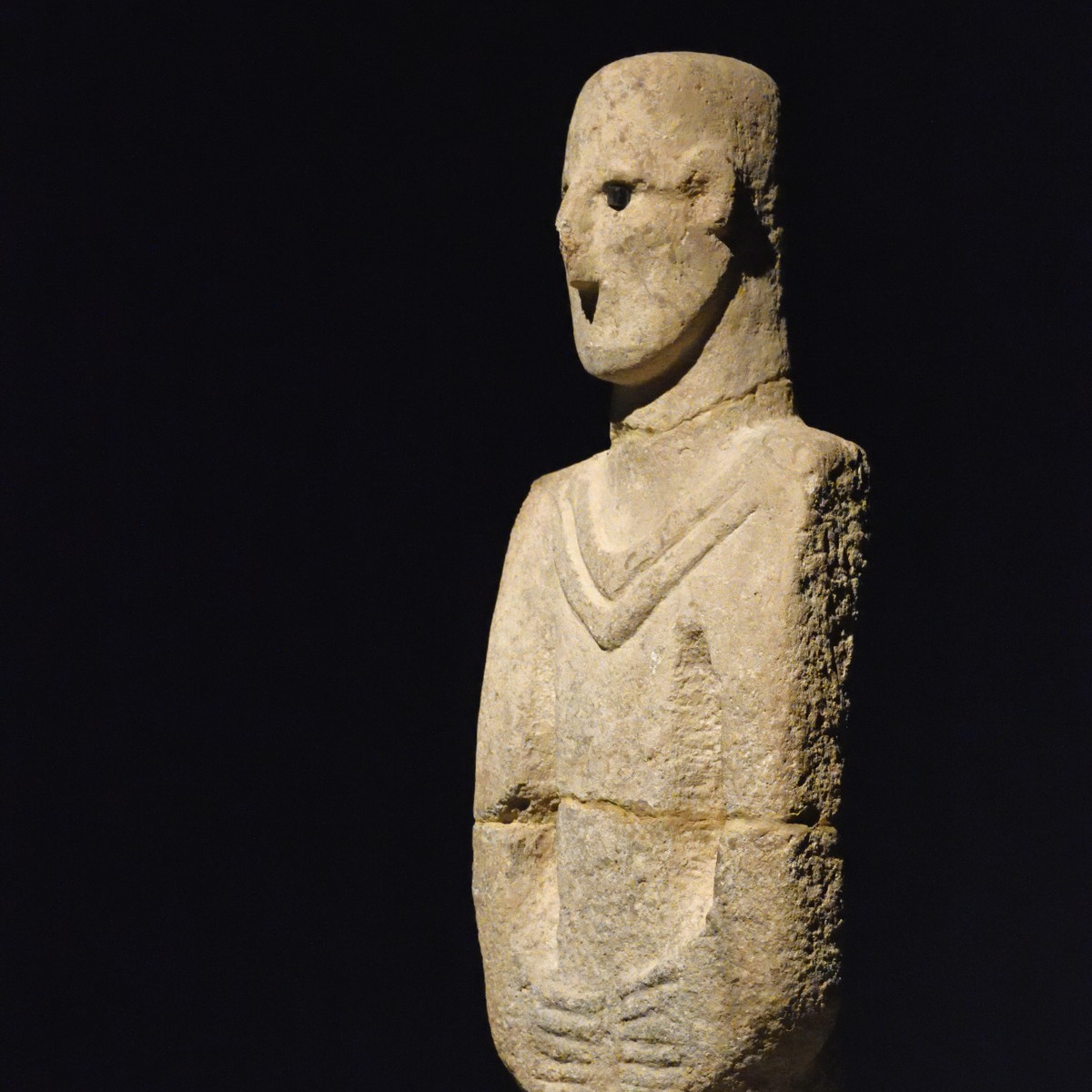
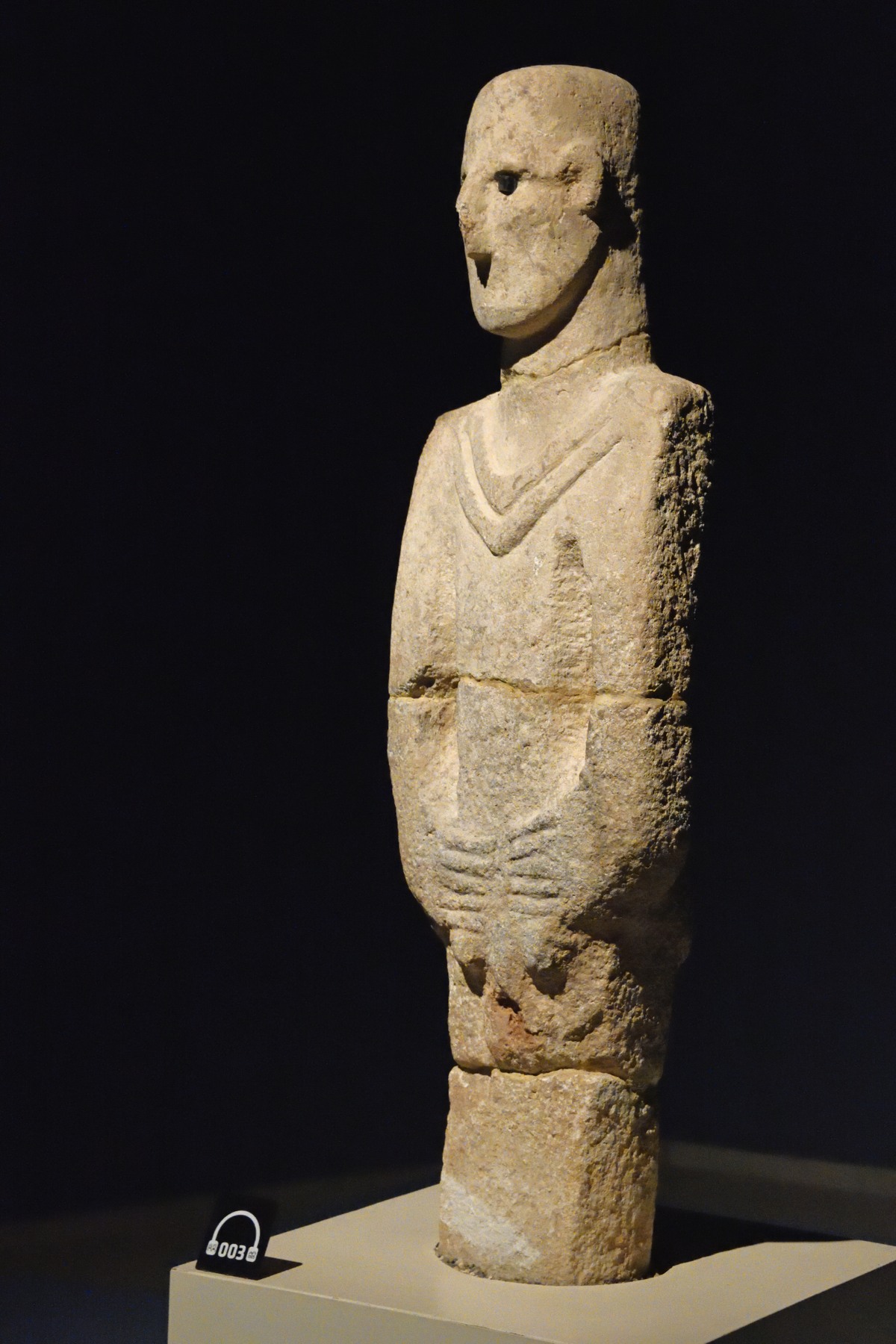
Cropped photographic detail of Urfa Man in the Şanlıurfa Archaeology Museum, showing the eyes, V-shaped feature and hands. A modern square crop of Dick Osseman’s 20 September 2019 photograph, not an image of the excavation site
License · Image source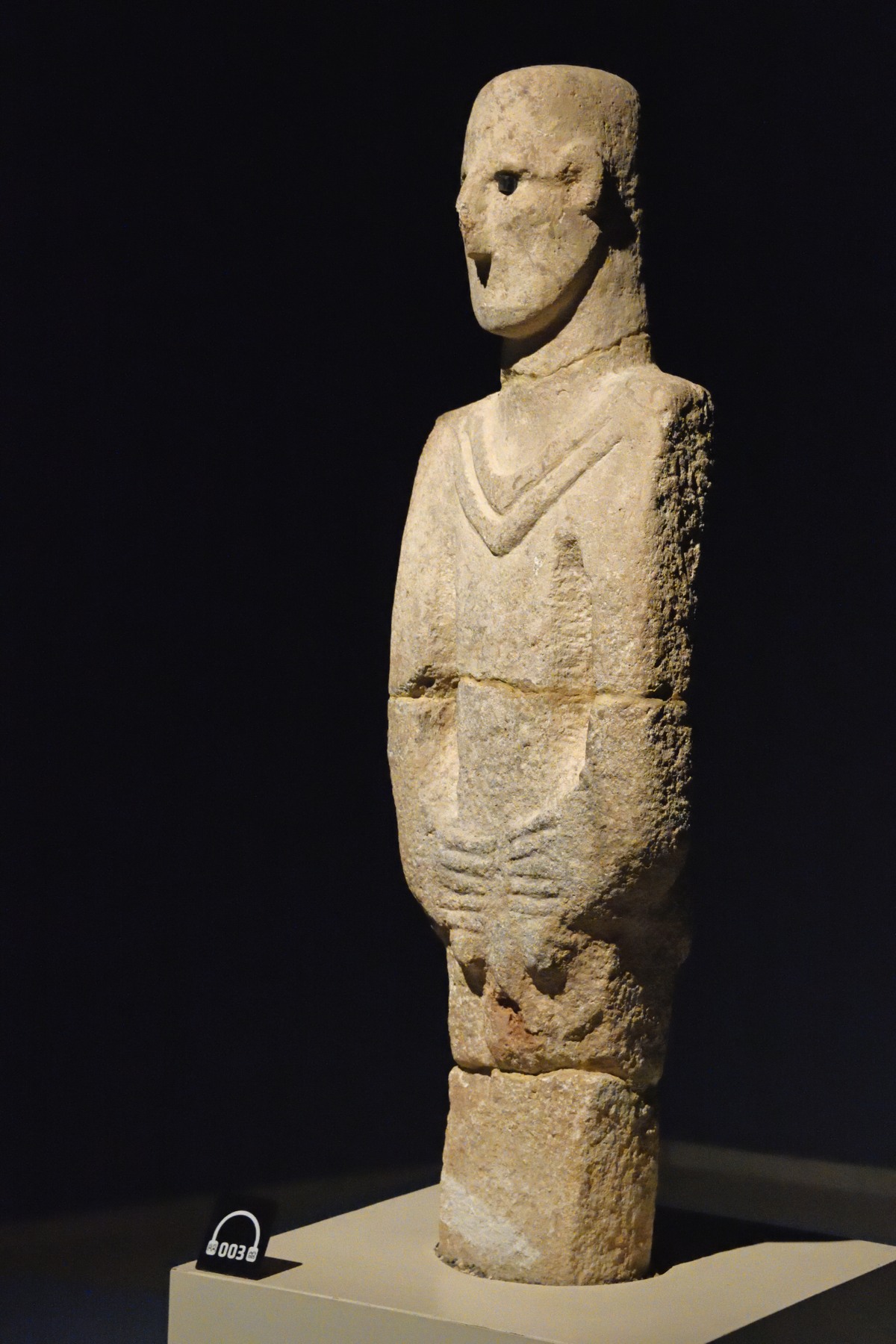
Photograph
Dosseman (Dick Osseman) · CC BY-SA
Urfa Man in the Şanlıurfa Archaeology Museum, photographed on 20 September 2019. The statue was found at Yeni Mahalle in Urfa, not Göbekli Tepe. Facial features, eyes and hands are visible; a mouth and separate legs are not represented
License · Image sourceObject details
- Title
- Urfa Man
- Rights
- CC BY-SA
Text
Introduction
How did a silent stone figure come to show a face, arms and a strikingly specific bodily gesture in a region also famous for abstract T-shaped pillars? The sculpture known today as Urfa Man, now displayed in the city's archaeology museum, invites a distinction between what is visible on the object, what is known about its discovery and what comparison with other Neolithic sculpture can actually establish.
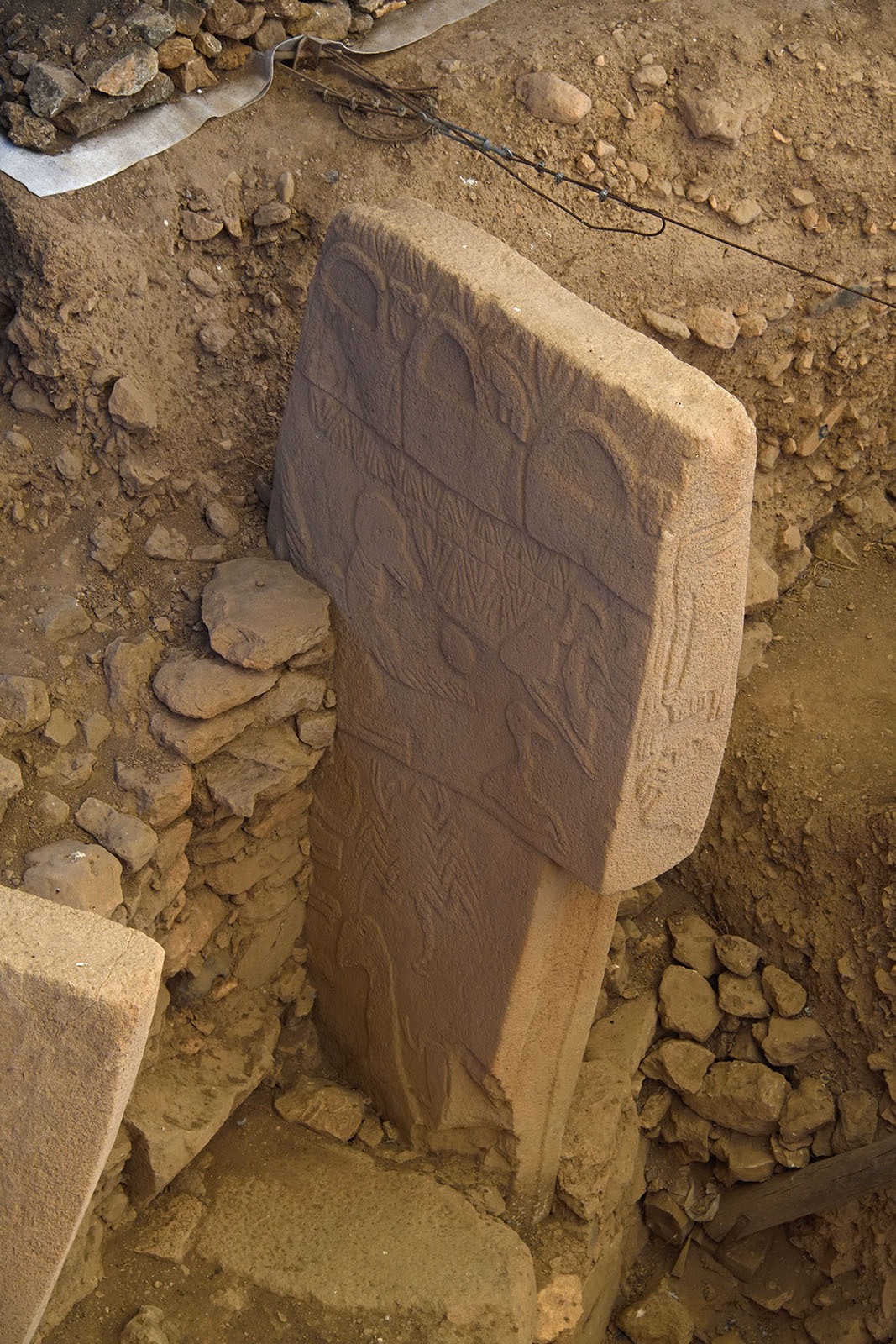
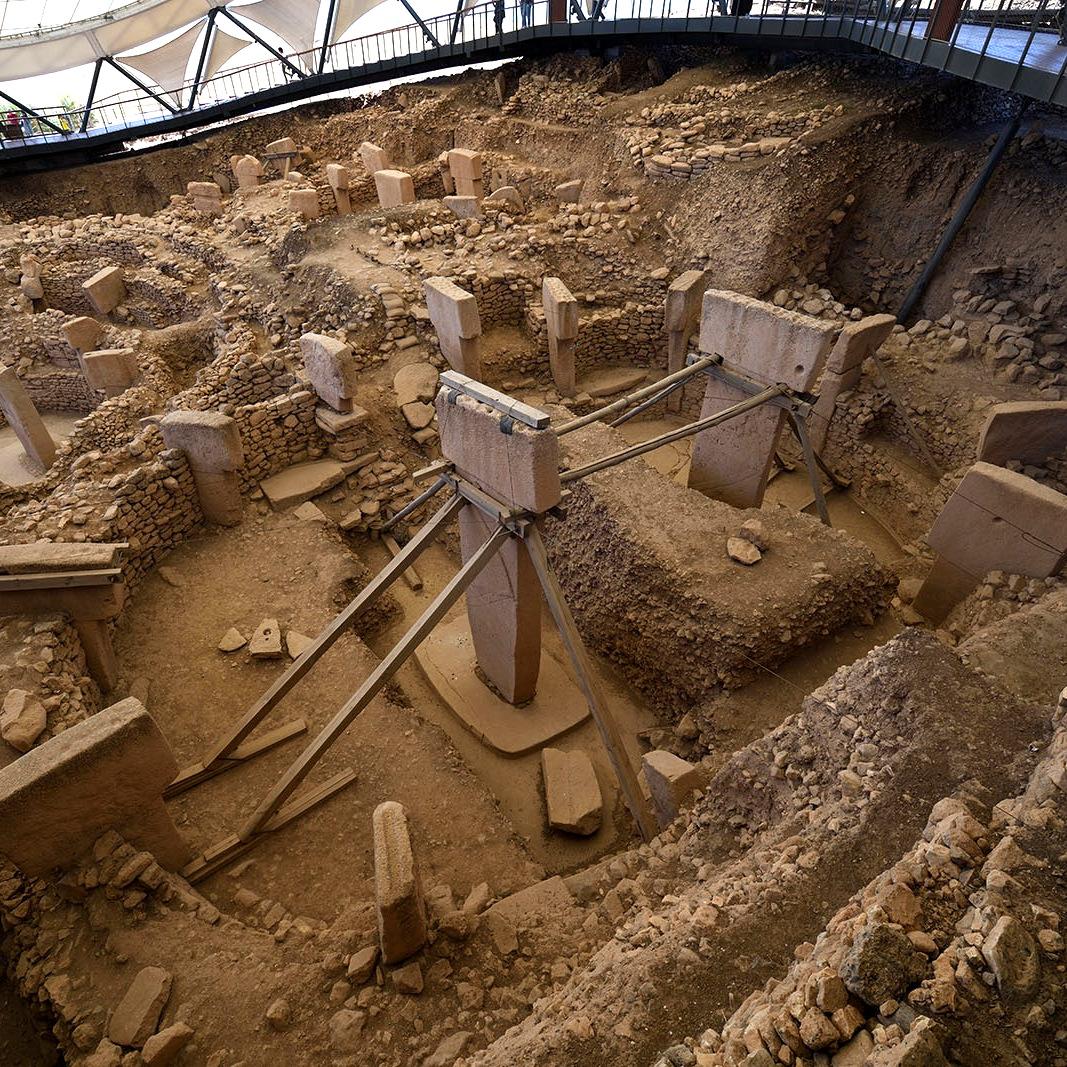
The essential geographical point is that the statue was found at Yeni MahalleYeni Mahalle (Neolithic Urfa settlement)Pre-Pottery Neolithic settlement in the Yeni Mahalle neighbourhood of Şanlıurfa, near Balıklıgöl. An archaeological section was investigated in 1997; Urfa Man had been found nearby in 1993. Settlement dates do not independently date the statue.Glossary · Click to read the explanation, within ŞanlıurfaŞanlıurfaA modern city in southeastern Turkey, near Göbekli Tepe, whose museum displays Urfa Man.Glossary · Click to read the explanation, not at Göbekli TepeGöbekli TepePre-Pottery Neolithic site near Şanlıurfa with T-shaped pillars and communal buildings. Evidence documents habitation and collective activities alongside a ritual component; the figures’ names are unknown.Glossary · Click to read the explanation. Whether it represents a particular person, an ancestor, a sacred being or an object used in ritualRitualAn organised or distinguished practice meaningful to a community; it may leave traces, but its form alone does not reveal an associated doctrine.Glossary · Click to read the explanation remains interpretation, rather than an identification inscribed on the stone.[1]
The modern name and the 1993 discovery
“Urfa Man” is a modern name, not one preserved in an ancient text. No accompanying writing explains the intended identity of the image. The statue was discovered during construction work in 1993 at Yeni Mahalle, near the Balıklıgöl area in Urfa's historic centre. Archaeologist Oliver DietrichOliver DietrichAn archaeologist on the Göbekli Tepe project since 2005, writing on its pillars, feasting and Urfa Man.Glossary · Click to read the explanation reports that it had broken into four roughly equal pieces, and that it was not recovered during a recorded stratigraphic excavation.[1][2]
The discovery must be distinguished from the archaeological work undertaken in 1997 on an exposed section of the nearby settlement. The first event brought the statue to light accidentally; the second recorded settlement deposits and associated material. Published discussions place the statue's findspot roughly one hundred metres from the excavated section. That is close geographically but still matters when assessing whether a layer can date this particular sculpture.[2][5]
Dating the settlement is not dating the statue
The excavated section yielded flint and obsidian tools, patches of polished terrazzo-type flooring and evidence of construction within a Pre-Pottery NeolithicPre-Pottery NeolithicA regional archaeological framework for early settlement, cultivation and animal management in Southwest Asia before the local spread of pottery vessels; its dates and trajectories vary and it implies no common religion.Glossary · Click to read the explanation settlement. The early excavation account discusses lithic indicators extending from the A phase into early B, while Dietrich considers other evidence, including a small T-shaped pillar visible in older records, to favour a B-phase setting. These are assessments of the wider archaeological context, not direct dating tests on the sculpture.[1][2]
In a later account, Bahattin Çelik reports radiocarbon results placing occupation at Yeni Mahalle approximately between 9400 and 8600 BCE. The published range concerns the settlement. We did not examine the original laboratory determinations or establish that dated samples were directly associated with the statue's installation. We therefore do not assign this range to the object's creation as though its age had been measured independently.[3]
The body visible in stone
The limestone figure is upright, with clearly shaped shoulders and arms along the torso. Its hands meet near a depicted male genital area. A nose and ears articulate the face, and deep eye sockets once held pieces of black obsidian that emphasized the eyes; there is no carved mouth. V-shaped incisions across the upper chest are often described as a necklace. That description is plausible, but the incisions alone cannot establish the material or purpose of the represented object.[1][4]
No separate legs were carved. Instead, the lower body ends in a stone projection that could have been secured in a base. Visible breaks and joining lines also reflect the statue's damaged condition and subsequent reassembly; they should not all be interpreted as intentional ancient details. The Turkish cultural-heritage portal gives a height of about 180 cm, whereas scholarly publications describe approximately 190–193 cm. Since the measurements differ, “approximately life-size” is more defensible here than a single supposedly exact dimension.[1][4][5]
Human bodies and T-shaped pillars
The comparison is often made with Göbekli TepeGöbekli TepePre-Pottery Neolithic site near Şanlıurfa with T-shaped pillars and communal buildings. Evidence documents habitation and collective activities alongside a ritual component; the figures’ names are unknown.Glossary · Click to read the explanation and its T-shaped monoliths. On some pillars, arms and hands are carved on the sides of a highly abbreviated body; they do not present a full face like Urfa Man. These shared and divergent features are worth comparing, but neither a similar hand gesture nor a different sculptural style establishes that every pillar depicts the same entity or that the statues and pillars served identical purposes.[1]
A 2018 study of a male figurineFigurineA small shaped object depicting a human, animal or abbreviated form, in clay, stone or another medium. Its form alone does not establish its use; manufacture, handling traces and find context matter.Glossary · Click to read the explanation from Harbetsuvan Tepesi adds regional evidence for variation in body modelling and genital imagery. Such parallels allow questions about shared visual conventions. They do not, without contextual evidence, prove direct transmission between workshops, common ownership or the same ritual use.[5]
Competing interpretations and a missing context
Dietrich suggests that the statue and traces of T-shaped pillars might point to a special building at Yeni Mahalle, possibly comparable to buildings known at Nevalı Çori. He explicitly calls the latter comparison speculation. Neither the statue's original position nor the activities conducted around it can be reconstructed securely from the surviving discovery record.[1]
The gesture at the groin has sometimes encouraged interpretations involving masculinity or fertility, including arguments made in comparative discussions of early regional figures.[5] But an anatomical feature does not by itself demonstrate a fertility cult, a system of male authority, or a single sexual meaning. A recent theoretical study challenges such automatic readings of phallic imagery at other sites in the Urfa region; it does not analyse Urfa Man directly, and its alternatives should not be presented as facts about this object.[6]
Other suggestions—an ancestral figure, an extraordinary being or an image intended for a communal space—remain questions that archaeologists might ask. None is established by an associated inscription, a documented installation or an undisturbed find context. The absence of such contextual evidence is not a minor detail: it is the main reason these explanations cannot presently be ranked with confidence.[1][2]
What the statue can and cannot tell us
Urfa Man demonstrates that early Neolithic communities of southeastern AnatoliaAnatoliaAnatolia is the region occupying the Asian part of present-day TurkeyGlossary · Click to read the explanation could produce emphatically human, detailed stone sculpture alongside more schematic monumental forms. The face, hands, worked torso and probable mounting element are physical evidence available for description and comparison. The exact year of manufacture, the identity represented, the original setting and any ceremonies attached to it are not securely known.
The object is therefore important as evidence for sculptural skill and visual diversity—not as direct proof of a named deity, a complete religious system or an unqualified world record for the earliest human sculpture. Keeping observation, contextual inference and speculation distinct makes the object more, not less, informative.
References and notes (6)
- Oliver Dietrich, “The ‘Urfa Man’,” The Tepe Telegrams (Göbekli Tepe research team), 14 October 2016. Full article, especially paragraphs 1–6; author’s 21 December 2016 reply concerning the single recorded pillar. Return to the text ↑
- Bahattin Çelik, “An Early Neolithic Settlement in the Center of Şanlıurfa, Turkey,” Neo-Lithics 2/3 (2000), 4–6. Printed pp. 4–6: the 1993 chance discovery, 1997 section, lithics and flooring, and the author’s interpretation. Return to the text ↑
- Bahattin Çelik, Arkeoloji’de Urfa, Şanlıurfa Provincial Directorate of Culture and Tourism, Istanbul, 2008, section “Urfa-Yeni Mahalle (Balıklıgöl Höyüğü).” Yeni Mahalle section, printed p. 15 (PDF page 43 counting from the cover); the author reports 9400–8600 BCE for the settlement. Original laboratory data and the entire book were not examined. Return to the text ↑
- Turkish Ministry of Culture and Tourism, Culture Portal, “Şanlıurfa Arkeoloji Müzesi,” section “Balıklıgöl Heykeli.” Museum-page paragraph about the statue: limestone, 180 cm figure, display and morphology; no unqualified “oldest” claim is adopted. Return to the text ↑
- Celal Uludağ, Bahattin Çelik and Kaya Tolon, “A Male Figurine from Harbetsuvan Tepesi,” Karadeniz International Scientific Journal 38 (2018), 19–25 (authors as printed in PDF). Article text pp. 19–23 and bibliography pp. 23–25; bodily parallels, findspot distance and dimensions. The publisher’s web metadata lists two authors, but the PDF identifies three. Return to the text ↑
- Emre Deniz Yurttaş, “A Queer Feminist Perspective on the Early Neolithic Urfa Region: The Ecstatic Agency of the Phallus,” Cambridge Archaeological Journal 35 (2025), 489–503, doi:10.1017/S0959774325000083. Abstract, introduction and early discussion on pp. 489–493 of the open-access PDF; examines imagery at other regional sites, not Urfa Man directly. Return to the text ↑
Archive records may be reviewed and refined as better evidence or sources become available. Suggest a correction
Suggest a correction · Suggest a source for this record
Cite this record
IL Archive, «Urfa Man», https://ilarchive.com/en/artifacts/urfa-man
Continue reading