Entity · Concept
Work feasting
A reference page linking a name, group, or concept to the materials that discuss it.
Work feasting is a model linking collective labour to shared food and hospitality. Used to explain the abundant grinding equipment at Göbekli Tepe, it remains a hypothesis, not a direct record of any particular feast.
Estimated reading time: 5 min Published Last reviewed:
Share article

Text
Introduction
How might feeding people who build or harvest together help mobilize labour and sustain social ties? “Work feasting” names one model of this relationship. It has been applied to Göbekli TepeGöbekli TepePre-Pottery Neolithic site near Şanlıurfa with T-shaped pillars and communal buildings. Evidence documents habitation and collective activities alongside a ritual component; the figures’ names are unknown.Glossary · Click to read the explanation, where extensive food-processing equipment occurs near monumental buildings. This entry distinguishes the objects and their study from an inferred meal, workforce and social occasion.
What is a work feast?
Not every shared meal is a feast, and a feast need not be religious. In the work-feasting model, hospitality and food accompany an undertaking that requires cooperation; participants may create reciprocal obligations, while a host may gain status or influence. Archaeologists propose this combination of provisioning and participation to interpret some past activities. It is an analytical model informed by comparison, not the builders’ own recorded term.[1][2][3]
Researchers also distinguish occasions that reinforce solidarity from those that display competition or inequality, and work feasts from funerary or celebratory meals. Calling an archaeological occurrence a “work feast” therefore requires evidence of unusually organised consumption and connected collective effort, rather than food or containers alone.[4]
Why Göbekli Tepe?
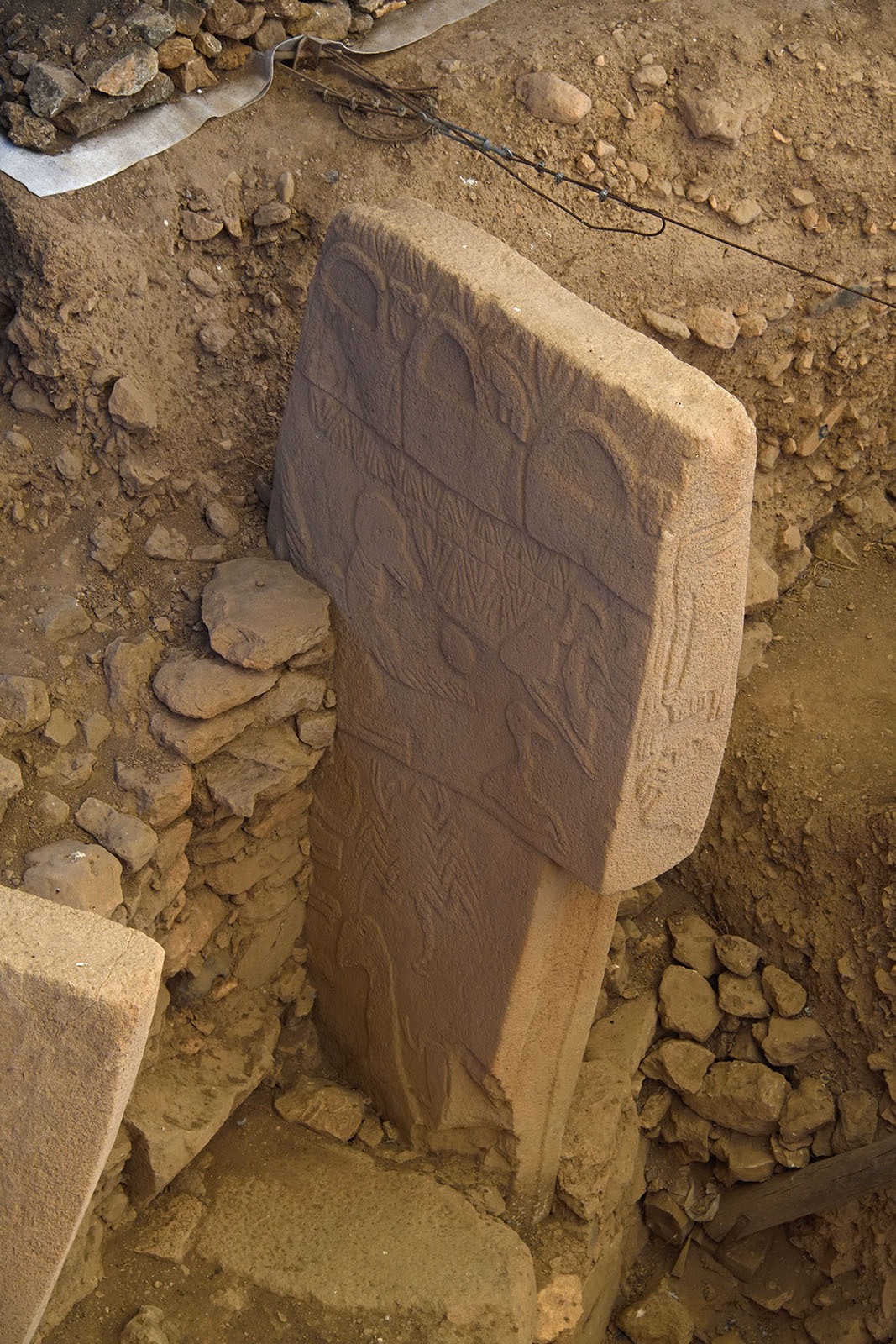
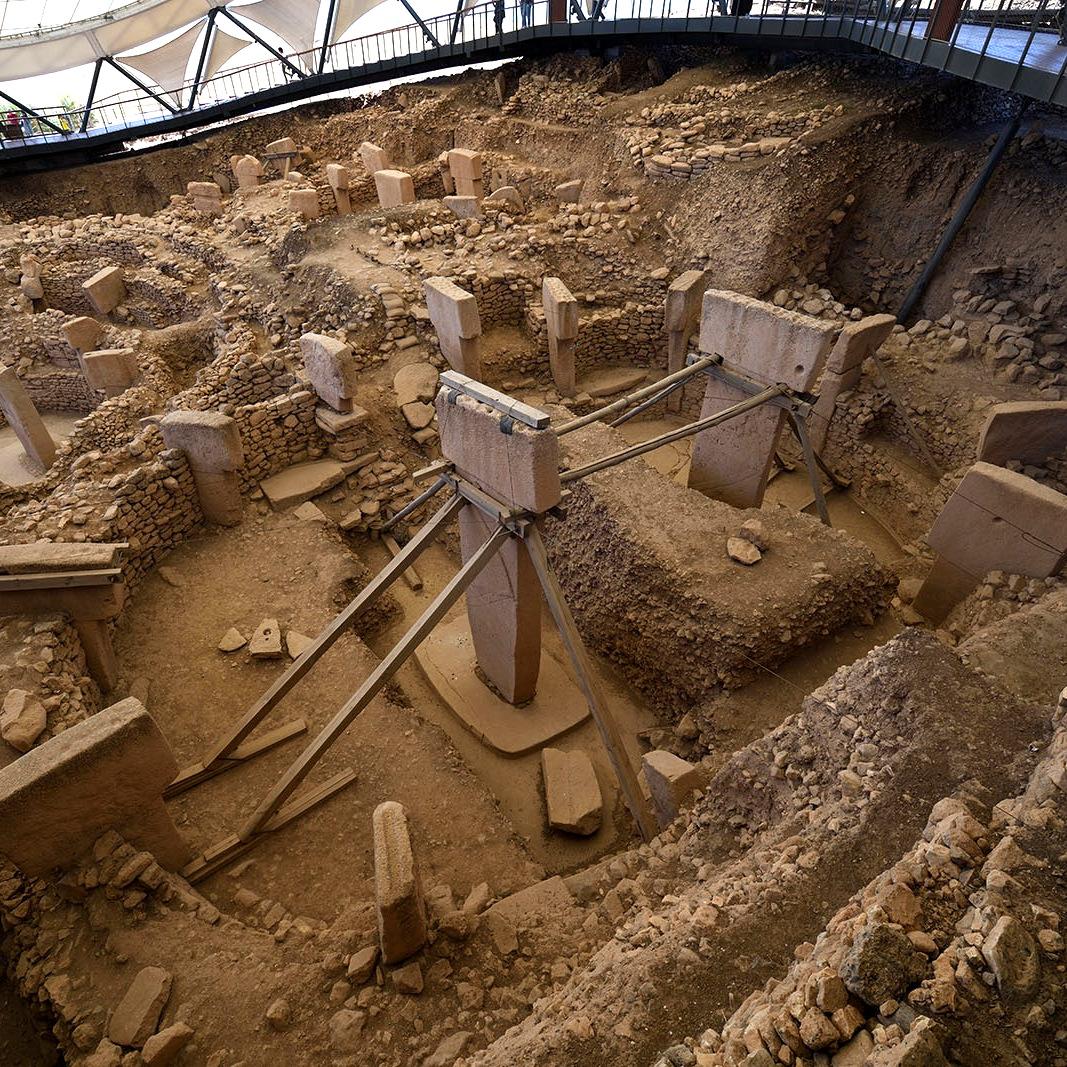
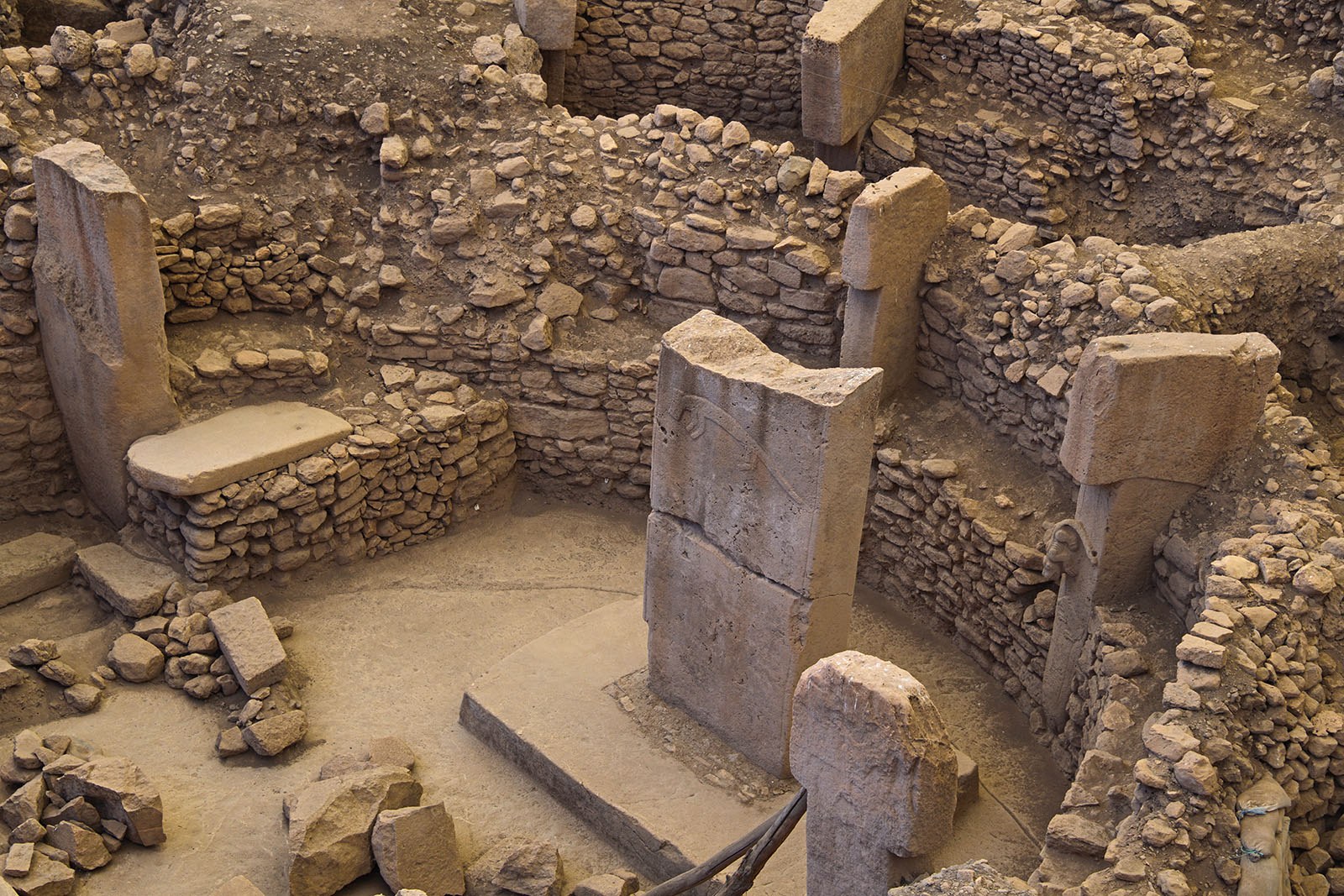
At this site in southeastern AnatoliaAnatoliaAnatolia is the region occupying the Asian part of present-day TurkeyGlossary · Click to read the explanation, people built circular or oval stone structures with T-shaped pillars alongside rectangular buildings, some overlapping in time and others later. Much of the best-known activity dates to the tenth and ninth millennia BCE, within the Pre-Pottery NeolithicPre-Pottery NeolithicA regional archaeological framework for early settlement, cultivation and animal management in Southwest Asia before the local spread of pottery vessels; its dates and trajectories vary and it implies no common religion.Glossary · Click to read the explanation. Archaeologist Klaus SchmidtKlaus SchmidtA German prehistorian who directed the Göbekli Tepe excavations from 1995 until his death on 20 July 2014.Glossary · Click to read the explanation suggested that constructing the monuments required the cooperation of large groups. In 2012 Oliver DietrichOliver DietrichAn archaeologist on the Göbekli Tepe project since 2005, writing on its pillars, feasting and Urfa Man.Glossary · Click to read the explanation and colleagues discussed gatherings and feasts in a ritualRitualAn organised or distinguished practice meaningful to a community; it may leave traces, but its form alone does not reveal an associated doctrine.Glossary · Click to read the explanation interpretation of the site. These are explanations of social organisation, not contemporary written accounts of ceremonies.[2][5]
Grinding equipment: what was processed?
In a freely accessible 2019 study, Laura Dietrich and colleagues examined more than seven thousand stone implements, including handstones, grinding bowls and pestles. They compared use-wear with modern grinding experiments and examined microscopic plant remains known as phytoliths. The results indicate that cereal processing was an important function of many of these tools. This is substantial evidence of repeated food-related work, but it does not reveal how many people shared a particular meal.[1]

A subsequent study of wear patterns found coarse-grinding traces, potentially associated with porridge-like foods, more common than traces of fine flour that might relate to bread-like products. Neither result preserves a recipe or proves that the food was made exclusively for workers.[6]
Where was food prepared?
Grinding equipment was recovered in rectangular buildings and open areas around larger structures. Many pieces, however, came from fills and upper layers rather than undisturbed occupation floors. The 2019 study explored possible activity on roofs or terraces and noted the difficulty of establishing which buildings were in use simultaneously. Spatial distribution thus supports possible reconstructions of activity, but does not provide a certain plan of a communal kitchen or dining hall.[1]
Seasons, labour and meals
Proponents connect the scale of some building projects with opportunities to collect and process food when resources were abundant. A study of gazelle remains and isotopes supports possible seasonal movements of these animals, allowing the hypothesis that hunting, construction and gatherings coincided. Seasonal overlap cannot by itself establish why people assembled or prove that meals were compensation for labour.[7]
The absence of identified large storage facilities in the investigated areas also led the 2019 authors to favour food prepared for relatively immediate consumption. That inference depends on excavation coverage and preservation; it does not demonstrate the absence of storage everywhere on the site.[1]
What about fermented drinks?
The 2012 paper proposed that a fermented drink made from wild crops may have accompanied gatherings, and mentioned stone vessels with several possible uses. The 2019 discussion also remains tentative on fermentation. These studies have not established a specific beverage at a particular occasion; the implements alone cannot confirm beer, an intoxication rite or a number of participants. Fermentation therefore remains a hypothesis within the feasting model, not direct testimony to an event.[2][1]
A competing reading: residence as well as gathering
In a 2023 review, archaeologist Edward B. Banning argued that abundant food-processing tools and domestic activity may also point to residents pursuing daily life at the site, rather than only intermittent ritual gatherings and feasts. He does not deny that feasts could have taken place; he challenges the exclusion of habitation whenever grinding, cooking or other domestic traces appear. Uses could have varied across periods, and assemblage size alone cannot settle the choice.[8]
A better-attested feast, but not a work feast
For comparison, the Hilazon TachtitHilazon TachtitA Late Natufian burial cave in Galilee, with an exceptional woman’s grave and deposits interpreted as funerary feasts.Glossary · Click to read the explanation cave belongs to the earlier NatufianNatufian cultureA Levantine archaeological culture, roughly 13,000–9500 BCE, marked at some sites by stone buildings, extended occupation, varied food tools and burials before domesticated farming; not a documented ethnic self-name.Glossary · Click to read the explanation period in the LevantThe LevantThe Levant is a regional name for lands along the eastern MediterraneanGlossary · Click to read the explanation. A 2010 study documented the butchery and consumption of at least three wild cattle and at least 71 tortoises in a burial context, interpreted as an exceptional funerary gathering. The evidence here more directly supports a mortuary feast, not a meal intended to mobilise a construction workforce.[9]
At Kfar HaHoresh in the southern Levant, a 2016 faunal study identified a notable preference for wild animals in a mortuary setting amid changing regional approaches to animal management. Food can thus have both economic and ritualRitualAn organised or distinguished practice meaningful to a community; it may leave traces, but its form alone does not reveal an associated doctrine.Glossary · Click to read the explanation roles, without bones revealing the rules of labour or reward.[10]
How can the model be tested?
The inference becomes stronger when independent indicators converge: the scale of food preparation relative to housing, the placement of implements, unusually dense consumption refuse, and comparable dates for construction and use. Katheryn Twiss proposed examining quantities, contexts and gathering places before identifying feasting. The strength of each clue varies with the site.[4]
It also helps to distinguish ritualizationRitualizationThe acquisition of special qualities by familiar practices or places; an analytical concept that need not separate ritual from everyday life.Glossary · Click to read the explanation, the marking of certain actions as special, from ordinary subsistence. Grain could be ground for a household, visitors or a work party, and purposes could overlap. Archaeologists recover residues of actions and their subsequent preservation, not participants’ statements of intent.[1]
What the evidence permits
Observed: abundant grain-processing implements, their wear and distribution, communal constructions, and animal and plant remains. Interpretation: provisioning may have helped coordinate some communal work and gatherings. Alternative: a substantial share of the same evidence may reflect residence and varied daily activities. “Work feasting” is a useful question about cooperation and food, not an ancient recorded ceremony or a direct demonstration of any particular belief.
References and notes (10)
- Laura Dietrich et al. (2019). Cereal processing at Early Neolithic Göbekli Tepe, southeastern Turkey. PLOS ONE 14(5), e0215214. Accessible full article: abstract, introduction, use-wear and phytolith methods, find contexts and discussion; Figs 6, 7 and 11. Not all supplementary tables or raw data were examined. Return to the text ↑
- Oliver Dietrich, Manfred Heun, Jens Notroff, Klaus Schmidt & Martin Zarnkow (2012). The role of cult and feasting in the emergence of Neolithic communities. New evidence from Göbekli Tepe, south-eastern Turkey. Antiquity 86(333), 674–695. Cambridge Core extract, bibliographic metadata and reference list only; full article not accessed. The fermented-drink claim is an interpretation in the extract, not a confirmed result. Return to the text ↑
- Michael Dietler and Brian Hayden, eds., Feasts: Archaeological and Ethnographic Perspectives on Food, Politics, and Power, University of Alabama Press, 2001. Publisher description and table of contents only; inaccessible chapters not read. Return to the text ↑
- Katheryn C. Twiss, “Transformations in an Early Agricultural Society: Feasting in the Southern Levantine Pre-Pottery Neolithic,” Journal of Anthropological Archaeology 27 (2008), 418–442. Publisher abstract and brief section previews only; complete article not read. Return to the text ↑
- German Archaeological Institute, “FAQ,” Tepe Telegrams project blog. Available sections on architecture, discoveries, dating and interpretive limits read; outbound resources not exhaustively followed. Return to the text ↑
- Laura Dietrich and Max Haibt, “Bread and Porridge at Early Neolithic Göbekli Tepe: A New Method to Recognize Products of Cereal Processing Using Quantitative Functional Analyses on Grinding Stones,” Journal of Archaeological Science: Reports 33 (2020), 102525. Publisher abstract, highlights and brief section previews; full paywalled article not read. Return to the text ↑
- Caroline Lang, Joris Peters, Nadja Pöllath, Klaus Schmidt and Gisela Grupe, “Gazelle Behaviour and Human Presence at Early Neolithic Göbekli Tepe, South-East Anatolia,” World Archaeology 45(3) (2013), 410–429. Indexed publisher abstract only; opening the full text was blocked. Seasonal inference treated as a possibility. Return to the text ↑
- Edward B. Banning, “Paradise Found or Common Sense Lost? Göbekli Tepe’s Last Decade as a Pre-Farming Cult Centre,” Open Archaeology 9 (2023), 20220317. Article abstract and indexed passages on habitation and grinding; publisher full text directly blocked, so not all sections inspected. Return to the text ↑
- Natalie D. Munro and Leore Grosman, “Early Evidence (ca. 12,000 B.P.) for Feasting at a Burial Cave in Israel,” PNAS 107 (2010), 15362–15366. Open abstract, Results and Discussion read for Hilazon Tachtit; minimum animal counts used; B.P. not converted to an exact BCE year. Return to the text ↑
- J. S. Meier, A. N. Goring-Morris and N. D. Munro, “Provisioning the Ritual Neolithic Site of Kfar HaHoresh, Israel at the Dawn of Animal Management,” PLOS ONE 11(11) (2016), e0166573. Open abstract, introduction, results overview and provisioning discussion read; raw supplements not reanalysed. Return to the text ↑
Suggest a correction · Suggest a source for this record
Cite this record
IL Archive, «Work feasting», https://ilarchive.com/en/entities/work-feasting
Continue reading