Site
Hilazon Tachtit
- Timeline
- From 10450 BCE to 10050 BCE
A Late Natufian burial cave in Galilee, with an exceptional woman’s grave and deposits interpreted as funerary feasts.
Estimated reading time: 3 min Published Last reviewed:
Share article
Text
Introduction
How can we study a funeral whose participants left no texts explaining it? Hilazon Tachtit Cave in Galilee preserves the exceptional burial of a woman, food remains and objects deposited with her. Its importance lies in distinguishing material traces of the funeral from interpretations of her position and the community’s beliefs.
Location and chronology
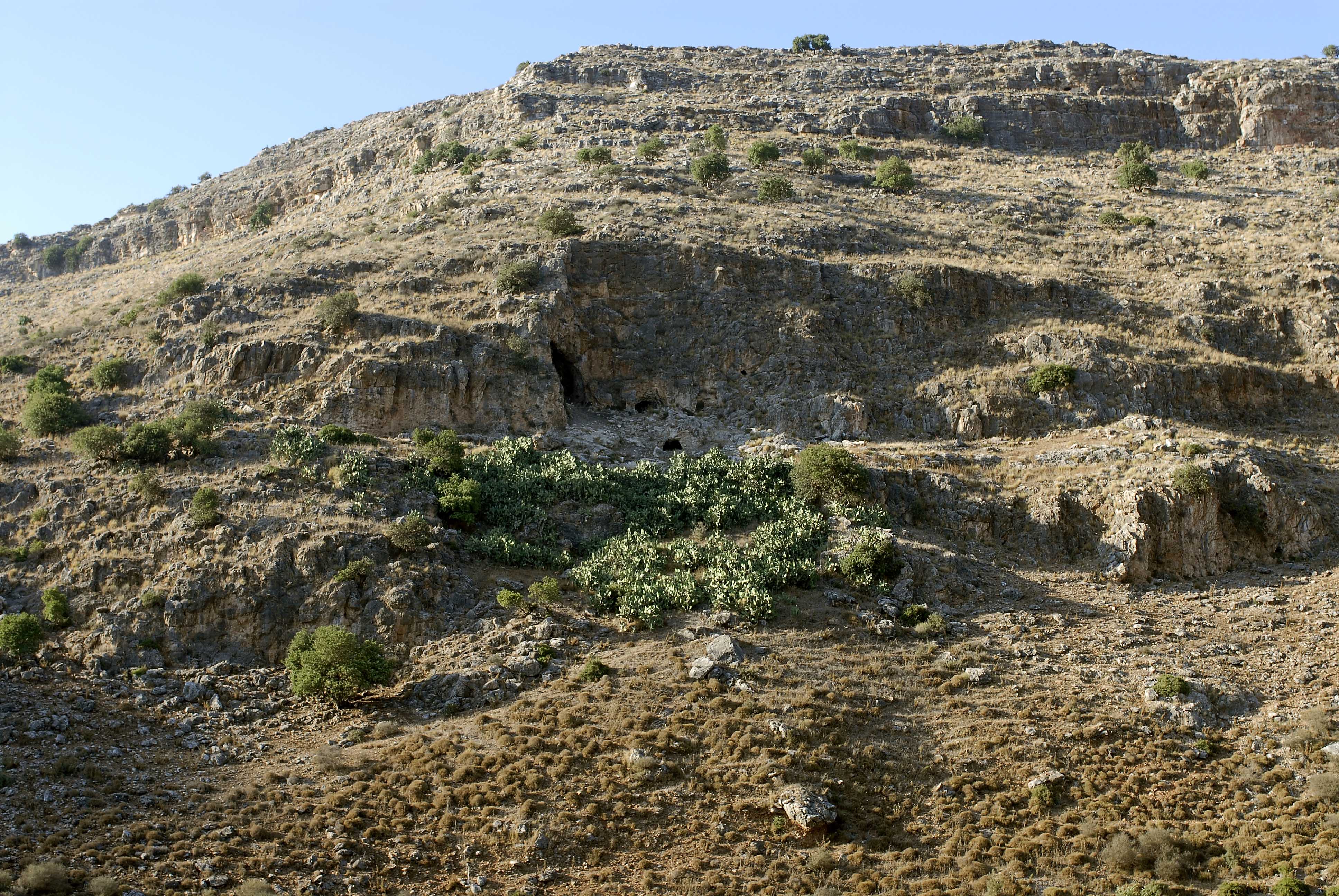
The cave stands above the Hilazon valley in western Galilee, in present-day northern Israel. A team directed by Leore Grosman excavated it between 1997 and 2008. It served as a burial place for at least 28 people of different ages, in two structures and collective pits.[3]
Its funerary use belongs to the later phase of Natufian cultureNatufian cultureA Levantine archaeological culture, roughly 13,000–9500 BCE, marked at some sites by stone buildings, extended occupation, varied food tools and burials before domesticated farming; not a documented ethnic self-name.Glossary · Click to read the explanation, a Levantine hunter-gatherer culture before economies based on domesticated crops and livestock became established. It dates to approximately 12,400–12,000 calibrated years before present, or about 10,450–10,050 BCE. “Before present” here counts from 1950; this is a range for the site’s use, not the date of the woman’s death.[1][2]
An exceptional grave, not a written identity
In Structure A, a woman estimated to have been about forty-five was placed in a carefully prepared grave. Finds included tortoise carapaces, selected parts of a wild boar, golden eagle, aurochs or wild cattle, leopard and two stone martens, and a human foot belonging to someone else. Her bones also displayed congenital and age-related changes.[1]
In 2008 Grosman, Natalie Munro and Anna Belfer-Cohen proposed that she had been a shaman: a ritualRitualAn organised or distinguished practice meaningful to a community; it may leave traces, but its form alone does not reveal an associated doctrine.Glossary · Click to read the explanation specialist compared with mediators between humans and the spirit world. The argument combines the grave’s arrangement, objects and special treatment with ethnographic comparisons. It remains an interpretation: the authors themselves acknowledge that no standard archaeological criteria identify a shaman. Physical difference alone cannot establish occupation or belief.[1]
Why do tortoise counts differ?
A count needs its publication date, counting unit and depositional context. The 2008 paper’s main text reports more than fifty shells; the 2010 study identifies a minimum of 71 tortoises in Structure A and thirteen in B. In the 2016 analysis of the burial layer and layers immediately above it, 6,376 identifiable remains represented at least 86 tortoises.[1][2][4]
Fragments are therefore not animals, and a minimum number inferred from bones is not a count of complete shells displayed in place. These figures should not be added as extra animals, nor should their differences be attributed solely to different structures.
Food as part of the funeral
Munro and Grosman interpreted the density and processing traces of tortoise and wild-cattle remains, together with their funerary setting, as evidence for communal feasts. This includes fractures opening the tortoises, signs that some were roasted, and cattle bones processed for meat and marrow.[2]
The 2016 study also reconstructed six stages of grave preparation, deposition of objects and the body, filling and closure. These are an analytical sequence of actions, not six separately documented religious ceremonies with known names. Some labor and cooperation can be reconstructed; spoken words, emotions and prayers are not preserved in these finds.[4]
A broken bowl and the limits of interpretation
In 2019 Laure Dubreuil and colleagues studied a basalt vessel fragment. Wear and residue analysis suggested mixing ash or lime with liquid, probably water, followed by intentional breakage and deposition before the body, without evidence of subsequent use. The context supports a funerary interpretation of the breakage; its precise symbolic purpose remains unknown.[5]
Hilazon Tachtit shows what the arrangement and treatment of objects can reveal, beyond their unusual appearance. It is important evidence for burial practices and gatherings around the dead, while the participants’ beliefs and the woman’s precise social identity remain open to interpretation.
References and notes (5)
- Leore Grosman, Natalie D. Munro and Anna Belfer-Cohen, “A 12,000-year-old Shaman burial from the southern Levant (Israel),” PNAS 105(46), 2008, pp. 17665–17669. DOI: 10.1073/pnas.0806030105. Scientific main text from introduction through discussion in the author-uploaded ResearchGate copy; chronology p. 17665, grave and finds pp. 17666–17667, limits of shaman identification p. 17668. Abstract: 50 shells; main text: over 50. Return to the text ↑
- Natalie D. Munro and Leore Grosman, “Early evidence (ca. 12,000 B.P.) for feasting at a burial cave in Israel,” PNAS 107(35), 2010, pp. 15362–15366. DOI: 10.1073/pnas.1001809107. Abstract and selected background, results and discussion passages in the author-uploaded ResearchGate copy, pp. 15362–15365; p. 15363: 5,505 tortoise specimens in A represent at least 71 individuals, and 600 in B represent 13. Processing traces pp. 15363–15364. Not a full reading of the article. Return to the text ↑
- Institute of Archaeology, Hebrew University, “Hilazon Tachtit Cave,” excavation project overview. Complete site overview; opening two paragraphs for location, excavation seasons and burials. The overview’s “near 90” is not treated as the same counting unit as detailed studies. Return to the text ↑
- Leore Grosman and Natalie D. Munro, “A Natufian Ritual Event,” Current Anthropology 57(3), 2016, pp. 311–331. DOI: 10.1086/686563. Abstract and selected author-copy passages: stages p. 314 and fig. 2, tortoise assemblage pp. 318–319, reconstruction passage and limits on sensory experience; Deborah Olszewski’s comment on stages as an analytical device. Article and supplement not read in full. Return to the text ↑
- Laure Dubreuil, Ahiad Ovadia, Ruth Shahack-Gross and Leore Grosman, “Evidence of ritual breakage of a ground stone tool at the Late Natufian site of Hilazon Tachtit cave (12,000 years ago),” PLOS ONE 14(10), 2019, e0223370. DOI: 10.1371/journal.pone.0223370. Complete scientific main text from abstract through discussion and captions to figs. 1–4, excluding supplement; especially use-wear/residue analysis, tool life history and discussion. Object M13c-377; no particular symbolic purpose or hallucinogen use established. Return to the text ↑
Suggest a correction · Suggest a source for this record
Cite this record
IL Archive, «Hilazon Tachtit», https://ilarchive.com/en/sites/hilazon-tachtit
Continue reading