Period
Natufian culture
- Names
- Natufian culture
- Timeline
- From 13000 BCE to 9500 BCE
- Region
- The Levant, especially Palestine, Jordan and the area around Lake Tiberias / southern Levant
A late Epipalaeolithic culture of the Levant (roughly 13,000–9500 BCE), linked among some foraging groups with stone architecture and repeated burials before domesticated farming; it varies from site to site.
Estimated reading time: 6 min Published Last reviewed:
Share article
Text
Introduction
How did some communities move from hunting, gathering and moving between resources toward prolonged occupation of places before farming with domesticated crops emerged? The Natufian culture, known through buildings, tools, food remains and graves rather than written texts, helps us examine that transformation without assuming that all Natufian groups shared one way of life or a single religion.
This account compares evidence from Shuqba, Eynan, Shubayqa 1 and Raqefet CaveRaqefet CaveA Mount Carmel cave with a multigenerational Natufian cemetery. Plant impressions in four graves support a flowering-plant lining, whereas the proposed brewing function of three mortars remains contested.Glossary · Click to read the explanation, distinguishing the material discoveries from interpretations of settlement, subsistence and burial practices.
A name and a chronology, not a known ethnic identity
“Natufian” is an archaeologists’ name for a related set of material practices in the late Epipalaeolithic LevantThe LevantThe Levant is a regional name for lands along the eastern MediterraneanGlossary · Click to read the explanation. It derives from Wadi Natuf near Shuqba Cave, west of Ramallah in Palestine, where Dorothy Garrod excavated in 1928; she subsequently identified comparable assemblages on Mount Carmel. We do not know what the people who made these objects called themselves or what languages they spoke. An archaeological classification cannot by itself establish a single ethnic people.[3]
The Natufian is broadly placed around 15,000–11,500 calibrated years before present, approximately 13,000–9500 BCE, with boundaries differing across regions and chronological schemes. Calibrated years before present (cal BPCalibrated years before present (cal BP)cal BP denotes calibrated calendar years before the fixed reference year 1950, not raw ¹⁴C BP measurements; calibrated intervals depend on the curve, sample and probability model.Glossary · Click to read the explanation) are counted from the conventionally fixed reference year CE 1950: 14,600 cal BP is not 14,600 BCE. Archaeologists distinguish early and late, sometimes also final, phases, whose boundaries can overlap between sites.[1]
How are Natufian sites identified?
Natufian flint assemblages contain small crescent-shaped inserts called lunates. Differences in how their backs were retouched may help distinguish certain phases. Worked bone, grinding and pounding stones, and ornaments made from shells, bone or stone also occur. No single tool is sufficient to assign an archaeological site: typology must be evaluated alongside stratigraphy, radiocarbon dates, architecture, and preserved plant and animal remains.[1]
This matters especially when a site is called the “first” village or an “earliest” permanent settlement. Some sequences are interrupted; some radiocarbon ranges are broader than the lifespan of a particular building; and successive occupations may leave intermingled material.
Geography and ecology: Shubayqa beyond the traditional core
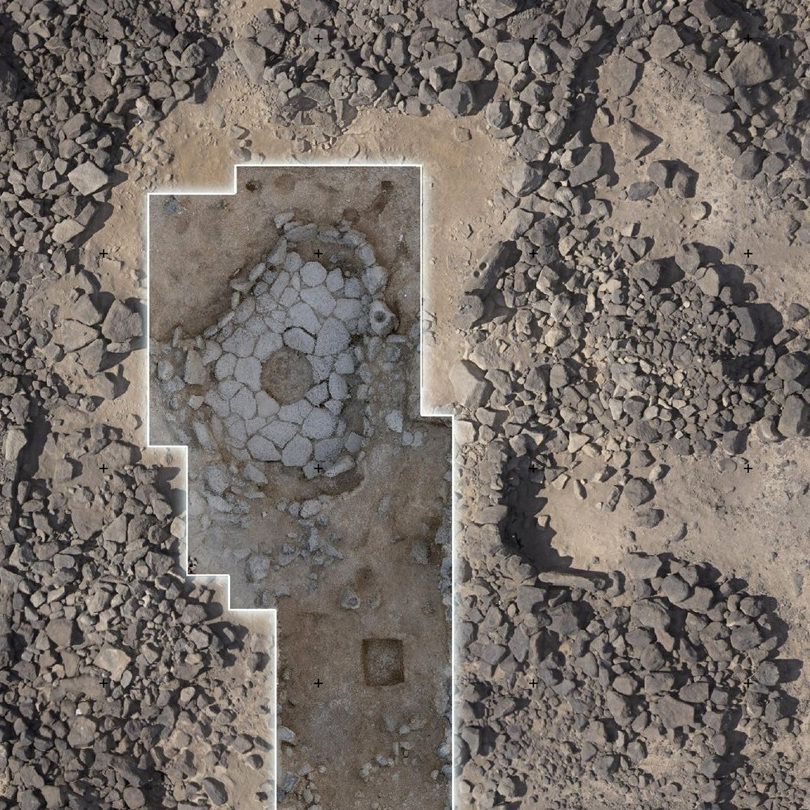
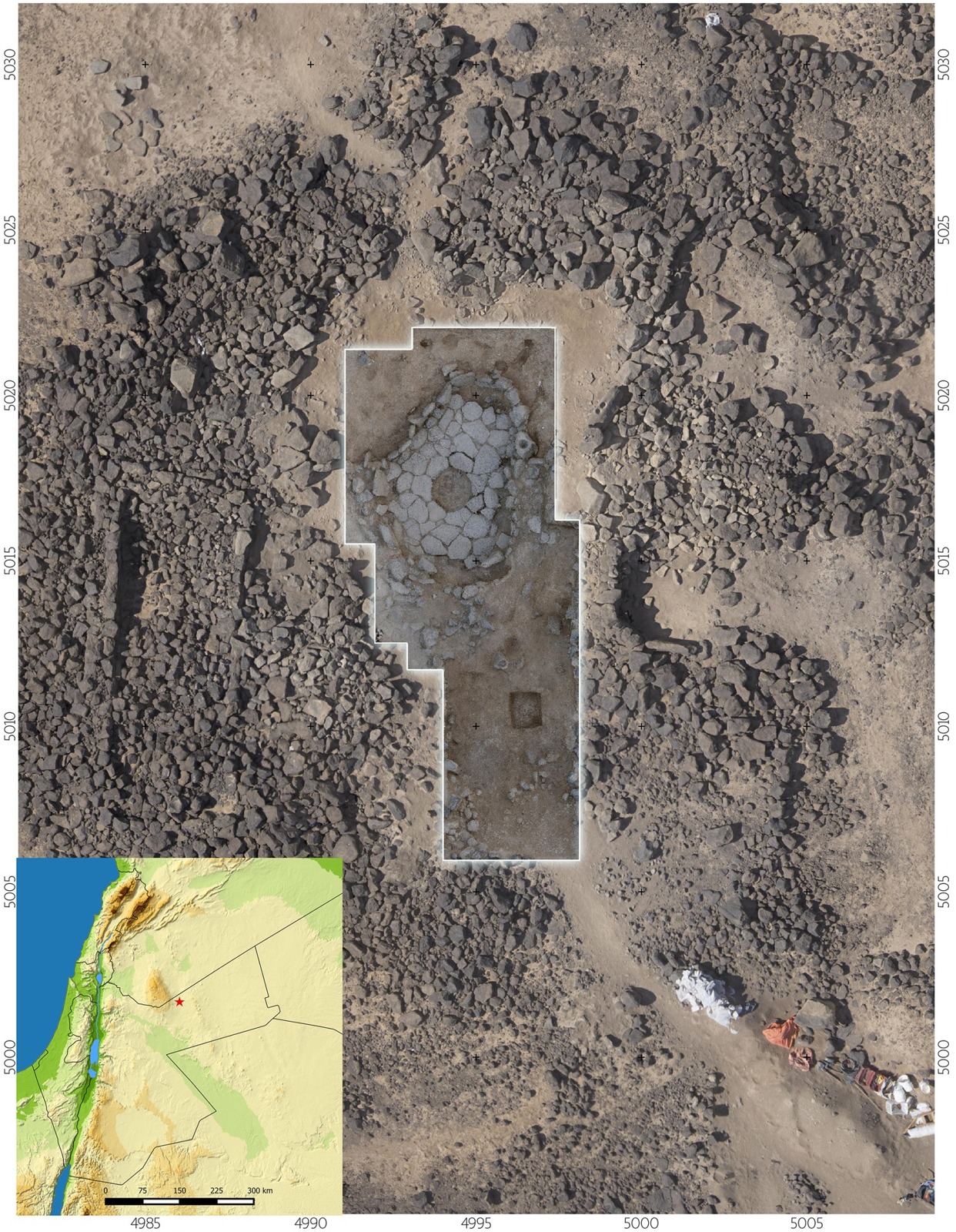
Many initially recognized sites lay in wooded Mediterranean uplands, valleys and coastal areas. Yet Natufian settlement was not confined to that ecological zone. At Shubayqa 1 in northeastern JordanJordan, the modern countryModern Levantine country independent as a kingdom in 1946, whose present territory includes Dhiban and ancient Moabite sites.Glossary · Click to read the explanation, excavators found stone structures and evidence of wetland plants and waterfowl beside a basin that retained substantially more water in the late Pleistocene than its present desert appearance would suggest.[1]
A series of 27 accelerator mass spectrometry radiocarbon measurements provided a detailed local chronology. The researchers’ model allows an initial occupation as early as approximately 14,600 cal BP within its wider probability range, followed by a gap of roughly nine centuries, another Natufian occupation, and a second interruption before a later return. These are dates for discontinuous episodes at one site, not the beginning of the entire Natufian culture or proof of an uninterrupted year-round village.[1]
Buildings, residence and competing reconstructions
At Eynan (Ain Mallaha) in the Hula Valley, excavations exposed curving, partly sunken stone-built structures and burial areas associated with different occupation phases. The publisher’s description of a chapter by François Valla and colleagues places Eynan among the significant examples of settlement before farming, but only that chapter’s publisher summary was available here. An independently accessible field study shows why particular reconstructions remain open to reassessment: the geometry of Shelter 131/51 and the stratigraphic attribution of its postholes have been reinterpreted, while its lost roof remains hypothetical.[2][4]
Nahal Ein Gev II, near the Sea of Galilee, provides another perspective. Researchers used substantial stone architecture, accumulated deposits and faunal evidence to argue for intensive or near-permanent occupation in a late Natufian community. A place used over centuries, however, is not automatically one where the same people stayed all year; residence is inferred from converging lines of evidence, not wall shapes alone.[7]
Food and technology before domesticated agriculture
Natufian groups hunted and collected varied animal and plant foods, in combinations that differed between sites. The evidence includes gazelle and bird hunting, smaller prey, grinding, pounding and harvesting tools. Such activities show processing or gathering, but do not by themselves establish planted fields or domesticated wheat. Indeed, the Shubayqa research cautions against assuming that wild cereal exploitation dominated every Natufian food economy.[1][7]
At Shubayqa 1 researchers studied 24 charred food fragments and identified them as likely remains of flat, bread-like products made from wild plants, including cereals and starchy underground storage organs. Their analysis places this kind of food preparation thousands of years before agriculture. It neither recovers an exact recipe nor establishes that bread was an everyday staple for all Natufian groups.[5]
Cereal cutting and milling techniques did not begin abruptly with the Natufian. Evidence from Ohalo II on the Sea of Galilee dates relevant practices to around 23,000 years ago. What becomes especially visible at some Natufian sites is the scale and combination of investments in place, equipment and food resources, not the invention of each technique from nothing.[8]
Burials and ornaments: social acts, not religious scriptures
Repeated burials took place near living spaces or within caves; some contexts preserve ornaments, particular arrangements of bodies and prepared graves. At Raqefet CaveRaqefet CaveA Mount Carmel cave with a multigenerational Natufian cemetery. Plant impressions in four graves support a flowering-plant lining, whereas the proposed brewing function of three mortars remains contested.Glossary · Click to read the explanation on Mount Carmel, excavators identified plant-stem impressions and phytoliths in four graves dating between approximately 13,700 and 11,700 cal BP. They interpret the associated evidence as deliberate lining of graves with flowering plants, with some botanical identifications supported by stem morphology and local plant distributions.[6]
These material traces strongly suggest care for the dead and sometimes repeated funerary gatherings. They do not preserve prayers, the names of gods, or a specific doctrine of the afterlife. Calling an unusual building a “temple” or a person a “priest” merely because of later analogies would require additional evidence.
Climate and the passage toward the Neolithic
Parts of the late Natufian overlap the Younger Dryas, a cooling interval conventionally dated to roughly 12,900–11,700 cal BP. Models have linked shifts in mobility and subsistence to climatic stresses, but the extent of drying was not uniform across the Levant. The findings from Nahal Ein Gev II challenge the idea of a general return to nomadism among all late Natufian communities: major residential investment continued in the Jordan Valley during this interval.[7]
Some Natufian practices in architecture, food processing and mortuary life preceded features of the region’s Pre-Pottery NeolithicPre-Pottery NeolithicA regional archaeological framework for early settlement, cultivation and animal management in Southwest Asia before the local spread of pottery vessels; its dates and trajectories vary and it implies no common religion.Glossary · Click to read the explanation communities. The shift from foraging to cultivation and domestication was neither an instantaneous event nor an identical sequence in every valley. New excavations and radiocarbon samples continue to refine the proposed trajectories.[7][8]
What can the evidence support?
“Natufian” identifies a multi-site archaeological pattern, not a state, a named religion or the proven single origin of all later farming villages. Stone construction, elaborate equipment, burial places and diverse food preparation among pre-agricultural communities are strongly documented. Year-round permanence, the share of cereals in diets, the use of particular buildings and the meanings of funerary acts remain site-specific research questions.
Shubayqa, Eynan and Raqefet matter because they reveal distinct local routes toward a stronger attachment to place, not one continuous biography of humanity before agriculture.
References and notes (8)
- Tobias Richter, Amaia Arranz-Otaegui, Lisa Yeomans and Elisabetta Boaretto, “High Resolution AMS Dates from Shubayqa 1, northeast Jordan Reveal Complex Origins of Late Epipalaeolithic Natufian in the Levant,” Scientific Reports 7, article 17025 (2017), DOI: 10.1038/s41598-017-17096-5. Publisher HTML actually read: abstract, Introduction, Shubayqa 1, Results, Discussion, Fig. 1 caption and Rights and permissions; no claim to the full PDF or supplementary files. The model distinguishes three occupations and hiatuses. Return to the text ↑
- François R. Valla, H. Khalaily, N. Samuelian, F. Bocquentin, A. Bridault and R. Rabinovich, “Eynan (Ain Mallaha),” chapter 34 in Quaternary of the Levant, ed. Yehouda Enzel and Ofer Bar-Yosef (Cambridge, 2017), 295–302, DOI: 10.1017/9781316106754.034. Only the Cambridge publisher summary and bibliographic information were available, not the complete chapter pp. 295–302. Architectural reinterpretations come independently from [4]. Return to the text ↑
- UNESCO World Heritage Centre, “Wadi Natuf and Shuqba Cave,” tentative-list submission by the State of Palestine, 6 June 2013, reference 5712; location, naming of the culture and Garrod’s excavation history. The tentative-list entry was read; it is a State Party submission, not an inscription on the World Heritage List or UNESCO’s independent endorsement of all claims. Return to the text ↑
- Gil Haklay and Avi Gopher, “A New Look at Shelter 131/51 in the Natufian Site of Eynan (Ain-Mallaha), Israel,” PLOS ONE 10(7), e0130121 (2015), DOI: 10.1371/journal.pone.0130121. Read the abstract, Introduction/site description, the architectural problem, Discussion and proposed reconstruction; the roof is a proposal, not preserved fabric. Return to the text ↑
- Amaia Arranz-Otaegui, Lara Gonzalez Carretero, Monica N. Ramsey, Dorian Q. Fuller and Tobias Richter, “Archaeobotanical evidence reveals the origins of bread 14,400 years ago in northeastern Jordan,” PNAS 115(31), 7925–7930 (2018), DOI: 10.1073/pnas.1801071115. Read accessible PMC full-text HTML: abstract, 24-fragment description, microscopy, related discussion, Conclusions and pertinent Materials and Methods; supplementary files not fully read. Return to the text ↑
- Dani Nadel et al., “Earliest floral grave lining from 13,700–11,700-y-old Natufian burials at Raqefet Cave, Mt. Carmel, Israel,” PNAS 110(29), 11774–11778 (2013), DOI: 10.1073/pnas.1302277110. Read PMC abstract, Materials and Methods, Results, Discussion and figure captions; not all supplement data. Floral lining is the authors’ archaeobotanical inference from plant traces. Return to the text ↑
- Leore Grosman, Natalie D. Munro, Itay Abadi et al., “Nahal Ein Gev II, a Late Natufian Community at the Sea of Galilee,” PLOS ONE 11(1), e0146647 (2016), DOI: 10.1371/journal.pone.0146647. Read Abstract, Introduction, Architecture, Faunal Assemblage, relevant burials, Discussion and “Population Mobility and the Younger Dryas”; not every table or supplemental item. Return to the text ↑
- N. Groman-Yaroslavski et al., “Composite Sickles and Cereal Harvesting Methods at 23,000-Years-Old Ohalo II, Israel,” PLOS ONE 11(11), e0167151 (2016), DOI: 10.1371/journal.pone.0167151. Read the open article’s Abstract, Introduction, pertinent use-wear observations and Discussion; Ohalo II is pre-Natufian and is not assigned to Natufian culture. Return to the text ↑
Suggest a correction · Suggest a source for this record
Cite this record
IL Archive, «Natufian culture», https://ilarchive.com/en/periods/natufian