Entity · Concept
Calibrated years before present (cal BP)
A reference page linking a name, group, or concept to the materials that discuss it.
cal BP denotes calibrated calendar years before the fixed reference year 1950, not raw ¹⁴C BP measurements; calibrated intervals depend on the curve, sample and probability model.
Estimated reading time: 5 min Published Last reviewed:
Share article

Text
Introduction
What does “11,500 cal BP” mean in an excavation report? It expresses a number of calibrated calendar years before the fixed reference year AD 1950, not years before the date on which the report is read. This entry distinguishes an uncalibrated radiocarbon determinationRadiocarbon datingA method for estimating the age of organic material by measuring carbon-14 and calibrating the result; parchment age does not directly date writing.Glossary · Click to read the explanation from its calendar-age estimate and explains how the calibration curve, sample and archaeological context affect the interpretation.
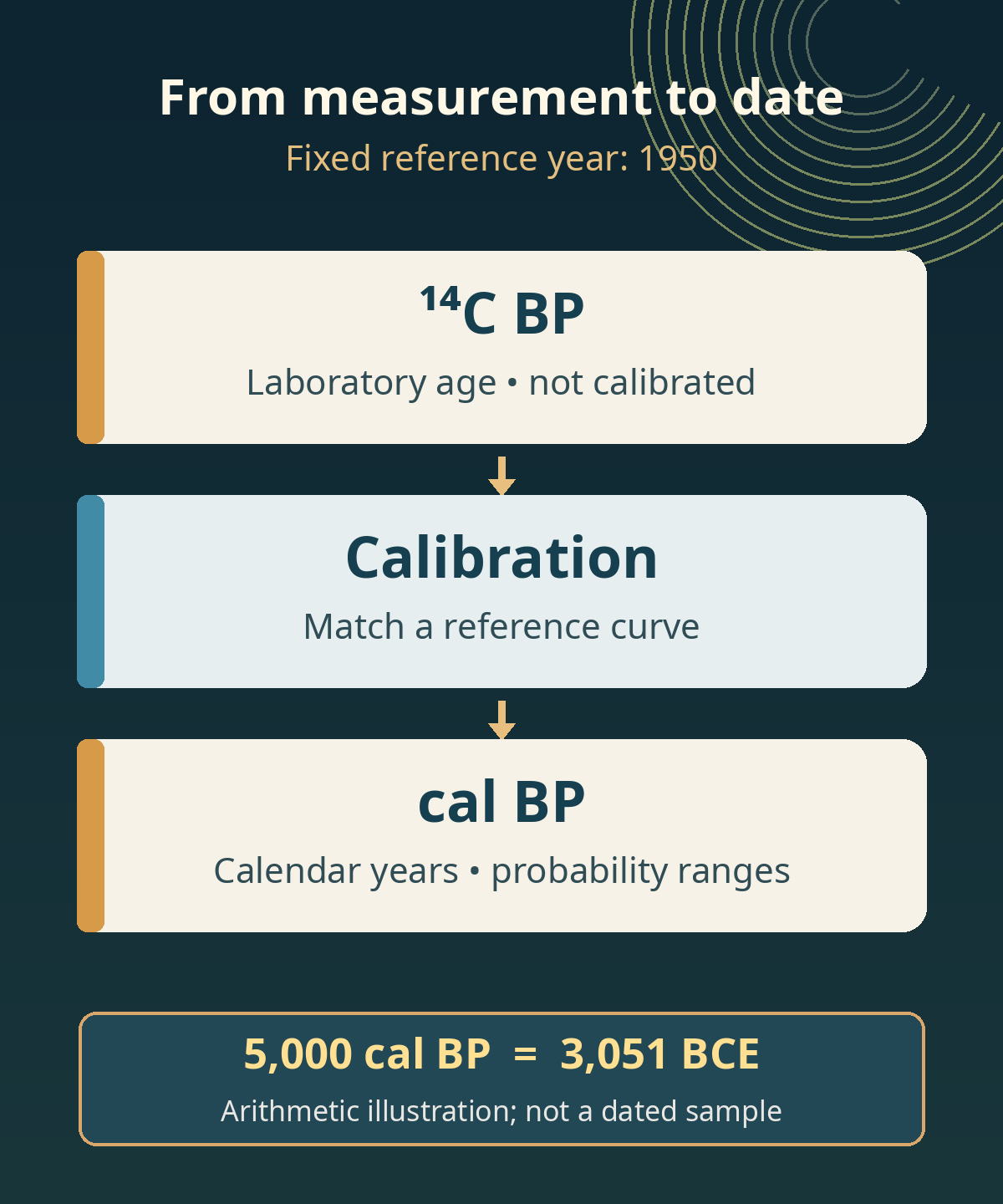
Converting a calibrated calendar year to a BCE or CE label can be arithmetic, but that conversion does not itself calibrate radiocarbon, nor does it erase the uncertainties of the measurement.
What do BP and cal mean?
BP means before present, yet the “present” in this convention is AD 1950, permanently fixed. Zero BP refers to 1950 even when a measurement or publication dates from decades later. In radiocarbon reporting, BP alone commonly denotes a conventional, uncalibrated radiocarbon age; the method and context must therefore be read rather than the letters alone.[1][2]
The prefix cal means calibrated: cal BP specifies a position on a calendar-year scale after calibration, not a raw laboratory result or a historically certain single year. The journal Radiocarbon explicitly distinguishes the adjective “calibrated” from the broader term “calendar” when explaining this prefix.[3]
What does radiocarbon actually measure?
Living organisms exchange carbon with their environments. When exchange ceases, the radioactive isotope ¹⁴C continues to decay. A laboratory measures the radiocarbon remaining in suitable material and usually reports a conventional age in ¹⁴C BP with an uncertainty, such as “± 40 years.” By long-standing reporting convention the calculation still uses Libby's 5,568-year half-life even though the modern physical estimate differs.[2][11]
This dates carbon within a sample—a tree ring, seed, bone or parchment—not necessarily the construction of a wall, writing of a text or use of a nearby object. Past atmospheric ¹⁴C concentrations also varied: an uncalibrated radiocarbon age is therefore not automatically the elapsed number of calendar years.[2][4]
How is calibration established?
Calibration compares the measurement with a reference curve compiled from independently calendar-dated materials, particularly annually dated tree rings, together with other evidence for earlier periods such as sediment records, speleothems and corals. The IntCal20 curve's tree-ring-based atmospheric record reaches about 13,900 cal BP; older evidence is combined out to about 55,000 cal BP. This is the published curve's coverage, not a guarantee of precise dating for every sample near radiocarbon's practical limit.[4][10]
Because the curve is not a straight line, one laboratory result can correspond to several possible calendar intervals. Calibration is not accomplished by subtracting 1950 from “3500 ± 40 BP”: researchers select a suitable curve, supply the measured age and uncertainty to calibration software, and preserve the resulting ranges.[3][4]
Why does sample environment matter?
IntCal20 primarily represents Northern Hemisphere atmospheric radiocarbon. SHCal20 accounts for measured offsets in the Southern Hemisphere atmosphere; tropical or mixed-influence regions may require additional assessment rather than an automatic choice based solely on continent. The fixed 1950 origin does not change between curves.[4][5]
Marine-derived samples require Marine20 and, where appropriate, a local marine reservoir correction (ΔR) and its uncertainty. Ocean-surface carbon differs from atmospheric carbon, and the global marine curve alone is not appropriate everywhere, especially in polar regions. Freshwater settings and aquatic diets can also produce artificially old apparent ages—the freshwater reservoir effect—which must be evaluated case by case.[6][7]
What do 68.2% and 95.4% ranges mean?
Calibration normally yields a probability distribution, not one determinate year. OxCal, for example, reports ranges accounting for 68.2% or 95.4% of the probability distribution; these can consist of separated intervals if the curve produces multiple likely dates. The midpoint of their combined limits is not necessarily the best estimate.[8]
A plateau or wiggle in the curve may broaden calibrated intervals despite a precise laboratory measurement. Bayesian models using the order of associated layers can also revise date ranges, but the result then depends on both the dated evidence and the assumptions of the model. It must not be presented as a separate direct measurement.[4][8]
Converting cal BP to BCE or CE
For calendar conversion only, the zero of the scale is AD 1950. Within the Common Era, the numbered CE year is 1950 − cal BP. The BCE/CE calendar has no year zero: 1950 cal BP corresponds to 1 BCE, whereas 1949 cal BP corresponds to 1 CE. For older integer values, the numbered BCE year is cal BP − 1949. This is calendar arithmetic, not radiocarbon calibration.[9]
Thus 5,000 cal BP = 3,051 BCE, 11,500 cal BP = 9,551 BCE, and 15,000 cal BP = 13,051 BCE in integer-year labels. The last two may be described more broadly as “about 9,500 BCE” or “about 13,000 BCE” at a coarser scale, but the rounding must be apparent. It must not imply that a sample has been dated to a single exact year.[9]
The sampled material is not necessarily the event
A dated inner ring in a long-lived tree records the growth of that ring, which may be long before the tree was cut or its timber used. Carbon in bone may relate to the animal's life rather than its burial; contamination can also distort results. Oxford's radiocarbon laboratory stresses the selection of short-lived material—such as a single grain—and knowledge of archaeological context.[2]
This matters when dating archaeological deposits of pre-literate communities in the LevantThe LevantThe Levant is a regional name for lands along the eastern MediterraneanGlossary · Click to read the explanation and elsewhere: a charred seed from a settlement layer does not automatically date every associated building or ritualRitualAn organised or distinguished practice meaningful to a community; it may leave traces, but its form alone does not reveal an associated doctrine.Glossary · Click to read the explanation. Its relationship to the event must be established, and redeposition and environmental offsets considered.[2][7]
How should a calibrated result be reported?
Where available, retain the laboratory identifier, sample material, raw ¹⁴C BP age and uncertainty, curve and version, calibration software and version, any reservoir corrections or chronological modelling, and all relevant intervals with their probability levels. Indicate whether a value has been rounded or only converted between calendar notations. These details allow comparison without silently combining calibrated and uncalibrated results.[3][6]
If a source simply reports “8500 BP,” it is not legitimate to relabel it “8500 cal BP.” Conversely, a reported “8500 cal BP” can be discussed on the calendar scale, but should not be calibrated a second time as though it were a raw ¹⁴C determination. This entry explains notation; no new archaeological sample was calibrated and no independent measurements were generated here.[3][9]
References and notes (11)
- Oxford Radiocarbon Accelerator Unit, “Radiocarbon Calibration” (inherited legacy link). Search-indexed excerpts only on 1950, half-life and calibration; full page timed out. Return to the text ↑
- University of Oxford, School of Archaeology, “Oxford Radiocarbon Accelerator Unit.” Read “What is radiocarbon dating?”, “Complications” and “What can be dated?” on the institutional page. Return to the text ↑
- Radiocarbon (Cambridge University Press), “Preparing your materials,” “Reporting ¹⁴C Dates.” Read “Reporting ¹⁴C Dates,” including BP, cal BP, cal BC/AD, ranges and software reporting. Return to the text ↑
- Paula J. Reimer et al., “The IntCal20 Northern Hemisphere Radiocarbon Age Calibration Curve,” Radiocarbon 62/4 (2020), 725–757, DOI:10.1017/RDC.2020.41. Read abstract, Introduction, and selected dataset screening paragraphs; not the complete 725–757 article. Return to the text ↑
- Alan G. Hogg et al., “SHCal20 Southern Hemisphere Calibration,” Radiocarbon 62/4 (2020), 759–778, DOI:10.1017/RDC.2020.59. Abstract, opening historical discussion and selected interhemispheric offset passages; not entire paper. Return to the text ↑
- Timothy J. Heaton et al., “Marine20—The Marine Radiocarbon Age Calibration Curve,” Radiocarbon 62/4 (2020), 779–820, DOI:10.1017/RDC.2020.68. Read abstract, Introduction/“Marine Specific Calibration,” and “How to Calibrate a Marine Radiocarbon Sample”; not entire paper. Return to the text ↑
- Bente Philippsen, “The Freshwater Reservoir Effect in Radiocarbon Dating,” Heritage Science 1 (2013), article 24. Abstract and indexed Introduction passages only; not the full article. Return to the text ↑
- University of Oxford, OxCal help, “Analysis Details,” “Ranges.” Read the “Ranges” passage on 68.2%, 95.4% and multimodal distributions. Return to the text ↑
- University of Oxford, OxCal help, “Specification of Information,” “Definition of time-scale.” Read the 1950 datum, example and BCE/CE no-year-zero rule; article calculations are applications of these conventions. Return to the text ↑
- US National Park Service, “Dendrochronology—The Study of Tree Rings.” Indexed excerpt only on tree rings and crossdating; full article and its copyrighted image not used. Return to the text ↑
- Minze Stuiver and Henry A. Polach, “Discussion: Reporting of ¹⁴C Data,” Radiocarbon 19 (1977), 355–363. Cambridge Core abstract/extract only; original article pages not read. Return to the text ↑
Suggest a correction · Suggest a source for this record
Cite this record
IL Archive, «Calibrated years before present (cal BP)», https://ilarchive.com/en/entities/cal-bp
Continue reading