Entity · Concept
Radiocarbon dating
A reference page linking a name, group, or concept to the materials that discuss it.
How carbon-14 dating works, why it dates organic material rather than the writing on it, and what Birmingham’s Qur’an parchment reveals.
Estimated reading time: 5 min Published Last reviewed:
Share article
Text
Introduction
How can we determine the age of the skin on which an early manuscript was written? Radiocarbon dating helps estimate when organic material stopped exchanging carbon with its environment, but the result does not itself date the writing. This entry explains how a laboratory turns a sample into a calibrated date range and how historians interpret that range when studying transmitted texts.
Parchment leaves of an early Qur'an manuscript held at the University of BirminghamBirmingham, United KingdomBirmingham is a city in England whose university preserves early Qur’anic parchment leavesGlossary · Click to read the explanation provide a concrete example of the distinction between the age of a physical support, the date of writing and the history of the text copied onto it.
What does the carbon-14 clock measure?
Carbon-14 is a radioactive isotope formed in the atmosphere. It enters plants and then animals through the food chain. A living organism continues exchanging carbon with its surroundings; after death, that ordinary exchange ceases and the carbon-14 in its tissues gradually decays. The isotope's physical half-life is about 5,730 years: roughly half the original quantity decays over that period. Measuring its abundance relative to stable carbon isotopes therefore helps estimate the time elapsed since exchange ceased. [10]
The method applies to materials that were once part of living organisms, including wood, charcoal, bone, plant remains and animal skin. It does not directly date a stone or metal object merely because it was found in an archaeological site. Organic material associated with an object or deposit can be tested, but its relationship to the event being dated must first be established. The method normally reaches back tens of thousands of years, not into the remote geological past. [10]
From a sample to a calibrated date
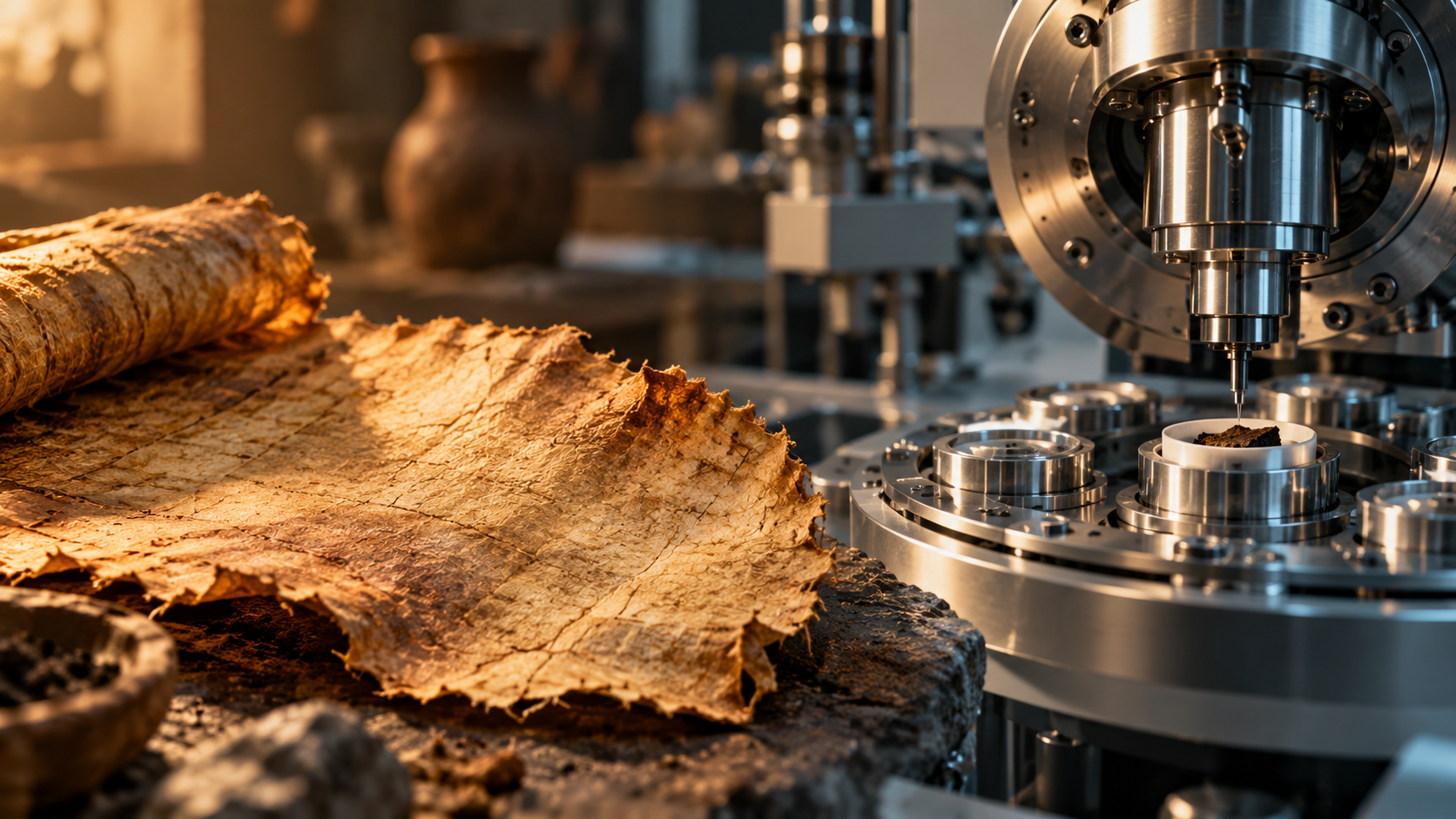
Researchers select a sample with a documented context and pretreat it to remove later carbon introduced by soil, conservation materials or storage. Laboratories then measure radiocarbon, often using accelerator mass spectrometry (AMS), which can determine isotope ratios from small samples. Results are reported with a laboratory identifier and experimental uncertainty, commonly as conventional radiocarbon years BP, whose reference “present” is fixed by convention at AD 1950. [10]
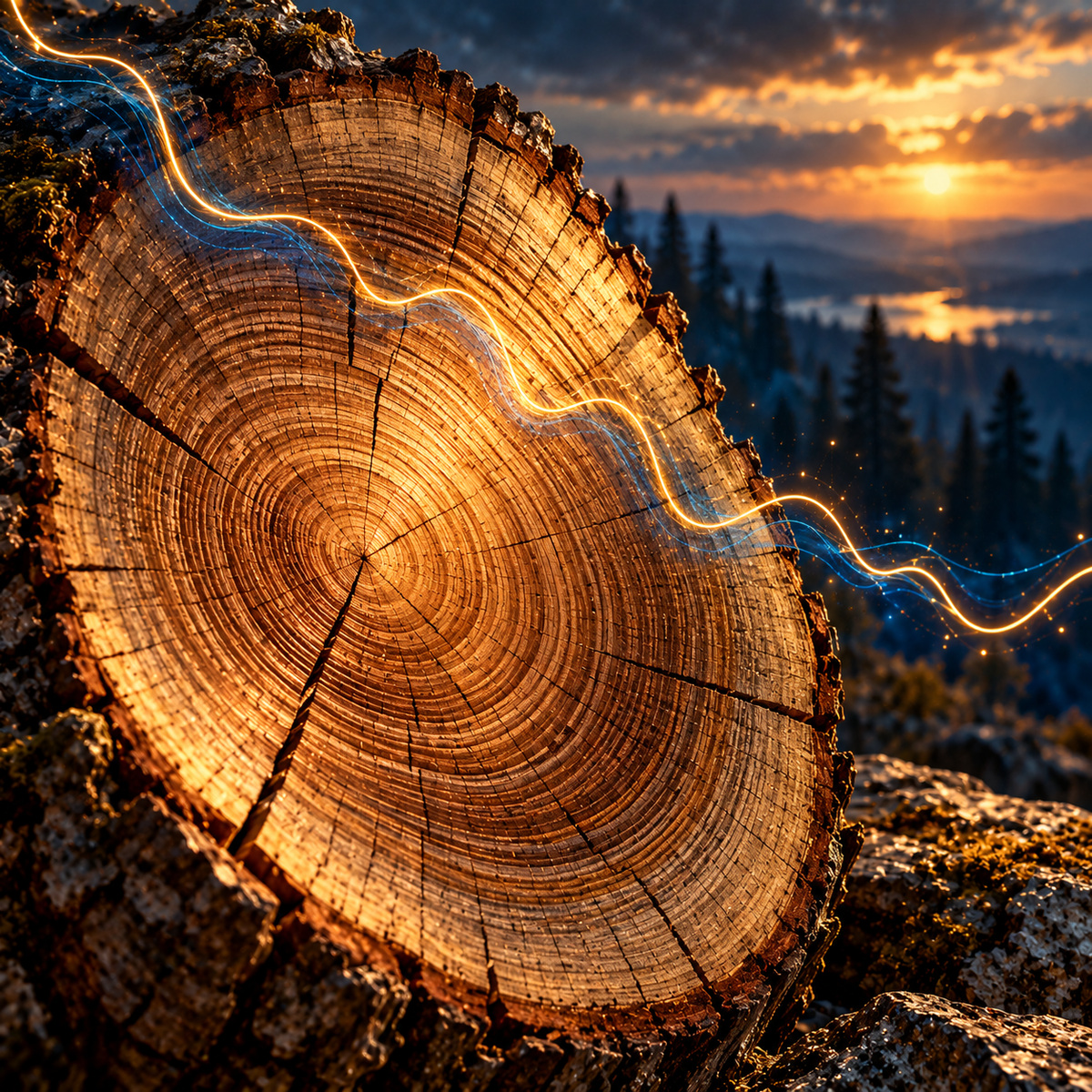
A radiocarbon age is not yet a calendar date. Atmospheric carbon-14 levels have varied, so measurements are compared against calibration curves assembled using materials of independently known calendar age, including tree rings. IntCal20 is one reference curve for terrestrial samples from the Northern Hemisphere. Calibration may yield one interval or several intervals with different probabilities, rather than one certain year. The expression calibrated years before present (cal BP)Calibrated years before present (cal BP)cal BP denotes calibrated calendar years before the fixed reference year 1950, not raw ¹⁴C BP measurements; calibrated intervals depend on the curve, sample and probability model.Glossary · Click to read the explanation refers to calendar time and must not be confused with uncalibrated radiocarbon BP. [10][11]
A range described as carrying 95.4% calibrated probability is a statistical estimate for the sample under the measurement and calibration model; it does not mean that every year within the range is equally likely. Published ranges can also change when measurements are recalibrated with updated curves. The laboratory identifier and original determination therefore matter as well as the published calendar interval. [10][11]
What can affect the interpretation?
The dated material is not necessarily as old as the archaeological event of interest. Construction timber, for example, may come from an old tree, or material may have been stored or reused long after the original organism died. Intruding younger or older carbon can also distort a measurement, which makes sample assessment and pretreatment indispensable. [10]
The carbon cycle is not identical in all environments. Reservoir effects can occur where an organism obtains carbon from sources whose apparent radiocarbon age differs from that of contemporary air, especially in some aquatic settings. Marine and freshwater samples may therefore require appropriate calibration curves or corrections rather than a routine terrestrial calibration. [10]
The Birmingham parchment: what was actually dated?
The Cadbury Research Library at the University of Birmingham holds two parchment leaves from an early manuscript of parts of the Qur'anThe QuranThe central scripture of Islam, consisting of 114 Arabic surahs; its study distinguishes Quranic discourse from manuscript history, reading traditions, and historical inference.Glossary · Click to read the explanation, in the Mingana Collection, catalogued as MINGANA Islamic Arabic 1572a. They preserve portions of surahs 18, 19 and 20, in an early Ḥijāzī hand. The university identifies the parchment as probably made from sheep or goat skin. [8][9]
Oxford's Radiocarbon Accelerator Unit tested the parchment in 2014, and Birmingham publicised the result in 2015. The university's published calibrated interval places the death of the animal whose skin became the parchment between AD 568 and 645 at 95.4% probability. The sample's laboratory identifier is OxA-29418. This estimate concerns the writing material before its use; it is not a direct measurement of the year in which the verses were written on it. [8][9]
The university also investigated the manuscript through palaeography, multispectral imaging and ink analysis. It reports that the imaging found no concealed earlier writing and that the inks were not themselves directly dated by radiocarbon. Together such observations help evaluate an early manuscript, but the date of the animal skin does not become a precise year for every line of writing or for the composition of the surahs. [8]
Three different chronological questions
For manuscripts we must distinguish the age of the support, the date when its writing was copied, and the origin and transmission history of the text. Those dates may be close, but they need not coincide. Radiocarbon dating can establish a range for the animal's death; palaeography, letter forms, ink studies, textual history and independent contextual evidence can then inform estimates of the writing date, each with its own limitations. [8][10]
Radiocarbon dating is therefore a powerful line of evidence within a wider investigation, not a single clock that answers every historical question. Its value lies in identifying exactly what was measured and interpreting that result in relation to the object and the text. [10]
References and notes (4)
- University of Birmingham, “Conservation and research”, sections on radiocarbon testing (2014), publication (2015), multispectral imaging and inks. The university lists OxA-29418 and 1456 ±21 BP, while its calibration line reads R_Date(1461,21); the underlying full laboratory report was not read. Research sections on carbon dating, multispectral imaging and inks; OxA-29418 and calibrated dating, university web page Return to the text ↑
- University of Birmingham, “Frequently Asked Questions”, entries identifying MINGANA Islamic Arabic 1572a, the two leaves and their Qur’anic contents, OxA-29418 and photographic publication permissions. The FAQ cites Higham et al. (2018), Archaeometry, p. 634; that full article was not read. FAQ entries on manuscript identity, leaf contents, date result and image permissions Return to the text ↑
- Alex Bayliss and Peter Marshall, Radiocarbon Dating and Chronological Modelling: Guidelines and Best Practice, Historic England (2022), chapter 1: fundamental principles, sample pretreatment and measurement, reporting, calibration and reservoir effects. Consulted the relevant web sections, not the entire PDF. Chapter 1, §§1.1–1.3, 1.5–1.6, Historic England web edition Return to the text ↑
- Paula J. Reimer et al., “The IntCal20 Northern Hemisphere Radiocarbon Age Calibration Curve (0–55 cal kBP),” Radiocarbon 62(4) (2020): 725–757, doi:10.1017/RDC.2020.41. Bibliographic entry checked on the IntCal Working Group site and applicability cross-checked with Historic England; the full journal article was not read. IntCal Working Group, Publications: 2020 entry for Reimer et al.; Historic England §1.5 Return to the text ↑
Suggest a correction · Suggest a source for this record
Cite this record
IL Archive, «Radiocarbon dating», https://ilarchive.com/en/entities/radiocarbon-dating
Continue reading