Site
Raqefet Cave
- Timeline
- From 11750 BCE to 9750 BCE
A Mount Carmel cave with plant-lined burial evidence and mortars whose possible use for brewing has been debated.
Text
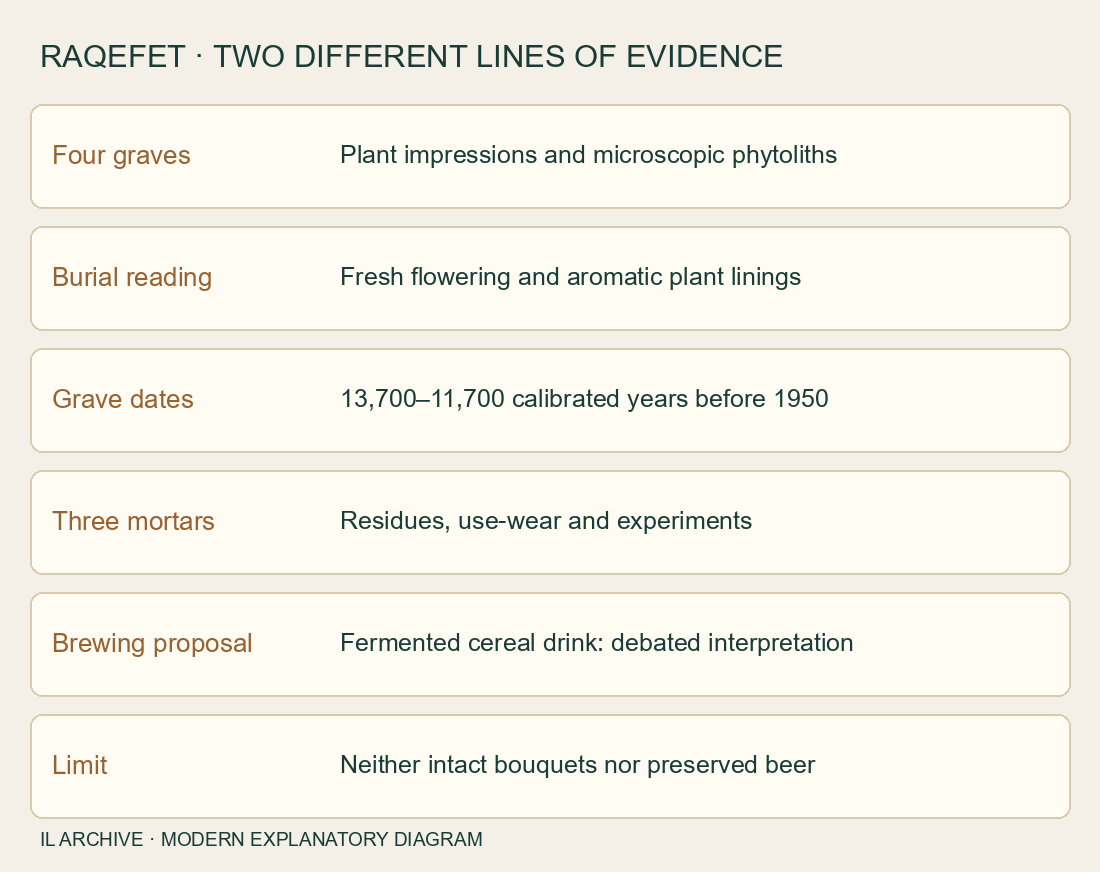
A 2013 study interprets plant impressions and phytoliths in four graves as fresh flowering-plant linings, dated c.13,700–11,700 cal BPCalibrated years before present (cal BP)A calendar dating convention anchored to 1950, distinct from an uncalibrated radiocarbon age.Glossary · Click to read the explanation, approximately 11,750–9750 BCE. The finds are traces, not intact flowers.[1]
A 2018 study proposes cereal fermentation in some mortars from residues, use-wear and experiments. A 2019 discussion confirms debate about that reconstruction and mortar functions. The proposal is not direct evidence of preserved beer.[2][3]
References and notes
- Dani Nadel et al. (2013). Earliest floral grave lining from 13,700–11,700-year-old Natufian burials at Raqefet Cave, Mt. Carmel, Israel. PNAS. DOI: 10.1073/pnas.1302277110. Abstract, methods, results and selected discussion: four graves, plant impressions and phytoliths, and lining interpretation. Dates are cal BP; no intact bouquets were recovered. Return to the text ↑
- Li Liu, Jiajing Wang, Danny Rosenberg, Hao Zhao, György Lengyel & Dani Nadel (2018). Fermented beverage and food storage in 13,000 y-old stone mortars at Raqefet Cave, Israel: Investigating Natufian ritual feasting. Journal of Archaeological Science: Reports. DOI: 10.1016/j.jasrep.2018.08.008. University-repository abstract and indexed methods excerpt; full paper not read. Brewing reconstruction relies on microscopic residues, use and experiments; its link with feasting is the authors’ proposal. Return to the text ↑
- Li Liu et al. (2019). Response to comments on archaeological reconstruction of 13,000-y old Natufian beer making at Raqefet Cave, Israel. Journal of Archaeological Science: Reports 28, 101914. DOI: 10.1016/j.jasrep.2019.101914. University of Haifa abstract only: establishes a published discussion of fermentation and mortar functions. Neither full criticism nor full response was read; no claim that the debate is resolved. Return to the text ↑
Research history
Substantive changes are retained here. Minor copy edits remain in the internal operational log.
-
Substantive record update
Suggest a correction · Suggest a source for this record
Cite this record
IL Archive, «Raqefet Cave», Edition 2, https://ilarchive.com/en/sites/raqefet-cave