Site
Hilazon Tachtit
- Timeline
- From 10450 BCE to 10050 BCE
A Late Natufian burial cave in Galilee, with an exceptional woman’s grave and deposits interpreted as funerary feasts.
Text
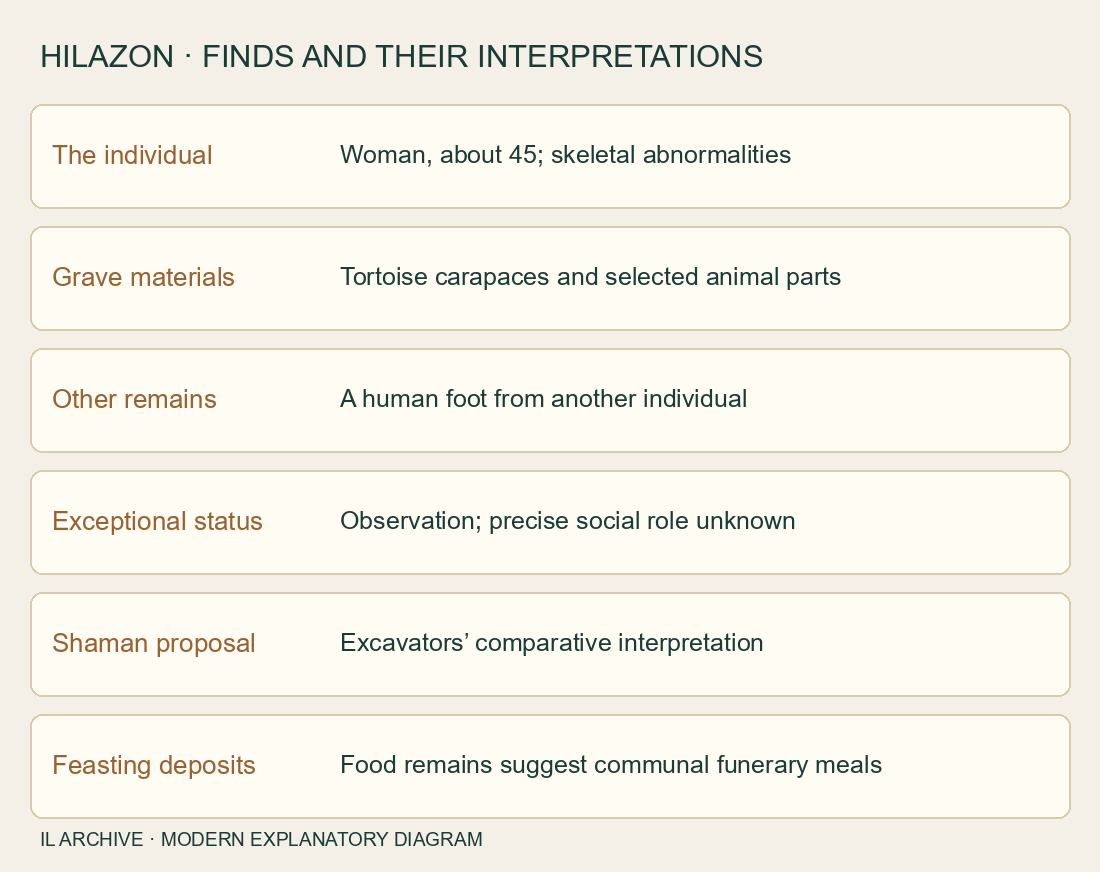
Its NatufianNatufian cultureA late Epipalaeolithic Levantine archaeological culture, with some long-duration settlements before fully developed agriculture.Glossary · Click to read the explanation burial use dates to c.12,400–12,000 cal BPCalibrated years before present (cal BP)A calendar dating convention anchored to 1950, distinct from an uncalibrated radiocarbon age.Glossary · Click to read the explanation, approximately 10,450–10,050 BCE, not 12,400–12,000 BCE. A woman about forty-five received more than fifty tortoise carapaces, selected animal parts and a foot from another person.[1]
Shaman is a comparative interpretation, not an identity read from an ancient text. A separate study interprets tortoise and aurochs deposits as funerary feasting. Counts for Structure A and the woman’s grave concern different contexts.[1][2]
References and notes
- Leore Grosman, Natalie D. Munro & Anna Belfer-Cohen (2008). A 12,000-year-old Shaman burial from the southern Levant (Israel). PNAS. DOI: 10.1073/pnas.0806030105. Abstract, results and discussion: woman about 45; main text reports over fifty tortoise carapaces, golden eagle and two stone martens among the finds. Shaman is a comparative interpretation; 12,400–12,000 cal BP is not BCE. Return to the text ↑
- Natalie D. Munro & Leore Grosman (2010). Early evidence (ca. 12,000 B.P.) for feasting at a burial cave in Israel. PNAS. DOI: 10.1073/pnas.1001809107. Full-text results and discussion: tortoise and aurochs remains, processing, deposition and funerary-feasting interpretation. Structure A’s count differs from the woman’s grave count; contexts must remain distinct. Return to the text ↑
Research history
Substantive changes are retained here. Minor copy edits remain in the internal operational log.
-
Substantive record update
Suggest a correction · Suggest a source for this record
Cite this record
IL Archive, «Hilazon Tachtit», Edition 2, https://ilarchive.com/en/sites/hilazon-tachtit