Entity · Concept
Ritualization
A reference page linking a name, group, or concept to the materials that discuss it.
Ritualization examines how everyday practices become differentiated, patterned and socially meaningful, distinguishing archaeological observations from interpretations of houses, deposits and enclosures.
Estimated reading time: 6 min Published Last reviewed:
Share article
Text
Introduction
How can cooking a meal or using part of a house become an action performed in a distinctive way? “Ritualization” is a scholarly concept for studying differentiation within social practice, not the name of one ancient rite or a necessary stage preceding the temple. This entry asks how archaeologists read recurring spaces and deposits, and why it is difficult to separate ritualRitualAn organised or distinguished practice meaningful to a community; it may leave traces, but its form alone does not reveal an associated doctrine.Glossary · Click to read the explanation sharply from everyday work.
Examples from prehistoric Europe and AnatoliaAnatoliaAnatolia is the region occupying the Asian part of present-day TurkeyGlossary · Click to read the explanation show that dwellings could combine habitation, food, memory and burial. Recovering what inhabitants made of those actions, however, requires dated contextual evidence and competing explanations rather than one assumed religious meaning behind every repeated pattern.
What does ritualization mean?
The religious-studies scholar Catherine Bell proposed examining ritualization as a distinctive way of acting within social activity, rather than isolating a supposedly “religious” sphere in advance. A community may distinguish a familiar action through particular procedures, times, places or roles, and these distinctions may relate to memory, authority and belonging. This interpretive framework concerns differences in performance; it cannot by itself identify the performers’ beliefs.[1]
In a later account of ritual-like activities, Bell discussed formality, traditionalism, relative invariance, rules, symbolism and performance. These are not conditions that every ritual must meet, but aids for observation and comparison; their intensity varies by setting.[2]
Not the opposite of usefulness
A meal can nourish those eating it while its timing and presentation express hospitality or reshape relationships. Archaeologist Joanna Brück cautioned that calling ritual “impractical” may reproduce modern categories; participants may regard its performance as effective and necessary. A practical function therefore does not exclude symbolic meaning, just as a function we cannot understand does not establish one.[3]
Prehistoric European archaeologist Richard Bradley applied this objection to the divide between remains of “settlement” and “ceremony”. Domestic transactions, he argued, can become more ordered and public without losing their links to food, work and economy; there need be no universal passage from house to temple.[4]
How can patterns be recognized in the ground?
Excavation may reveal where a pot broke, how animal bones were distributed, whether a pit was reused or an entrance sealed. But an archaeological deposit reflects overlapping events: use, repair, movement, backfilling, collapse and later disturbance. Duncan Garrow argued that some accounts of “structured deposition” have been too ready to turn visible patterning into deliberate symbolic acts while neglecting everyday disposal and routine activity.[5]
A claim about ritualization requires comparisons across contexts and layers, examination of storage and rubbish deposits, and attention to the position and life history of each feature. An unusual assemblage is an observation; calling it an offering, protection or memorial is an interpretation; naming a divine recipient or reconstructing spoken words is a more fragile hypothesis without independent support.[6]
A house has more than one purpose
An entrance may be reorganized, a hearth renewed and, years later, a dwelling closed with selected objects. Bradley drew on houses, pits and enclosures in Neolithic, Bronze Age and Iron Age Europe to explore how domestic activities acquired additional social emphasis. He did not argue that every house was a temple or every deliberate deposit the same rite.[7]
The accompanying modern diagram is a metaphor for the relationship between the house and surrounding practices; it is neither an excavation plan nor a reconstruction of a particular ritual. Contextual deposits and dating, rather than the illustration, must guide interpretation.
Çatalhöyük: beneath the living floor
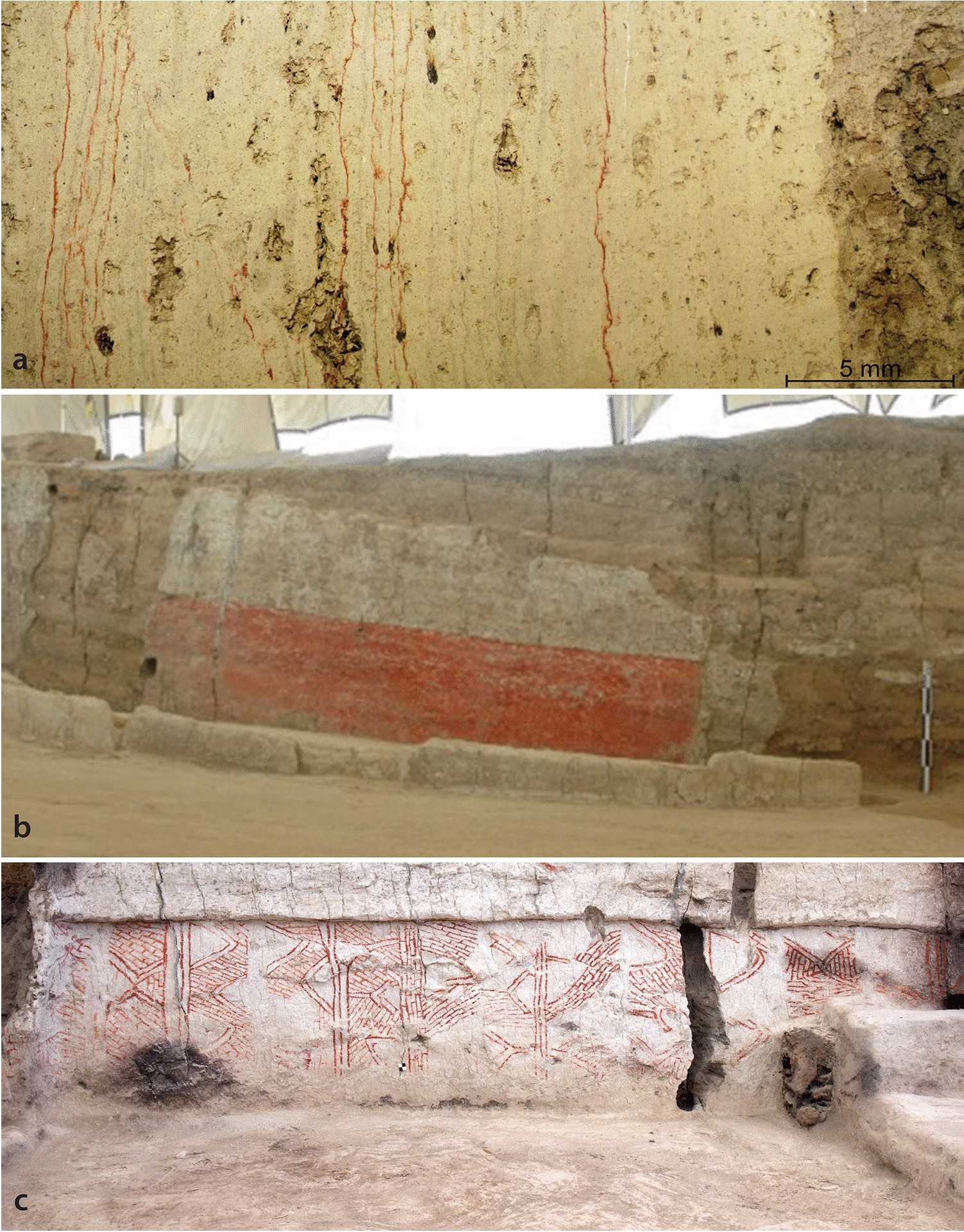
At ÇatalhöyükÇatalhöyükNeolithic site on the Konya Plain in central Anatolia, with clustered houses, subfloor burials and imagery on the East Mound, and later Chalcolithic phases on the West Mound.Glossary · Click to read the explanation, a Neolithic settlement in Anatolia, adjoining houses contained ovens, storerooms, platforms, repeatedly plastered floors, wall paintings and burials beneath some domestic platforms. The excavation project presents these as material, social and ritual aspects of the houses’ histories; archaeologist Ian HodderIan HodderAn archaeologist who directed the Çatalhöyük project from 1993 to 2018 and read its buildings as houses of dwelling and memory, not necessarily separate temples.Glossary · Click to read the explanation directed a lengthy phase of modern excavations there.[8]
In a 2025 study, Scott Haddow examined how human remains relate to building, occupation, transformation and closure of houses. Reading burial within the “life history” of a house is a contextual archaeological interpretation. It does not recover the words of ceremonies or the beliefs of every resident, nor does it turn every dwelling into a separate temple.[9]
Göbekli Tepe: must we choose between home and temple?
The monumental stone buildings and carved imagery at Göbekli TepeGöbekli TepePre-Pottery Neolithic site near Şanlıurfa with T-shaped pillars and communal buildings. Evidence documents habitation and collective activities alongside a ritual component; the figures’ names are unknown.Glossary · Click to read the explanation encouraged some scholars to describe it as a temple complex separate from settlement. In 2011, archaeologist E. B. Banning challenged the necessity of that choice, proposing that symbol-rich buildings may also have served residential functions. This did not prove that all buildings were houses; it tested whether exceptional architecture alone rules out domestic life.[10]
The disagreement concerns competing interpretations of the buildings, not the existence of their pillars and carvings. It shows the value of asking how social activities intersect instead of assuming that ritual must occupy a separate space.
Food, storage and enclosures in Europe
Bradley discussed enclosures such as Durrington Walls in Britain, storage pits, food residues, vessels and animal bones at Bronze and Iron Age sites. Food can support daily subsistence while its sharing or deposition also follows special conventions. The size of a structure or orderly vessels alone cannot identify participants or the meaning of a gathering. These are dated regional examples, not a world map of religion’s origins.[11]
What do broad surveys add?
An English-language archaeological report published in the Netherlands in 2024 surveys unusual deposits around houses and yards from the Neolithic to modern times, including finds interpreted as ritual in excavation reports. A survey permits comparison of recurring and divergent patterns; it does not independently prove that every assemblage previously labelled “ritual” really was one.[12]
At Ezinge in the northern Netherlands, a 2020 study by Annet Nieuwhof inventoried 142 Iron Age deposits interpretable as ritual, many associated with houses. She related these deposits to the house’s life cycle and household identity and continuity. This is an interpretation bounded by the site and its preservation, not a direct report of each depositor’s intention.[13]
The dispute over deposition and discard
Broken pottery, bone and seeds enter the ground through many processes: rubbish disposal, rebuilding, moved soil, and sometimes intentional placement. Mark Brudenell and Andrew Cooper, examining material from Broom in Britain, warned that treating everything as a “special deposit” without reconstructing its formation can flatten the archaeological story. One must distinguish deliberate closure from later rubble accumulation and disturbance.[14]
Conversely, a plausible practical explanation does not empty an act of social significance. The researcher should say why one interpretation is preferred and what observation would count against it. A text describing a rite, a repeated pattern with no text, and a much later story furnish different kinds of evidence.
Participants, memory and difference
Ritualization is not simply “mechanical repetition”. One person may follow an inherited pattern and another perform it with a different purpose or within an unequal relationship of authority. In their study of Jain worship, Caroline Humphrey and James Laidlaw analysed the relation between a participant’s intentions and a publicly prescribed form of action. Their account is not identical to Bell’s, reminding us that ritualization does not name one unanimously accepted theory.[15]
Limits of the concept
When using the concept at a particular site, ask: Which observable action recurs? Where and when? Who might have had access? Does the pattern change when houses are rebuilt or households reorganized? What rival explanations can be tested? These are research questions, not a mechanical ritual-detection test.
Ritualization helps explain how ordinary activity may acquire distinctive organization and meaning, and how livelihood, memory and symbolism can overlap. It cannot by itself take us from a pit, a bowl or a threshold to a particular belief, and it implies no compulsory progression from a “secular house” to a “sacred temple”.
References and notes (15)
- Catherine M. Bell, Ritual Theory, Ritual Practice (Oxford University Press, 1992); bibliographic overview, WorldCat Publisher/catalogue overview only; full book not accessed. Return to the text ↑
- Catherine Bell, Ritual: Perspectives and Dimensions (Oxford University Press, 1997), ch. 5, “Characteristics of Ritual-like Activities” Publisher’s abstract of chapter 5 only; chapter text not accessed. Return to the text ↑
- Joanna Brück (1999), “Ritual and Rationality: Some Problems of Interpretation in European Archaeology,” European Journal of Archaeology 2(3), 313–344 Article abstract only; full article not accessed. Return to the text ↑
- Richard Bradley (2003), “A Life Less Ordinary: The Ritualization of the Domestic Sphere in Later Prehistoric Europe,” Cambridge Archaeological Journal 13(1), 5–23 Selected parts of accessible full-paper PDF, conceptual discussion around printed pp. 11–14, not the entire paper. Return to the text ↑
- Duncan Garrow (2012), “Odd deposits and average practice: A critical history of the concept of structured deposition,” Archaeological Dialogues 19(2), 85–115 Publisher abstract only; full paper not accessed. Return to the text ↑
- Richard Bradley (2003), “A Life Less Ordinary,” case studies of Gussage All Saints and depositional histories Selected full-paper PDF passages on Gussage All Saints, printed pp. 7–9; not all pages. Return to the text ↑
- Richard Bradley (2003). A Life Less Ordinary: the Ritualization of the Domestic Sphere in Later Prehistoric Europe. Cambridge Archaeological Journal 13(1), 5–23. Selected passages in accessible PDF, printed pp. 5–8, 12–16 and 18–21; not a cover-to-cover reading. Return to the text ↑
- Çatalhöyük Research Project, “Architecture”, excavation project website Full available textual content of the project’s Architecture page; images not reused. Return to the text ↑
- Scott D. Haddow (2025), “Bodies in buildings: Human remains and the life histories of houses at Neolithic Çatalhöyük,” Archaeological Research in Asia 41, 100598 Abstract and metadata only; full article access blocked. Return to the text ↑
- E. B. Banning (2011), “So Fair a House: Göbekli Tepe and the Identification of Temples in the Pre-Pottery Neolithic of the Near East,” Current Anthropology 52(5) Accessible article: introduction, prevailing interpretation, alternative view, conclusion; not all notes and responses. Return to the text ↑
- Richard Bradley (2003), “A Life Less Ordinary,” enclosures, food and storage in later prehistoric Europe Accessible full-paper PDF: selected sections on Durrington Walls, Sarup, storage and food, printed pp. 7–8, 14–20. Return to the text ↑
- D. S. Habermehl et al. (2024), NAR 79: Something Special. The Archaeology of Depositional Practices around the House and Yard, Cultural Heritage Agency of the Netherlands Institutional book/report landing-page overview only; 324-page PDF not read. Return to the text ↑
- Annet Nieuwhof (2020), “Creating a home. Ritual practice in a terp settlement in the northern Netherlands,” in Objekt • Depot • Motiv, pp. 95–109 Abstract and university repository metadata only; full book chapter not read. Return to the text ↑
- Mark Brudenell and Andrew Cooper (2008), “Post-Middenism: Depositional Histories on Later Bronze Age Settlements at Broom, Bedfordshire,” Oxford Journal of Archaeology 27(1), 15–36 Publisher abstract only; full article page returned access restriction. Return to the text ↑
- Caroline Humphrey and James Laidlaw (1994), The Archetypal Actions of Ritual: A Theory of Ritual Illustrated by the Jain Rite of Worship, Oxford University Press Publisher’s chapter abstracts for chapters 3 and 4 and conclusion only; full book not accessed. Return to the text ↑
Suggest a correction · Suggest a source for this record
Cite this record
IL Archive, «Ritualization», https://ilarchive.com/en/entities/ritualization
Continue reading