Study
Houses and Ancestors at Çatalhöyük: When Architecture Became Memory
An extended study of a topic, with evidence and references.
- Timeline
- From 7100 BCE to 5950 BCE
- Region
- Central Anatolia — Konya Plain
Subfloor burial, architectural continuity and the kinship of the dead: what the evidence reveals about memory and affiliation, and the limits of ancestor and descent interpretations.
Share article
Text
When architecture became memory
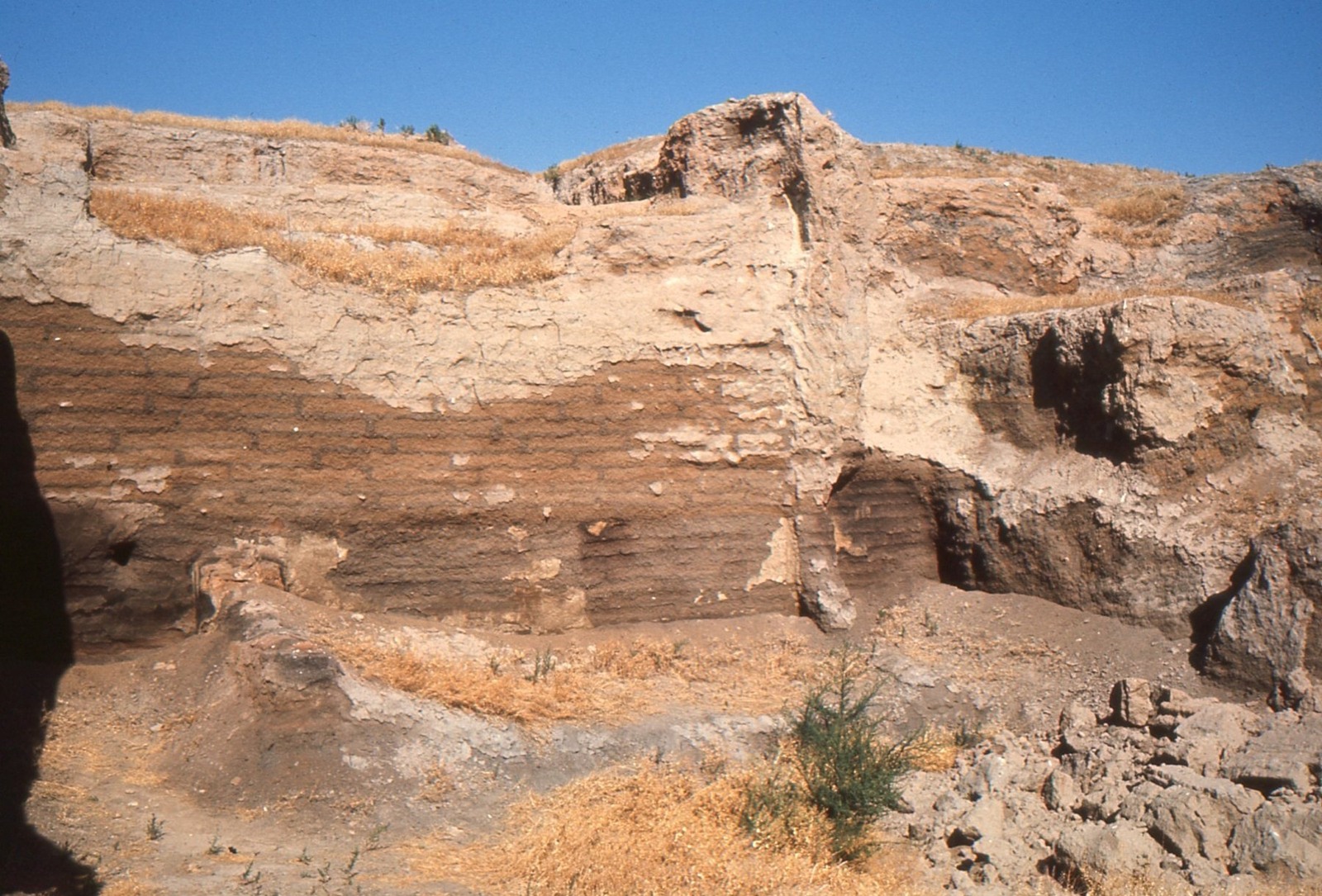
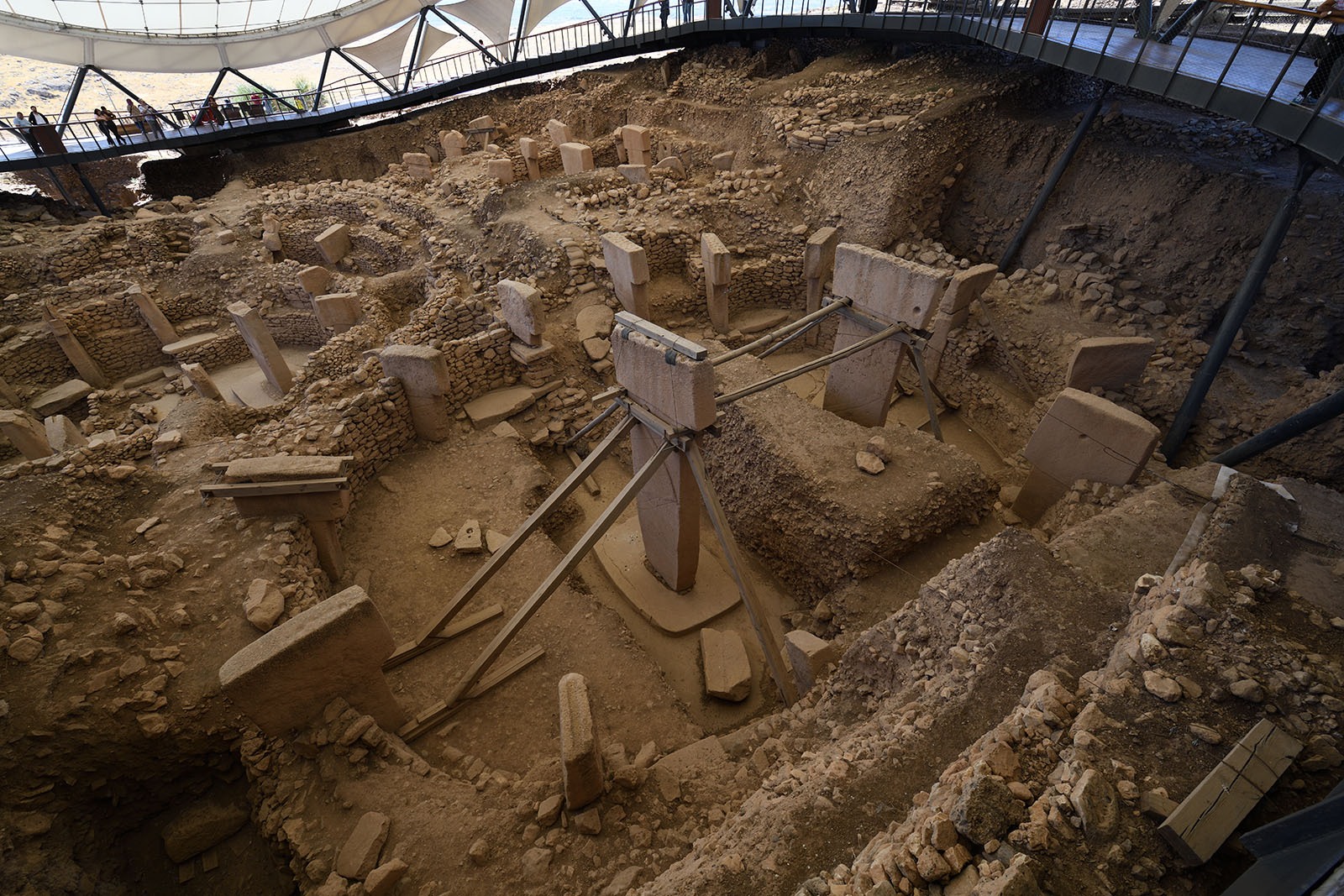
At ÇatalhöyükÇatalhöyükA Neolithic site in central Anatolia where domestic houses combined dwelling with burial, symbolism and social memory.Glossary · Click to read the explanation, houses accommodated more than the living. People used rooms and platforms beneath which some of their dead lay. A floor was opened, a body buried, the pit closed and the surface replastered; life continued above the grave. Years later another burial might be added, or previously buried remains accessed again.[7][8]
Eventually a house was demolished or closed. A new building could occupy the same position and retain parts of its layout. The place could thus hold a history longer than any resident’s life. This underlies the interpretation of some buildings as “history housesHistory housesA modern concept for certain Çatalhöyük houses accumulating rebuilding, burials and elaboration over time. It concerns a place’s history and group, without making the house a temple or every building identical.Glossary · Click to read the explanation”.[2][3]
Ancient DNA has added another question: people buried together were not always close biological relatives, especially in later phases. Membership of a house and its remembered past may have extended beyond descent. That is a possibility concerning burial communities; identifying who actually lived in a house requires additional evidence.[1]
A house built above a house
The settlement lies on the Konya Plain in central AnatoliaAnatoliaAnatolia is the region occupying the Asian part of present-day TurkeyGlossary · Click to read the explanation, in present-day TürkiyeTurkeyTurkey is a modern country including Anatolia and territory in southeastern EuropeGlossary · Click to read the explanation. The 2025 genomic study covers approximately 7100–5950 BCE, parts of the seventh and sixth millennia BCE. This is the study’s eastern-mound chronological framework, not the date of every mound and occupation phase at the site.[1]
At several locations, houses succeeded one another in the same position, maintaining orientations, platforms or divisions. Hodder and Cessford interpreted repetition through daily practice and social memorySocial memoryHow a group forms relationships to the past through narratives, practices, objects and places.Glossary · Click to read the explanation. Yet rebuilding need not always have been religious: materials, foundations, labour and spatial organisation also mattered. Continuity is clear in some sequences, but its extent varies between houses.[2][5]
“History houses”
Ian Hodder and Peter Pels proposed the concept for houses that acquired particular significance through burials, symbols and continuity of place. Some elaborately decorated buildings contained more burials; some underwent repeated rebuilding. The three characteristics need not always coincide, and “history house” is not an attested inhabitants’ term.[3]
Bull skullsBucraniaBull heads or skulls with horns displayed or incorporated in architecture. At Çatalhöyük they occur among the installations of some houses; they do not by themselves establish a ritual’s meaning or a bull god.Glossary · Click to read the explanation, horns and wall paintings do not automatically identify a separate temple: cooking, storage and domestic activity remained part of these buildings. Kuijt’s house-society model also differs from Kay’s emphasis on building biographies, in which functions and relationships changed during a house’s life. These are interpretations to test, not fixed categories applicable everywhere.[3][4][5]
Unequal numbers of dead
The buildings examined in the 2024 study show marked variation. Table 4 gives minimum individual counts of 60 for Building 1, 39 for Building 77, 15 for Building 114 and one for Building 59. Building 77 includes 34 individuals in primary deposits and five in secondary deposits. These are report-specific individual counts, not grave counts or a final 2026 census.[6]
Variation does not explain its own causes. Building lifespan, excavation coverage and preservation matter alongside burial selection. We cannot assume that everyone who lived in a house was buried beneath it, or that more burials demonstrate greater wealth or rank. Some houses may have received wider communities, but that interpretation requires contextual evidence.[4][6]
Living above the dead
Most intramural burialIntramural burialDeposition of the dead within a settlement’s built area; burial beneath a domestic floor is one form.Glossary · Click to read the explanation occurred while buildings were occupied, according to Haddow’s 2025 study, rather than only after abandonment. Burial pits were closed and surfaces used again. Many primary burials contained flexed bodies, while burial locations varied with age, period and building.[7][11]
The dead thus formed part of houses still in use. This does not mean every resident knew the identity of every person beneath the floor, or that their feelings can be recovered. Architecture and burial demonstrate proximity; experiences of grief and belonging remain less directly accessible.
Returning to some of the dead
For some bodies, treatment continued beyond initial burial. The 2017 study documents skull removal following primary deposition and discusses redeposited skulls. It also warns that retrieval from old graves cannot account for every case: some heads may have been separated before final inhumation, within a sequence of mortuary treatments.[8]
Intentional transfer must be distinguished from disturbance, and redeposition from removal out of an earlier grave. Stratigraphy, articulation and preservation delimit interpretation. A detached skull neither names a rite nor automatically establishes “ancestor worship”; documented cases nevertheless allow relationships continuing after death to be investigated.[8][11]
A skull with another person’s body
In 2004, grave F1517 was uncovered beneath the position later occupied by Building 42. The field report describes a flexed adult woman holding another person’s plastered and pigmented skull between her arms. A neonate lay a few centimetres above her burial. The grave cut older midden deposits beneath the building’s first plaster surface.[9]
The season review describes white plaster from brow to chin, red pigment and a modelled nose. Preliminary observations around the eyes suggested repeated modelling; the report expressly labelled its observations provisional. The woman’s relationship to the skull’s owner is unknown. The grave was proposed as a reason for locating the house there, without establishing a foundation sacrifice or property right.[9][10]
Was the plastered skull an ancestor’s face?
Plaster restored something of a face, and pigment made the remains a distinctive visual object. This treatment can be interpreted through remembrance or the preservation of a dead person’s presence. It identifies neither that person nor the reason for retaining the head.[8][10]
Was the person a biological relative, someone of particular social standing, or a member of another group? Available evidence does not select one answer. “An ancestor’s face” therefore remains a possible reading, not a secure archaeological identification. Documented treatment and its proposed meaning should remain distinct.
Pigment on bodies and buildings
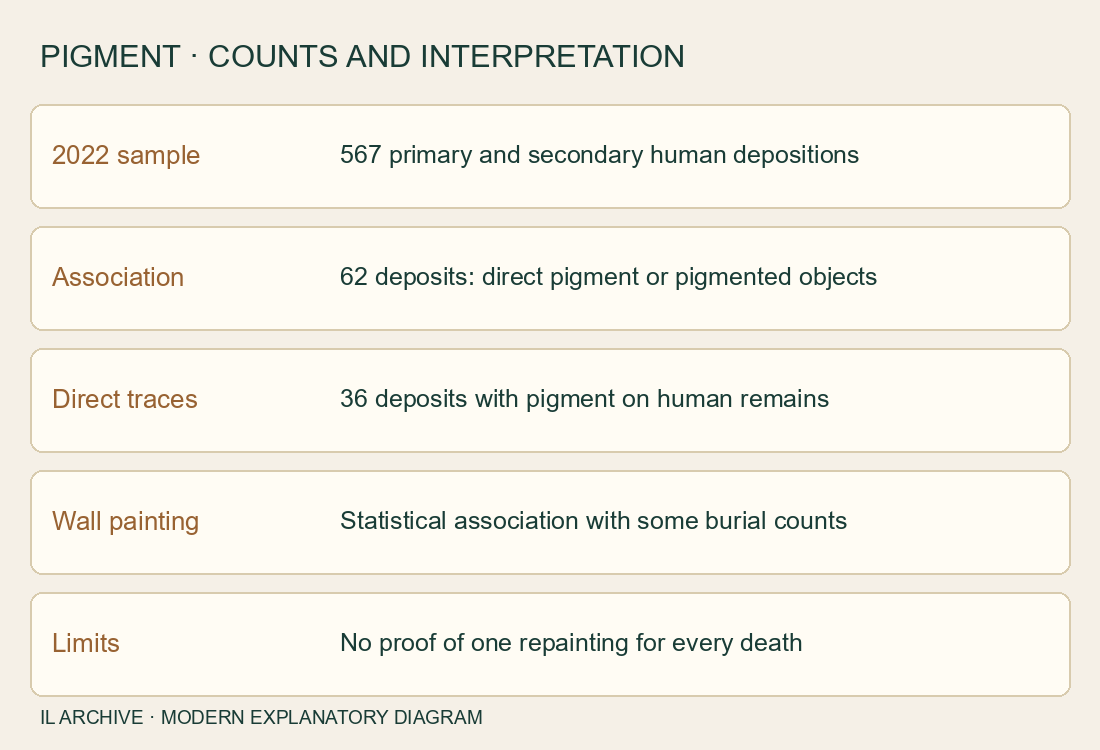
The 2022 study examined pigments in human remains and architecture. Of 567 primary and secondary human depositions, 62 were associated with direct pigment or pigmented objects; 36 had pigment directly on the remains. The approximately 11% figure therefore uses the broader definition of association, rather than counting wholly painted bodies.[11]
Statistical analysis found an association between numbers of certain human deposits and the minimum number of wall-paint layers. This supports investigating burial and house renewal together, but does not show one repainting per death or that burial caused every repainting. Red does not by itself establish meanings such as blood or birth; meanings may vary with context.[11]
Construction, use and closure
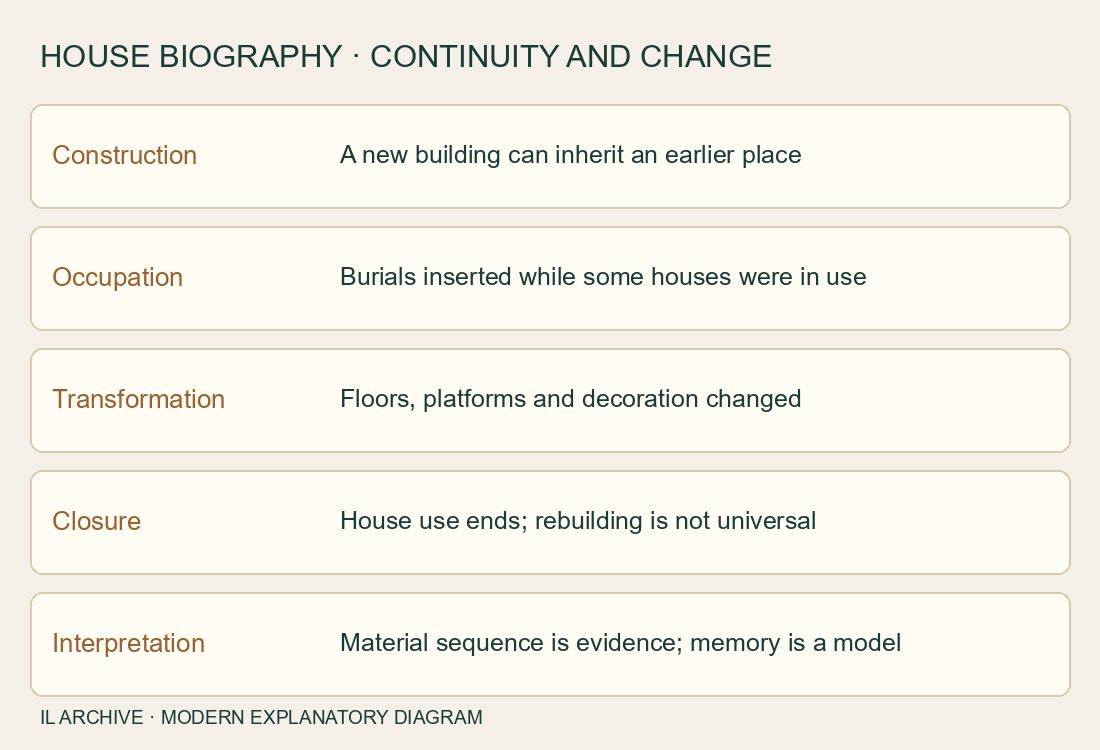
A “building biographyBuilding biographyReading a building through construction, use, transformation and closure, rather than as a fixed plan.Glossary · Click to read the explanation” follows events before construction and through occupation, transformation and closure. Bodies or body parts entered different stages of some such histories. Platforms, decoration and plastering changed; a final plan does not represent everything the house had been.[5][7]
Some actions may have been ritualRitualAn organised or distinguished practice meaningful to a community; it may leave traces, but its form alone does not reveal an associated doctrine.Glossary · Click to read the explanation or highly structured, but their sequence, repetition and context must support that interpretation. Not every fill was ceremonial, and not every rebuilt wall expressed doctrine. The useful proposition is that a house was a history of actions, rather than an unchanging container for objects.
DNA enters the house
Before ancient DNA, teeth and skeletal morphology helped assess relationships. A 2011 dental study of 266 individuals found little phenotypic affinity among people within individual buildings and discussed broader social kinship. Dental resemblance, however, is an indicator rather than a direct genealogical test.[12]
Genomes enabled more precise estimates of genetic kinshipGenetic kinshipEstimating descent relationships from shared genetic material, within sampling and data-quality limits.Glossary · Click to read the explanation. The Çatalhöyük sample in the 2021 study was limited; the larger 2025 study could compare periods more extensively. DNA still does not unlock the whole house: it describes relationships among people whose remains survived, not their beliefs or every inhabitant.[1][13]
What 131 genomes changed
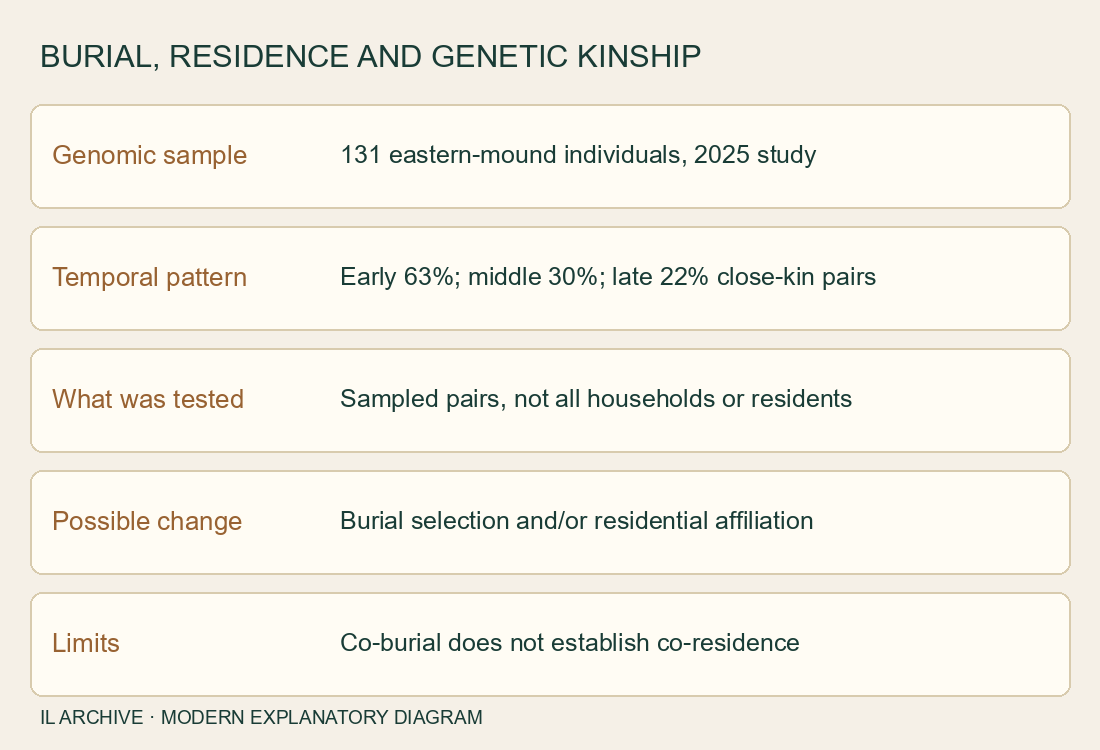
The team generated data for 131 eastern-mound individuals across phases spanning roughly a millennium. The sample was biased towards subadults because of DNA preservation, and does not evenly represent the population.[1]
A major temporal difference emerged: close kinship among co-buried people was more common early, then declined in middle and late phases. In the central comparison of buildings with multiple sampled burials, about 63% of tested pairs were first- to third-degree relatives in the early phase, 30% in the middle and 22% in the late phase. These are sampled-pair proportions, not percentages of “real families” in society.[1]
The findings revise a picture of houses organised only through social kinship throughout their history. Biological relationships mattered in some early groups; burial communities then broadened or changed. Failure to detect close kinship does not rule out all distant shared ancestry.
Children in one burial place, not necessarily siblings
Thirteen neonates, estimated to be up to two months old, were studied in five late-phase houses. Not all were close relatives; four of 12 comparable within-building pairs showed close relationships. Dietary isotopes help investigate similarities, but reflect maternal pregnancy diet, feeding and metabolic influences.[1]
The authors offer two non-exclusive explanations: individuals from different households may have been selected for burial together, or residential groups themselves may have broadened to include social kin and children without close biological ties. The study does not decide between them. “Buried in the same house” does not mean “all lived there”, and adoption as a specific practice is not demonstrated.
A recurring maternal connection
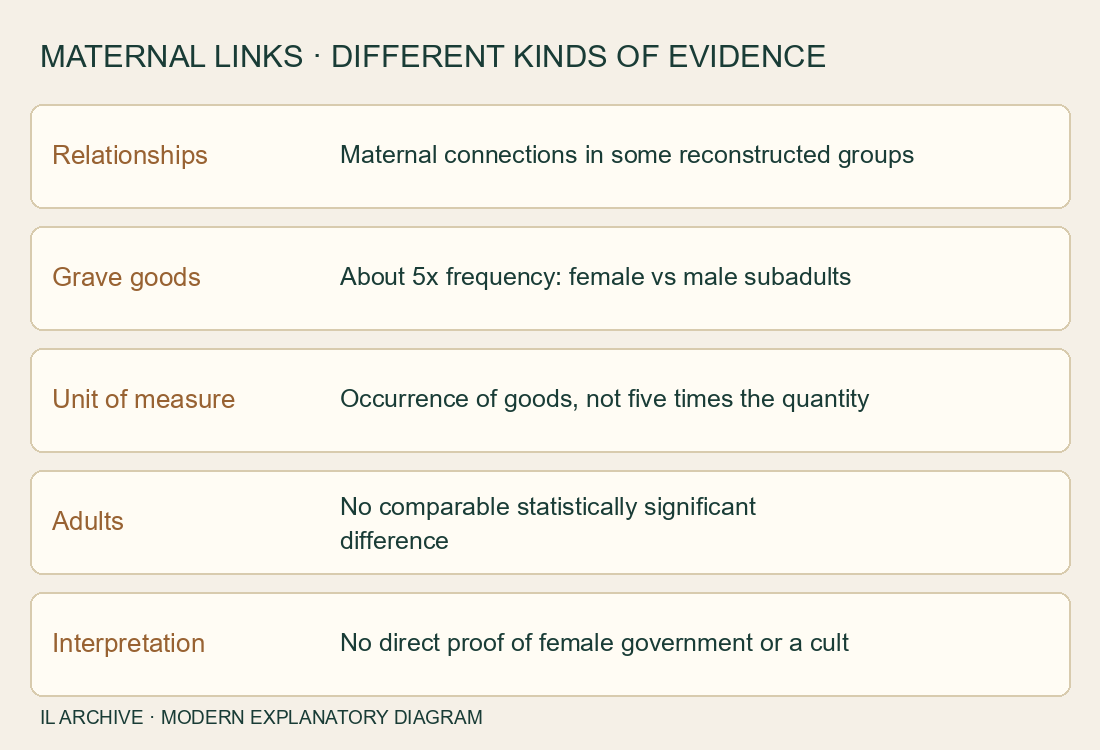
Reconstructed relationships included connections through mothers, sisters and sisters’ children, rather than a single paternal pattern. Mitochondrial DNA and some chromosome-based comparisons were consistent with stronger maternal connections in particular burial groups. Parts of reconstructed pedigrees are hypothetical; not every proposed person has a sequenced genome.[1]
These findings allow discussion of affiliation through women and movement between houses within the settlement. They do not establish a formal matrilineal system, female government or worship of a “Great Mother”. Analysis of movement between sites also found no clear sex bias that simply equates to “women stayed and men left”.[1]
Different treatment of female subadults
In the sample, grave goods occurred about five times more frequently in female subadult burials than in male subadult burials. This concerns the occurrence of goods, not five times as many objects for every girl. The adult difference was not similarly statistically significant.[1]
The result strengthens investigation of the importance of females in mortuary practice, with attention to sampling, age groups and genetically estimated sex. It does not directly measure power or wealth during life. Objects accompanying a dead person may express age, relationship or commemorative value rather than political rank.
A thousand years of changing houses
Çatalhöyük was not an unchanged picture lasting a millennium. Architectural density, decoration, mortuary treatments and relationships within burial groups changed. Close kinship can therefore matter in an early house and be less evident in a later burial group without contradiction.[1][5][11]
Genomes need to be joined to chronology and building biographies, rather than reduced to “the house was a family” or “the house was not a family”. Burial selection may differ from residential membership. Sampled change is real; its social explanation requires multiple kinds of evidence.
Was the house a lineage?
A house-society model proposes that a house can gather rights, names, memory and people through descent or social kinship. A house in this sense may extend beyond a single building. Kuijt used the model to interpret unequal burial concentrations and relationships between buildings.[4]
The 2024 study questions stable multi-house alliances without enduring spatial traces, treating the individual building as a clearer analytical unit. Fluid connections and alliances remain possible. Evidence does not allow every house to be called a fixed hereditary lineage, or every building group a single institution.[6]
An ancestor without biological descent?
This is a question the archaeology permits, not an answer it records. In different societies, affiliation, adoption and shared places can give someone a position resembling a social ancestor. A memory model need not require all living people to descend from all the dead.
Yet absence of close genetic kinship does not establish a social ancestor or house founder. The person may belong to a burial community distinct from the resident group, or share distant kinship not tested. Genomic results broaden possibilities; they do not select a particular belief.[1]
Rethinking “ancestor worship”
The expression sometimes combines different acts: retaining remains, remembering a person, identifying an ancestor and performing rites for an effective supernatural power. These are not equivalent. The site documents some treatment, retention and redeposition; these findings do not establish prayers to the dead or beliefs that they granted rain or children.[8][11]
Relations between the dead, houses and memory can be investigated without turning every grave into an object of worship. “Ancestor worship” remains a hypothesis requiring definition and independent indicators, rather than an automatic label for subfloor burial.
Why return to the same place?
Possible answers combine labour and memory. An existing location offers earlier foundations, familiar organisation and previous investment; it may also retain burial places and a house’s remembered story. Practical reasons do not exclude social value, and social value does not eliminate practical calculation.[2][5]
Building 42 itself reminds us that the relationship need not always be a house directly above another: its grave lay in older midden before construction. Each sequence needs examination, rather than turning the entire site into one architectural genealogy.[9]
Did the dead support claims to a house?
Burials could theoretically give a group a lasting connection to a place and support a claim such as “this is our house”. House-society models discuss this possibility. It does not mean that a property deed or inheritance law has been discovered at Çatalhöyük.[4]
No local texts define house transfer or residents’ rights. Relationships may have been collective, negotiated or changing. Linking graves to claims over places remains a social hypothesis, not a documented system of private ownership or inheritance through women.
When a place outlasts its residents
What endures may be a location and parts of its organisation, rather than identical walls or one lineage. Residents change, buildings are renewed and an earlier place remains recognisable. A house can consequently provide a framework for people without close shared descent.[1][2]
This is a reading through social memorySocial memoryHow a group forms relationships to the past through narratives, practices, objects and places.Glossary · Click to read the explanation, not proof that every individual remembered every wall’s history. Tradition can continue through work, repair and replastering without a complete narrated history. Persistence of form nevertheless gives the past a material presence.
Biological kinship did not disappear
Documented early kinship prevents describing the settlement as a community without biological families. Diverse later burial groups also prevent reducing every house to two parents and their children. Descent, social kinship and affiliation to place can operate together.[1]
Someone can be a particular mother’s child and a member of a wider house group. The inhabitants’ terms for such connections remain unknown. Genomically inferred relationships, archaeologically identified burial groups and reconstructed residential units should remain distinct.
What can be stated securely?
Documented: burial in some occupied houses, further treatment of some remains, rebuilding in certain locations and unequal burial counts. Documented in the 2025 sample: more frequent early close kinship, important maternal connections in some groups and a sex difference in the occurrence of subadult grave goods.[1][6][7][8]
Interpretively plausible: houses and some of the dead helped create affiliation and social memory. Not established: that all the buried were residents, every skull belonged to an ancestor, women governed the settlement or burial founded property law. Genomes do not demonstrate a particular doctrine.[1][2][3]
Architecture as memory
Here everyday and mortuary life meet in the same place: food, storage and work above ground, some of the dead below it. The house changes, and another may be built in its position. We lack the inhabitants’ explanations, but retain traces of their actions.[2][7]
Genetics identifies some relationships of descent; architecture reveals histories of continuity and change. Neither replaces the other. Together they broaden the question of an ancestor: someone from whom you descend, someone whose community you belong to, or someone whose traces lie beneath your house?
There is no single answer for every house and century. The question nevertheless captures why Çatalhöyük matters: a dwelling could retain the dead and give the past a material presence within life renewed above it.
References and notes
- Eren Yüncü et al. (2025). Female lineages and changing kinship patterns in Neolithic Çatalhöyük. Science 388(6754), eadr2915. DOI: 10.1126/science.adr2915. Liverpool author manuscript: abstract, introduction and sample, PDF pp. 3–6; mobility, kinship, diet, maternal connections, grave goods and discussion, pp. 9–22. Not every supplement page read. 131 eastern-mound individuals; percentages concern tested pairs and fivefold concerns occurrence of goods. Return to the text ↑
- Ian Hodder & Craig Cessford (2004). Daily Practice and Social Memory at Çatalhöyük. American Antiquity 69(1), 17–40. DOI: 10.2307/4128346. Publisher abstract only, not the full article: continuity of house practices and social memory are the authors’ interpretation, not inhabitants’ recorded beliefs. Return to the text ↑
- Ian Hodder & Peter Pels (2010). History houses: A new interpretation of architectural elaboration at Çatalhöyük. In Religion in the Emergence of Civilization, pp. 163–186. DOI: 10.1017/CBO9780511761416.007. Publisher chapter summary only, not the full chapter. Elaborate buildings sometimes had more burials and some were repeatedly rebuilt; all traits need not coincide. The term is a modern model. Return to the text ↑
- Ian Kuijt (2018). Material Geographies of House Societies: Reconsidering Neolithic Çatalhöyük, Turkey. Cambridge Archaeological Journal 28(4), 565–590. DOI: 10.1017/S0959774318000240. Abstract, house model and selected mortuary/architectural sections in the full text. Alliances and social kinship are a debated model; current building counts use the later 2024 table. Return to the text ↑
- Kevin Kay (2020). Dynamic Houses and Communities at Çatalhöyük: A Building Biography Approach to Prehistoric Social Structure. Cambridge Archaeological Journal 30(3), 451–468. DOI: 10.1017/S0959774320000037. Publisher abstract only: biographies of four contemporary buildings and changing roles and connections. Full paper not read; the abstract does not assume fixed house groups. Return to the text ↑
- Katheryn C. Twiss et al. (2024). “But some were more equal than others:” Exploring inequality at Neolithic Çatalhöyük. PLOS ONE 19, e0307067. DOI: 10.1371/journal.pone.0307067. Abstract, house as analytical unit, burial results, Table 4 and selected discussion read through Europe PMC. Minimum individuals: B1=60; B77=39 (34 primary +5 secondary); B114=15; B59=1. More burials do not establish economic rank. Return to the text ↑
- Scott D. Haddow et al. (2025). Bodies in buildings: Human remains and the life histories of houses at Neolithic Çatalhöyük. Archaeological Research in Asia 41, 100598. DOI: 10.1016/j.ara.2025.100598. Author-university abstract only: most burial during occupation and remains incorporated into building biographies. Full PDF unavailable; Building 42 details rely on direct 2004 field reports. Return to the text ↑
- Scott D. Haddow & Christopher J. Knüsel (2017). Skull Retrieval and Secondary Burial Practices in the Neolithic Near East: Recent Insights from Çatalhöyük, Turkey. Bioarchaeology International 1(1–2). DOI: 10.5744/bi.2017.1002. Journal abstract only: stratigraphically documented skull retrieval after primary burial, and alternative pathways including removal from bodies not yet buried. Does not establish uniform ritual circulation of every skull. Return to the text ↑
- Gareth Chaffey & Simon McCann (2004). Excavations of the South Area: Building 42. Çatalhöyük Archive Report 2004. Field report: F1517, adult woman holding the skull, neonate above, below first plaster in older midden. Locating the building because of the grave is an interpretation, not proof of sacrifice or ownership. Return to the text ↑
- Ian Hodder & Shahina Farid (2004). Çatal Newsletter 11: Season review. Season-review skull passages: plaster, pigment, nose modelling and possible repeated treatment. Observations expressly preliminary; no precise age, identity or unique-through-2026 claim inferred. Return to the text ↑
- Eline M. J. Schotsmans et al. (2022). New insights on commemoration of the dead through mortuary and architectural use of pigments at Neolithic Çatalhöyük, Turkey. Scientific Reports 12, 4055. DOI: 10.1038/s41598-022-07284-3. Publisher full text: selected introduction, results and discussion. 62/567 include direct pigment or pigmented items; 36/567 have direct traces. Associations of wall layers with primary and tertiary deposits are statistical, not proven causation or a uniform cycle. Return to the text ↑
- Marin A. Pilloud & Clark Spencer Larsen (2011). “Official” and “practical” kin: Inferring social and community structure from dental phenotype at Neolithic Çatalhöyük, Turkey. American Journal of Physical Anthropology 145(4), 519–530. DOI: 10.1002/ajpa.21520. PubMed abstract only: dental phenotype in 266 individuals. An affinity indicator, not a DNA test; its social-kinship interpretation does not replace later genomic findings. Return to the text ↑
- Reyhan Yaka et al. (2021). Variable kinship patterns in Neolithic Anatolia revealed by ancient genomes. Current Biology 31(11), 2455–2468.e1–e18. DOI: 10.1016/j.cub.2021.03.050. Selected results, discussion and site context examined in the preceding study. Çatalhöyük sample was small; the 2025 study extends individuals and periods. Not every supplement re-read. Return to the text ↑
Suggest a correction · Suggest a source for this record
Cite this record
IL Archive, «Houses and Ancestors at Çatalhöyük: When Architecture Became Memory», Edition 1, https://ilarchive.com/en/studies/house-ancestors-catalhoyuk
Continue reading