Study
The Ark of the Covenant: A Throne without a Statue?
An extended study of a topic, with evidence and references.
Cherubim, kapporet, voice and cloud: what texts say about Yahweh’s presence, and what remains interpretation in comparisons with thrones and Egyptian shrines.
Estimated reading time: 12 min Published Last reviewed:
Share article
Text
Introduction
How do biblical texts locate YahwehYahwehThe proper name of Israel’s deity, written יהוה (YHWH), the Tetragrammaton. Its exact ancient pronunciation is not directly preserved; texts and inscriptions witness its history.Glossary · Click to read the explanation’s presence at the Ark, and why do some scholars understand its arrangement as a throne while others propose a frame? This study examines the chest, cover, cherubim, voice and cloud, weighing interpretations of how they belong together.
IL Archive studies the Ark to understand relationships between material objects and divine representation. Biblical descriptions are compared with Egyptian furniture and shrines, including evidence from TutankhamunTutankhamunLate Eighteenth-Dynasty Egyptian king, originally Tutankhaten, later Tutankhamun as official patronage of Amun resumed. Famous for tomb KV62; aspects of his parentage and death are debated.Glossary · Click to read the explanation’s fourteenth-century BCE setting. Artifact dates, narrative settings and composition dates remain distinct.
The question left by the sacred space
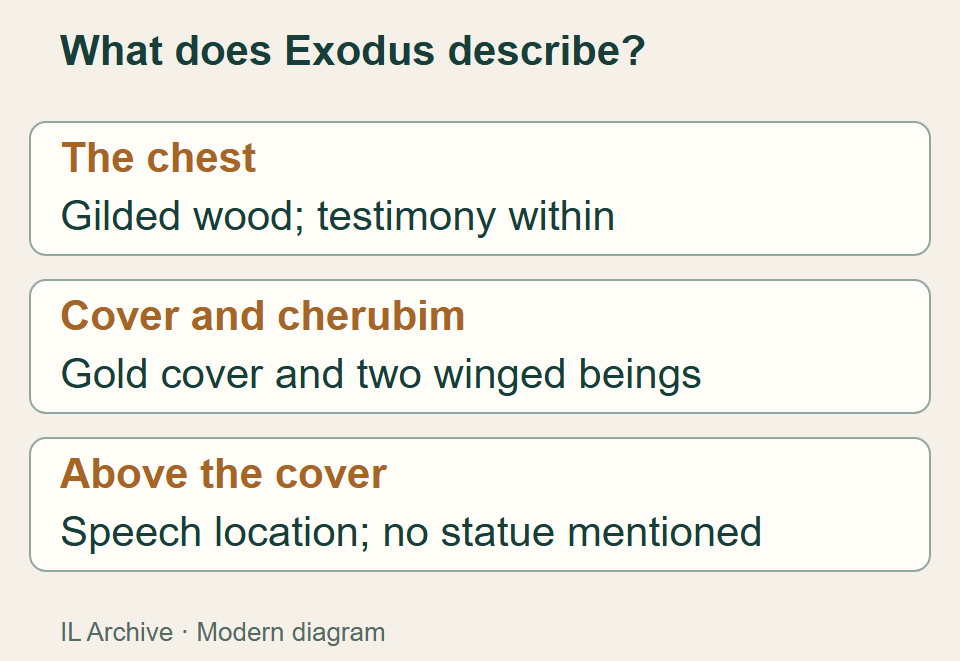
At the center of the holiest space described in Israelite worship traditions stands a gilded chest, a cover and two winged beings. The description places no statue of YahwehYahwehThe proper name of Israel’s deity, written יהוה (YHWH), the Tetragrammaton. Its exact ancient pronunciation is not directly preserved; texts and inscriptions witness its history.Glossary · Click to read the explanation between them. It connects that location with speech, encounter and presence. Was the Ark an unoccupied throne, or does the word throne interpret an arrangement that the texts never describe so precisely? [1][4]
Wood, gold, wings and ritualRitualAn organised or distinguished practice meaningful to a community; it may leave traces, but its form alone does not reveal an associated doctrine.Glossary · Click to read the explanation make this a sensory setting even without a central Yahweh statue in its description. Reading the texts alongside known objects brings together different kinds of evidence: an account of the Ark and a surviving Egyptian artifact do not bear witness in the same way.
What was the Ark of the Covenant?
The Ark of the CovenantArk of the CovenantPortable sacred chest in the Hebrew Bible, associated with the covenant tablets and divine presence. Descriptions and roles differ in Exodus, Deuteronomy, Samuel, and Kings. It is distinct from Noah’s vessel.Glossary · Click to read the explanation, in HebrewHebrewA Northwest Semitic language of the Canaanite group, encompassing Iron Age epigraphy, Biblical, Rabbinic, medieval and Modern Hebrew; its scripts and pronunciations changed over time.Glossary · Click to read the explanation ʾaron habberit, is a portable sacred chest associated with covenant and divine presence in the sanctuary. Calling it an ark should not make us imagine a coffin or confuse it with NoahNoahNoah is the flood-story figure in Genesis and a prophet in the Qur’anGlossary · Click to read the explanation’s vessel. Similar wording in some translations does not make the two objects identical. [2]
The descriptions give the chest two roles: keeping the covenant tablets and marking a place of encounter. The covenant binding deity and community is connected with a place of divine presence. This relationship, beyond storage alone, explains the chest’s importance in the narratives. [1][4]
A chest of wood and gold
Exodus 25 provides a detailed description: acacia wood, gold covering inside and outside, and a gold molding. Length is two and a half cubits; width and height are each one and a half. These are textual dimensions, not measurements taken by an archaeologist from a discovered object. Converting them to centimeters depends on the cubit assumed. [1]
Materials and dimensions describe something that can be made, carried and installed. Dating the first Ark or relating a description to its narrated events requires other evidence; a precise account of craftsmanship does not itself date composition.
Four rings are explicit; pole count needs care
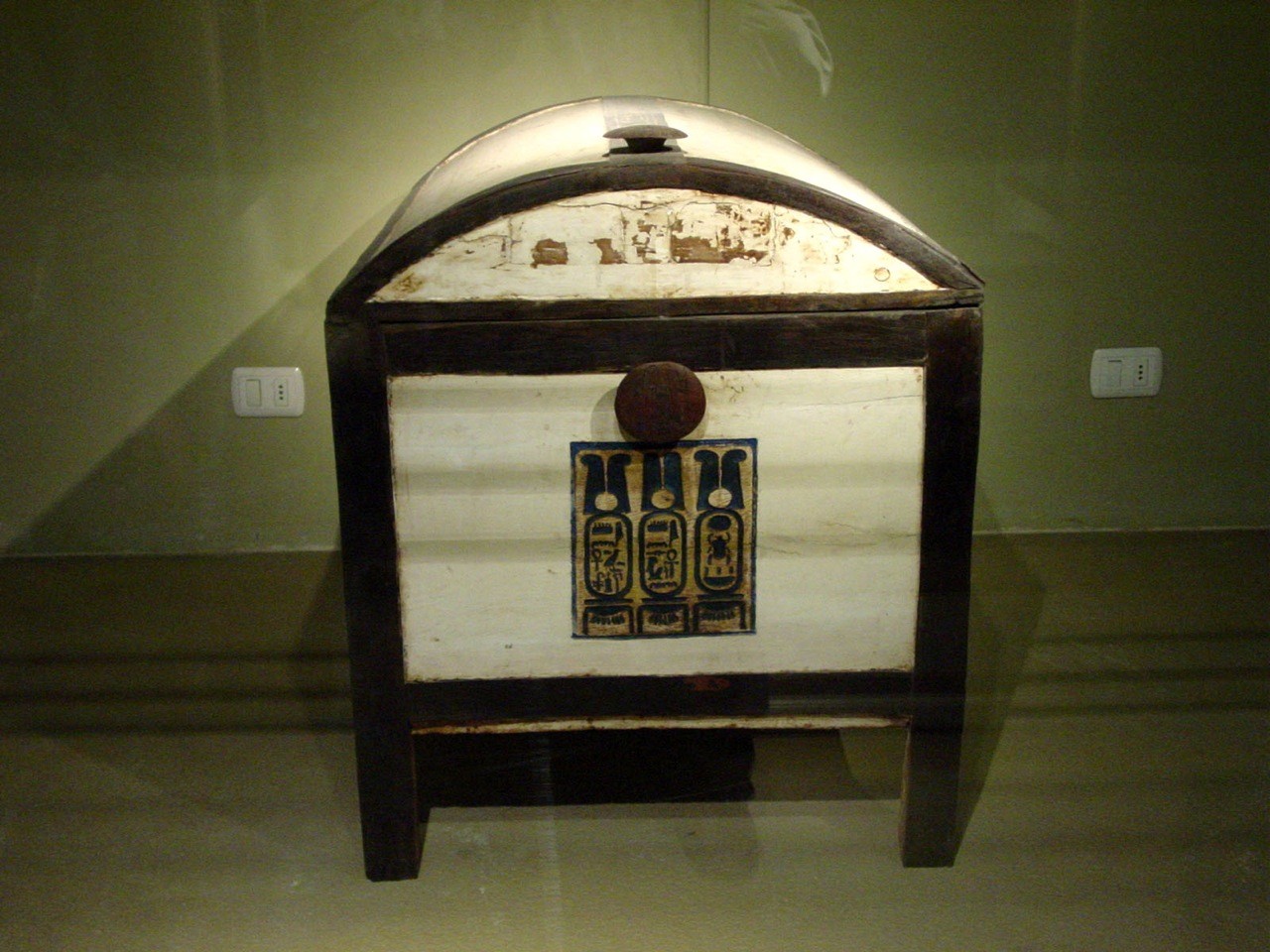
Exodus names four gold rings and gilded acacia carrying poles, which must remain in the rings. It does not explicitly count the poles: the familiar two long poles are an intelligible reconstruction rather than a stated number. [1]
Raanan EichlerRaanan EichlerHebrew Bible scholar at Bar-Ilan University studying the Ark and cherubim.Glossary · Click to read the explanation, a Hebrew Bible scholar, proposes four sliding poles by comparison with a chest from Tutankhamun’s tomb. Retraction helps him explain preparing the poles for carrying while keeping them attached. The furniture photograph here provides context; it is not identified as his comparative Carter object 32. [3]
Kapporet: cover and ritual location
The gold cover is called kapporetKapporetGold object above the biblical Ark, associated with cherubim, divine speech, and the purification rite of Leviticus 16. “Atonement cover” names its position and ritual role; “mercy seat” does not establish a chair.Glossary · Click to read the explanation, kappōret. It is sometimes translated as an atonement cover or mercy seat. The word seat in a translation does not prove an identifiable chair. Exodus describes a cover bearing two cherub figures, with encounter and speech located above it. [1]
In Leviticus 16, the cover becomes central to incense and blood ritual. Craftsmanship and ritual action meet, giving it significance as a place of atonement and encounter. Understanding it as a divine seat is an interpretation of this arrangement, considered alongside alternatives. [5]
The cherubim are not Yahweh’s portrait
In Exodus the cherubimCherubimCherubim as Eden’s guardians, Ark and Temple figures, and beings in Ezekiel’s vision: a plural name, varying descriptions, and the limits of ancient visual comparisons.Glossary · Click to read the explanation are two golden winged beings at the cover’s ends, their faces directed toward one another and the cover. It does not say that each has two faces or provide a complete bodily anatomy. We should not automatically fill the gaps from EzekielEzekielEzekiel is a priest and prophet in the Hebrew Bible, whose book is associated with the Judean exile in Babylonia in the sixth century BCE.Glossary · Click to read the explanation’s visions or later art showing winged infants. [1]
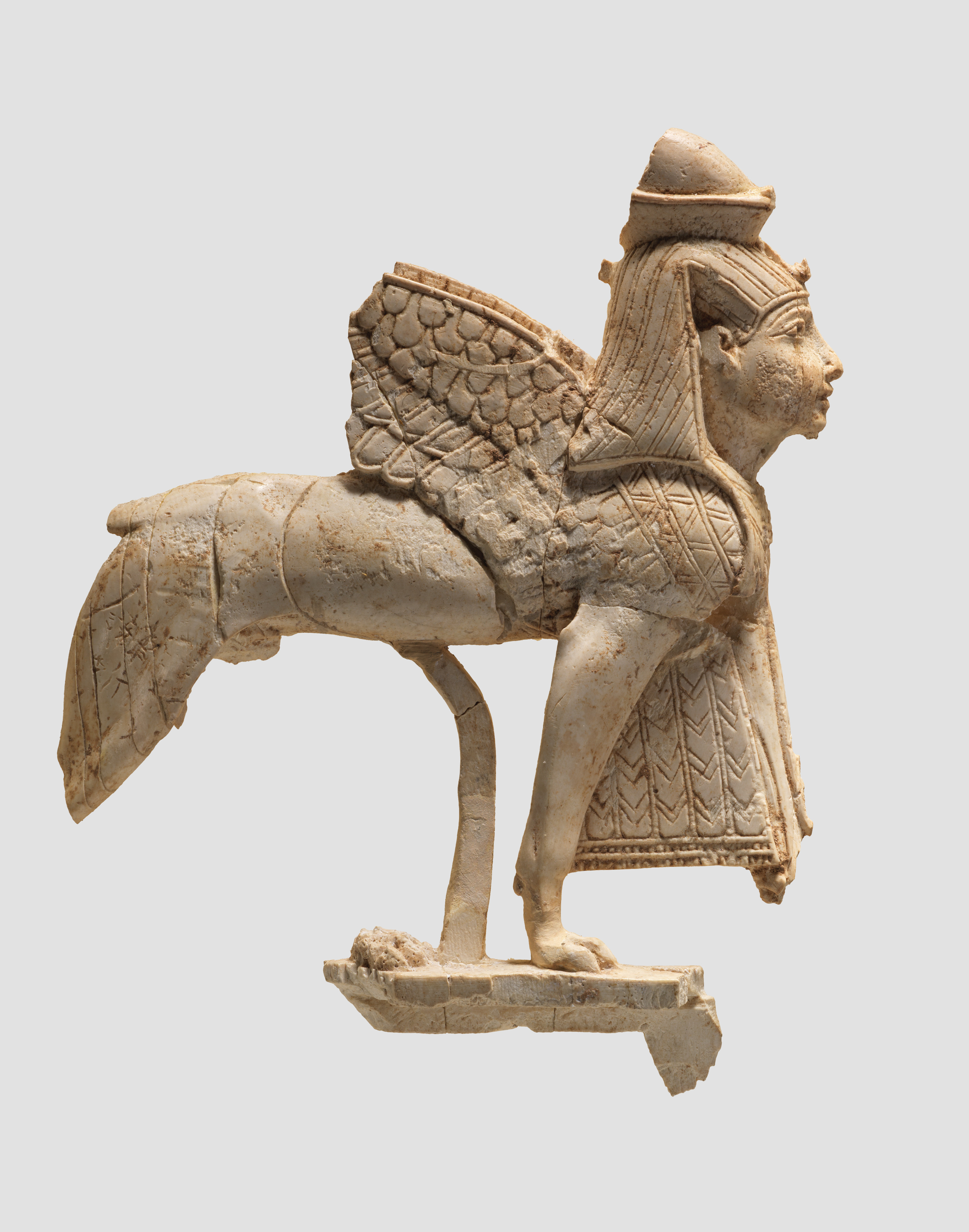
Eichler proposes winged humans rather than the familiar human-headed winged lions. The debate draws on bodily posture, wings and comparison with ancient imagery. Exodus specifies position and facial orientation, while the complete form remains a matter of interpretation. [11]
The voice above the cover
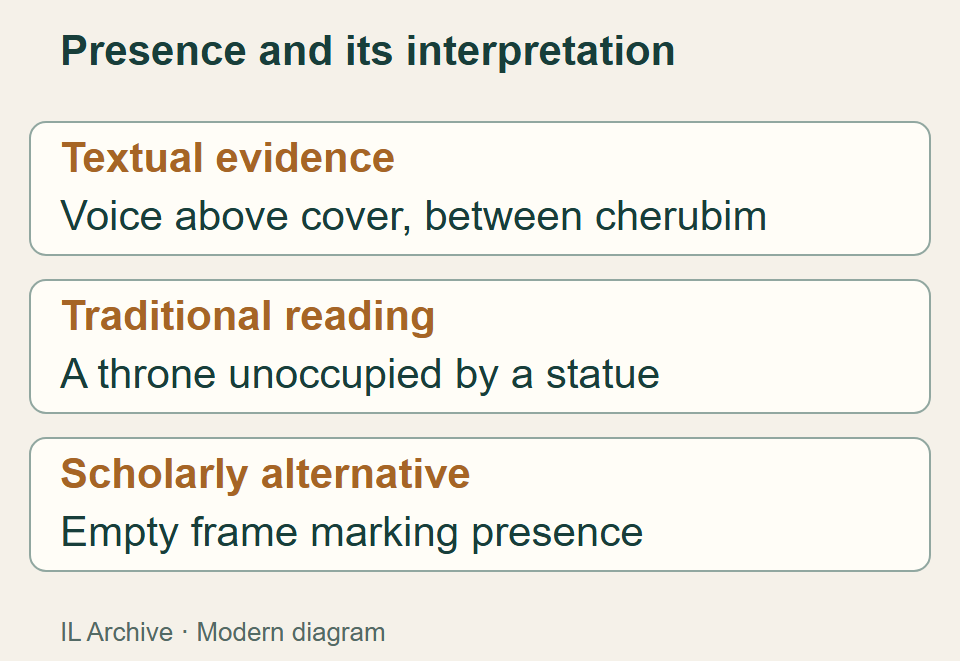
Exodus 25:22 associates the space above the cover, between the cherubim, with meeting MosesMosesCentral figure in Exodus, Torah traditions and the Qur’an; childhood accounts differ in detail.Glossary · Click to read the explanation and speaking to him. Numbers 7:89 repeats this small geography of speech. Neither scene describes Moses hearing a statue’s mouth or instructs the manufacture of a divine body in the center. That absence is clear within the description. [1][4]
The passage creates a spatial relationship between cover, beings and divine speech. It supports presence without a statue described in this text, while neither representing every Israelite practice nor documenting an excavated Ark.
Cloud and incense: manifestation and screen
Leviticus 16:2 associates manifestation with a cloud above the cover; 16:13 makes an incense cloud screen it. The cloud’s role differs between the statements, which both regulate approach to the sacred location and direct visibility. [5]
Cloud also manifests and screens presence at Exodus’s end and the temple dedication in Kings: it fills the space and prevents entry or service. Presence acts within the scene without taking the form of an exposed statue. [6]
When the Ark entered battle
In 1 Samuel 4, the people of IsraelAncient IsraelName attested for a population on the Merneptah Stele around 1208 BCE, later for the northern Iron Age kingdom and for broader textual and religious identities; the senses are not identical.Glossary · Click to read the explanation fetch the Ark from ShilohShiloh / SeilunArchaeological site in the West Bank highlands, associated with the Ark in Samuel.Glossary · Click to read the explanation after defeat, hoping for deliverance. Its arrival produces a great shout, and the Philistines interpret it as a god’s arrival in the camp. This is not the language of a neutral container: the characters connect the Ark with presence and power. [7]
The story ends with Israel defeated and the Ark captured. It combines recognition of the symbol’s power with criticism of confidence that possession guarantees victory. Carrying the sacred object does not, within the narrative, give its characters control over the deity.
“Enthroned on the cherubim”: text and translation
Samuel uses yōšēḇ hakkeruḇîm, frequently translated as sitting or enthroned on the cherubim. The Hebrew formula itself contains no explicit preposition meaning on. Sitting, dwelling and the relationship to the cherubim belong to interpretation; a familiar translation does not settle the issue. [7][11]
Royal meaning gains strength alongside other sanctuary and throne evidence. The wings’ role remains a further question: seat, protection or definition of place? Interpreting the epithet thus differs from reconstructing one physical arrangement.
The traditional reading: throne and footstool
A common interpretation understands the cherubim as parts of a throne unoccupied by a statue, with the chest serving as the deity’s footstool. It draws on royal and divine imagery from the ancient Near EastAncient Near EastModern scholarly label for ancient societies of Mesopotamia, the Levant, Anatolia and Iran, sometimes extending to Egypt and other neighbours depending on the study; not one civilization or religion.Glossary · Click to read the explanation, showing winged creatures around thrones. Comparison makes the model intelligible, but does not prove every winged creature serves the same seating function. [9]
This model combines several witnesses. First Chronicles 28:2 associates the Ark with a footstool, whereas Isaiah 66:1 makes heaven the throne and earth the footstool. Their comparison shows the range of divine-sovereignty language and the throne model’s appeal, without reducing every usage to one chest. [8]
Covenant at the deity’s feet
Treaty comparisons help explain the conjunction of document and divine authority. Scott B. NoegelScott B. NoegelUniversity of Washington scholar of ancient Near Eastern languages and religions.Glossary · Click to read the explanation, a scholar of ancient Near Eastern languages and religions, discusses evidence for placing covenant writing at divine feet in Egyptian and Hittite contexts. Within a footstool interpretation of the Ark, storing the tablets below could signify a deity witnessing relationship and obligation. [9]
These witnesses give the comparison more than a visual resemblance: writing, covenant and sovereignty meet in a ritual arrangement. They can strengthen a historical interpretation alongside carrying, shrine and procession evidence, while the cherubim’s role and the process of adaptation remain debated.
A modern alternative: an empty frame
In The Ark and the Cherubim, Eichler proposes an alternative: the objects together constituted an empty frame defining a place of presence, rather than a throne or footstool. [10]
A throne evokes a king imagined sitting even without a manufactured statue. A frame instead marks the place of presence; Eichler also understands it as limiting anthropomorphic conceptions within worship. [10]
Cover cherubim and temple-room cherubim
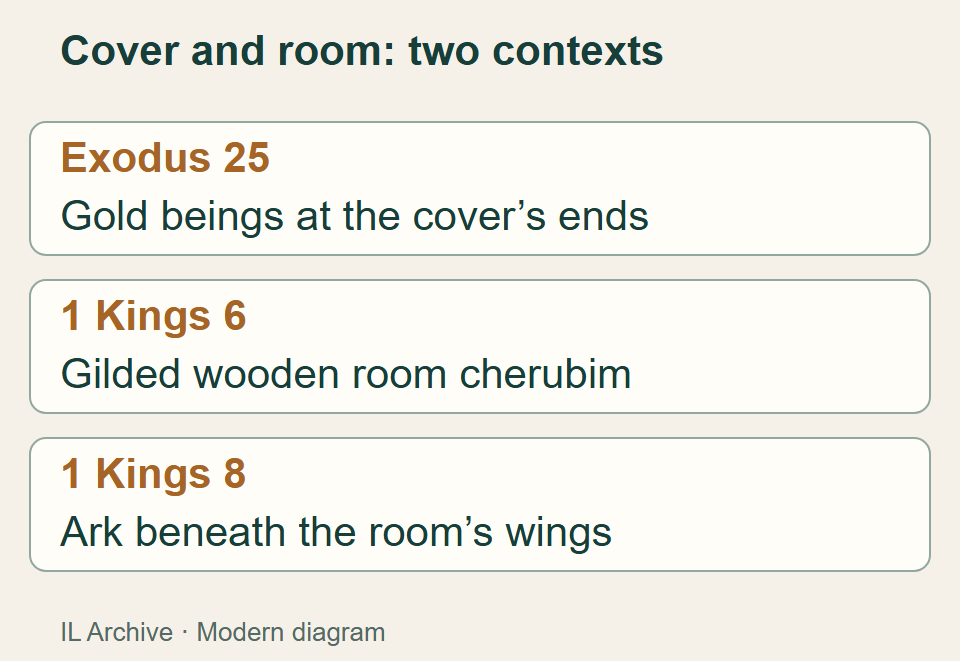
Exodus describes two golden beings at the cover’s ends. 1 Kings 6 describes two large cherubim inside the Holy of HoliesHoly of HoliesMost sacred inner zone of the biblical sanctuary. Kings places the Ark beneath its cherubim; Leviticus regulates approach behind the curtain. Wilderness and Jerusalem temple traditions describe distinct settings.Glossary · Click to read the explanation, made of gilded olivewood and each ten cubits high. Their wings extend across the room; in Kings 8 the Ark is installed beneath them. [1][12]
Differences in material, scale and location help keep each description in view. Cover beings and temple room both relate to the Ark, but combining their details requires an account of the texts’ relationship. The diagram compares the settings instead of inventing an original artifact’s appearance.
The sanctuary was not devoid of images
Kings describes cherub, palm and floral carvings on temple walls and doors. The sculpted cherubim are themselves manufactured images. The absence of a described Yahweh statue therefore cannot become a claim that the worship portrayed here prohibited every image and every art form. [12]
The question becomes where an image is placed and what it does: creatures and ornament surrounding sacred space, or a representation of the deity as worship’s object. A richly figured room can lack a central Yahweh statue in its description; it need not be an artless space.
Egypt: portable shrine and sacred bark
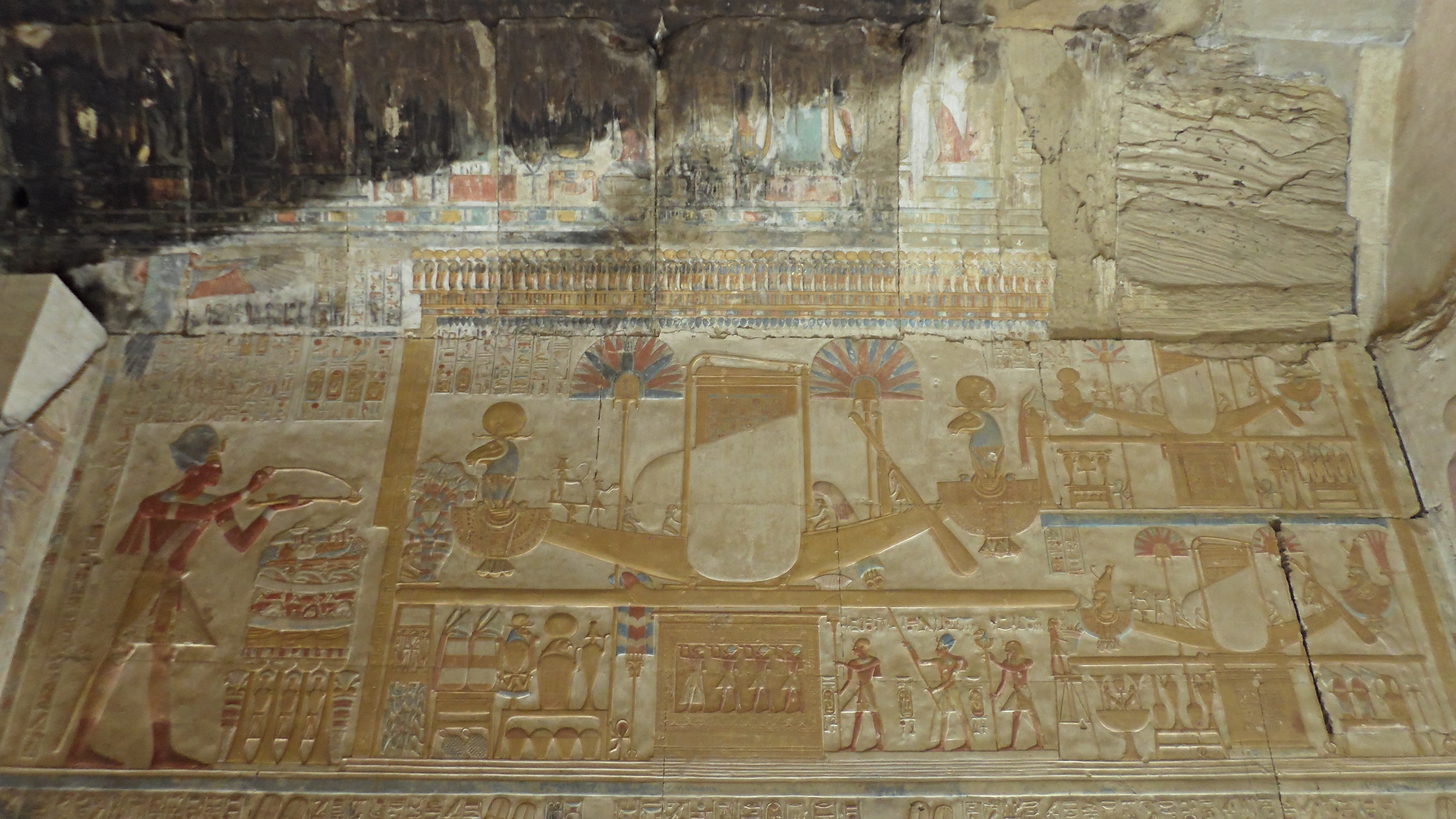
Noegel regards Egyptian sacred barks as the Ark’s strongest non-Israelite parallel. His case combines poles, gold covering, shrine, screening, procession and divine consultation, weighing manufacture and function together rather than a chest’s appearance alone. [9]
Noegel proposes adaptation of a model, not a claim that the Ark literally was a boat. He places the likely Egyptian influence in the Late Bronze AgeLate Bronze AgeAn archaeological period around 1600–1200 BCE in much of the Near East, with international diplomacy, exchange and religious diversity; its endpoints vary by region.Glossary · Click to read the explanation. His argument gains force from combined parallels in manufacture and use, with form and content changed in an Israelite setting. He regards this as a probable historical explanation, distinct from discovering the Ark itself. [9]
Curtain and shrine: what survives materially?
Madeleine MumcuogluMadeleine MumcuogluVirologist with a PhD, also researching archaeological shrines and curtains.Glossary · Click to read the explanation, an archaeology researcher, and Yosef GarfinkelYosef GarfinkelArchaeologist and Hebrew University professor emeritus researching prehistory and the Iron Age.Glossary · Click to read the explanation, an archaeologist, discuss portable clay shrines and curtains. One comparison is an AbydosAbydos in EgyptAncient Upper Egyptian site associated with royal burials and the cult of Osiris.Glossary · Click to read the explanation shrine, CG 70041, associated with surviving textile dated to the twelfth century BCE. It shows that screening a shrine was materially feasible in the region’s ancient world. [13]
Surviving textile is material evidence of concealment; identifying depicted clay ribbons as curtains is an iconographic proposal. Distinguishing them permits each witness to be weighed: artifacts document objects and practices, while comparison explores their relationship with the textual sanctuary.
What was inside the chest?
Exodus orders the testimony deposited in the Ark. In Deuteronomy 10, Moses makes a wooden chest and places the tablets within. Then 1 Kings 8:9 says the Ark contains only the two stone tablets. These passages give the covenant document a clear central position in the presentation of its contents. [1][14][12]
Exodus and Deuteronomy describe keeping the tablets with different details of manufacture. These differences support study of the traditions’ relationship and editing, while the covenant document remains central. They do not alone produce a continuous archaeological history of the chest.
Manna and Aaron’s staff: preserve the difference
The New Testament Letter to the Hebrews (9:4) includes the manna vessel, AaronAaron, priest in the biblical narrativeMoses’s brother and a priest in biblical narrative; Leviticus 16 assigns him sanctuary purification and confession over the living goat.Glossary · Click to read the explanation’s staff and tablets among the Ark’s contents. Exodus 16 and Numbers 17 describe preserving manna and staff before the testimony. Kings emphasizes the tablets alone. These differences should not disappear into a claim that every text supplies an identical list. [15][12]
These are differing lists and placements. Religious interpretation may harmonize them, while research retains each passage’s wording. For locating the reference, Numbers 17:25 in Hebrew corresponds to 17:10 in many English translations. [15]
Did the Ark conceal a statue?
One can hypothesize that at an undocumented stage the chest held a statue or divine symbol, or that its description was later reinterpreted. Comparison with an Egyptian shrine containing an image does not establish that history. The texts examined here narrate no removal of a Yahweh statue; their explicit contents emphasize testimony and tablets. [1][12][14]
That hypothesis is less documented than the tablets in the explicit descriptions. The evidence used here includes neither a verified original Ark nor an account of a statue removed from it. Conversely, absence in this description remains narrower than a judgment on all Israelite history.
Archaeology supplies context, not every missing detail
Egyptian furniture, clay shrines and winged imagery illuminate a world familiar with carrying, concealing and framing sacred objects. Resemblance does not turn them into the Ark. A photograph of a real artifact first supplies information about that artifact, then supports comparison within stated limits. [3][9][13]
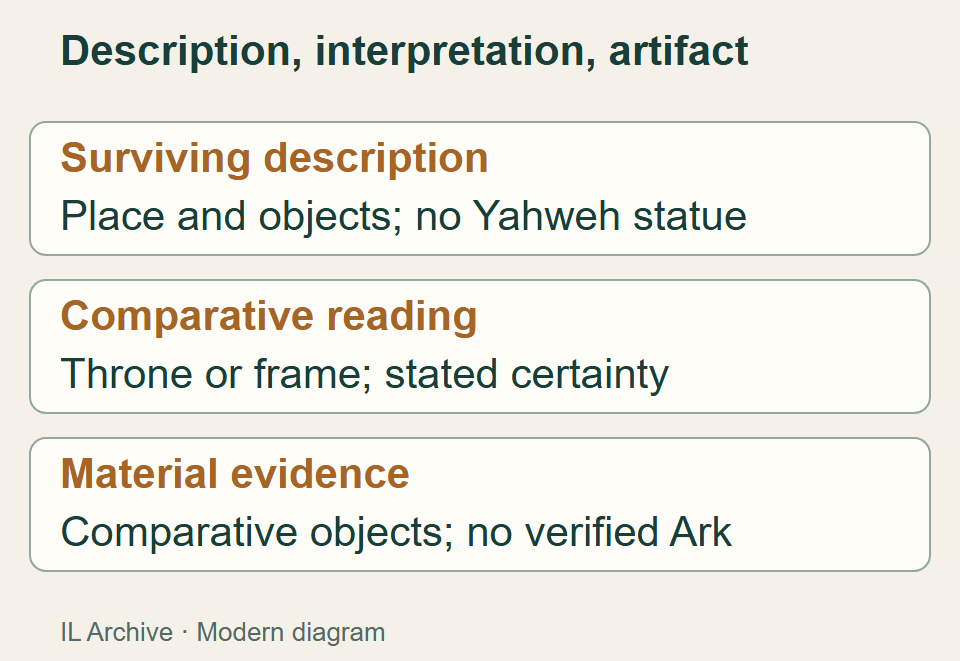
Sites such as Shiloh, Beth ShemeshAncient Beth ShemeshShephelah archaeological site associated with the Ark’s return in 1 Samuel.Glossary · Click to read the explanation and Kiriath-jearimKiriath-jearim / Deir el-AzarArchaeological hill west of Jerusalem near Abu Ghosh, associated with the Ark in Samuel.Glossary · Click to read the explanation provide narrative geography. Documenting a site or building differs from identifying an object once inside it. The accompanying diagrams organize evidence and interpretation rather than reconstructing a lost Ark’s form.
A divine body in language is not necessarily a statue
Hebrew texts speak of Yahweh’s face, hand and back, notably in Exodus 33. This belongs to the study of anthropomorphismAnthropomorphismRepresentation of a thing or being with human traits. It describes visible or linguistically attributed features, not by itself a person, ancestor or deity.Glossary · Click to read the explanation. It does not prove the speaker was looking at a cult statue, while a statue’s absence from the Ark description does not establish an entirely disembodied conception of the deity. [16]
A bodily image in language differs from a body manufactured for a temple. A text can imagine face or hand without describing a cult statue. A “throne without a statue” therefore concerns representation of presence in the sanctuary, rather than every conception of divine embodiment.
Aniconism: define the term’s scope
AniconismAniconismDivine presence expressed in worship without a central anthropomorphic or zoomorphic image; it may describe an image-free practice or an explicit rejection, depending on contextual evidence.Glossary · Click to read the explanation here describes worship without representing the deity in a cult statue or image. This definition leaves room for ornament and creature imagery. Representation, monotheismMonotheismBelief that only one God possesses divinity in its fullest sense. Historically distinct from exclusively worshipping one deity without denying others; its theological forms vary.Glossary · Click to read the explanation and the social extent of a practice are related but distinct questions. [1][12]
Here material objects, imagery and ritual gather around a location where no manufactured Yahweh body is mentioned. Aniconism can thus be examined as a choice about representing the deity within a practice rich in forms and sensory things.
Words inside, presence above
The texts permit a compelling interpretation: tablets inside the chest, speech above the cover and between the cherubim. Written covenant meets a presence addressing the community. The Ark can thus be understood as keeping and renewing a relationship, rather than as an impoverished substitute for a missing statue. [1][4][14]
This reading concerns a scene’s construction and meaning; historical change between forms of worship needs further evidence. Images and ritual remained, while the texts belong to multiple stages. Dating monotheism is consequently broader than interpreting the Ark’s arrangement.
Degrees of certainty
Textually, Exodus describes a gilded chest, cover and two cherubim, locates speech above the cover between them, and gives no instruction for a Yahweh statue there. Kings describes large room cherubim and figured decoration, and names only the tablets inside the Ark. These are specific reading results. [1][4][12]
Interpretations have a different weight from these explicit descriptions. The throne model combines royal imagery; Eichler proposes a frame; Noegel argues for adaptation of an Egyptian model through converging parallels. A removed hidden statue or continuous physical history of every change lacks comparable documentation here. [9][10][13]
The Ark: presence does not depend on a statue
“A throne without a statue?” remains useful with its question mark intact. It captures a powerful traditional reading while allowing an interpretation as a frame or encounter space. The firmer conclusion is not a chair we can confidently draw, but that key texts locate Yahweh’s presence without describing his statue between the cherubim. [1][4][10]
The Ark emerges as a location joining covenant and voice with wood, gold and wings. It opens a question about constructing sacred presence, while distinctions between literary description, comparative interpretation and surviving artifacts sustain a balanced reading.
References and notes (16)
- Exodus 25:10–22. Hebrew text, Sefaria. Wood, gold, dimensions, rings, poles, cover, cherubim and speech location. Pole count not explicit. Textual description, not documentation of an excavated object. Return to the text ↑
- Raanan Eichler (2017). “Ark of the Covenant.” Oxford Bibliographies. DOI: 10.1093/obo/9780195393361-0245. Public introduction only: portable chest, covenant documents, divine presence and sanctuary location. Restricted portions were not read in full. Return to the text ↑
- Raanan Eichler (2016). “The Poles of the Ark and Tutankhamun’s Chest.” TheTorah.com. No explicit pole count; author proposes four sliding poles, comparing Carter object 32. Research proposal; the contextual photograph here is not identified as that chest. Return to the text ↑
- Numbers 7:89. Hebrew text, Sefaria. Speech heard above the cover between the cherubim; no Yahweh statue described there. Return to the text ↑
- Leviticus 16:2, 13–14. Hebrew text, Sefaria. Appearance in a cloud over the cover, incense cloud and blood rite. Distinguish expressions and roles rather than equating every cloud with incense. Return to the text ↑
- Exodus 40:34–35; 1 Kings 8:10–11. Hebrew text, Sefaria. Cloud and glory in the tent and temple dedication. Literary depictions of presence, not photographic records of archaeological events. Return to the text ↑
- 1 Samuel 4:3–11; 2 Samuel 6:2. Hebrew text, Sefaria. Shiloh procession, defeat and capture; yōšēḇ hakkeruḇîm. The formula contains no explicit “on” preposition; enthronement translation is contextual. Return to the text ↑
- 1 Chronicles 28:2; Isaiah 66:1. Hebrew text, Sefaria. First connects Ark and footstool; second calls earth the footstool and heaven the throne. The term alone does not establish one material blueprint. Return to the text ↑
- Scott B. Noegel (2015). “The Egyptian Origin of the Ark of the Covenant.” In Israel’s Exodus in Transdisciplinary Perspective, pp.223–243. DOI: 10.1007/978-3-319-04768-3_17. The chapter abstract was also read; it proposes likely Egyptian influence in the Late Bronze Age. Pp.223–229: Ark description, conventional interpretation, sacred barks, images, procession, oracle and covenant texts at divine feet. Egyptian origin is Noegel’s hypothesis, not conclusive archaeology. Not the entire chapter. Return to the text ↑
- Raanan Eichler (2021). The Ark and the Cherubim. Forschungen zum Alten Testament 146. Mohr Siebeck. DOI: 10.1628/978-3-16-159264-5. Publisher description: rejection of throne/footstool model and proposal of an empty frame. Documents the announced position, not a full reading of the book’s arguments. Return to the text ↑
- Raanan Eichler (2016). “What Kind of Creatures Are the Cherubim?” TheTorah.com. Form survey, sitting/dwelling formula, criticism of winged-sphinx identification and proposal of winged humans. Contested identification, not a verified original object. Return to the text ↑
- 1 Kings 6:23–35; 8:6–9. Hebrew text, Sefaria. Gilded olivewood room cherubim ten cubits high; cherub, palm and floral decoration; Ark under wings, only two tablets within in 8:9. Return to the text ↑
- Madeleine Mumcuoglu and Yosef Garfinkel (2020). “Was a Sacred Curtain (Parokhet) Depicted on Portable Shrines in the Ancient Near East?” Religions 11(9),469. DOI: 10.3390/rel11090469. Comparative shrines and curtains; Abydos CG 70041 with associated textile, twelfth century BCE. Clay-ribbon curtains are an iconographic proposal. Does not adopt the erroneous Hatshepsut date in figure 3 caption. Return to the text ↑
- Deuteronomy 10:1–5. Hebrew text, Sefaria. Moses makes a wooden chest and deposits the tablets. Description differs from Exodus; does not by itself date either tradition or the object. Return to the text ↑
- Hebrews 9:1–5; Exodus 16:33–34; Numbers 17:25 (Hebrew numbering, often 17:10 in English). Hebrews 9:4 includes manna, staff and tablets; Torah passages place manna/staff “before” the testimony. Difference retained without imposing one harmonization. Article paraphrases, not a modern-translation quotation. Return to the text ↑
- Exodus 33:20–23. Hebrew text, Sefaria. Face, hand and back language; bodily description does not establish a cult statue or its absence throughout Israelite history. Return to the text ↑
Suggest a correction · Suggest a source for this record
Cite this record
IL Archive, «The Ark of the Covenant: A Throne without a Statue?», https://ilarchive.com/en/studies/ark-throne-without-image
Continue reading