Entity · Concept
Ark of the Covenant
A reference page linking a name, group, or concept to the materials that discuss it.
Sacred chest associated with covenant and divine presence in the Hebrew Bible: descriptions, contents, capture and transport narratives, functions, Egyptian comparisons, and the distinction between narrative and textual history.
Estimated reading time: 7 min Published Last reviewed:
Share article
Text
Introduction
The Ark of the Covenant is a sacred portable chest in the HebrewHebrewA Northwest Semitic language of the Canaanite group, encompassing Iron Age epigraphy, Biblical, Rabbinic, medieval and Modern Hebrew; its scripts and pronunciations changed over time.Glossary · Click to read the explanation Bible, associated with the covenant tablets and with the presence of Israel’s god, YHWHYahwehThe proper name of Israel’s deity, written יהוה (YHWH), the Tetragrammaton. Its exact ancient pronunciation is not directly preserved; texts and inscriptions witness its history.Glossary · Click to read the explanation. Hebrew ʾărôn habbĕrît means the chest of the covenant; it is not NoahNoahNoah is the flood-story figure in Genesis and a prophet in the Qur’anGlossary · Click to read the explanation’s vessel, designated by a different Hebrew word. Exodus, Deuteronomy, Samuel, and Kings give it different descriptive and narrative emphases. Reading these witnesses together is useful, provided that their differences are not silently converted into one archaeological object whose complete history and appearance are known. [1][2][3][4]
A chest, its covering, and the tablets
Exodus 25:10–22 prescribes an acacia-wood chest two and a half cubits long and one and a half cubits wide and high, overlaid with gold inside and outside. Four rings receive gold-covered wooden carrying poles, which are to remain in place. Cubits are retained here because converting them to one exact modern measurement would conceal uncertainty about the unit. Exodus 37:1–9 attributes execution of the work to Bezalel. [1]
Above the chest is the kapporetKapporetGold object above the biblical Ark, associated with cherubim, divine speech, and the purification rite of Leviticus 16. “Atonement cover” names its position and ritual role; “mercy seat” does not establish a chair.Glossary · Click to read the explanation, a pure-gold covering with two hammered-gold cherubimCherubimCherubim as Eden’s guardians, Ark and Temple figures, and beings in Ezekiel’s vision: a plural name, varying descriptions, and the limits of ancient visual comparisons.Glossary · Click to read the explanation. Its length and width correspond to the chest’s, while its thickness is not specified. The figures face one another, with wings spread over the covering. The text does not prescribe a human image of YHWH sitting there. Chest, covering, and cherubim must nevertheless be distinguished: the account describes their relations, not a modern museum reconstruction. [1]
Deuteronomy 10:1–5 gives a different emphasis. MosesMosesCentral figure in Exodus, Torah traditions and the Qur’an; childhood accounts differ in detail.Glossary · Click to read the explanation makes a wooden chest to receive the replacement tablets after the first pair was broken. Gold and cherubim do not form part of this account’s description. That omission does not by itself prove a different physical object, but neither should the reader erase the contrast by importing every Exodus detail. In Deuteronomy 31:24–26 the book of the law is placed beside the Ark, not inside it. [4]
Kings is explicit about the contents at the temple installation:
The later Christian text Hebrews 9:4 also puts the manna jar and Aaron’s staff inside the Ark. That is a distinct textual inventory, not a reason to rewrite Kings’ “nothing…except.” The biblical library preserves different presentations, and an accurate description must identify which witness it follows. [3][5]
Presence and speech: more than a container
Exodus 25:22 locates the divine encounter and speech above the covering, between the cherubim. The tablets explain the language of covenant and testimony, but storage alone does not account for the Ark’s narrative importance. Its sacred setting also makes presence, communication, and controlled access central. Leviticus 16 associates the covering with incense and blood rites that purify the sanctuary; it does not turn the chest into a sacrificial altar. [1][6]
A different image appears in David’s speech in 1 Chronicles 28:2:
The association with a divine footstool supports a royal-presence interpretation alongside the chest’s function as a repository. It does not supply the missing dimensions of a throne or prove that the gold covering was a literal chair. The strongest reading allows these functions to coexist within the texts, rather than declaring one speculative original function to explain every passage. [1][7]
Procession, capture, and the danger of proximity
In Joshua 3, priests bearing the Ark enter the Jordan; the narrative connects their arrival with the waters stopping and the people crossing. Joshua 6 places the Ark within the ritualRitualAn organised or distinguished practice meaningful to a community; it may leave traces, but its form alone does not reveal an associated doctrine.Glossary · Click to read the explanation circuits of Jericho, accompanied by priests and horns, before the wall falls. These scenes make divine guidance and conquest prominent. Their literary contrast with the later defeat in Samuel shows why the Ark cannot be treated as a mechanically effective weapon in every story. [16]
In 1 Samuel 4 the Ark is brought from Shiloh into battle against the Philistines because the Israelites expect it to help secure victory. They are defeated and it is captured. The story therefore frustrates, rather than simply endorses, the idea that possession of the sacred object guarantees military success. [8]
Chapters 5–6 follow its presence among the Philistines: DagonDaganA god worshipped in Syria and Mesopotamia, especially at Tuttul and Terqa on the Euphrates, and associated with royal authority. His name appears as Dagon in the Hebrew Bible; no ancient image of him is securely identified.Glossary · Click to read the explanation’s image falls before it, affliction spreads, and it is returned on a cart drawn by cows. The gold offerings accompanying the return occupy a separate container. The danger also reaches Israelites at Beth-shemesh. These episodes portray divine power as resistant to both enemy appropriation and Israelite presumption. They are narrative witnesses, not independent reports verifying every event. [8]
In 2 Samuel 6 David’s first attempt to transport the Ark is interrupted by Uzzah’s death after he reaches toward it. The Ark remains with Obed-edom for three months, brings blessing to his household, and is then brought to JerusalemJerusalemJerusalem is a city of religious importance in Judaism, Christianity and IslamGlossary · Click to read the explanation amid ritual celebration. Danger and blessing belong to the same account; reducing the Ark to a weapon or a benign emblem misses that tension. [9]
Jerusalem: the room is not the covering
In 1 Kings 8 the Ark enters the Holy of HoliesHoly of HoliesMost sacred inner zone of the biblical sanctuary. Kings places the Ark beneath its cherubim; Leviticus regulates approach behind the curtain. Wilderness and Jerusalem temple traditions describe distinct settings.Glossary · Click to read the explanation beneath the wings of the room’s cherubim. According to 6:23–28 these figures are olive wood covered with gold, each ten cubits high. They are not simply enlarged versions of the hammered-gold figures attached to the covering in Exodus. The distinction affects any illustration: a reconstruction must say which passage and scale it represents, rather than merging the two arrangements without explanation. [1][3]
The temple installation marks a change of setting within the narrative, from a movable sacred object to its placement in a royal sanctuary. It does not establish that the descriptions in Exodus were written earlier than those in Kings. The sequence of episodes and the formation of the literary accounts are separate historical questions. [3][10]
Egyptian comparison: similarities and limits
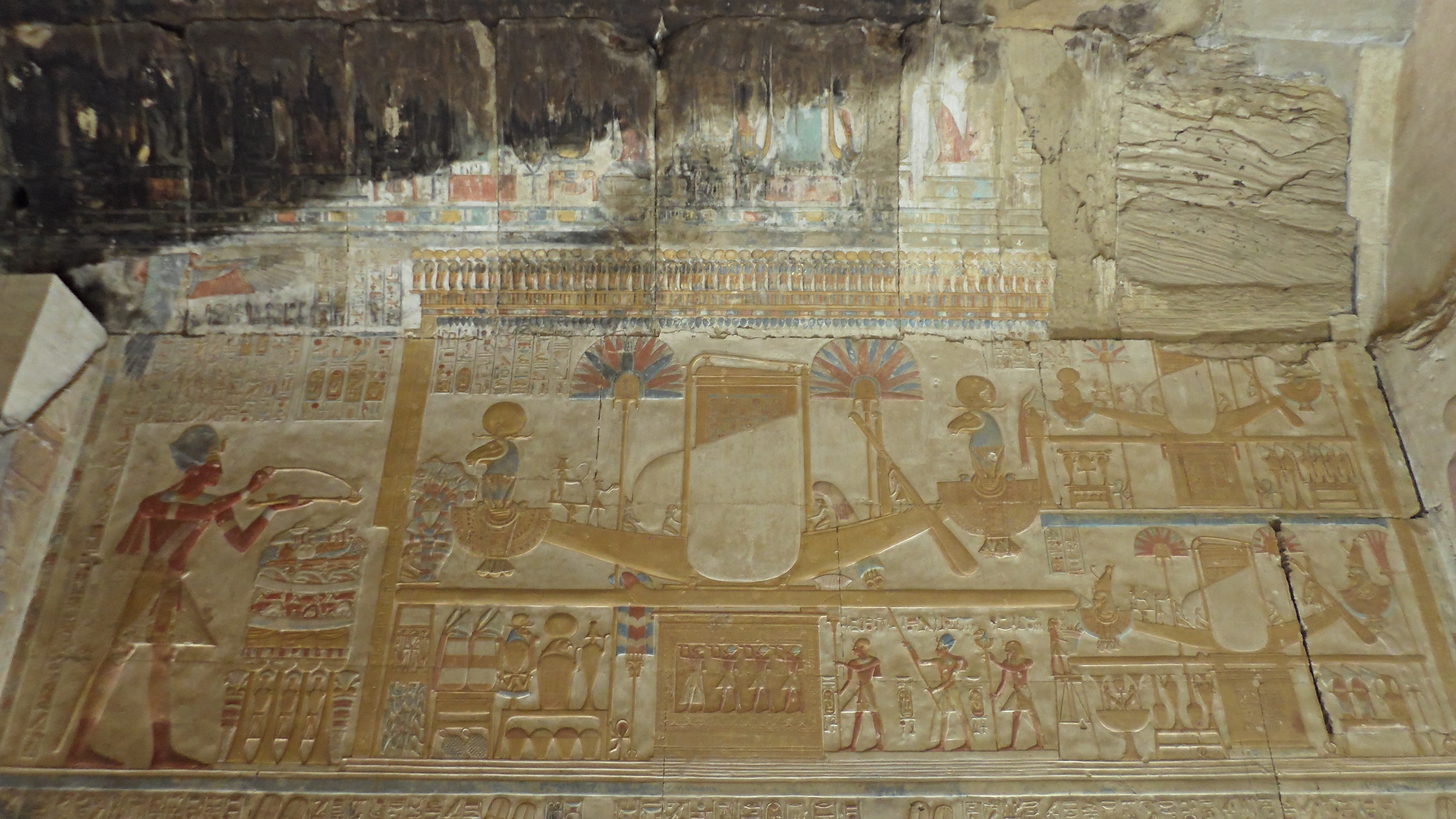
Scott Noegel argues that Egyptian processional barks provide a model for the Ark: portable sacred structures, poles, valuable materials, and divine presence. His comparison is illuminating, but Egyptian barks housed a divine image and had a boat form absent from the biblical chest. Noegel himself proposes adaptation, not identity; the parallels nevertheless do not by themselves establish direct derivation. [11]
The photograph presents actual Egyptian reliefs: the festival barks of Amun, Khonsu, and Mut in the chapel of Amun at Seti I’s temple at Abydos. It illustrates a comparative ritual setting, not the Ark, an Israelite artifact, or proof of borrowing. [12]
Absence, later traditions, and historical sequence
Jeremiah 3:16 imagines a future in which the Ark will no longer be remembered, missed, or made again. This is not an eyewitness report of its destruction. Second Maccabees 2:4–8 tells instead of Jeremiah concealing sacred objects in a cave and leaving their location unknown until divine restoration. These witnesses answer theological questions about absence; neither supplies a verified modern findspot. [13][14]
The chronology should therefore be kept in separate layers:
- Narrated settings: the wilderness traditions concern Moses; Samuel and Kings place the Ark in Shiloh, Philistine territory, and Jerusalem. David and Solomon are conventionally situated in the tenth century BCE, not dated here by the Ark itself. [1][3][8][9]
- Composition and editing: the surviving accounts belong to different literary traditions. Their relative dating, including priestly and Deuteronomistic materials, remains disputed; a simple progression from “plain chest” to “gold throne” is not established by narrative order. [10]
- Surviving textual witnesses: a medieval codex is not the author’s original. The Aleppo Codex, about 930 CE, is one landmark of Hebrew biblical transmission; most of its Torah portion is now lost. Our quotations follow modern electronic Hebrew editions, not direct inspection of that manuscript. [15]
The most secure result is a differentiated account of how the texts describe and interpret the Ark. Its precise manufacture, the history behind each episode, and its eventual physical fate cannot be recovered merely by assembling every passage into a single uninterrupted biography.
References and notes (16)
- Exodus 25:10–22; 37:1–9. Hebrew text, Sefaria, Miqra according to the Masorah. Both passages read. Chest dimensions: 25:10; gold, rings, poles: 11–15; cover and cherubim: 17–21; speech: 22; execution: 37:1–9. Cover thickness is not specified. Return to the text ↑
- Raanan Eichler, “Ark of the Covenant,” Oxford Bibliographies in Biblical Studies (2017; reviewed 2023). DOI: 10.1093/obo/9780195393361-0245. Only the public introduction and opening of General Treatments read; subscription-restricted remainder not read. General definition uses that introduction and primary passages, not assumed details from inaccessible sections. Return to the text ↑
- 1 Kings 6; 8:1–13. Hebrew text, Sefaria, Miqra according to the Masorah. Chapter 6 and 8:1–13 read in full. Room cherubim: 6:23–28; Ark: 8:6–9. Quotation opens 8:9, retaining vowels, omitting cantillation, without restoration; editorial translations. Return to the text ↑
- Deuteronomy 10:1–5; 31:24–26. Hebrew text, Sefaria. Both passages read in full: chest and replacement tablets in chapter 10; law book beside Ark in chapter 31. Chapter 10’s description does not mention gold or cherubim. Return to the text ↑
- Hebrews 9:1–14, New American Bible, USCCB. Verses 1–14 and note to verse 4 read. Used here only for the inventory in 9:4. English translation read, not Greek original; wording paraphrased rather than quoted. Return to the text ↑
- Leviticus 16. Hebrew text, Sefaria. Entire chapter read; curtain and covering: 2; incense, blood, and sanctuary purification: 12–20. Return to the text ↑
- 1 Chronicles 28:2. Hebrew text, Sefaria, Miqra according to the Masorah. Full verse read; quotation is the Ark-and-footstool phrase, with vowels but without cantillation or restoration. Editorial translations; royal imagery is a contextual inference, not a plan of an excavated throne. Return to the text ↑
- 1 Samuel 4–6. Sefaria. Three chapters read in English translation with relevant passages checked; used to summarize capture and return narratives, not to affirm every event as history. Disputed numerical details at Beth-shemesh are not reproduced. Return to the text ↑
- 2 Samuel 6. Sefaria. Entire chapter read in English translation: Uzzah’s death, three months with Obed-edom, and entry into Jerusalem with celebration. Return to the text ↑
- Maria J. Metzler, The Ark of the Covenant and Divine Rage in the Hebrew Bible (Harvard University dissertation, 2016), pp. 52–53. Pages read on disputed relative dating of priestly and Deuteronomistic materials. Dissertation not read in full; no single settled chronology asserted here. Return to the text ↑
- Scott B. Noegel, “The Egyptian Origin of the Ark of the Covenant,” in Israel’s Exodus in Transdisciplinary Perspective (2015), pp. 223–241. Pages 223–231 and beginning of 232 read, not the whole chapter. Comparison uses processional bark discussion on 226–230. Derivation hypothesis attributed to author, not adopted as an established result. Return to the text ↑
- A. Parrot, Barques of Amun, Mut, and Khonsu, Temple of Seti I at Abydos, photograph (2015), Wikimedia Commons. Photographer’s page read for location and license: south wall, Amun chapel, Seti I temple, Abydos; Amun in main scene, Khonsu upper right, Mut below. CC0. Photograph does not depict the Ark. Return to the text ↑
- Jeremiah 3:16. Hebrew text, Sefaria. Verse read in Hebrew and translation; future absence of remembering, missing, or making the Ark, not an eyewitness destruction report. Return to the text ↑
- 2 Maccabees 2:4–8, New American Bible, USCCB. Passage and note to 4–5 read in English. Tradition of hidden sacred objects and future revelation, not archaeological documentation of the Ark’s location; Greek original not examined. Return to the text ↑
- Yad Ben-Zvi, “The Aleppo Codex.” Full page read: ca. 930 CE and loss of most Torah. Landmark of textual transmission, not date of Ark construction or composition of its description. Return to the text ↑
- Joshua 3; 6. Sefaria. Both chapters read in full in English translation. Used for crossing in 3:13–17 and circuits in 6:6–20, not archaeological verification or event dating. Return to the text ↑
Suggest a correction · Suggest a source for this record
Cite this record
IL Archive, «Ark of the Covenant», https://ilarchive.com/en/entities/ark-of-covenant
Continue reading