Entity · Concept
Holy of Holies
A reference page linking a name, group, or concept to the materials that discuss it.
The biblical sanctuary’s most sacred inner chamber: its furnishings, boundaries, and relation to the Ark, distinguishing wilderness and Jerusalem traditions from comparative archaeological evidence.
Estimated reading time: 5 min Published Last reviewed:
Share article
Text
Introduction
The Holy of Holies is the most sacred inner zone of the biblical sanctuary, not a name for the entire temple. HebrewHebrewA Northwest Semitic language of the Canaanite group, encompassing Iron Age epigraphy, Biblical, Rabbinic, medieval and Modern Hebrew; its scripts and pronunciations changed over time.Glossary · Click to read the explanation qōdeš haqqŏdāšîm expresses a superlative degree of holiness. In the description of Solomon’s temple, this inner chamber is also called the dĕbîr. Its distinctiveness lies not only in its position but in the furnishings, boundaries, and regulated approach associated with divine presence. The wilderness sanctuary, Solomon’s temple, and the later Second Temple must nevertheless be examined separately. [1][2][3]
The inner chamber in Kings
When the priests carry the Ark of the CovenantArk of the CovenantPortable sacred chest in the Hebrew Bible, associated with the covenant tablets and divine presence. Descriptions and roles differ in Exodus, Deuteronomy, Samuel, and Kings. It is distinct from Noah’s vessel.Glossary · Click to read the explanation into the temple, 1 Kings 8:6 describes its destination with two expressions:
The continuation places the Ark beneath the cherubimCherubimCherubim as Eden’s guardians, Ark and Temple figures, and beings in Ezekiel’s vision: a plural name, varying descriptions, and the limits of ancient visual comparisons.Glossary · Click to read the explanation’s wings. In 1 Kings 6:16–20 the room occupies the rear twenty cubits of the building and measures twenty cubits in length, width, and height: a cube in the textual description. Cedar panelling and gold covering distinguish the interior. Retaining cubits avoids turning an uncertain ancient unit into a falsely exact modern measurement. [1]
Two olive-wood cherubim overlaid with gold stand in this room. Each is ten cubits high, with a ten-cubit wingspan; their outer wings touch the walls and their inner wings meet. Carved cherubim, palms, and flowers also decorate walls and doors. These large figures are not the hammered-gold cherubim attached to the Ark’s cover in Exodus 25. In Kings, the Ark lies under the room’s figures, and 8:9 specifies two stone tablets as its contents. The room, the chest, and its covering are therefore distinct levels of description. [1][2]
A curtain in Exodus, doors in Kings
Exodus 26:31–35 places a woven curtain between the holy place and the Holy of Holies, with the Ark and kapporetKapporetGold object above the biblical Ark, associated with cherubim, divine speech, and the purification rite of Leviticus 16. “Atonement cover” names its position and ritual role; “mercy seat” does not establish a chair.Glossary · Click to read the explanation behind it. The table and lampstand stand outside this partition. The curtain marks an interior boundary; it is not identical to the entrance screen described in verses 36–37. [2]
Kings instead describes olive-wood doors for the inner chamber, decorated and overlaid with gold (1 Kings 6:31–32). A modern plan that combines every detail from both passages may be an interpretive model, but it is not a drawing directly supplied by either text. This distinction matters especially when a portable sanctuary and a monumental building are presented as if they shared one securely recoverable architectural arrangement. [1][2]
Access and the annual purification rite
Leviticus 16:2 warns Aaron against entering behind the curtain whenever he wishes. The chapter then provides a permitted procedure: washing, linen garments, sacrifices, incense, and applications of blood. The incense cloud covers the kapporet; blood rites address the contamination of sanctuary, tent, and altar. Approach is regulated rather than absolutely forbidden. [3]
Verses 29–34 assign the observance to the tenth day of the seventh month, annually. This is the basis of the association with the Day of AtonementYom Kippur — Day of AtonementJewish observance on 10 Tishrei; Leviticus 16’s sanctuary purification and two-goat rite are distinct from later Mishnaic accounts and from fasting, prayer and repentance.Glossary · Click to read the explanation, Yom Kippur. “Once a year” does not mean that only one movement across the threshold occurs: the prescribed sequence distinguishes bringing incense, the bull’s blood, and the goat’s blood. The text regulates the priest’s actions and the community’s purification together, not simply the secrecy of a room. [3]
A sacred interior without the Ark
The absence of an Ark does not erase the category of an inner sanctuary. Josephus, writing The Jewish War around 77 CE and describing the temple destroyed in 70, says that its innermost twenty-cubit space contained nothing and was screened by a veil (5.219). This is evidence about his representation of the late Second Temple, not about Solomon’s room centuries earlier. [4]
Mishnah Yoma 5:2 introduces its account of a stone on which the priest set the incense-pan with these words:
The Mishnah was compiled around 200 CE, after the temple’s destruction. Its account preserves ritualRitualAn organised or distinguished practice meaningful to a community; it may leave traces, but its form alone does not reveal an associated doctrine.Glossary · Click to read the explanation memory of an absent Ark and a stone called šĕtiyyâ, but is not a contemporary excavation record. Josephus and the Mishnah support the importance of a sacred interior without the Ark; their different descriptions should not be flattened into identical inventories, nor used to establish where the Ark went. [5]
Archaeology: useful comparisons, not the recovered room
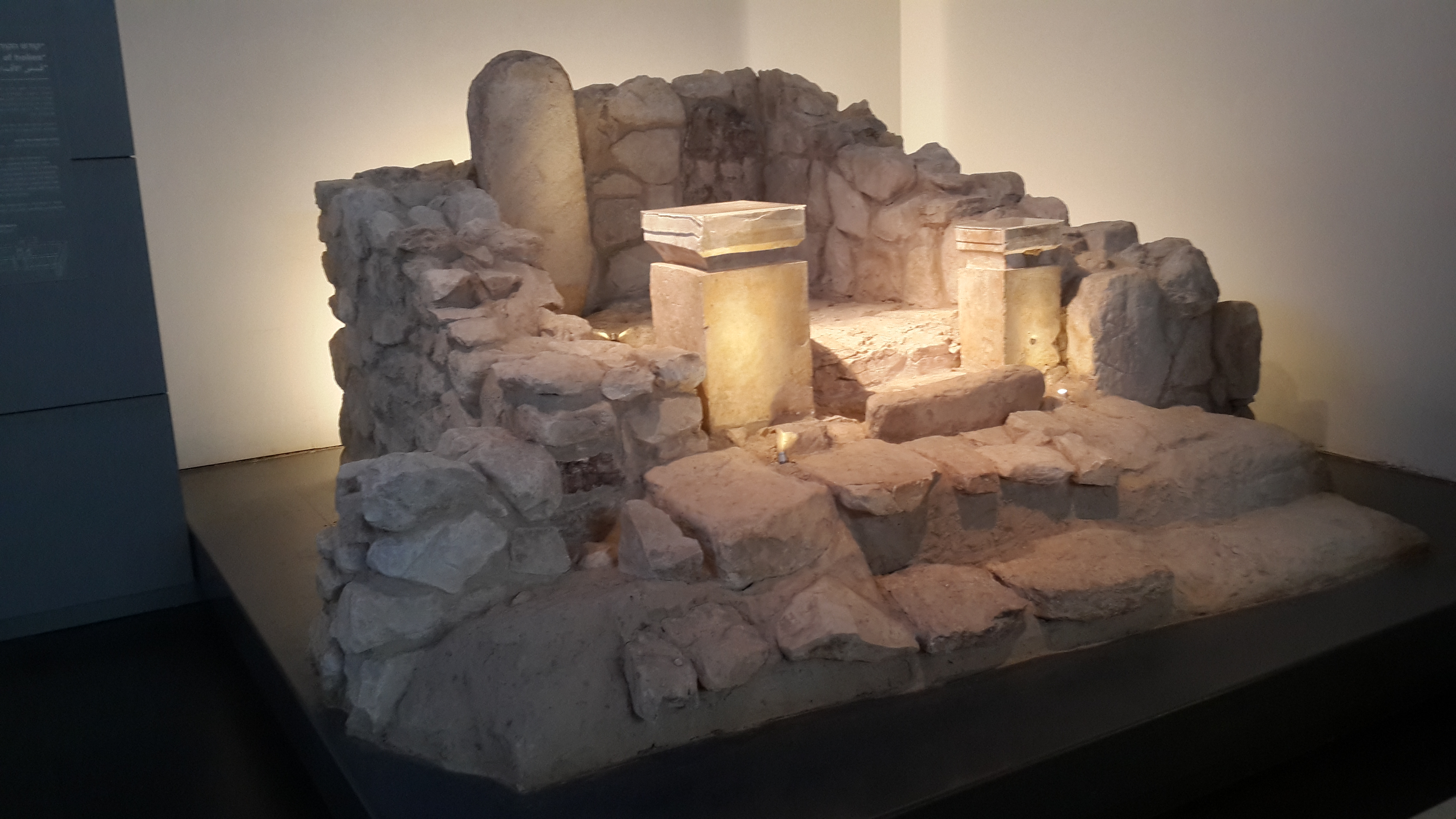
The photograph shows the Israel Museum’s modern reconstruction of the eighth-century BCE inner sanctuary at Arad. Its standing stone and two small altars make the organization of a sacred interior visible. They are evidence from another Judahite sanctuary, not the surviving furniture of JerusalemJerusalemJerusalem is a city of religious importance in Judaism, Christianity and IslamGlossary · Click to read the explanation’s Holy of Holies. The museum reconstruction is itself a modern arrangement of archaeological evidence. [6]
Garfinkel and Mumcuoglu use regional parallels to defend an Iron Age setting for features described in Kings. Their proposed elevated inner floor is plausible by comparison, but Kings supplies no such staircase. Analogies establish architectural possibilities more securely than the date or exact form of an unexcavated Jerusalem room. [7]
Even within Kings, the whole building’s thirty-cubit height and the inner room’s twenty-cubit height leave a problem for reconstruction (6:2, 20). Different floor or roof levels and an upper space are possible solutions, not explicit instructions. We therefore retain the stated dimensions while distinguishing them from the extra decisions needed to produce a modern model. [1][7]
Keeping the historical layers apart
The narrative locates Solomon’s building in the monarchy, conventionally the tenth century BCE; that does not date the writing or editing of its present description. Scholarly proposals include older Iron Age material and later rewriting. The separate dates of Josephus’s work and the Mishnah likewise date literary testimony, not surviving manuscript copies. [4][5][7]
Our Hebrew excerpts follow modern electronic editions. As a landmark in the transmission of biblical Hebrew, the Aleppo Codex dates to about 930 CE, far later than the temple it describes. Thus a narrative setting, the formation of a text, a medieval witness, and a modern archaeological reconstruction answer different questions. The Holy of Holies is best understood through their controlled comparison, not by treating one as a substitute for all the others. [8]
References and notes (8)
- 1 Kings 6; 8:1–13. Hebrew text, Sefaria, Miqra according to the Masorah. Both passages read in full. Chamber: 6:16–20; cherubim: 23–28; doors: 31–32; Ark installation and contents: 8:6–9. Quotation consists of consecutive phrases in 8:6, retaining vowels, omitting cantillation, without restoration. Translations are editorial. Return to the text ↑
- Exodus 25:10–22; 26:31–37. Hebrew text, Sefaria. Both passages read: Ark cover and cherubim in chapter 25; inner curtain, two zones, and entrance screen in chapter 26. Return to the text ↑
- Leviticus 16. Hebrew text, Sefaria. Entire chapter read. Restricted entry: 2; incense and blood: 12–19; annual occasion: 29–34. Procedures distinguish incense, bull’s blood, and goat’s blood. Return to the text ↑
- Flavius Josephus, The Jewish War 5.219, William Whiston translation, Lexundria. Full paragraph and work metadata, dated ca. 77 CE, read. English translation paraphrased here; Greek original not examined. Return to the text ↑
- Mishnah Yoma 5:1–3. Hebrew text, Torat Emet; Sefaria. Three sections read in Hebrew and translation. Quotation opens 5:2, without restoration; editorial translations. Compilation ca. 200 CE follows Sefaria’s brief library introduction, not the date of an individual manuscript. Return to the text ↑
- The Israel Museum, Reconstruction of the Holy of Holies from the sanctuary at Arad, Google Arts & Culture museum record. Museum record read for identification, reconstruction, and eighth-century BCE dating. Photograph used is separate: Yair Haklai, 2018, CC BY-SA 4.0, not the copyrighted museum photograph in this record. Return to the text ↑
- Yosef Garfinkel and Madeleine Mumcuoglu, “The Temple of Solomon in Iron Age Context,” Religions 10.3 (2019), 198. DOI: 10.3390/rel10030198. Pages 1–2 and 10–11 and portions of page 13 read, not the whole article. Architectural comparison and raised-floor reconstruction are the authors’ proposals, not documentation of excavation in Jerusalem’s chamber. Return to the text ↑
- Yad Ben-Zvi, “The Aleppo Codex.” Full page read. Codex dated ca. 930 CE; most of its Torah portion lost. Example of textual transmission, not composition or construction date. Return to the text ↑
Suggest a correction · Suggest a source for this record
Cite this record
IL Archive, «Holy of Holies», https://ilarchive.com/en/entities/holy-of-holies
Continue reading