Entity
Cherubim
A reference page linking a name, group, or concept to the materials that discuss it.
Cherubim as Eden’s guardians, Ark and Temple figures, and beings in Ezekiel’s vision: a plural name, varying descriptions, and the limits of ancient visual comparisons.
Estimated reading time: 7 min Published Last reviewed:
Share article
Text
Introduction
Cherubim are beings and winged figures associated with guarding sacred space and with divine presence in the HebrewHebrewA Northwest Semitic language of the Canaanite group, encompassing Iron Age epigraphy, Biblical, Rabbinic, medieval and Modern Hebrew; its scripts and pronunciations changed over time.Glossary · Click to read the explanation Bible. Yet the texts do not give them a single detailed form: EdenEden: The Setting of Genesis’s GardenThe place in which the garden of Genesis 2–3 is planted; the story describes rivers, trees and a human test, while its archaeological location and name’s derivation remain unsettled.Glossary · Click to read the explanation’s guardians are not a description of a statue, and the figures on the Ark cover are not Ezekiel’s vision. This entry explains the name, functions and varying descriptions, then considers what comparison with ancient images can establish.
Name and context
Hebrew keruv is singular and keruvim plural; English uses cherub and cherubim, French chérubin and chérubins. Arabic al-shārūbīm and al-karūbīm are customary forms. The name is not that of one god, nor does it imply a fixed number of beings in every passage. Grammatical number does not settle the word’s historical etymology. [9]
In Genesis 3:24, after the human is expelled from Eden, cherubim and a turning, flaming sword guard access to the tree of lifeTree of Life in GenesisA tree in the garden of Genesis 2–3, distinct from the tree of knowledge. After the forbidden fruit is eaten, the way to the tree of life is guarded lest humans eat from it and live forever. The text does not identify its fruit or explain precisely how it works.Glossary · Click to read the explanation. The verse specifies neither their number nor their bodily form, and does not say that each carries a sword. This is a guardianship scene in a narrative of beginnings, not a description of an excavated artifact. [1]
The Hebrew phrase “לִשְׁמֹר אֶת־דֶּרֶךְ עֵץ הַחַיִּים” means “to guard the way to the tree of life.” What is guarded is access to the life-bearing tree denied to the human; this is not a list of angelic ranks. The excerpt is from Genesis 3:24. Here and below, the short translations are editorial translations of the published Hebrew text. [1]
A chronology of different kinds of evidence
This sequence distinguishes kinds of testimony, rather than establishing a settled evolutionary ladder:
- Narrative time: Eden belongs to the story of beginnings, the Exodus instructions to MosesMosesCentral figure in Exodus, Torah traditions and the Qur’an; childhood accounts differ in detail.Glossary · Click to read the explanation’ time within the narrative, and the Temple to Solomon’s reign. This sequence does not itself date the writing of the cherubim descriptions. [1][4][5]
- Comparative artifact: An ivory throne model from Megiddo, in northern historical Palestine, is dated by its museum to about 1300–1200 BCE. It illustrates thrones flanked by winged beings before Ezekiel’s Babylonian setting, not the composition date of a particular verse. [12]
- Prophetic setting and editing: Ezekiel’s call is placed around 593 BCE in the Babylonian exileBabylonian exileJudean deportations to Babylonia and the kingdom’s collapse in the early sixth century BCE; several phases, not everyone removed or returned at once.Glossary · Click to read the explanation. That is distinct from the completion date of every passage in the book. Disagreement about chapter 10’s editing does not erase its final reading, but prevents treating chapter order as a direct record of the imagery’s development. [6][9][15]
- Surviving copies: The complete Leningrad Codex is an early eleventh-century CE witness; the Princeton Geniza Project dates its completion approximately to 1008–1010 CE. This dates copying, not the composition of the narratives. The excerpts here follow the published Mechon-Mamre text, not a direct collation of that codex. [14]
Ark, Temple and divine presence
Exodus 25:17–22 describes two gold figures at the ends of the kapporetKapporetGold object above the biblical Ark, associated with cherubim, divine speech, and the purification rite of Leviticus 16. “Atonement cover” names its position and ritual role; “mercy seat” does not establish a chair.Glossary · Click to read the explanation, the gold cover of the Ark of the CovenantArk of the CovenantPortable sacred chest in the Hebrew Bible, associated with the covenant tablets and divine presence. Descriptions and roles differ in Exodus, Deuteronomy, Samuel, and Kings. It is distinct from Noah’s vessel.Glossary · Click to read the explanation, a portable sacred chest holding the testimony in the narrative. Their faces turn toward each other and the cover, with wings spread over it. The location is associated with divine speech to Moses, the recipient of the book’s instructions. The text specifies number, material and posture, but not a complete anatomy. [4]
The wings’ function stands out in Exodus 25:20: “סֹכְכִים בְּכַנְפֵיהֶם עַל־הַכַּפֹּרֶת,” “sheltering over the cover with their wings.” Speech comes, according to 25:22, from above the cover and between the two figures. The description therefore does not state that the figures represent God himself, nor does it alone decide whether they form his seat or a protective frame for his presence. [4]
By contrast, 1 Kings 6:23–29 describes two large olivewood figures overlaid with gold in the innermost sanctuary of the JerusalemJerusalemJerusalem is a city of religious importance in Judaism, Christianity and IslamGlossary · Click to read the explanation Temple attributed to King Solomon. Each is ten cubits high, with two wings measuring five cubits apiece. The wings reach the walls and meet in the middle. These are not simply the small gold figures envisaged on the Ark cover. The passage also mentions cherubim carved on the walls. These are literary descriptions of sacred furnishings, not evidence that those objects survive. [5]
Another function appears in the poem preserved in 2 Samuel 22:8–15: God rides a cherub and flies amid a storm scene. This imagery combines movement and divine sovereignty; the witnesses cannot all be reduced to the function of a message-bearing envoy. [8]
Why is Ezekiel’s vision different?
EzekielEzekielEzekiel is a priest and prophet in the Hebrew Bible, whose book is associated with the Judean exile in Babylonia in the sixth century BCE.Glossary · Click to read the explanation is a priest and prophet whose book is associated with the Judean exile in Babylonia in the sixth century BCE. Chapter 1 describes four “living creatures,” each with four faces and four wings, human hands beneath the wings, and feet resembling calves’ hoofs. Their faces are human, leonine, bovine and aquiline; wheels accompany them. [6]
Chapter 10 calls them cherubim, and verse 20 explicitly identifies them as the creatures previously seen by the prophet. A throne-like appearance stands above them, and the divine glory departs from the Temple. Nevertheless, 10:14 names one face as a cherub’s face, whereas 1:10 names an ox’s face. This difference should remain visible, rather than combining the chapters into a uniform description imposed on every biblical cherub. How the description and the designation cherubim became associated during the book’s editing is also debated. [7][9]
Ezekiel 10:20 makes the identification explicit: “וָאֵדַע כִּי כְרוּבִים הֵמָּה,” “and I knew that they were cherubim.” This identification in the text’s final form is more secure than a hypothetical reconstruction of an earlier stage. Yet the Temple decoration described in 41:18–19 has cherubim with two faces, human and leonine, between palm trees. The variation therefore occurs within the same book as well. [7][13]
Comparative images, not secure identifications
A common interpretation likens cherubim to winged sphinxes: winged lions with human heads. The abundance of these images in Levantine art and their association with thrones support the comparison. Hebrew Bible scholar Raanan EichlerRaanan EichlerHebrew Bible scholar at Bar-Ilan University studying the Ark and cherubim.Glossary · Click to read the explanation objects to treating it as a settled identification: other winged images are also common, the expression linking God’s enthronement and cherubim is disputed, and he reads the sculpted Ark figures as upright beings rather than quadrupeds. This challenges the identification of their form, not their general association with sacred space and the throne. [9]
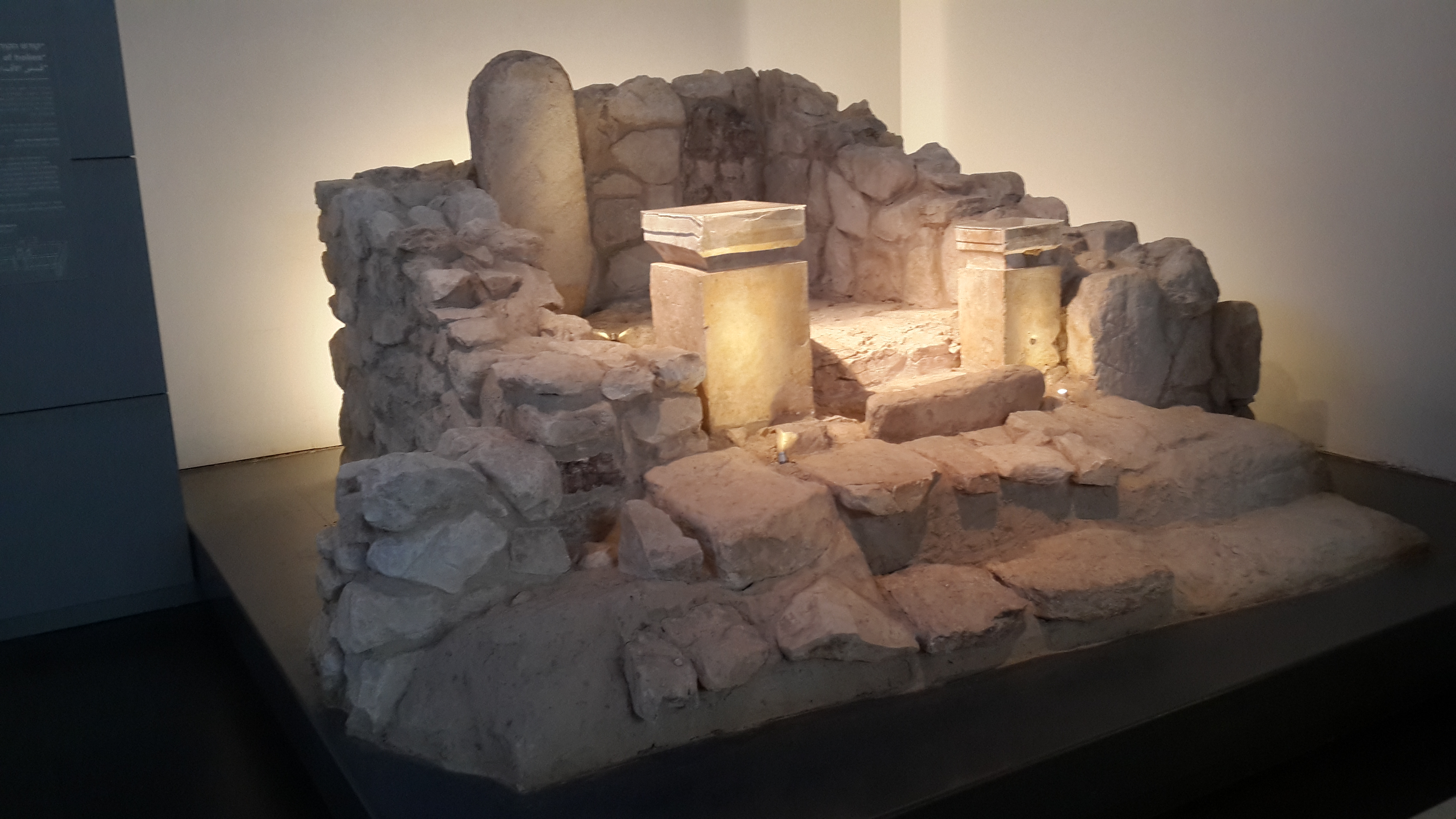
A more specific archaeological parallel than the mere presence of wings is Megiddo throne model OIM A22251. The University of Chicago catalog interprets it as a throne guarded by two winged sphinxes. This strengthens the functional throne comparison, but does not supply the figures’ Hebrew name. [12]
Conversely, Eichler emphasizes that the figures’ height and wingspan in 1 Kings 6 are equal, while the Exodus figures shelter the cover with wings from its ends; his later account favors winged humans. [11] In our assessment, these details weaken any confident quadrupedal reconstruction based on broad resemblance alone. Yet they remain selective literary descriptions, not measurements of a surviving object that could resolve every form. In the Exodus description specifically, sheltering the cover is more explicit than supporting a divine seat; bodily form remains a question for each witness, not something settled by a conjectural etymology.
Psalm 99:1 links “יֹשֵׁב כְּרוּבִים” (commonly interpreted as “enthroned upon the cherubim”) with YHWHYahwehThe proper name of Israel’s deity, written יהוה (YHWH), the Tetragrammaton. Its exact ancient pronunciation is not directly preserved; texts and inscriptions witness its history.Glossary · Click to read the explanation’s kingship. This rendering interprets the spatial relationship; the phrase itself has no preposition “upon.” [16]
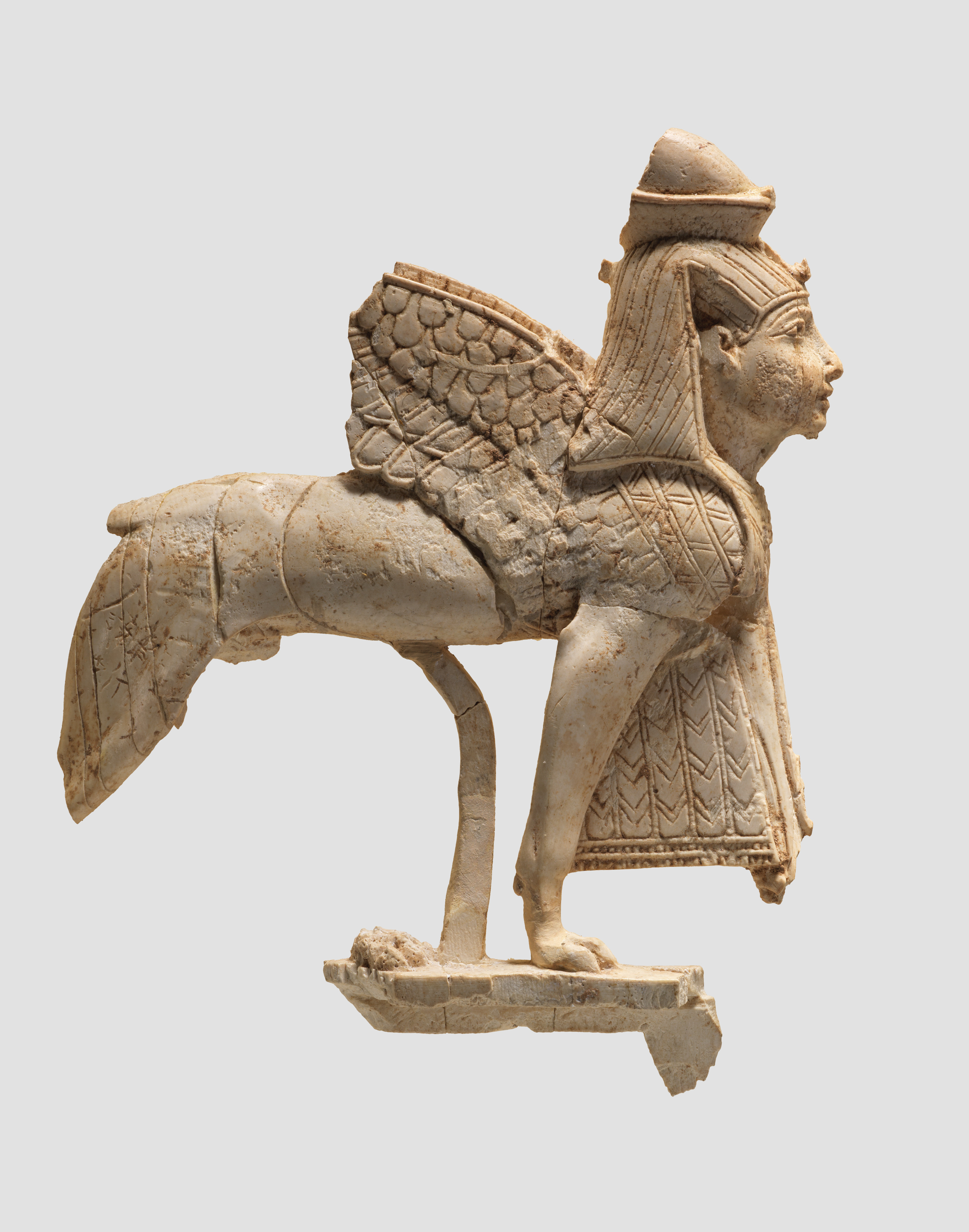
The cover shows an ivory furniture plaque with a winged sphinx, dated approximately to the ninth–eighth century BCE and probably from Arslan Tash in northern Syria according to the museum. It is Metropolitan Museum object 57.80.1. This is a genuine visual comparison, not an object inscribed with a secure identification as a cherub, nor an image of the Ark. Likewise, wings alone do not make every sphinx or Assyrian guardian a cherub. [10]
Cherubim, seraphim and messengers
The seraphimSeraphimSix-winged attendants of the throne in Isaiah 6, associated with praise and purification. Related Hebrew wording also refers to serpents; seraphim are not automatically cherubim or all angels.Glossary · Click to read the explanation of Isaiah 6 are six-winged beings in a throne vision; one purifies the prophet’s lips with a coal. MalakhAngel / Heavenly MessengerHebrew malʾakh (מַלְאָךְ) means “envoy,” human or heavenly according to the passage. Messenger roles vary; the word alone proves neither wings nor an earlier divine identity.Glossary · Click to read the explanation, meanwhile, means “messenger” according to context. Genesis 32:2–4 in Hebrew numbering uses the term for heavenly envoys and Jacob’s human messengers in adjacent passages. These differences of terminology and function matter before applying a later angelic classification. [2][3]
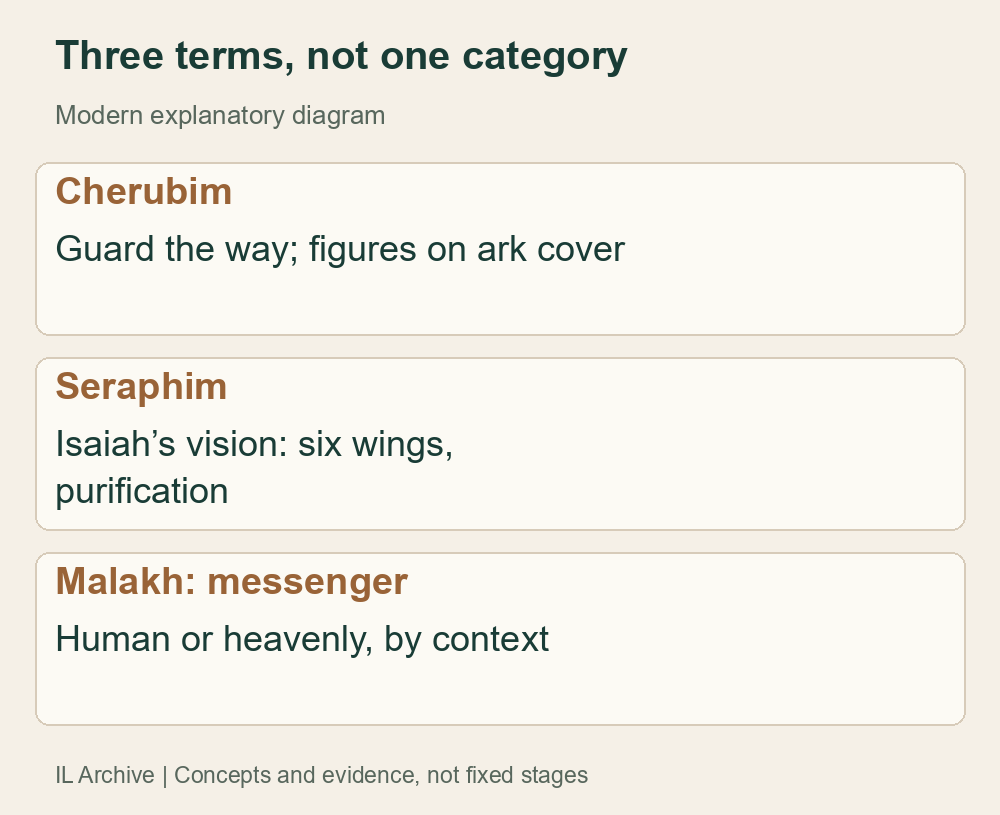
The diagram is a modern comparison of terms, not an archaeological reconstruction. Winged children in later art belong to the history of representation and reception, not direct evidence for the form of cherubim in ancient Hebrew texts. [9]
References and notes (16)
- Hebrew Bible, Genesis; Mechon-Mamre text with the Jewish Publication Society English translation (1917). 3:22–24: expulsion and guarding access to the tree of life. Return to the text ↑
- Hebrew Bible, Isaiah; Mechon-Mamre, English translation (1917). 6:1–8: six wings and purification with a coal. Return to the text ↑
- Hebrew Bible, Genesis; Mechon-Mamre, English translation (1917). 32:2–4 in Hebrew numbering: heavenly and human messengers; some translations number these verses differently. Return to the text ↑
- Hebrew Bible, Exodus; Mechon-Mamre, English translation (1917). 25:17–22: cover, paired figures, wings and divine speech. Return to the text ↑
- Hebrew Bible, 1 Kings; Mechon-Mamre, English translation (1917). 6:19–29: statues, dimensions and wall decoration. Return to the text ↑
- Hebrew Bible, Ezekiel; Mechon-Mamre, English translation (1917). 1:1–28: exile setting, living creatures, faces, wings, hands, feet, wheels and throne. Return to the text ↑
- Hebrew Bible, Ezekiel; Mechon-Mamre, English translation (1917). 10:1–22: throne, faces, wheels, identification as cherubim and departure of the glory. Return to the text ↑
- Hebrew Bible, 2 Samuel; Mechon-Mamre, English translation (1917). 22:8–15: cherub in the storm scene. Return to the text ↑
- Raanan Eichler, “Cherub: A History of Interpretation,” Biblica 96/1 (2015), pp. 26–38. Read: pp. 26–28 and 35–38; grammatical number, varying descriptions, interpretation history and arguments for and against the sphinx comparison. Return to the text ↑
- The Metropolitan Museum of Art, Openwork furniture plaque with a striding sphinx, accession 57.80.1. Object details and description: ivory, ca. ninth–eighth century BCE; probably from Arslan Tash. Return to the text ↑
- Raanan Eichler, “What Kind of Creatures Are the Cherubim?”, TheTorah.com (2016). Sections “Winged Sphinx” and “Winged Adult Revisited”: posture, dimensions and wings. Return to the text ↑
- Gabrielle Vera Novacek, Ancient Israel: Highlights from the Collections of the Oriental Institute University of Chicago, OIMP 31 (2011). p. 61, object 33, throne model OIM A22251; PDF page 77. Return to the text ↑
- Hebrew Bible, Ezekiel; Mechon-Mamre with English translation (1917). 41:18–20: two faces and decoration between palm trees. Return to the text ↑
- Princeton Geniza Project, RNL Yevr. I B 19, record 38606. Description, dating metadata and first-colophon transcription: ca. 1008–1010 CE. No direct collation of cherubim verses in the manuscript. Return to the text ↑
- Christine Hayes, Introduction to the Old Testament, Yale, lecture 19. Opening of transcript chapter 1: exile and Ezekiel’s call around 593 BCE. Return to the text ↑
- Hebrew Bible, Psalms; Mechon-Mamre with English translation (1917). 99:1, יֹשֵׁב כְּרוּבִים in a kingship context; the spatial wording in translation interprets the construction. Return to the text ↑
Suggest a correction · Suggest a source for this record
Cite this record
IL Archive, «Cherubim», https://ilarchive.com/en/entities/cherubim
Continue reading