Entity
Seraphim
A reference page linking a name, group, or concept to the materials that discuss it.
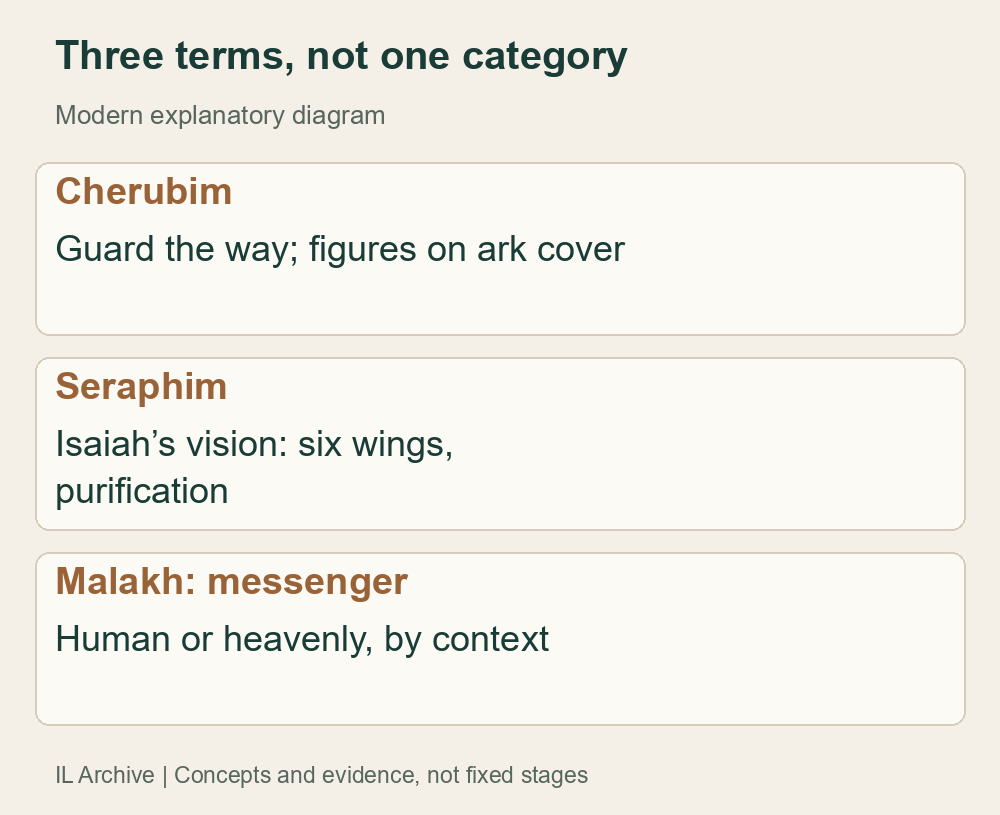
Six-winged beings in Isaiah 6’s throne vision, associated with praise and purification; not automatically identical to cherubim or every angel.
Text
Isaiah 6 describes wings covering faces and feet and others used for flight. One seraph purifies the prophet’s lips with a coal. These belong to a particular vision, not a general description of heaven or proof that every angel has wings. [1]
Distinguishing seraphim from cherubimCherubimBeings or figures with guarding and sacred functions in Hebrew texts, at the tree-of-life access and on the ark; not equivalent to every heavenly messenger.Glossary · Click to read the explanation and messengers helps trace changed classifications. Later traditions can organize different beings within broad angelologyAngelologyStudy and organization of angels and heavenly beings: names, ranks and roles within particular traditions, without assuming one fixed system.Glossary · Click to read the explanation, without erasing earlier terminology or establishing a particular god’s conversion into a seraph. [2][3]
References and notes
- Hebrew Bible — Isaiah 6:1–8. Mechon-Mamre, Hebrew/Aramaic text with JPS 1917 English translation. Six-winged seraphim in throne vision and purification with a coal. Category not automatically cherubim or every messenger. Return to the text ↑
- Hebrew Bible — Genesis 3:24 and Exodus 25:18–22. Mechon-Mamre, Hebrew/Aramaic text with JPS 1917 English translation. Cherubim guard way to tree of life and appear on ark cover; roles/images, no identification with particular Canaanite gods. Return to the text ↑
- Annette Yoshiko Reed (2020). Rethinking Scribalism and Change in Second Temple Judaism. Demons, Angels, and Writing in Ancient Judaism, pp. 87–131. doi:10.1017/9781139030847.004. Summary situates important written angelology/demonology in third century BCE, using Aramaic evidence; scholar’s thesis, not year of first angel’s invention. Full chapter not read. Return to the text ↑
Research history
Substantive changes are retained here. Minor copy edits remain in the internal operational log.
-
Substantive record update
Suggest a correction · Suggest a source for this record
Cite this record
IL Archive, «Seraphim», Edition 2, https://ilarchive.com/en/entities/seraphim