Site
Eden: The Setting of Genesis’s Garden
The place in which the garden of Genesis 2–3 is planted; the story describes rivers, trees and a human test, while its archaeological location and name’s derivation remain unsettled.
Estimated reading time: 8 min Published Last reviewed:
Share article
Text
Introduction
In the Book of GenesisBook of GenesisHebrew book of the Torah containing Noah’s flood, survival offering and covenant with living creatures.Glossary · Click to read the explanation, Eden is the region in which God plants a garden; it is not necessarily another name for the garden itself. The narrative describes trees and a river that divides into four waterways, two of them identifiable as the Tigris and Euphrates, before relating the human beings’ residence there and their expulsion. These indications invite study of the narrative’s imagined place and its later interpretation, but they do not establish an excavated site that can be identified as the Garden of Eden.
Eden and the garden in the Hebrew text
The Masoretic HebrewHebrewA Northwest Semitic language of the Canaanite group, encompassing Iron Age epigraphy, Biblical, Rabbinic, medieval and Modern Hebrew; its scripts and pronunciations changed over time.Glossary · Click to read the explanation of Genesis 2:8 begins its description of the setting with these words.
In a close English rendering, “The LORD God planted a garden in Eden, toward the east.” The expression gan be-ʿeden distinguishes the garden (gan) from Eden, the place containing it. The word miqqedem may convey “eastward” or “in the east,” depending on the presumed point of reference; it supplies no modern coordinates. Genesis 2:15 likewise calls the place the “garden of Eden,” where the human is set to cultivate and keep it. [3]
Genesis 2:10 introduces the garden’s water supply.
That is, “A river flows out of Eden to water the garden, and from there it divides.” The verse goes on to speak of four “heads,” or principal watercourses. This is a spatial statement within the narrated world, not a set of distances or flow directions that can simply be plotted on a present-day map. [3]
Four rivers: evidence and uncertainties
Genesis 2:11–14 names the rivers in sequence. Pishon encircles the land of Havilah, associated with gold, bdellium, and shoham stone; the precise identification of the last substances, particularly the stone, is disputed in translation. Gihon encircles Cush, a name elsewhere in the Bible often associated with Nubia or regions south of Egypt, without proving the meaning of the reference here. Hiddekel is the Hebrew name of the Tigris, described as flowing east of, or in front of, Asshur. The fourth, Perat, is the Euphrates. No city or coordinates are supplied for an archaeological search. [3]
The identification of Hiddekel and Perat with two real rivers gives the story genuine ancient Near Eastern geographical names. Pishon and Gihon, however, lack generally accepted modern identifications, and no one river system securely accounts for all four descriptions together. The upper tributaries of the Tigris and Euphrates occupy a broad northern mountain region, whereas their lower courses meet in the south. Neither arrangement straightforwardly reproduces a single river branching into four. Consequently, locations near the northern headwaters in AnatoliaAnatoliaAnatolia is the region occupying the Asian part of present-day TurkeyGlossary · Click to read the explanation and upper MesopotamiaMesopotamiaHistorical region associated with the Tigris and Euphrates: Uruk, Ur, Eridu, cuneiform, Sumer, Akkad, Babylon and Assyria, their languages and cults, and the limits of archaeological evidence.Glossary · Click to read the explanation have been proposed, as have southern Mesopotamian or Persian Gulf settings and hypothetical former channels. Each proposal explains selected details but fails to verify every name and relationship in the passage. [9]
An alternative literary-cosmological interpretation treats the east, abundant waters, extraordinary trees, and guarded boundary as features of an ancient divine garden imagined at the edge of the inhabited world, rather than directions for finding a site. Peet J. van Dyk has developed this reading from the narrative’s imagery. It is an argued scholarly interpretation, not an archaeological finding that proves the garden existed either outside or inside the known world. It is methodologically safer to read recognizable geographical names as elements within a larger literary setting than to promote any proposed map to certainty. [9]
How earlier readers identified the rivers
Changing identifications in the history of interpretation demonstrate the problem rather than the discovery of a location. In the first century CE, Flavius Josephus, in Jewish Antiquities, associated Pishon with the Ganges and Gihon with the Nile, while retaining the Tigris and Euphrates. The evidence consulted here is an early English translation of Josephus, not a collation of the original Greek. Approximately a millennium later, Rashi, the eleventh-century Jewish biblical commentator, identified Pishon itself with the Nile and related its name to the river’s rise or the growing of flax. Even the identity of the supposedly Egyptian river was therefore not fixed among commentators. [10] [11]
Trees, boundaries, and the point of the story
The garden does more in the narrative than locate the action. Genesis 2:9 describes both the tree of lifeTree of Life in GenesisA tree in the garden of Genesis 2–3, distinct from the tree of knowledge. After the forbidden fruit is eaten, the way to the tree of life is guarded lest humans eat from it and live forever. The text does not identify its fruit or explain precisely how it works.Glossary · Click to read the explanation and the tree of the knowledge of good and evilTree of the Knowledge of Good and EvilThe tree prohibited in Genesis 2:17 and eaten from in Genesis 3, narratively distinct from the tree of life; its fruit is unidentified.Glossary · Click to read the explanation; these are distinct narrative trees. Genesis 2:17 forbids eating from the latter. AdamAdamAdam is a figure in Genesis’s narratives of beginnings, linked with Cain, Seth and Abel.Glossary · Click to read the explanation is charged with working and keeping the garden, before he and the woman, later named EveEve, figure in GenesisFirst woman in Genesis, whose making is linked to the human’s rib or side and whose name to mother of all the living.Glossary · Click to read the explanation, disobey. Genesis never specifies that the forbidden fruit was an apple. In 3:22–24 the expulsion prevents access to the tree of life, while cherubim and a turning flaming sword guard the way. [3]
The final words of Genesis 3:24 describe the purpose of the guard.
This means “to guard the way to the tree of life.” The protected threshold matters to the story’s contrast between divine space and human access. Elsewhere, “Eden” or “God’s garden” serves as an image of magnificence or lost abundance, rather than a fresh land survey: the lament over TyreTyreTyre is a city on the coast of present-day southern Lebanon and an important ancient Phoenician centerGlossary · Click to read the explanation’s ruler in Ezekiel 28:13, the comparison with trees in Ezekiel 31:8–9, and the promised restoration of Zion in Isaiah 51:3 are examples. Each belongs in its prophetic and literary context, not on a map assembled from every allusion. [12]
The name Eden and Sumerian edin
A similar-sounding word in a different language does not by itself demonstrate an etymology. The Hebrew name ʿEden (עֵדֶן) begins with the consonant ʿayin, whereas Sumerian edin denotes a plain or open country in known contexts. Their sounds and meanings cannot simply be equated. The academic Keilschriftbibliographie summarizes Alan R. Millard’s 1984 article The Etymology of Eden as arguing for a Semitic root associated with lushness, rather than a direct Sumerian derivation. That is the bibliographic summary, not a fresh reading of all four pages of Millard’s article. Etymological details remain debated; neither proposal locates a physical garden. [8]
Dilmun and Mesopotamian gardens: comparison, not identity
DilmunDilmun: Ancient Gulf Land and Literary SettingDilmun was an ancient Gulf trading land with a major archaeological centre in Bahrain and connections to eastern Arabia and Failaka. This entry separates boats, burials and kings from the literary purity and fresh water of Enki and Ninhursaga, and tests the limits of comparison with Eden.Glossary · Click to read the explanation was a region prominent in Mesopotamian literature and Gulf commerce, with archaeological remains especially connected to Bahrain. The ancient harbour at Qal’at al-Bahrain, identified with the Dilmun civilization, preserves evidence of occupation and exchange beginning around 2300 BCE. Nothing in that archaeological record identifies a structure there as the biblical Garden of Eden. [15]
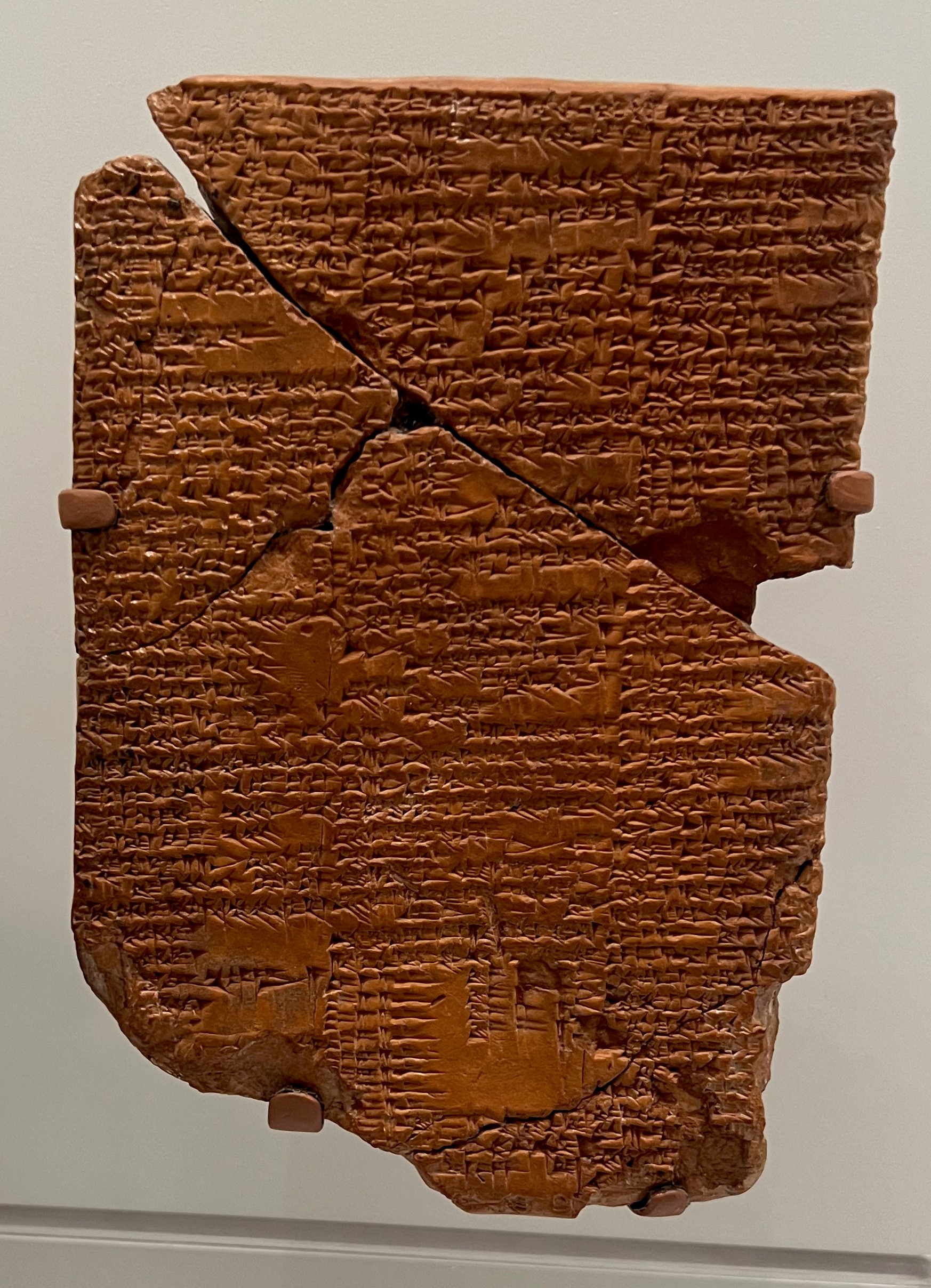
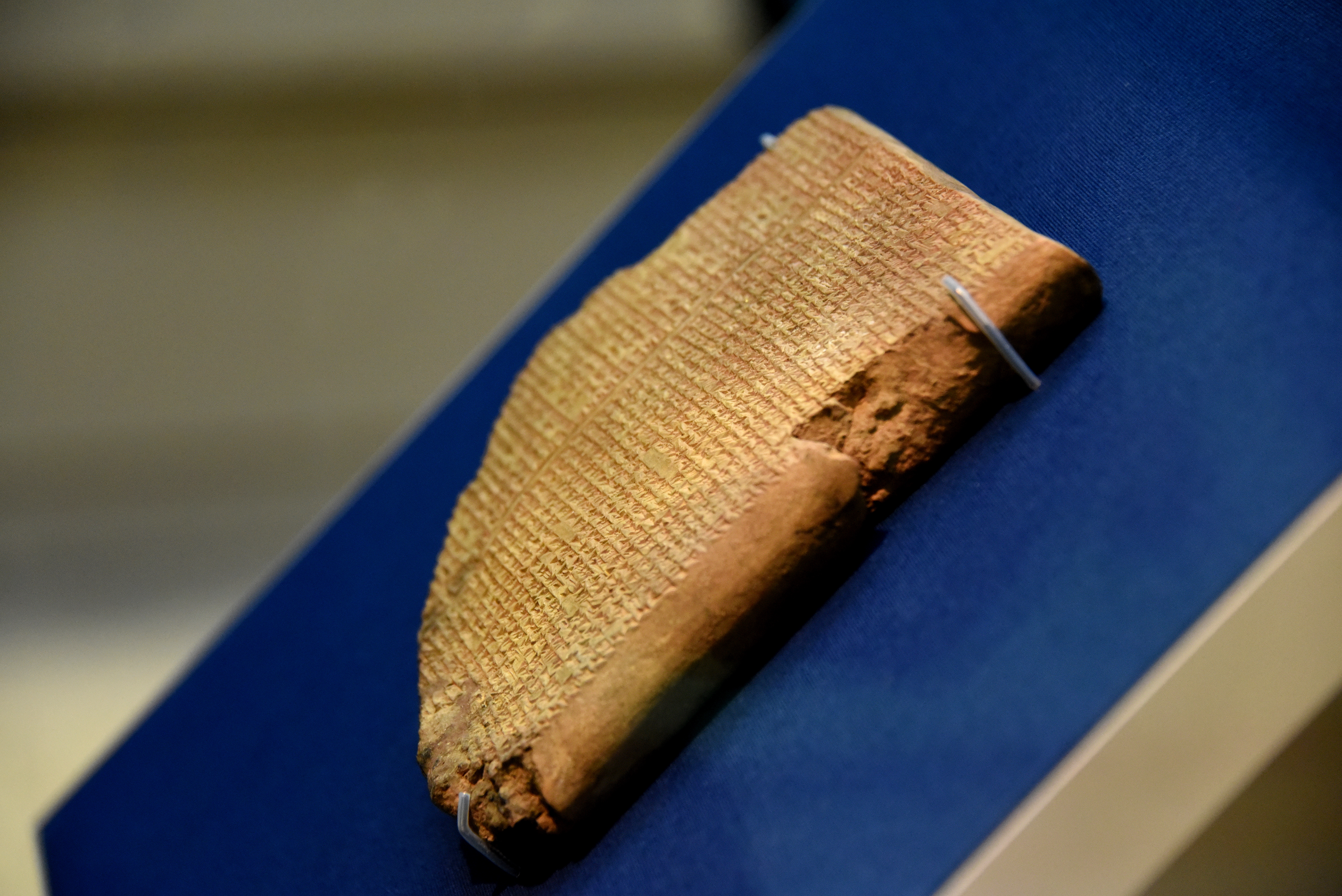
The Sumerian composition EnkiEnkiMesopotamian deity also known as Ea, linked with Eridu and the Abzu (deep fresh waters), wisdom, incantations, and narratives of creation and cosmic order. Later written attestations do not identify the deity of Eridu’s earliest layers.Glossary · Click to read the explanation and Ninhursanga portrays Dilmun in lines 1–28 as pure, without various familiar signs of illness or predation. Line 3 of the Oxford Electronic Text Corpus of Sumerian Literature composite text includes the following transliteration; this follows the published composite edition, not a personal reading of a particular tablet.
In a concise rendering, “The land of Dilmun is pure.” Yet in lines 29–49 the text also describes a lack of irrigation and fields, after which Enki promises fresh water and commercial prosperity. A manuscript from Ur contains an additional passage, numbered 49A–49V, listing goods and regions; this must not be attributed to all witnesses or mistaken for one intact tablet underlying the modern composite. The story continues with deities, plants, and births. Its plot differs markedly from the human test and the forbidden tree in Genesis. [13] [14]
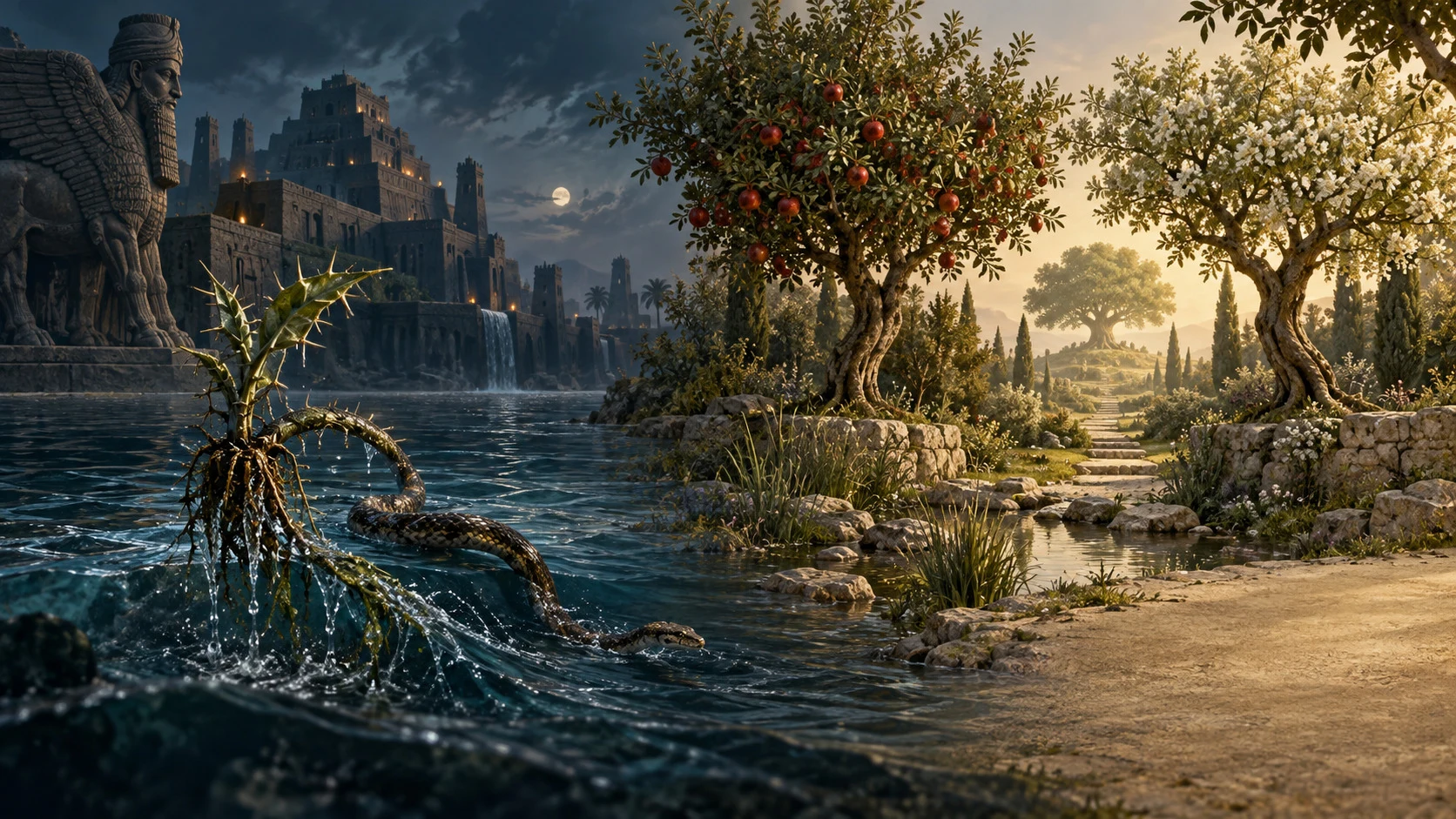
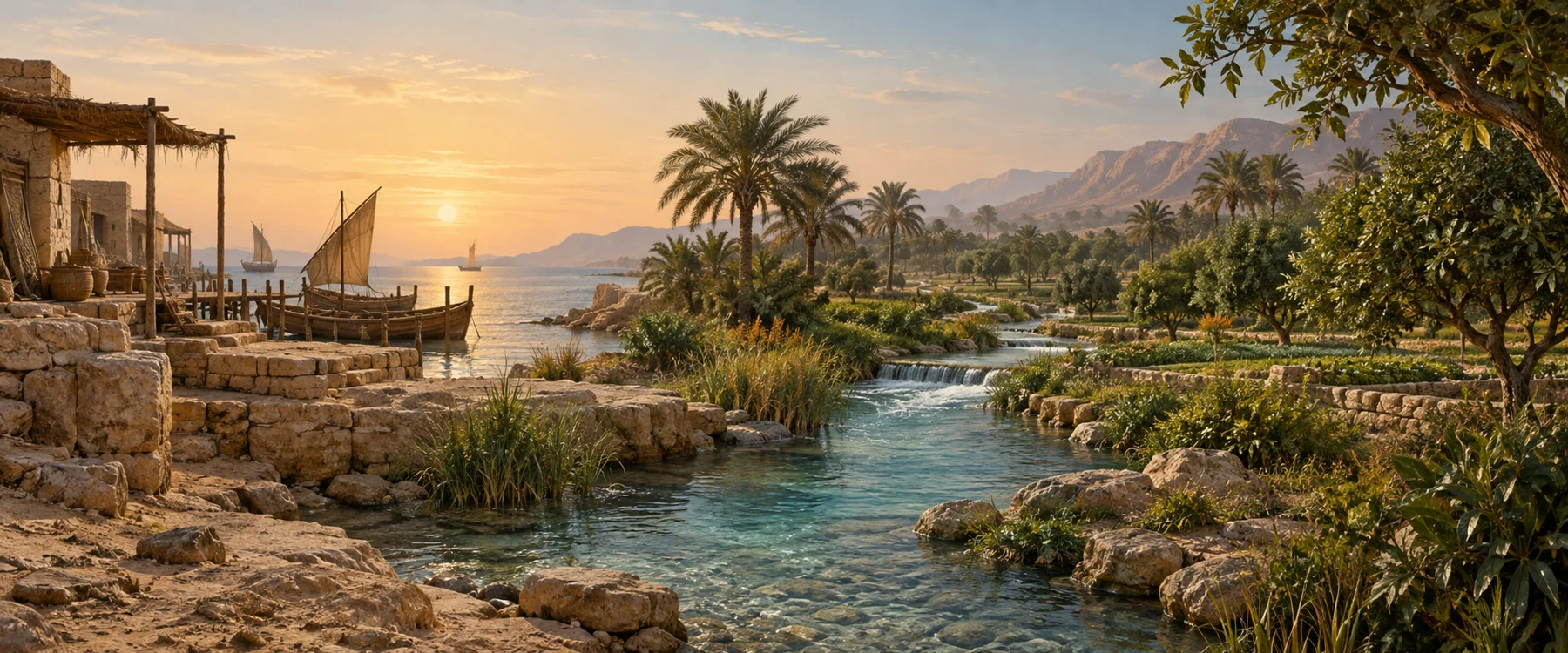
The shared imagery of water, fertility, and divine gardens helps situate both works within a broad ancient cultural vocabulary. It does not establish that Dilmun was Eden or that the author of Genesis copied this specific composition. Specialist studies have cautioned against the old label of a “Sumerian paradise,” emphasizing the poem’s creation of fertility, interactions among gods, and trading setting. The same distinction applies to comparisons with Mesopotamian royal gardens: shared motifs have better support than geographical identity. A modern illustration combining these motifs is not an archaeological reconstruction. [14] [16]
Narrative time, composition, and surviving witnesses
The story’s primordial setting provides no archaeologically datable year for its events. The following chronology separates different kinds of evidence rather than asserting a proven chain of borrowing.
- Time within the story: the beginnings of human life, without a verifiable historical date.
- Sumerian Dilmun composition: preserved principally in Old Babylonian scribal copies, roughly 1900–1600 BCE, with possible earlier traditions. These are dates for textual witnesses, not for an event in Eden. [14]
- Genesis 2–3: its composition and redaction are discussed within the formation of the Torah in the first millennium BCE. Scholars disagree over earlier material, later editing, and whether the narrative should be separated cleanly from Priestly composition; there is no agreed single year of composition. [17] [18]
- Greek textual tradition: translation of the Pentateuch into Greek, later associated with the SeptuagintSeptuagintA name for the varied ancient Greek translations and writings associated with Jewish scripture; beginning with the Torah, the texts differ across books and manuscripts.Glossary · Click to read the explanation, began around the third century BCE. That dates translation activity, not the creation of the Hebrew story. [19]
- Medieval Masoretic witness: the complete Hebrew Leningrad Codex, held at the National Library of Russia as Ms. EVR I B 19a, is catalogued to 1008–1009 CE. It witnesses a much older textual tradition; its copying date is not the date Genesis was written. [20]
What the evidence permits
Genesis sets a garden in Eden and connects it with four rivers. Tigris and Euphrates are identifiable names; the other identifications and the arrangement of all four are unsettled. The story can plausibly draw on cultural imagery of irrigation, life, and a protected divine domain without yielding a unique modern location. Neither Bahrain, IraqIraqIraq is a modern country encompassing much of ancient MesopotamiaGlossary · Click to read the explanation, nor Anatolia has produced evidence that securely identifies the biblical garden. Distinguishing the text, its interpretive history, and archaeology of real places is therefore more informative than claiming that a plausible comparison has solved the map. [9] [14]
References and notes (14)
- Genesis 2–3, Masoretic Hebrew and the Jewish Publication Society translation (1917), Mechon-Mamre; Hebrew excerpts and brief original editorial renderings. Genesis 2:8–17; 3:1–24. Both chapters read in full; chapter 3 at the corresponding /p/pt/pt0103.htm. No direct manuscript collation. Return to the text ↑
- Alan R. Millard, “The Etymology of Eden,” Vetus Testamentum 34, no. 1 (1984), 103–106; University of Tübingen Keilschriftbibliographie record, not the full article. Only the catalogue record and its short synopsis were read; pp. 103–106 are bibliographic metadata, not pages read during this review. DOI 10.2307/1518211. Return to the text ↑
- Peet J. van Dyk, “In Search of Eden: A Cosmological Interpretation of Genesis 2–3,” Old Testament Essays 27, no. 2 (2014), open-access article. Read the introduction, discussion of geographic proposals, cosmological interpretation, and conclusion; the author’s hypothesis is not treated as consensus. Return to the text ↑
- Flavius Josephus, Jewish Antiquities, Book I, 1.1.3; consulted in William Whiston’s English translation hosted by the University of Chicago, not in Greek. Book I, chapter 1, §3; Pishon/Ganges and Gihon/Nile identifications. Return to the text ↑
- Rashi (Shlomo Yitzhaki), Commentary on Genesis 2:11, Sefaria; Hebrew and Rosenbaum–Silbermann English translation (1929–1934). Genesis 2:11, comment beginning “פישון ... הוא נילוס נהר מצרים”; Hebrew commentary and displayed English rendering. Return to the text ↑
- Ezekiel 28:13; 31:8–9; Isaiah 51:3, Hebrew prophetic passages and translations; literary uses of Eden rather than archaeological descriptions. Ezekiel 28:12–17; 31:8–9; Isaiah 51:3, selected passages consulted; no critical collation of these books. Return to the text ↑
- University of Oxford, Electronic Text Corpus of Sumerian Literature, “Enki and Ninhursanga,” composite Sumerian text c.1.1.1 and published English translation; not a single tablet. Composite transcription and translation, lines 1–62, especially 3, 29–49 and 49A–49V; translation at /section1/tr111.htm. Sumerian snippet follows Oxford transliteration. Return to the text ↑
- Isabel Gomes de Almeida, “Enki and Ninḫursaĝa,” Database of Religious History (2024), description deposited on Zenodo. Read the published scholarly description, particularly the witness dates, Dilmun setting, waters, and lines 49A–49V; original tablets not examined. Return to the text ↑
- UNESCO World Heritage Centre, “Qal’at al-Bahrain – Ancient Harbour and Capital of Dilmun,” official site description; archaeological evidence for Dilmun, not Eden. Principal description: tell stratigraphy, occupation since about 2300 BCE, and harbour role; full excavation reports not read. Return to the text ↑
- Bendt Alster, “Dilmun, Bahrain, and the Alleged Paradise in Sumerian Myth and Literature,” in Dilmun (1983), pp. 39–74; only indexed bibliography and summary consulted. Bibliographic record only; article pages 39–74 were not read. Return to the text ↑
- Walter Bührer, “The Relative Dating of the Eden Narrative Gen *2–3,” Vetus Testamentum 65, no. 3 (2015), pp. 365–376; publisher abstract only. Abstract on competing relative datings only; page numbers are publication data, not pages read. Return to the text ↑
- Benjamin Kilchör, “The Eighth Day: The Appointment of Adam as Priest in Eden and the Priestly Profile of Genesis 2–3,” Scandinavian Journal of the Old Testament 36, no. 2 (2022), pp. 255–266; publisher abstract only. Only the abstract discussing the narrative’s Priestly profile; full text not read. Return to the text ↑
- Leonard Greenspoon and William Ross, “Septuagint,” Oxford Bibliographies in Biblical Studies; accessible introductory overview of the Greek Pentateuch’s translation date. Accessible introduction on third-century-BCE Torah translation; full extended bibliography not read. Return to the text ↑
- National Library of Israel, Hebrew Manuscripts catalogue, Leningrad Codex, National Library of Russia, Ms. EVR I B 19a; cataloguing data and 1008–1009 CE date. Catalogue entry, copying-date field and shelfmark; images of the Genesis folios were not examined. Return to the text ↑
Suggest a correction · Suggest a source for this record
Cite this record
IL Archive, «Eden: The Setting of Genesis’s Garden», https://ilarchive.com/en/sites/eden-garden-genesis
Continue reading