Entity · Concept
Gilgamesh’s Rejuvenating Plant
A reference page linking a name, group, or concept to the materials that discuss it.
A thorny plant Gilgamesh finds underwater in Tablet XI and means to test for rejuvenation; a snake takes it and moults. The entry separates text from interpretation, cautiously comparing the plant with Eden’s two trees.
Estimated reading time: 7 min Published Last reviewed:
Share article
Video
The Epic of Gilgamesh: The Complete Story from the Ancient Tablets
A king no one could stop, a wild man made to match him, and a friendship that changes both. The whole Epic of Gilgamesh in eight illustrated chapters, told from the clay tablets of ancient Iraq; where the tablets are broken, the narration says so. Illustrations, narration voice and visual effects were created with AI tools by IL Archive; the text is a faithful retelling based on the ancient tablets.
The YouTube player loads only when you press play. Watch on YouTube
Text
Introduction
How could a plant retrieved from deep water change Gilgamesh’s fate, and why is it lost before he can test it? This entry examines the closing episode of Tablet XI in the Standard Babylonian Epic of Gilgamesh. It separates renewed youth from immortality, the actual wording of the episode from translators’ explanations, and the ancient story from the dates of its surviving manuscripts. A final comparison with the trees and serpent of Genesis explores meaningful parallels without declaring the stories identical.
Reading guide and primary passage
We begin with the epic’s textual history, follow the hero’s journey, and then examine the plant’s discovery, recovery and loss. Questions of line numbering, the return to UrukUrukAncient city at Warka in southern Iraq, a major urban centre around 3200 BCE that preserved early writing and accounting tablets.Glossary · Click to read the explanation, and comparisons with Genesis follow. The subject is a plant within a literary narrative, not a botanically identified specimen or a complete edition of Tablet XI. Alexander Heidel’s 1949 publication is an important stage in the modern edition and interpretation of the epic. The passage examined here is his printed pp. 91–93, not the whole book. [1]
Which text, and which tablet?
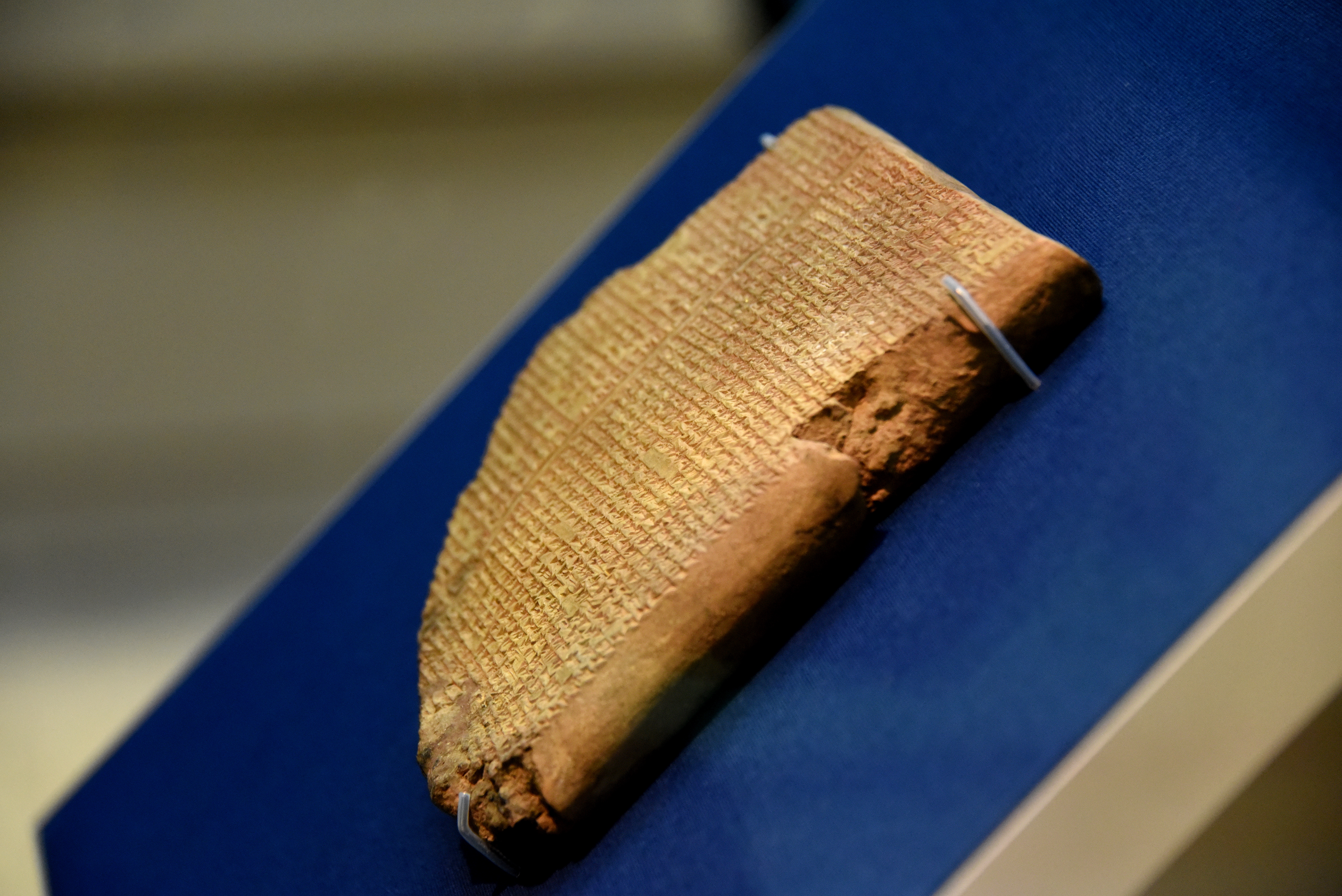
The Epic of GilgameshEpic of GilgameshA Babylonian literary work with multiple recensions, preceded by separate Sumerian poems on Uruk’s king and Enkidu. Its standard form explores friendship, death, the flood and the limits of seeking eternal life.Glossary · Click to read the explanation developed over centuries. Separate Sumerian poems, Old and Middle Babylonian witnesses, and a later Standard Babylonian recension have different textual histories. “Tablet XI” refers to a unit of the last tradition; it does not mean that all its lines survive intact on one physical tablet. British Museum K.3375, the celebrated “Flood Tablet,” is a seventh-century BCE witness to Tablet XI. The museum describes the preserved part as the flood narrative: its photograph is not a picture of the plant, nor proof that the entire plant episode is extant on that particular fragment. [2]
The Assyriologist Andrew R. GeorgeAndrew R. GeorgeAssyriologist and editor of Gilgamesh, and emeritus professor of Babylonian at SOAS.Glossary · Click to read the explanation explains how critical editions assemble manuscripts from different dates and places and why second-millennium versions should not simply be identified with the Standard Babylonian text. The episode discussed below belongs to the published composite text of Tablet XI. The narrative setting, the development of the composition and the dates of individual clay witnesses are distinct matters. [3][4]
From Enkidu’s death to Utnapishtim
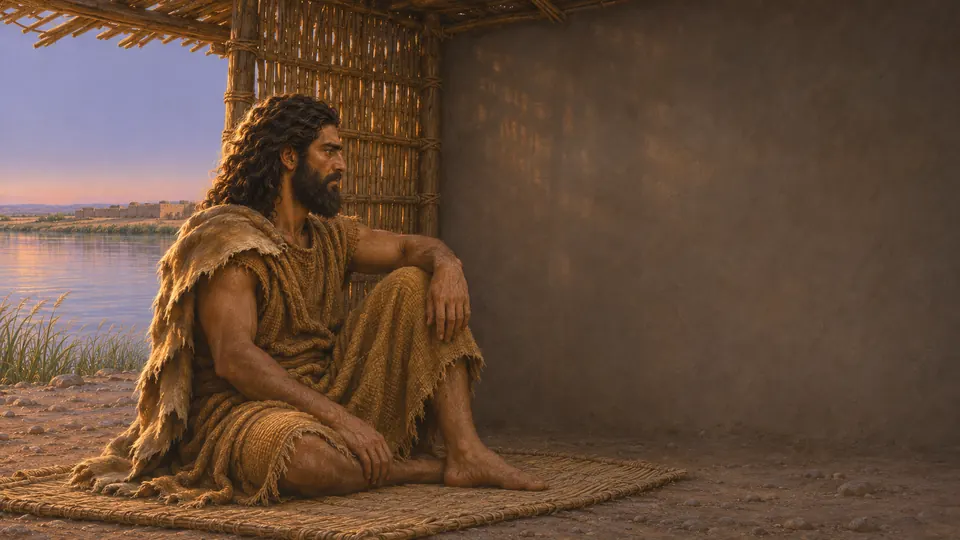
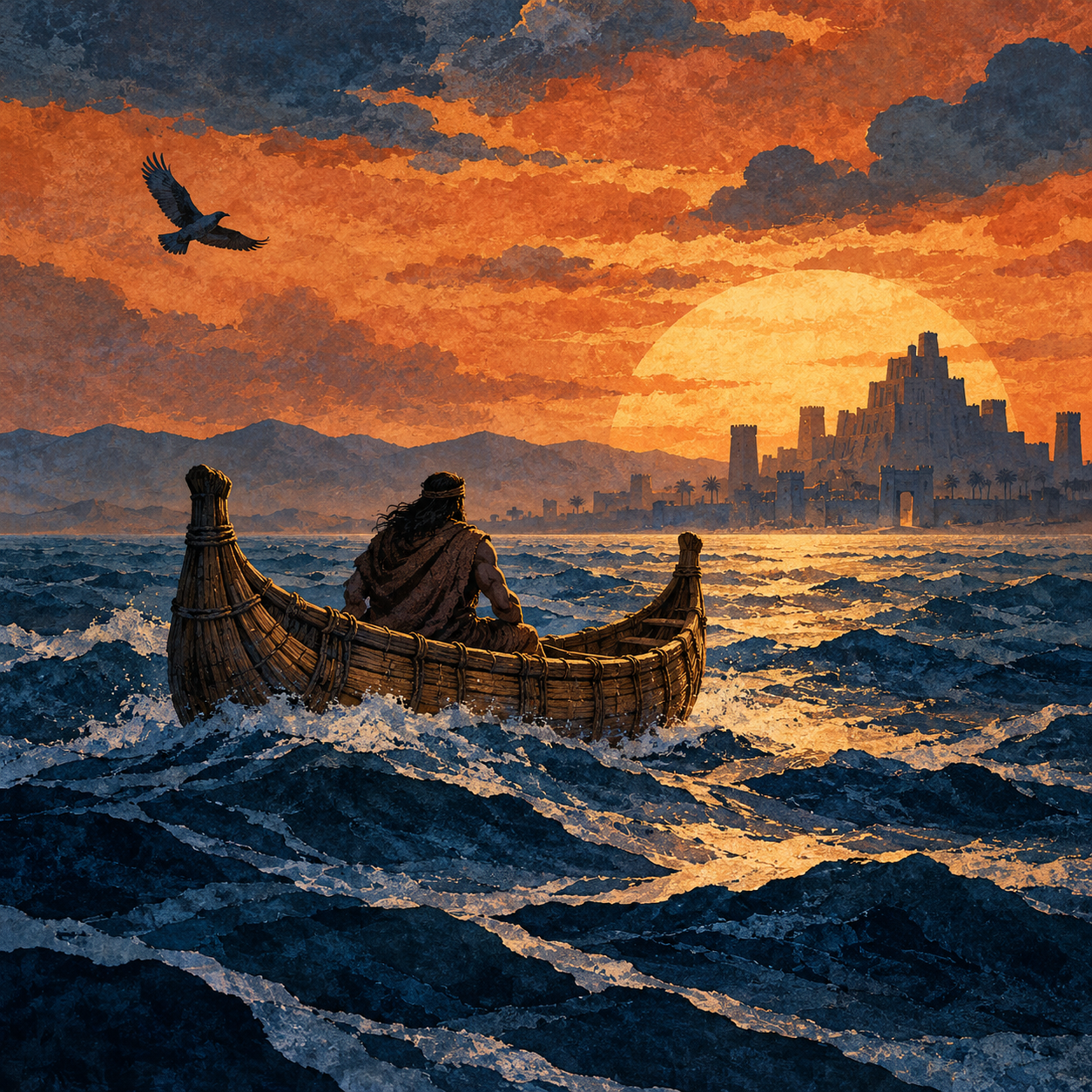
When Gilgamesh loses his friend EnkiduEnkidu, Gilgamesh’s companionGilgamesh’s companion in the Babylonian epic; his death sets the king searching for life beyond mortality.Glossary · Click to read the explanation, the certainty of his own death becomes intolerable. Leaving UrukUrukAncient city at Warka in southern Iraq, a major urban centre around 3200 BCE that preserved early writing and accounting tablets.Glossary · Click to read the explanation, he searches for UtnapishtimUtnapishtimThe flood hero of Standard Babylonian Gilgamesh, granted exceptional life with his wife by the gods. He tells Gilgamesh how he survived; his name overlaps with Atrahasis and Ziusudra traditions without making their narratives identical.Glossary · Click to read the explanation, the flood survivor whom the epic says the gods exceptionally raised, together with his wife, to undying life. Following arduous travels, the hero reaches him with the assistance of the ferryman Urshanabi. This is a literary geography; the route is not a surveyed archaeological itinerary. [5]
Immortality and the test of sleep
Utnapishtim explains that his special status followed a divine decision after the flood. Nothing suggests he can confer the same privilege upon every visitor. As a test of Gilgamesh’s limits, he asks him to remain awake for six days and seven nights, but the hero falls asleep. Loaves placed beside him record the passing time. The later discovery of the plant does not reverse that failure or constitute a new decree of immortality: it raises a different hope. [6]
What sort of plant?
Utnapishtim describes a hidden plant in the deep whose thorns can wound the hand. Translations compare it to boxthorn or a rose-like thorn; those are ways of conveying ancient imagery, not secure identifications of a modern botanical species. The location is variously rendered as the sea or the Apsû, the deep fresh waters in Mesopotamian cosmology. Neither formulation locates a real plant population or gives the reader a findspot that can be mapped. [7]
Retrieving it from the water
Gilgamesh fastens heavy stones to his feet to descend, takes hold of the plant despite its spines, cuts the stones loose and returns to the surface. Crucially, he does succeed in obtaining it. His loss happens afterwards, not during the dive. These lines do not describe him eating it or testing its powers at the water’s edge. [8]
The plan to test an old man
Gilgamesh tells Urshanabi that he intends to bring the plant to Uruk, have an elderly man eat it as a test, and then eat it himself to recover his own youth. Heidel renders its name as an old man becoming young again. The old man’s trial and Gilgamesh’s consumption are plans, not completed events. The episode never shows the human test taking place, and it does not establish the number of years the plant might restore, still less the gift of unconditional everlasting life. [9]
The serpent and the missed chance
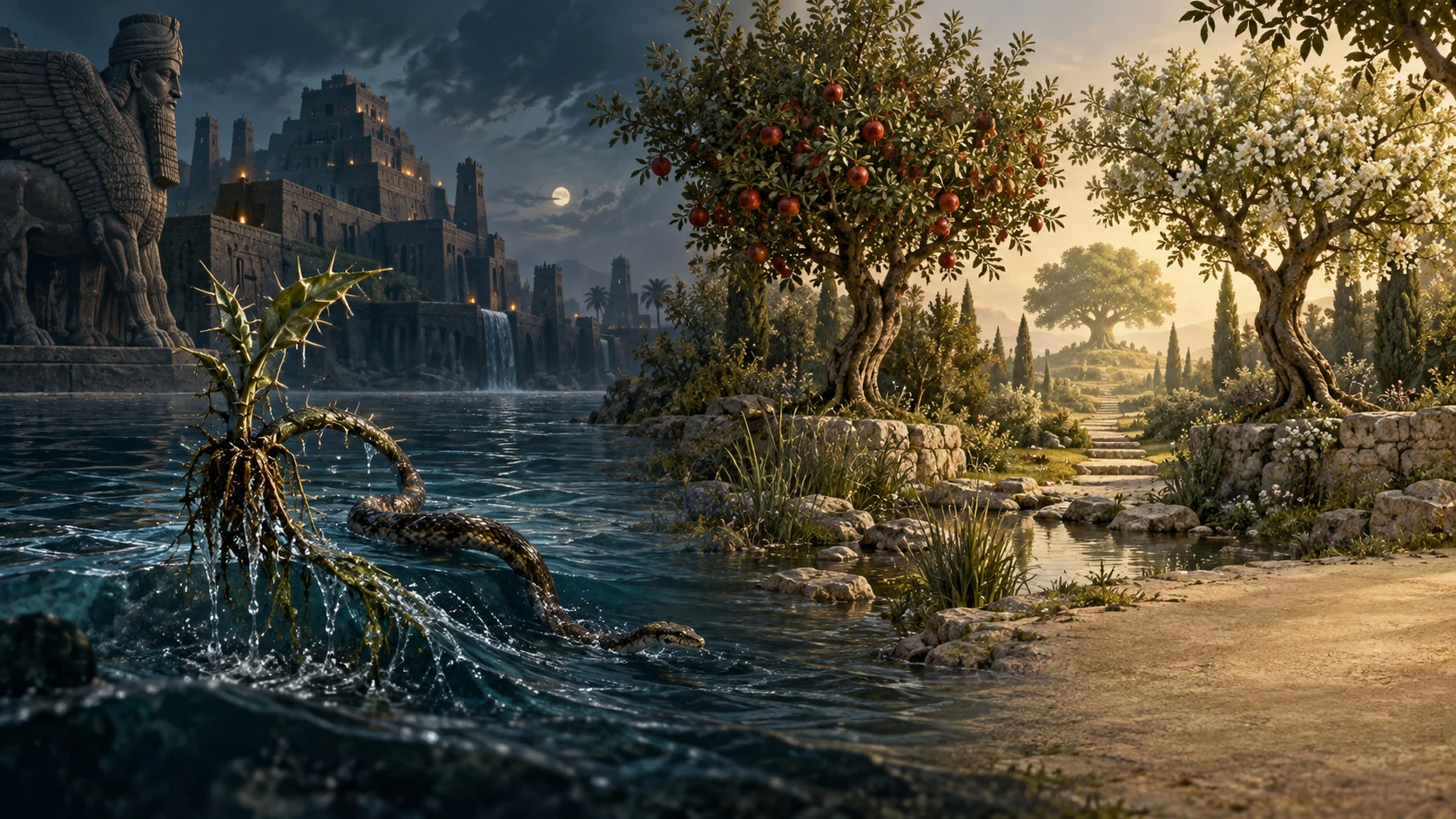
On the return journey, Gilgamesh stops to bathe in a pool of cool water. A serpent catches the plant’s scent, approaches, takes it away and sheds its skin as it retreats. Loss to the hero is juxtaposed with the creature’s apparent renewal through sloughing. The serpent is not introduced here as a divine gatekeeper, does not speak, and offers no moral judgment upon Gilgamesh. [10]
Did the snake eat the plant?
A distinction matters: the lines reviewed report smelling, taking and shedding, but do not explicitly report eating. Heidel’s translated lines say that the serpent seized the plant; his accompanying note then explains the shedding as the consequence of eating it. The latter is an interpretive inference, not the reproduction of an eating verb in those narrative lines. The shedding belongs to the story; an explanation in terms of the animal’s physiology, or a claim of a serpent made literally immortal, goes beyond what is narrated. [11]
Why line numbers differ
In Heidel’s 1949 edition the plant is disclosed around XI 266–270 and lost around XI 287–289, on printed pp. 91–92. A newer critical numbering, used for example when citing the snake scene as XI 305–307, places the same actions at different line numbers. These are editorial systems, not two sets of numbered lines visible on one unbroken artifact. Readings also differ in how the plant’s benefit, location and setting are rendered. We therefore give the narrative faithfully without claiming to have made an independent AkkadianAkkadianAn ancient East Semitic language written in cuneiform from the third millennium BCE; its varieties include Babylonian and Assyrian, and it served in international diplomacy.Glossary · Click to read the explanation collation. [12]
Tears and the return to Uruk
Gilgamesh sits down and weeps over the lost plant, questioning the cost of all his labor. He then returns with Urshanabi to Uruk and directs his attention to its walls and foundations. Readers often interpret this change of focus as a movement from bodily perpetuity toward the enduring work of a community. That is an interpretation of the ending, not an explicit promise that civic architecture confers individual immortality. The story does not stop with the picturesque image of a snake shedding its skin. [13]
The plant and the two trees in Genesis
GenesisBook of GenesisHebrew book of the Torah containing Noah’s flood, survival offering and covenant with living creatures.Glossary · Click to read the explanation 2:9 places the Tree of LifeTree of Life in GenesisA tree in the garden of Genesis 2–3, distinct from the tree of knowledge. After the forbidden fruit is eaten, the way to the tree of life is guarded lest humans eat from it and live forever. The text does not identify its fruit or explain precisely how it works.Glossary · Click to read the explanation alongside the distinct Tree of the Knowledge of Good and EvilTree of the Knowledge of Good and EvilThe tree prohibited in Genesis 2:17 and eaten from in Genesis 3, narratively distinct from the tree of life; its fruit is unidentified.Glossary · Click to read the explanation. In Genesis 3:22–24, access to the former is barred lest the human eat and live forever. The parallels are suggestive: a life-giving plant, a serpent and a human opportunity lost. But the plot differs in important ways. Gilgamesh’s plant lies in the waters and the snake removes it after the hero finds it. In Genesis the serpent addresses the woman about the forbidden tree; access to the other, life-giving tree is guarded after expulsion. [14]
David M. Carr reads the EdenEden: The Setting of Genesis’s GardenThe place in which the garden of Genesis 2–3 is planted; the story describes rivers, trees and a human test, while its archaeological location and name’s derivation remain unsettled.Glossary · Click to read the explanation narrative against Mesopotamian questions about wisdom and mortality while keeping its distinctive literary construction in view. In a more assertive recent comparison, Shawna Dolansky argues that the writers of Genesis were acquainted with Gilgamesh and/or related traditions. The distribution of the epic makes literary contact worth investigating, but shared images alone do not identify a particular intermediary text or reconstruct the path of transmission. [15]
Adapa and the lost opportunity
In the story of AdapaAdapaAdapa is a sage of Eridu in Mesopotamian tradition, associated with Ea. The South Wind story, audience with Anu, and ritual sources give him distinct roles; they do not establish his identity with Adam or the first human.Glossary · Click to read the explanation, a learned human likewise misses food and drink that might have altered his fate, having followed a deity’s warning. It is another story about wisdom and a missed opportunity, not a replica of the plant-and-snake plot. Reading these narratives alongside one another clarifies a wider Mesopotamian exploration of mortal limits. It does not, by itself, prove that one particular text was copied directly into Genesis. [16]
What the episode establishes
The published lines examined here support a clear sequence: Gilgamesh learned of a thorny plant, obtained it, planned a test, and lost it to a skin-shedding serpent. They do not themselves identify a botanical species, depict the human experiment, explicitly narrate the snake’s eating it, or establish that it grants endless immortality. Interpretations concerning mortality, renewal and human accomplishment are valuable when kept distinct from the actions the text actually recounts.
References and notes (16)
- Alexander Heidel, The Gilgamesh Epic and Old Testament Parallels (2nd ed., 1949), Tablet XI, printed pp. 91–93. The extracted text of these pages alone was read; the scanned page images and full book were not visually reviewed. Tablet XI, printed pp. 91–93 (PDF text extraction; selected passage only) Return to the text ↑
- British Museum, record for K.3375, the seventh-century BCE “Flood Tablet” of Gilgamesh. The catalogue identifies the artifact and the flood episode, not a photographed occurrence of the plant scene. K.3375 object record and short description only Return to the text ↑
- Andrew R. George, “The Epic of Gilgamesh,” Cambridge excerpt (2007): opening pages on Sumerian poems, Old Babylonian witnesses and the Standard Babylonian recension. An edited composite is not a single intact tablet. Excerpt PDF pp. 1–6 Return to the text ↑
- Andrew R. George, Cambridge excerpt on The Epic of Gilgamesh (2007), excerpt PDF pp. 2–4 and 9–10; only the excerpt, not the containing book, was consulted. Original note 4 and URL preserved. Excerpt PDF pp. 2–4, 9–10 Return to the text ↑
- Andrew R. George, Cambridge excerpt, summary of Enkidu’s death and Gilgamesh’s quest; checked against Maureen G. Kovacs’s published English translation of Tablet XI, not against a tablet inspected firsthand. Excerpt PDF pp. 5–10 Return to the text ↑
- Maureen Gallery Kovacs, published English translation of Tablet XI of Gilgamesh: passages on Utnapishtim’s special life, the wakefulness test and the loaves. Relevant passages only; no independent Akkadian collation. Tablet XI, immortality and waking-test passages Return to the text ↑
- Alexander Heidel, Tablet XI in his numbering, lines 266–270, printed p. 91; spines and editorial restorations are shown. No modern botanical species is established. Tablet XI 266–270; printed p. 91 Return to the text ↑
- Alexander Heidel, Tablet XI, lines 271–276, printed p. 91: descent with stones, taking the plant and ascent; no consumption is narrated there. Tablet XI 271–276; printed p. 91 Return to the text ↑
- Alexander Heidel, Tablet XI, lines 277–282, printed pp. 91–92; the old-man trial and the hero’s later eating are expressed as intentions, not completed events. Tablet XI 277–282; printed pp. 91–92 Return to the text ↑
- Maureen Gallery Kovacs, Tablet XI translation, the bathing-and-serpent episode: the plant is scented and carried off; the snake sheds skin. Compared with Heidel’s printed p. 92. Tablet XI, bathing, snake and skin-shedding passages Return to the text ↑
- Alexander Heidel, printed p. 92, lines 287–289 and note 212: the translated narrative reports seizure and sloughing, whereas the note interprets these as caused by eating. Text and commentary are separated. Tablet XI 287–289; printed p. 92, footnote 212 Return to the text ↑
- Compare Heidel’s XI 287–289 (printed p. 92) with the newer XI 305–307 citation in Shawna Dolansky’s comparison. The divergence reflects editorial line-numbering practices, not two physical sequences. Gilgamesh XI 305–307 in the Gilgamesh section; compare Heidel XI 287–289 Return to the text ↑
- Alexander Heidel, Tablet XI 290–307, printed pp. 92–93: the lament, return and inspection of Uruk’s walls. “Lasting civic achievement” is an interpretation of the narrative ending. Tablet XI 290–307; printed pp. 92–93 Return to the text ↑
- Genesis 2:9; 3:1–6, 22–24, particularly 3:22–24 about barred access to the Tree of Life. Specific passages were consulted in the public-domain King James Version, not a full biblical commentary. Genesis 3:22–24 (cf. 2:9 and 3:1–6) Return to the text ↑
- David M. Carr, “Precursors to the Eden Narrative (Gen 2:4b–3:24),” in The Formation of Genesis 1–11 (OUP, 2020). Only the published chapter abstract was accessible and read; the chapter itself was not read. Publisher’s chapter abstract only Return to the text ↑
- Shawna Dolansky, “Five Ancient Near Eastern Myths Behind the Bible’s Three Creation Accounts” (TheTorah.com, 2026), relevant Adapa, Gilgamesh and Eden comparison sections; these sections, not a fresh Akkadian examination, were consulted. Relevant Adapa, Epic of Gilgamesh and Eden comparison sections Return to the text ↑
Suggest a correction · Suggest a source for this record
Cite this record
IL Archive, «Gilgamesh’s Rejuvenating Plant», https://ilarchive.com/en/entities/gilgamesh-rejuvenating-plant
Continue reading