Entity
Tree of the Knowledge of Good and Evil
A reference page linking a name, group, or concept to the materials that discuss it.
The forbidden tree of Genesis 2–3: the narrative distinguishes the knowledge gained by eating from the immortality denied when access to the tree of life is guarded. The fruit is unidentified.
Estimated reading time: 8 min Published Last reviewed:
Share article
Text
Introduction
The “tree of the knowledge of good and evil” is not the name of a botanical species that can be identified in nature. It is a named tree within the story of the garden of EdenEden: The Setting of Genesis’s GardenThe place in which the garden of Genesis 2–3 is planted; the story describes rivers, trees and a human test, while its archaeological location and name’s derivation remain unsettled.Glossary · Click to read the explanation in GenesisBook of GenesisHebrew book of the Torah containing Noah’s flood, survival offering and covenant with living creatures.Glossary · Click to read the explanation, where it frames questions about knowledge, divine command, human choice, and life outside the garden. The first task of interpretation is to distinguish the wording of Genesis from later religious and artistic traditions. The narrative names neither an apple nor Satan; nor does it supply a single philosophical definition of “good and evil.” The many later interpretations form part of the story’s reception, but must not be read back as statements made explicitly by the ancient narrator. [1]
Contents
- The tree’s place and identity - The command, the dialogue, and the eating - What does “knowledge of good and evil” mean? - Death, the tree of lifeTree of Life in GenesisA tree in the garden of Genesis 2–3, distinct from the tree of knowledge. After the forbidden fruit is eaten, the way to the tree of life is guarded lest humans eat from it and live forever. The text does not identify its fruit or explain precisely how it works.Glossary · Click to read the explanation, and expulsion - One tree or two? A literary question - Mesopotamian comparisons and their limits - Ancient images and religious reception - Critical synthesis and degrees of certainty
The tree’s place and identity
Genesis 2:9 names two distinctive trees: the tree of lifeTree of Life in GenesisA tree in the garden of Genesis 2–3, distinct from the tree of knowledge. After the forbidden fruit is eaten, the way to the tree of life is guarded lest humans eat from it and live forever. The text does not identify its fruit or explain precisely how it works.Glossary · Click to read the explanation “in the midst of the garden,” and the tree of the knowledge of good and evil. In 2:16–17 the human is permitted to eat from the garden’s trees but explicitly forbidden to eat from the latter tree. A narrative name, however, tells us nothing about the tree’s botanical family, fruit colour, or taste. The customary apple is a later association, not an identification given by the passage. The two named trees ultimately have different roles in the narrative’s conclusion, whatever symbolic connections interpreters may find between them. [2]
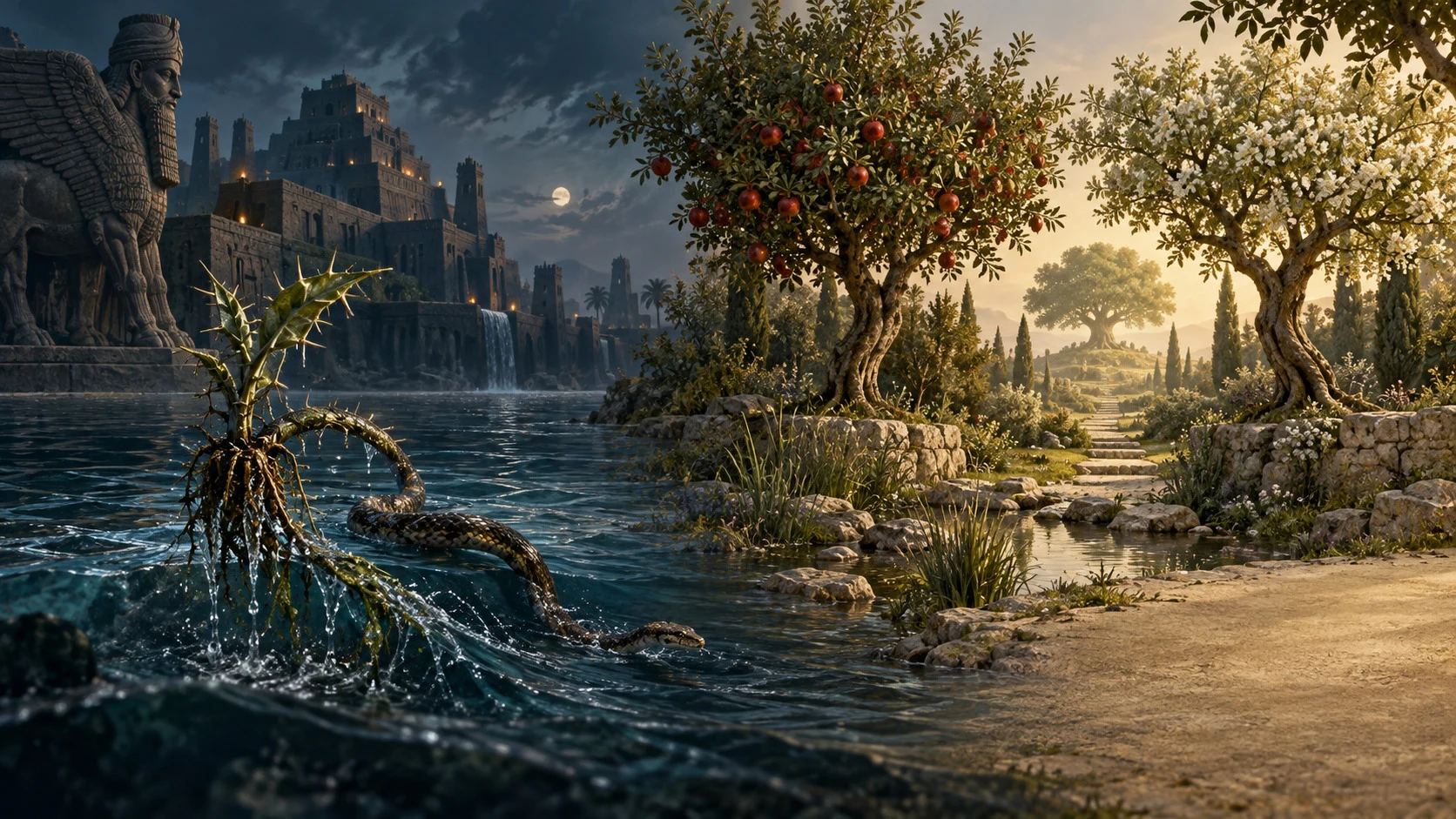
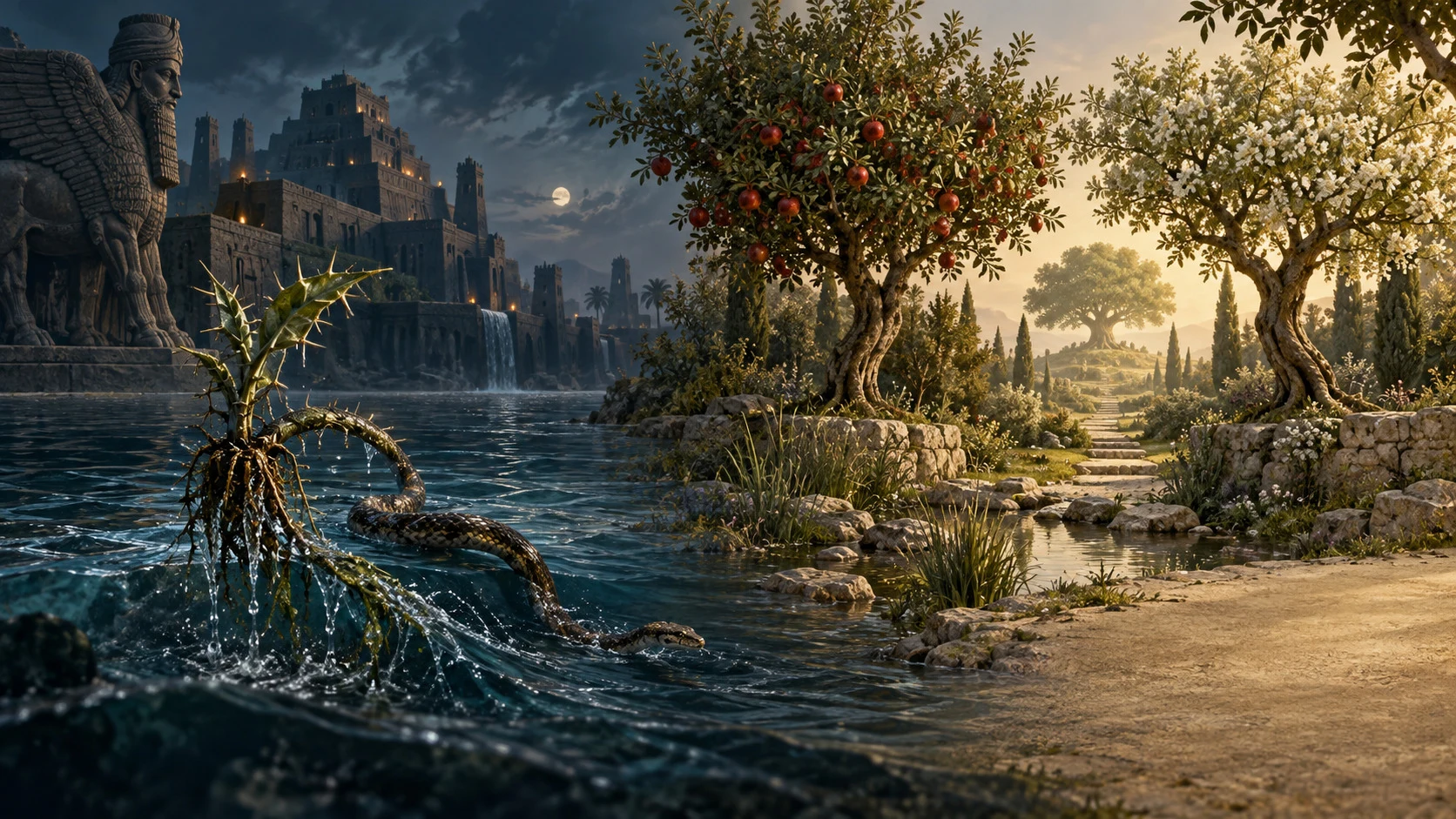
The accompanying cover is a modern conceptual illustration that places two garden trees opposite a water-borne plant. Its depicted fruit is not evidence for the fruit’s identity in Genesis; neither are its imagined buildings an archaeological reconstruction of Eden or of any Mesopotamian city.
The command, the dialogue, and the eating
Genesis 2 presents the prohibition before describing the creation of the woman. In Genesis 3 the serpent is introduced as a particularly crafty animal. It turns the prohibition of a particular tree into a question about the apparent scope of God’s command, then asserts that eating will open human eyes and impart knowledge of good and evil. In her reply the woman adds that the fruit must not even be touched; this addition occurs in her reported speech, not in the original wording of the command. She judges the fruit desirable, eats, and gives some to the man beside her. Their eyes are opened to their nakedness, and they sew fig leaves together as coverings. Fig leaves used as clothing do not identify the eaten fruit as figs, still less as apples. [3]
The episode cannot be reduced to a picturesque “forbidden fruit.” It develops the tension between instruction and persuasion, then narrates consequences for perception, relationships, labour, and access to the garden. The serpent is a figure within the HebrewHebrewA Northwest Semitic language of the Canaanite group, encompassing Iron Age epigraphy, Biblical, Rabbinic, medieval and Modern Hebrew; its scripts and pronunciations changed over time.Glossary · Click to read the explanation narrative; identifying it directly as Satan belongs to later trajectories of interpretation, not to an explicit designation in Genesis 3.
What does “knowledge of good and evil” mean?
The expression “good and evil” can indicate the ability to discriminate and judge, or convey a comprehensive range of experience through two contrasting poles. Deuteronomy 1:39 speaks of children who, at that time, do not know good and evil; this provides a useful comparison linking the expression to maturity or discernment, although it cannot settle the Eden story by itself. Isaiah 7:15–16 similarly places rejecting evil and choosing good in the context of a child’s development. These are linguistic parallels, not identical narratives or a ready-made definition for every occurrence. [4][5]
As a result, interpreters differ: the tree has been understood as bringing moral discernment, as symbolizing the seizure of a kind of autonomous wisdom beyond a divinely set limit, or as staging a transition from innocence toward bodily awareness and adulthood. Karel van der Toorn emphasizes maturation, nakedness, and sexuality in a recent reading, but that remains an interpretive proposal, not a direct explanation supplied by the narrator. Neither “scientific knowledge” nor “sexual transgression” can simply be announced as the one securely established meaning. [6]
Death, the tree of life, and expulsion
The command warns of death “in the day” of eating, but the two characters do not physically die within the scene in Genesis 3. Their condition changes, and they are expelled. Readings of the warning therefore vary: it might refer to the onset of mortality, death that will eventually ensue, or the forfeiting of access to unending life. Joseph Ryan Kelly stresses how the guarded tree of life makes the loss of immortality structurally important to the conclusion. This is an argument about the narrative as a whole, rather than a way of pretending that the tension with the earlier wording does not exist. [7]
Genesis 5:5 later reports the death of AdamAdamAdam is a figure in Genesis’s narratives of beginnings, linked with Cain, Seth and Abel.Glossary · Click to read the explanation at a great age; this comes in a different textual setting, not at the moment of eating. In Genesis 3:22–24, by contrast, God says the human has become one who knows good and evil, and prevents the human from also taking from the tree of life and living forever. Cherubim guard the way. Acquired knowledge and endless life remain distinct in the narrative’s final form. [8]
One tree or two? A literary question
The received narrative gives two named trees, yet a question of placement remains. In Genesis 2:9, the tree of life is said to stand “in the midst of the garden”; in the woman’s words in 3:3, the forbidden tree is described as being “in the midst.” Jack M. SassonJack M. SassonHebrew Bible and ancient Near Eastern cultures scholar, Vanderbilt professor emeritus, also specializing in Mari’s archives.Glossary · Click to read the explanation proposes an imaginative reading in which the characters could have mistaken the tree of life for the forbidden tree of knowledge. This is explicitly a speculative reconstruction, not a fact stated in the biblical text. [9]
In the published abstract of a specialist study, Mark Makowiecki explores how the wording allows a tension between one and two Edenic trees. Christoph Levin, in selected pages of a separate academic chapter, examines the growth and layering of Genesis 1–3, including the serpent’s role. Such proposals concern literary composition; they do not establish a scholarly consensus that only one physical tree existed in the story, or authorize assigning archaeological reality to a modern illustration. For Makowiecki I consulted the abstract only; for Levin, selected extracted pages, not the entire book. [10][11]
Mesopotamian comparisons and their limits
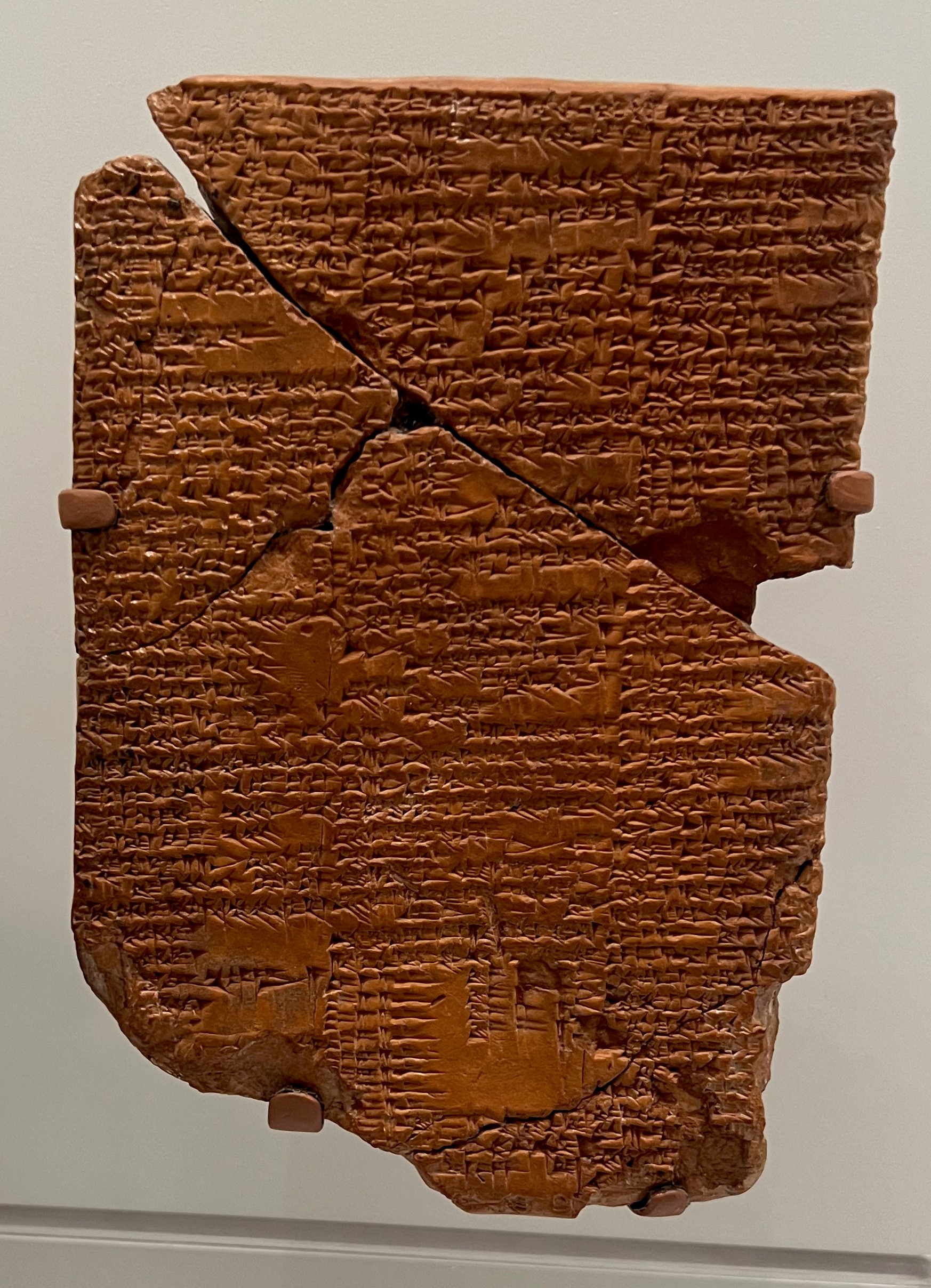
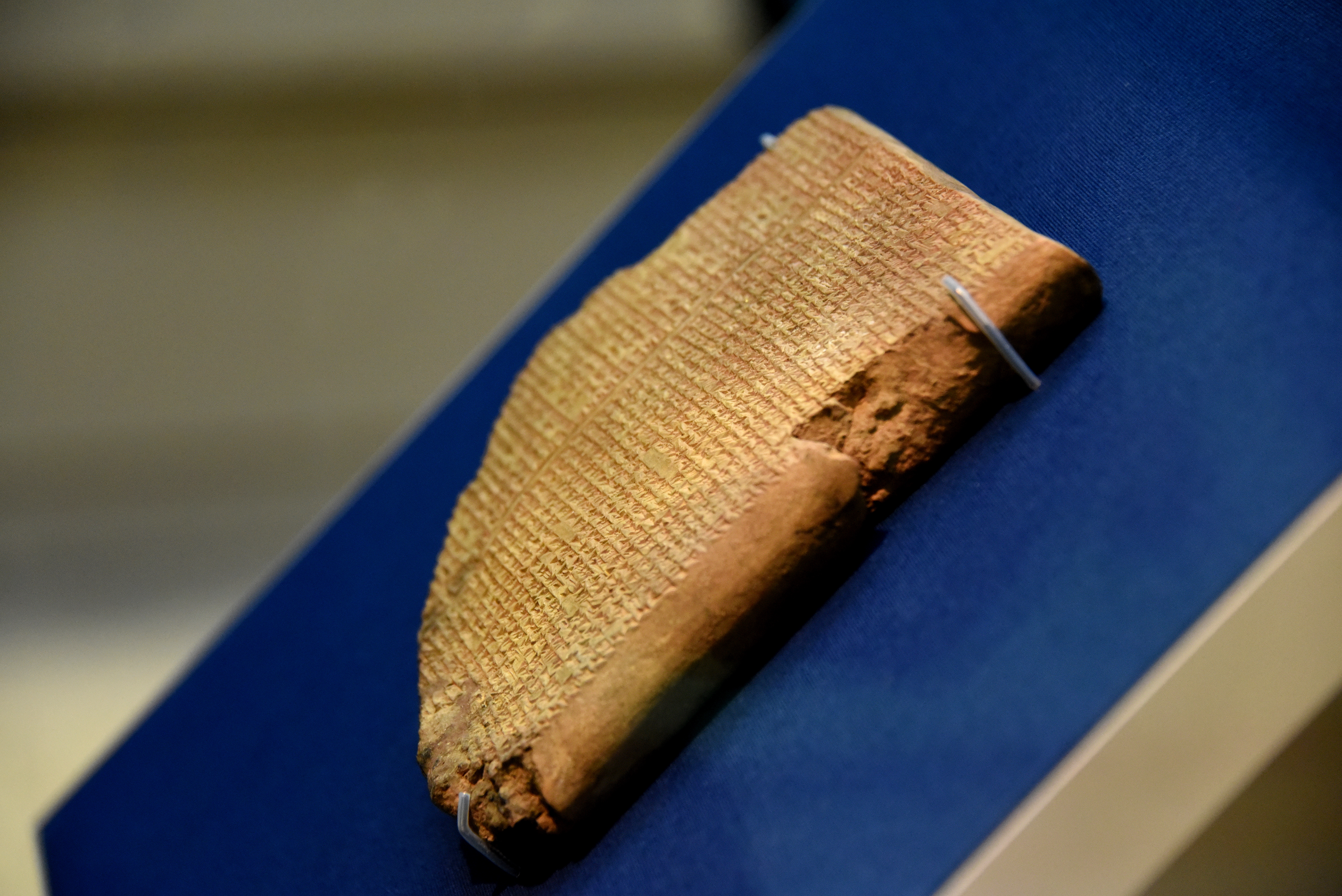
In Tablet XI of the Epic of GilgameshEpic of GilgameshA Babylonian literary work with multiple recensions, preceded by separate Sumerian poems on Uruk’s king and Enkidu. Its standard form explores friendship, death, the flood and the limits of seeking eternal life.Glossary · Click to read the explanation, the hero retrieves a plant from the watery depths that promises a renewal of youth but loses it when a snake takes it. The plant has its own catalogue identity as the Gilgamesh rejuvenating plantGilgamesh’s Rejuvenating PlantA thorny plant that Gilgamesh retrieves in Tablet XI and plans to test for rejuvenation, before a snake carries it away and sheds its skin. The account separates the narrative from interpretations of eating and immortality and cautiously compares the trees of Eden.Glossary · Click to read the explanation. The comparison is illuminating: a precious plant, a snake, and the loss of renewed youth in one narrative; named trees, a speaking serpent, and a guarded route to undying life in another. Yet Gilgamesh’s plant is not explicitly a guarantee of eternal immortality, and the tree of knowledge is not identical to that rejuvenating plant. Shared images may invite a historical comparison, but cannot, on their own, prove direct copying from one particular work to the other. I compared published textual witnesses and translations, without handling cuneiformCuneiformWriting with wedge-shaped signs, developed from Mesopotamian recording traditions and used for several languages from the third millennium BCE.Glossary · Click to read the explanation tablets or independently deciphering AkkadianAkkadianAn ancient East Semitic language written in cuneiform from the third millennium BCE; its varieties include Babylonian and Assyrian, and it served in international diplomacy.Glossary · Click to read the explanation. [12][13]
Ancient images and religious reception
Stylized trees are widespread in ancient Mesopotamian art. One example is an Assyrian shell plaque from Nimrud, accession number 58.31.22, described by the Metropolitan Museum of Art. The museum does not claim to know the motif’s precise meaning. It is therefore useful as a thematic comparison only, not as an illustration identified with Genesis’s forbidden tree, or evidence that an excavated artifact represents Eden. The conceptual image accompanying this entry likewise claims no ancient provenance. [14]
The Qur’an also gives a command not to approach “this tree” in 2:35, without identifying its species. In 20:120 Satan tempts Adam by speaking of the “tree of immortality”; this expression forms part of the tempter’s speech in that verse. It should not be treated as a botanical name supplied by Genesis, nor assumed to reproduce the distinction between two trees found in the biblical narrative. Each text must be read in its own literary context. [15][16]
Jewish and Christian interpreters also differ in how they understand disobedience, knowledge, and death; the narrative alone does not dictate one later, fully developed doctrine of “original sin.” Carol A. Newsom considers rational agency and early interpretation of Genesis 2–3 in an academic chapter, but I consulted only its published abstract, not the paywalled chapter. Proposed dates and compositional layers for the Eden narrative likewise remain subjects of scholarly argument rather than settled features of the story. [17]
Critical synthesis and degrees of certainty
Explicit in the text: a tree called the knowledge of good and evil is prohibited; the two humans eat from it; their awareness changes; the way to the separately named tree of life is finally guarded. Not specified: the species of fruit, whether it was an apple or a fig, a single philosophical definition of knowledge, or the serpent’s identification as Satan in the language of Genesis. Debated: the literary relation between the trees, precisely how the warning of death is fulfilled, and the degree of historical contact with Mesopotamian traditions. Comparisons are most valuable when they sharpen these questions rather than substituting resemblance for evidence of direct dependence. [18]
References and notes (18)
- Robert S. Kawashima, “Adam and Eve in the Garden of Eden: An Etiology for the Human Condition,” TheTorah.com (2022); introduction and principal etiological discussion consulted. Robert S. Kawashima (2022), introduction and etiological discussion Return to the text ↑
- Genesis 2 in Hebrew with parallel JPS translation; the chapter was read, especially verses 9 and 16–17. Genesis 2, Hebrew/JPS parallel, especially 2:9 and 2:16–17 Return to the text ↑
- Genesis 3 in Hebrew with parallel JPS translation; the chapter was read, especially verses 1–7 and 22–24. Genesis 3, Hebrew/JPS parallel, especially 3:1–7 and 3:22–24 Return to the text ↑
- Deuteronomy 1:39, Hebrew text and parallel JPS English; verse checked in context. Deuteronomy 1:39, Hebrew/JPS parallel Return to the text ↑
- Isaiah 7:15–16, Hebrew and parallel JPS translation; the verses read in context. Isaiah 7:15–16, Hebrew/JPS parallel Return to the text ↑
- Karel van der Toorn, “Becoming Homo Erectus: Adam and Eve in the Garden of Eden,” TheTorah.com (2025); sections on maturation, nudity and interpretation consulted. Karel van der Toorn (2025), sections on adulthood, nakedness and the Eden story Return to the text ↑
- Joseph Ryan Kelly, “The Secret of the Garden of Eden: Knowledge or Immortality,” TheTorah.com (2022); passages on prohibition, immortality and expulsion. Joseph Ryan Kelly (2022), sections on immortality, prohibition and expulsion Return to the text ↑
- Genesis 5:5, Hebrew/JPS parallel; Adam’s death notice checked, distinct from the eating episode. Genesis 5:5, Hebrew/JPS parallel Return to the text ↑
- Jack M. Sasson, “What Really Happened in the Garden of Eden,” TheTorah.com (2022); two-tree passages and conjectural rereading consulted. Jack M. Sasson (2022), sections on both trees and the speculative re-reading Return to the text ↑
- Mark Makowiecki, “Untangled Branches: the Edenic Tree(s) and the Multivocal WAW,” Journal of Theological Studies 71.2 (2020): 441–457; published abstract only, NOT full article. Mark Makowiecki (2020), published ABSTRACT ONLY; article pp. 441–457 NOT read Return to the text ↑
- Christoph Levin, “Paradise Established: The Foundation of Kosmos versus Chaos according to Genesis 1–3,” in Chaos from the Ancient World to Early Modernity (De Gruyter, 2020), 41–57; extracted text of pp. 41–42, 49 and 52–55 ONLY, not whole work or page images. Christoph Levin (2020), Paradise Established, pp. 41–42, 49 and 52–55; text extraction ONLY Return to the text ↑
- Epic of Gilgamesh XI 279–296, K.2252 manuscript witness; consulted mediated eBL transliteration and R. Campbell Thompson’s 1928 English through Theosis Library, not original cuneiform or independent Akkadian analysis. Gilgamesh XI 279–296, K.2252, mediated eBL transliteration/Thompson 1928 translation Return to the text ↑
- Epic of Gilgamesh XI 298–307, K.7752 manuscript, snake and plant; consulted reproduced transliteration and historical English rendering only. Gilgamesh XI 298–307, K.7752, snake/plant episode, mediated witness Return to the text ↑
- Metropolitan Museum of Art, “Plaque in the form of a tree,” Neo-Assyrian shell inlay, 58.31.22; museum catalog and interpretive description read, image not reused and object not physically examined. The Metropolitan Museum of Art, “Plaque in the form of a tree,” shell, 58.31.22; object record and interpretation Return to the text ↑
- Qur’an 2:35, the words “this tree”; checked verse and parallel translations provided by the Quranic Arabic Corpus. Qur’an 2:35, Arabic wording and translations displayed by Quranic Arabic Corpus Return to the text ↑
- Qur’an 20:120; verse and parallel translations of the tempter’s “tree of immortality” read via Quranic Arabic Corpus. Qur’an 20:120, Arabic/parallel translations of “tree of immortality” in Satan’s speech Return to the text ↑
- Carol A. Newsom, “Rational Agency and the Birth of the Human: Genesis 2–3 and Its Early Interpretation,” The Spirit within Me (Yale UP, 2021), chapter 5, 116–142; publisher abstract ONLY, not chapter text. Carol A. Newsom (2021), ch. 5 pp. 116–142, publisher ABSTRACT ONLY Return to the text ↑
- Shawna Dolansky, “Five Ancient Near Eastern Myths Behind the Bible’s Three Creation Accounts,” TheTorah.com (Sept. 22, 2026; updated Oct. 9); introduction, comparative analysis and conclusion consulted; historical interpretation distinguished from direct textual proof. Shawna Dolansky (2026), introductory and comparative sections on Genesis and ancient Near Eastern texts Return to the text ↑
Suggest a correction · Suggest a source for this record
Cite this record
IL Archive, «Tree of the Knowledge of Good and Evil», https://ilarchive.com/en/entities/tree-of-knowledge-genesis
Continue reading