Entity · Literary figure
Gilgamesh
A reference page linking a name, group, or concept to the materials that discuss it.
- Names
- Gilgamesh · Gilgameš
- Region
- Mesopotamia
Gilgamesh, a king of Uruk in Mesopotamian tradition and hero of Sumerian poems and the Akkadian epic named after him: Enkidu, the fear of death and Tablet XI’s flood, read as literature, not a documented biography.
Estimated reading time: 8 min Published Last reviewed:
Share article
Video
The Epic of Gilgamesh: The Complete Story from the Ancient Tablets
A king no one could stop, a wild man made to match him, and a friendship that changes both. The whole Epic of Gilgamesh in eight illustrated chapters, told from the clay tablets of ancient Iraq; where the tablets are broken, the narration says so. Illustrations, narration voice and visual effects were created with AI tools by IL Archive; the text is a faithful retelling based on the ancient tablets.
The YouTube player loads only when you press play. Watch on YouTube
Text
Introduction
Gilgamesh, a king of UrukUrukAncient city at Warka in southern Iraq, a major urban centre around 3200 BCE that preserved early writing and accounting tablets.Glossary · Click to read the explanation in Mesopotamian tradition, is the hero of the epic that bears his name, read today as a story about friendship, death and the search for lasting life. His story is also the outcome of a long history of writing and rewriting in MesopotamiaMesopotamiaHistorical region associated with the Tigris and Euphrates: Uruk, Ur, Eridu, cuneiform, Sumer, Akkad, Babylon and Assyria, their languages and cults, and the limits of archaeological evidence.Glossary · Click to read the explanation. This entry asks how it took shape across different witnesses, where the flood episode belongs in it, and what comparisons with other texts can—and cannot—establish.
Our focus is Tablet XI of the Standard Babylonian version, without treating the flood as the whole epic. Throughout, the time in which a story is set, the period in which it was composed and the date of a surviving tablet are different questions. What follows is historical analysis based on identified scholarly editions and translations, not a new translation from cuneiformCuneiformWriting with wedge-shaped signs, developed from Mesopotamian recording traditions and used for several languages from the third millennium BCE.Glossary · Click to read the explanation.
A king discovers the limits of life
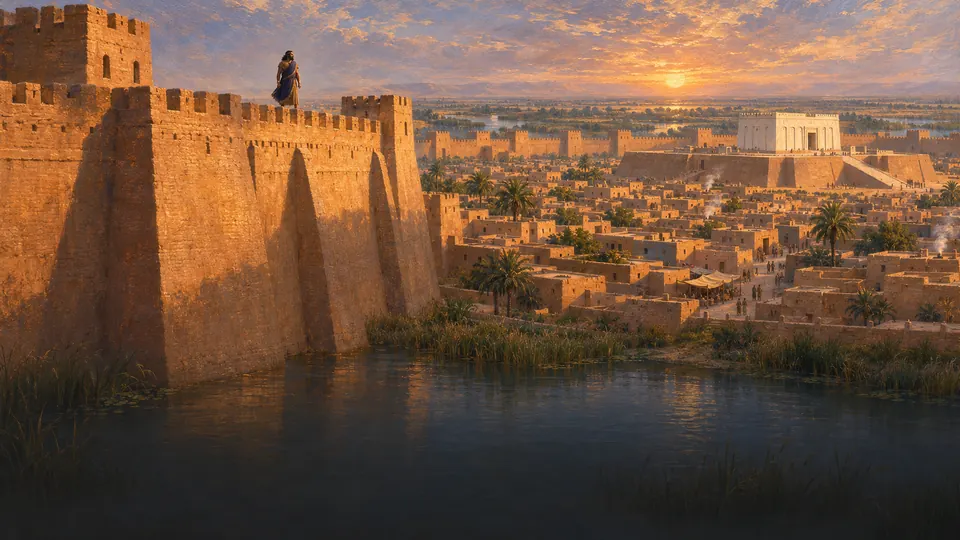
The epic takes its name from Gilgamesh, a king of UrukUrukAncient city at Warka in southern Iraq, a major urban centre around 3200 BCE that preserved early writing and accounting tablets.Glossary · Click to read the explanation in southern Mesopotamia, in present-day IraqIraqIraq is a modern country encompassing much of ancient MesopotamiaGlossary · Click to read the explanation. The story first depicts a powerful ruler whose behaviour burdens his city. The gods create EnkiduEnkidu, Gilgamesh’s companionGilgamesh’s companion in the Babylonian epic; his death sets the king searching for life beyond mortality.Glossary · Click to read the explanation as a counterweight. The two fight, become friends and venture to the Cedar Forest to confront HumbabaHumbaba, guardian of the Cedar ForestGuardian of the Cedar Forest confronted by Gilgamesh and Enkidu in the epic traditions.Glossary · Click to read the explanation. A conflict involving IshtarInanna / IshtarA prominent Mesopotamian goddess whose Sumerian name Inanna became associated with Akkadian Ishtar across diverse traditions. She was associated with desire, war, royal authority and Venus, while local forms and genealogies varied among texts.Glossary · Click to read the explanation and the Bull of Heaven follows. When Enkidu dies, the king's fear of death becomes personal, sending him in search of someone who escaped the common human fate. Eventually the narrative returns to Uruk and its walls rather than offering a universal recipe for immortality. These are events in a literary narrative, not archaeologically confirmed episodes of a king's biography. [1]
The label “Epic of Gilgamesh” is useful, but it does not mean that every Sumerian and AkkadianAkkadianAn ancient East Semitic language written in cuneiform from the third millennium BCE; its varieties include Babylonian and Assyrian, and it served in international diplomacy.Glossary · Click to read the explanation witness belonged to a single unchanged work. Scholars use the title both for a long literary tradition and for particular versions within it. Any claim about the words of a line should identify its version or edition. The existing entry for the epic as a literary workEpic of GilgameshA Babylonian literary work with multiple recensions, preceded by separate Sumerian poems on Uruk’s king and Enkidu. Its standard form explores friendship, death, the flood and the limits of seeking eternal life.Glossary · Click to read the explanation is a distinct published identity, not a reason to duplicate it here.
From separate poems to an epic in tablets
Independent Sumerian poems tell of Gilgamesh's exploits: encounters with Huwawa or Humbaba, the Bull of Heaven, and the netherworld, among others. They should not simply be assembled into a complete “Sumerian Gilgamesh epic” identical to the later Babylonian version. Oxford's published translation of “Gilgamesh and Huwawa” explicitly makes the wish for enduring fame a response to humanity's inability to pass beyond death. That affinity of theme does not make its lines interchangeable with those of the Akkadian epic. [3]
Old Babylonian-period manuscripts, dating to the second millennium BCE, attest to an Akkadian epic before the familiar Standard Babylonian text. A particular museum witness is Penn Museum tablet CBS 13116 from Nippur, dated in its catalogue to approximately 1900–1600 BCE. Crucially, it preserves a Sumerian literary fragment about Gilgamesh, Enkidu and the netherworld, not UtnapishtimUtnapishtimThe flood hero of Standard Babylonian Gilgamesh, granted exceptional life with his wife by the gods. He tells Gilgamesh how he survived; his name overlaps with Atrahasis and Ziusudra traditions without making their narratives identical.Glossary · Click to read the explanation's flood. The early Akkadian manuscripts themselves do not provide one complete continuous text: the literary tradition is older than the best-known surviving copies. [4]
The Standard Babylonian version is best known from first-millennium BCE copies, especially tablets from the library of AshurbanipalAshurbanipalAshurbanipal was an Assyrian king of the seventh century BCE, reigning about 668–631 BCEGlossary · Click to read the explanation at NinevehNineveh and KuyunjikNineveh is an ancient Assyrian city near Mosul in northern Iraq; Kuyunjik is one of its archaeological moundsGlossary · Click to read the explanation in northern Iraq. The continuous story reaches its closure in eleven tablets; a twelfth, connected to a Sumerian account of Enkidu and the netherworld, was appended rather than supplying a seamless continuation of the return to Uruk. The circumstances and date of the standard recension's composition remain questions of research. The date of an Assyrian manuscript is not the year the epic was first composed. [1]
What actually happens in the flood narrative?
Following Enkidu's death, Gilgamesh reaches UtnapishtimUtnapishtimThe flood hero of Standard Babylonian Gilgamesh, granted exceptional life with his wife by the gods. He tells Gilgamesh how he survived; his name overlaps with Atrahasis and Ziusudra traditions without making their narratives identical.Glossary · Click to read the explanation and asks how he acquired extraordinary life. The survivor recounts a divine councilDivine councilA divine council is a religious and literary scene in which divine beings gather before a superior authority for discussion, commissioning or judgment; it is not identical to a pantheon list.Glossary · Click to read the explanation's decision to send a flood. EaEnkiMesopotamian deity also known as Ea, linked with Eridu and the Abzu (deep fresh waters), wisdom, incantations, and narratives of creation and cosmic order. Later written attestations do not identify the deity of Eridu’s earliest layers.Glossary · Click to read the explanation, also known as Enki, passes a warning to him by addressing a reed wall or hut in the city of Shuruppak: he is to abandon his home, build a vessel and preserve living creatures. Utnapishtim describes constructing the vessel and taking aboard family members, craftspeople and animals. The dimensions reported by the translation should neither be silently harmonised with vessels in other narratives nor treated as measurements of a vessel found by archaeology. [1]
The storm devastates the land and, in the account, even terrifies the gods. The boat comes to rest on a mountain named Nisir or Nimush in different readings. The survivor releases a dove, a swallow and a raven, in that order. The first two return; the raven does not. After a sacrifice, the gods debate responsibility for the destruction, and Utnapishtim and his wife receive a privileged form of life. The frame story then returns to Gilgamesh: he cannot even remain awake for the required interval, and a serpent later takes the plant that might restore his youth. The exceptional fate of the couple is not a general promise of everlasting life to human beings. [1]
One physical fragment is not the whole edition
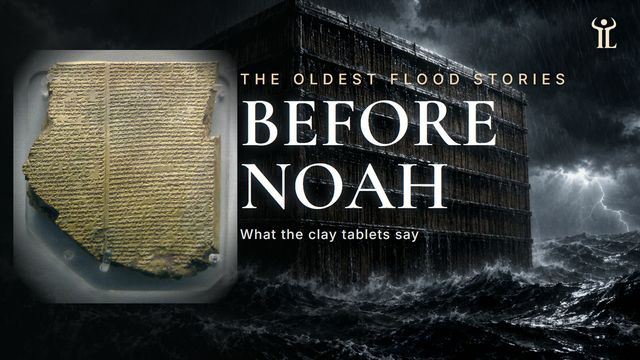
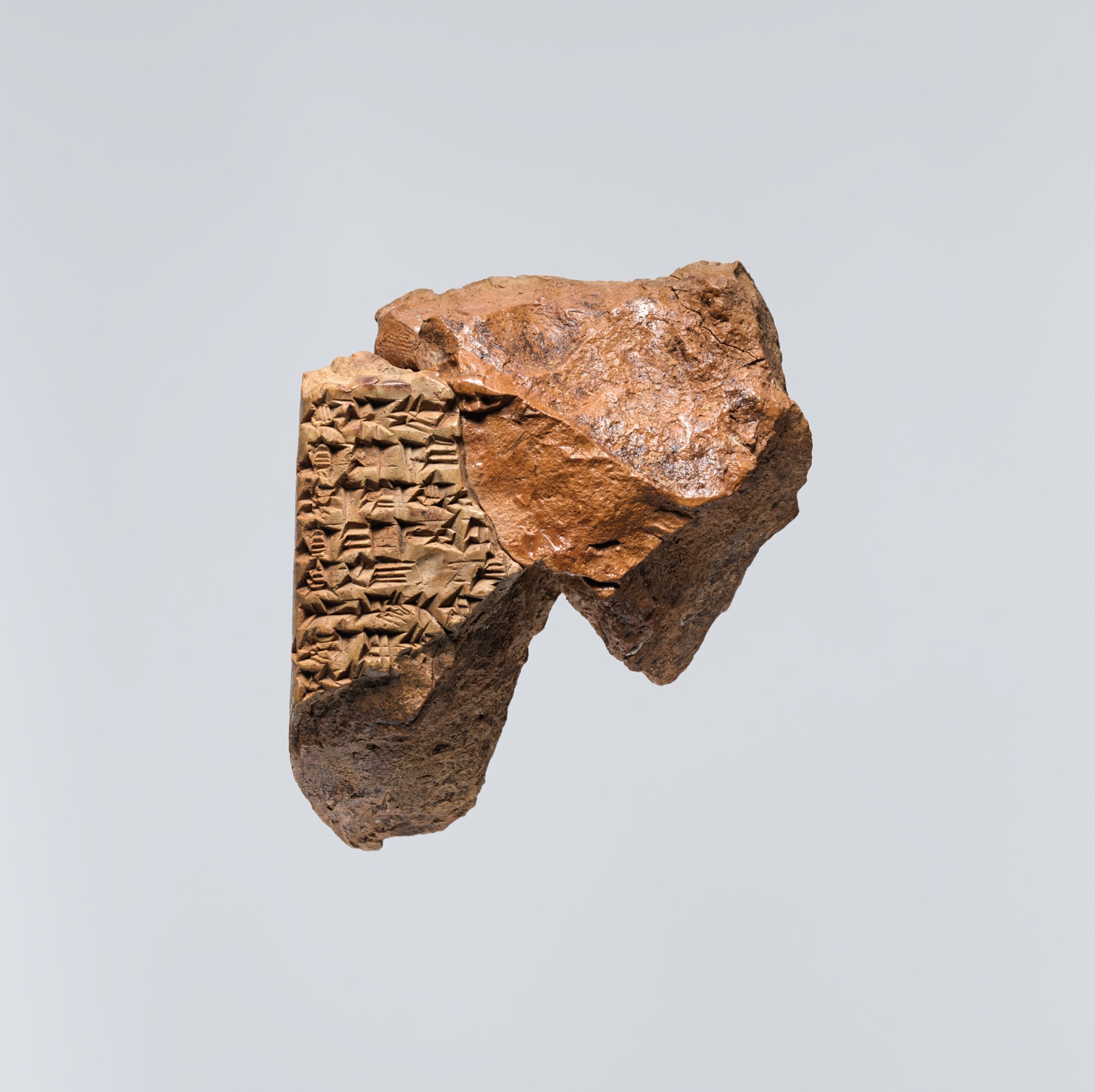
The British Museum's celebrated “Flood Tablet”, accession K.3375, is a particular Neo-Assyrian fragment from Nineveh, dated to the seventh century BCE. It preserves part of Tablet XI, written in Akkadian cuneiform. It would be wrong to say that every line of the foregoing narrative is visible on this fragment. Scholarly accounts of the tablet reconstruct a text from several surviving witnesses and explicitly mark uncertain and restored readings. A single object photograph cannot authenticate the whole composite edition or date the beginning of the story. [5]
Alexander HeidelAlexander HeidelAssyriologist who wrote The Gilgamesh Epic and Old Testament Parallels, second edition 1949.Glossary · Click to read the explanation published an influential English translation in 1949, with signs for damaged passages and discussion of different readings. His translation distinguishes legible evidence from editorial restorations; it must not be mistaken for an uninterrupted inscription or for a fresh reading of Akkadian undertaken here. Even the name of the landing mountain is given with qualifications. [1]
Flood traditions before the standard version
A separate Sumerian flood story recounts a warning given to ZiusudraZiusudraA literary king-priest in the fragmentary Sumerian Flood Story (ETCSL 1.7.4). He survives by boat, sacrifices, and receives divine life from An and Enlil in Dilmun. The surviving copy is Old Babylonian; his historicity is unproven.Glossary · Click to read the explanation, survival and extraordinary favour afterwards. The text published by Oxford's Electronic Text Corpus of Sumerian Literature has major lacunae. It preserves passages involving the warning, the storm, sacrifice and the survivor's destiny, but its missing parts cannot responsibly be filled from Gilgamesh or Genesis. Its seven-day storm also should not be conflated with the whole sequence of storm and bird-release in Tablet XI. [6]
AtrahasisAtrahasis: Epic and HeroAkkadian narrative on human creation, relations with the gods and the flood, named for its survivor warned by Enki. Its surviving manuscripts differ in date and preservation; its hero must not be equated uncritically with every Utnapishtim version.Glossary · Click to read the explanation is an Akkadian narrative of humanity's creation, multiplication, successive crises and a great flood. Its relationship to Utnapishtim's account is closer than a generic resemblance between boats. In the institutional abstract of his thesis, Alan Ralph MillardAlan Ralph Millard, 1937–2024Scholar of Hebrew and ancient Semitic languages, formerly a Liverpool professor, who studied Eden’s etymology.Glossary · Click to read the explanation identifies identical passages and judges literary borrowingLiterary borrowingUse of verbal or narrative material from an earlier text or tradition in a later work, distinguishing evidence of transfer from mere resemblance.Glossary · Click to read the explanation into Gilgamesh highly probable. The SOAS repository gives 1966 as the thesis award date; its reference to 1965 concerns the publication of new cuneiform material, not the award of the degree. [2]
Scholars including Andrew R. GeorgeAndrew R. GeorgeAssyriologist and editor of Gilgamesh, and emeritus professor of Babylonian at SOAS.Glossary · Click to read the explanation stress the need to compare different manuscripts and editions. Jean Bottéro's chapter on the first flood account likewise understands the episode as entering Gilgamesh from an older “Supersage” (Atrahasis) tradition. Such research offers strong grounds for literary relationship within Mesopotamia, but not a named copyist or the exact transmission date for each individual line. [8]
Genesis: parallels and differences
In the Book of GenesisBook of GenesisHebrew book of the Torah containing Noah’s flood, survival offering and covenant with living creatures.Glossary · Click to read the explanation, chapters 6–9, NoahNoahNoah is the flood-story figure in Genesis and a prophet in the Qur’anGlossary · Click to read the explanation survives a devastating flood with his family and living creatures on the ark. Warning, vessel, preservation of life, birds and sacrifice create striking parallels with Gilgamesh. Yet the order of birds differs: Genesis 8:7 begins with a raven flying back and forth; a dove is then released on several occasions, whereas Tablet XI has dove, swallow, raven. The rationale for the disaster, the relationship between the divine and humanity, and the outcome also differ. Genesis highlights human corruption and the promise that life will not again be destroyed by such a flood; Utnapishtim and his wife, by contrast, receive a distinctive quasi-divine status. This is a comparison of identified textual forms, not a claim that all flood narratives agree. [7]
The cumulative similarities make the relationship between Mesopotamian and biblical traditions a serious historical question. But they do not identify K.3375 as the manuscript directly copied by any writer of Genesis, nor demonstrate a single proven route. Long periods of circulation and adaptation, as well as differences in literary purpose, lie between the surviving evidence. A probable relationship among traditions is a different claim from verbatim copying of a particular extant artifact or proof of a particular intermediary. [8]
Images, translations and the limits of a witness
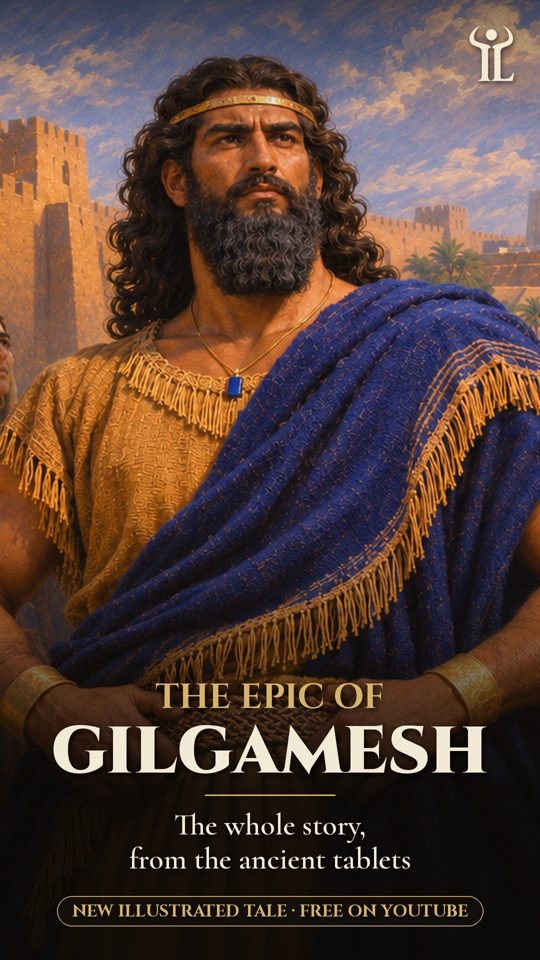
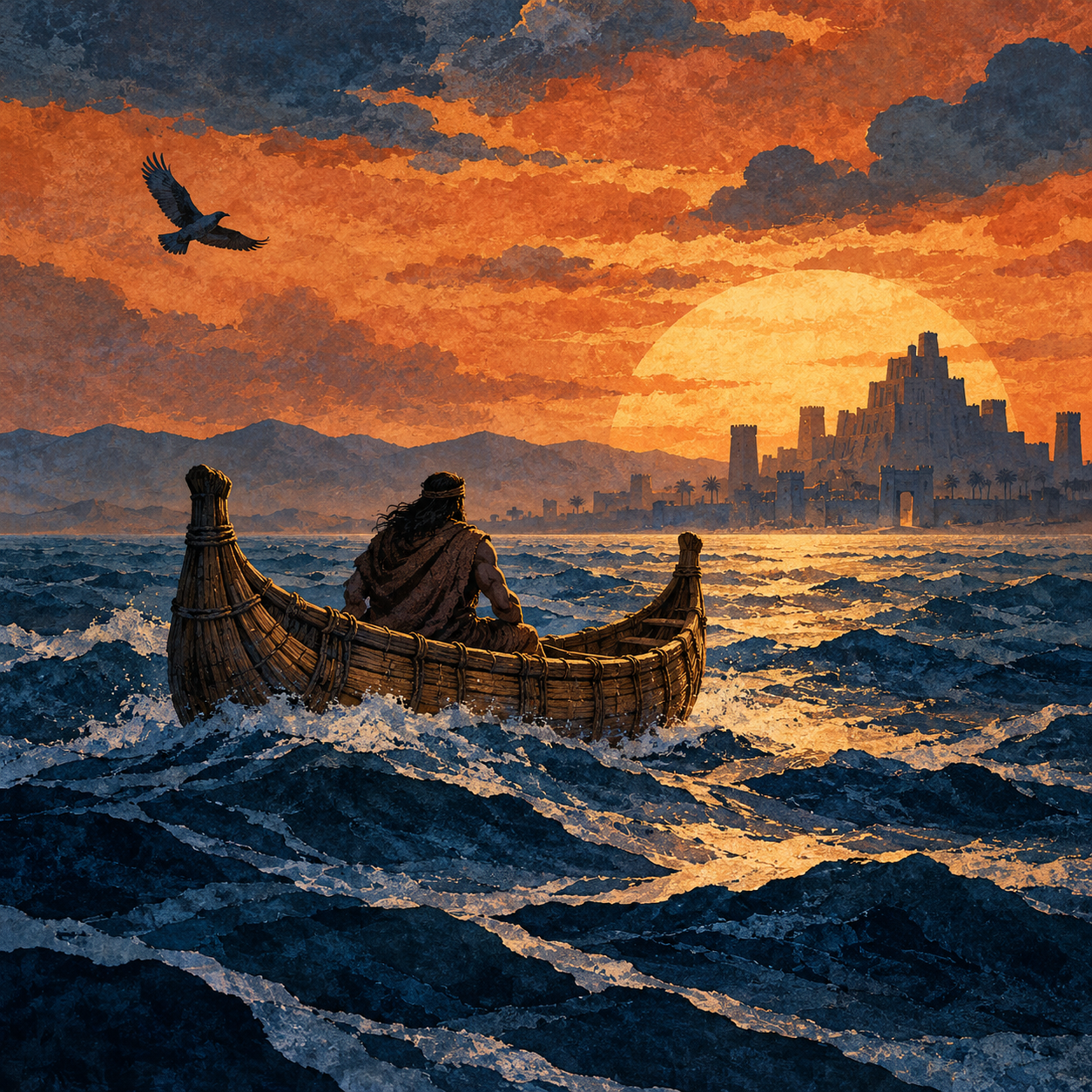
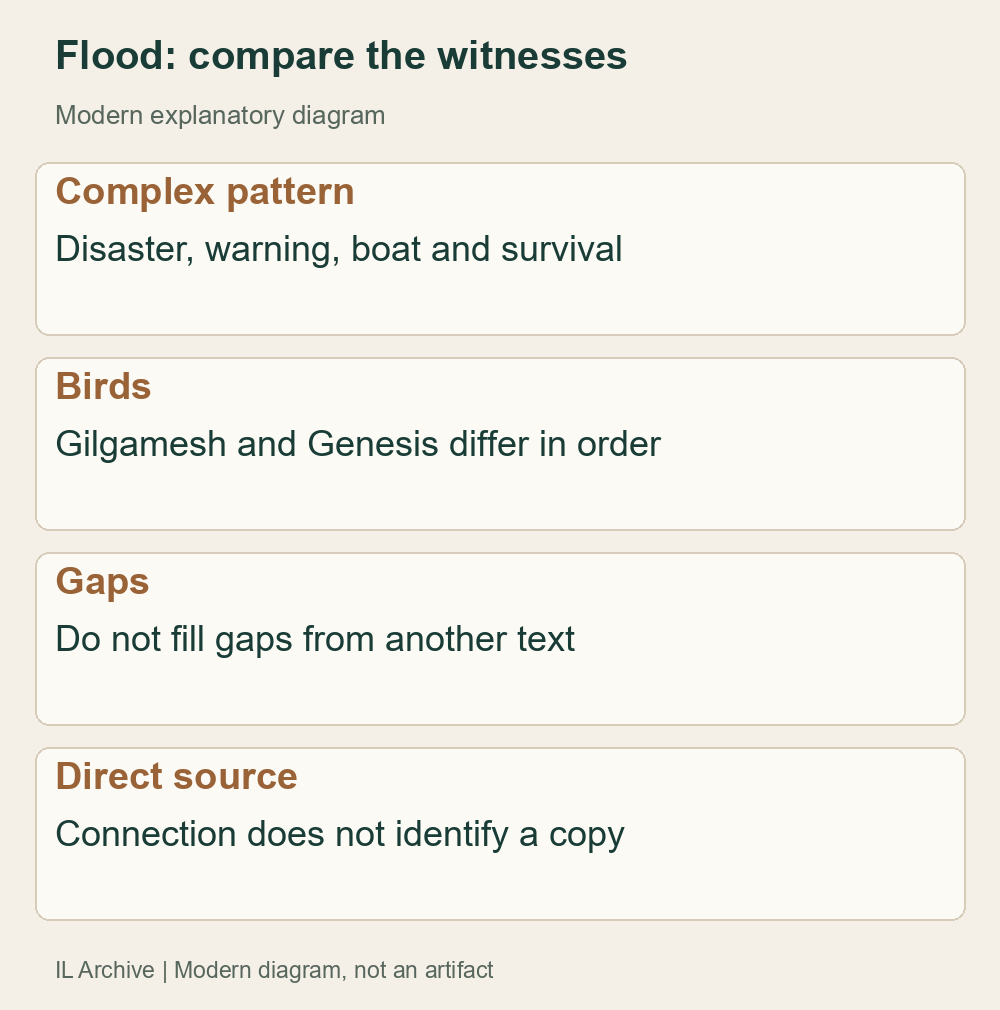
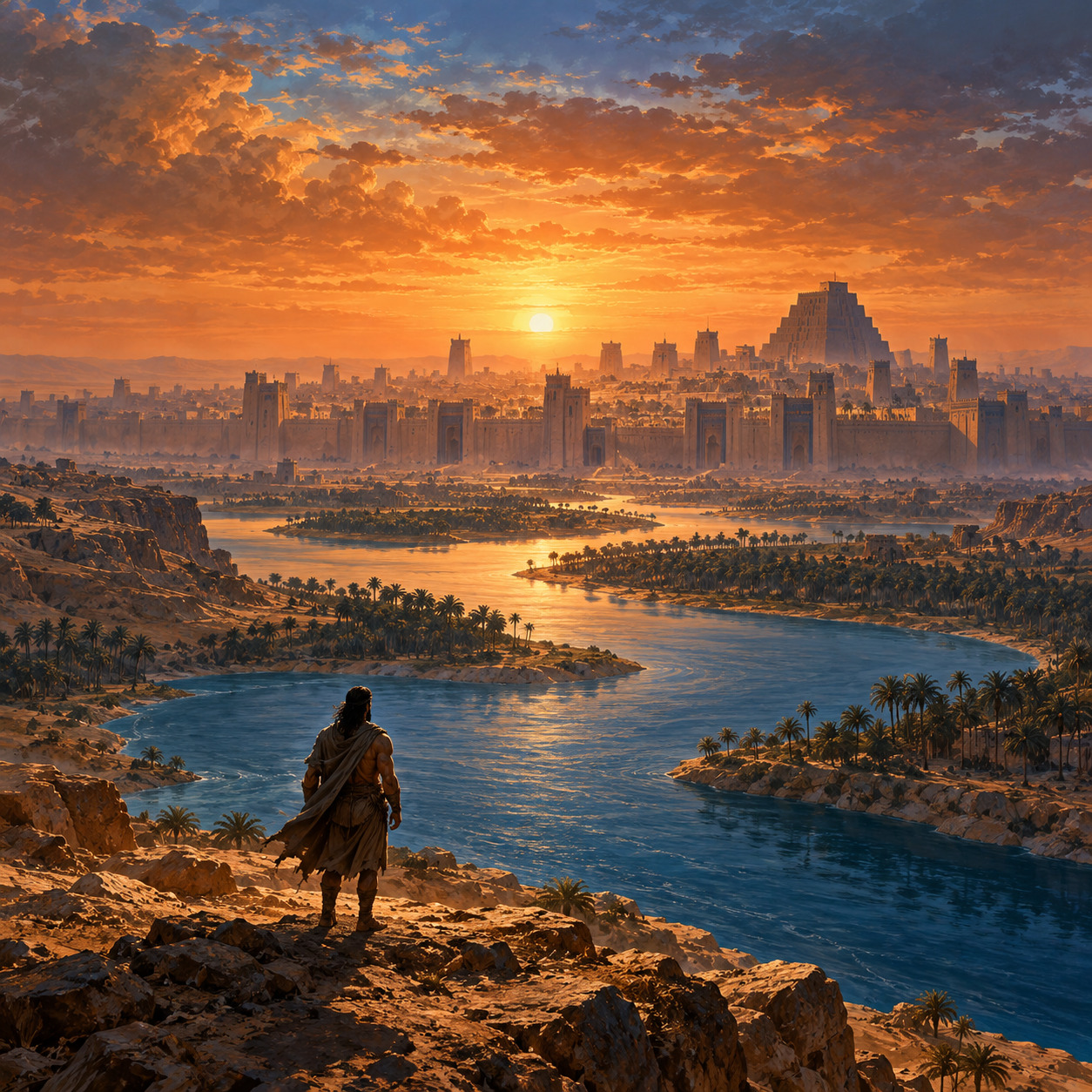
The cover is an expressly modern, AI-generated symbolic illustration of travel, water and a return to a city. It is neither a portrait of a historical Gilgamesh nor a photographed artifact or a scientifically established reconstruction. The accompanying diagram is likewise a modern editorial comparison rather than a cuneiform tablet. The generated cover is not attributed to the British Museum or to a photographer of the ancient tablet.
A further warning comes from the Metropolitan Museum's catalogue: a nineteenth-century clay reconstruction of the Flood Tablet combined interpretations of multiple ancient fragments. Although written in cuneiform, it is not an original ancient manuscript. The same distinction governs this article's evidence: K.3375 is a physical witness, whereas the text discussed here comes through an identified scholarly edition and translation, not from an Akkadian reading undertaken for this review. [9]
What the evidence supports
The epic matters not because it proves that a narrated world flood occurred, but because it lets us follow ancient reflections on friendship, power, death, hope and the reshaping of stories. The close relation between Atrahasis and Gilgamesh strongly supports Mesopotamian literary reuse; comparison with Genesis reveals both common patterns and consequential divergences. Identifying a particular tablet, scribe or path of transmission still requires independent evidence rather than resemblance alone.
References and notes (9)
- Alexander Heidel, The Gilgamesh Epic and Old Testament Parallels, 2nd ed. (University of Chicago, 1949), opening discussion, printed pp. 1–3, and Tablet XI, printed pp. 80–92. Relevant passages were read in text extracted from the university PDF; neither the Akkadian nor each page image was examined. Chapter I, printed pp. 1–3 and 80–92 Return to the text ↑
- Alan Ralph Millard, The Atrahasis Epic and its Place in Babylonian Literature, SOAS MPhil thesis, awarded 1966. Only the repository abstract was read; it describes chapter VI and argues probable borrowing of Gilgamesh’s flood from Atrahasis. Its 1965 date refers to the release of new texts. SOAS repository abstract only; chapter VI described, not read Return to the text ↑
- Oxford ETCSL, catalogue items 1.8.1.1–1.8.1.5.1 and the published English translation of “Gilgameš and Ḫuwawa” (A), lines 1–33 (specific published passages, not the Sumerian cuneiform). This is an editorial composite, not a single physical manuscript. ETCSL 1.8.1.5 (A), lines 1–33; catalogue entries 1.8.1.x Return to the text ↑
- Penn Museum, CBS 13116, Nippur: Sumerian literary fragment “Gilgamesh, Enkidu and Netherworld,” catalogued as c. 1900–1600 BCE. The complete online object description, not its ancient inscription, was read. Penn Museum object CBS 13116; museum online catalogue Return to the text ↑
- British Museum, K.3375, the “Flood Tablet,” from Kuyunjik/Nineveh, Neo-Assyrian, seventh century BCE. The museum’s catalogue result and its description on Google Arts & Culture were read. An object record is not the complete composite edition. British Museum K.3375, museum catalogue and explanatory object description Return to the text ↑
- Oxford ETCSL, English translation of the Sumerian “Flood story,” segments A–E (complete published webpage read, including lacunae). Not a complete physical tablet or Tablet XI of Gilgamesh. ETCSL 1.7.4, segments A–E, especially C–E Return to the text ↑
- Genesis 8:6–22 in the USCCB published English text; the whole of chapter 8 was read to check the raven, repeated dove, sacrifice and promise. Chapters 6–9 are the narrative setting, not chapters all read in full for this review. Genesis 8:6–22 (especially 8:7–12, 20–22) Return to the text ↑
- Jean Bottéro, “The First Account of the Flood,” chapter 13 in Everyday Life in Ancient Mesopotamia (2001). Only the Oxford Academic publisher abstract was consulted, which describes the incorporation of the flood from the “Supersage” tradition; the full chapter was not read. Publisher abstract only, Chapter 13 Return to the text ↑
- The Metropolitan Museum of Art, “Cast reconstruction of Babylonian Flood Tablet,” object 322133; the complete online record identifies a nineteenth-century reconstruction assembled from interpretations of several fragments, not a single ancient original. Met object 322133, full online catalogue page Return to the text ↑
Suggest a correction · Suggest a source for this record
Cite this record
IL Archive, «Gilgamesh», https://ilarchive.com/en/entities/gilgamesh
Continue reading
Related readings
Related posts and imagesAll videos and images