Entity · Book
Atrahasis: Epic and Hero
A reference page linking a name, group, or concept to the materials that discuss it.
- Names
- Epic of Atrahasis
- Region
- Mesopotamia
Atrahasis is both an early Akkadian epic and its flood-surviving hero: humans made to bear the gods’ labour, then noise, plague, scarcity and flood, then limits on childbirth. Its witnesses vary in preservation and age.
Estimated reading time: 8 min Published Last reviewed:
Share article
Video
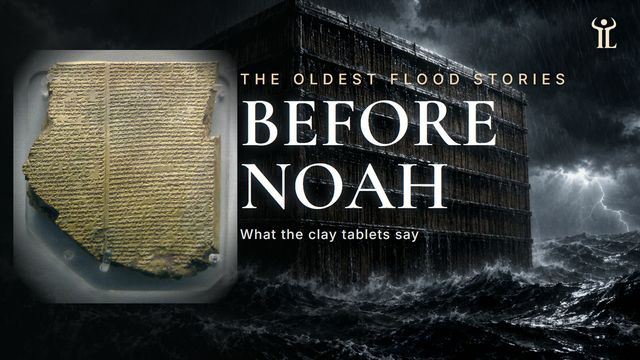
The Flood Before Noah: What the Clay Tablets Say
Our third documentary reads the oldest flood stories on clay: Ziusudra, Atrahasis and Gilgamesh, then sets them beside Noah in the Abrahamic scriptures. Some scenes are AI-generated illustrations.
The YouTube player loads only when you press play. Watch on YouTube
Text
Introduction
The Epic of Atrahasis poses two connected narrative questions: why did the gods create human beings, and why did they nearly destroy them in a flood? “Atrahasis” names both an AkkadianAkkadianAn ancient East Semitic language written in cuneiform from the third millennium BCE; its varieties include Babylonian and Assyrian, and it served in international diplomacy.Glossary · Click to read the explanation literary work and its exceptionally wise survivor, warned by the god EnkiEnkiMesopotamian deity also known as Ea, linked with Eridu and the Abzu (deep fresh waters), wisdom, incantations, and narratives of creation and cosmic order. Later written attestations do not identify the deity of Eridu’s earliest layers.Glossary · Click to read the explanation; neither name establishes a historically documented individual. This entry follows the story from divine labour and human creation through epidemic, famine and flood to the regulation of life afterwards, distinguishing what the tablets preserve from scholarly restoration and later comparisons.[1]
The title, the work and the survivor
“Atrahasis” (Atraḫasīs) is commonly interpreted as “exceedingly wise.” It designates the epic and, within its plot, the human protagonist. The literary work should not be confused with its character, nor with any single clay tablet containing part of the story. Its traditional opening is conventionally known as “When the gods were like humans”; its subject extends far beyond the familiar flood episode.[4]
The epic survives through a Mesopotamian written tradition of tablets and fragments with different dates and states of preservation, not through a complete authorial original. Old Babylonian witnesses allow a broad three-tablet sequence to be studied: human origins, a mounting series of crises, and survival followed by a new arrangement for human existence. Divine names, damaged sections and readings differ among manuscripts. Modern editions sometimes assemble passages from several witnesses: a continuous edited text is not necessarily legible on every individual object.[4][12]
Divine labour and the making of humanity
At the beginning, the lesser gods, the IgigiIgigiCollective of deities called Igigi or Igigū in Akkadian sources from the Old Babylonian period onward. They labour and rebel in Atrahasis; their numbers and relation to the Anunnaki vary by text.Glossary · Click to read the explanation, have to carry burdensome work involving the excavation and maintenance of waterways. They rebel against their duties, whereupon the great gods discuss creating humans to assume the labour. The divine cast includes EnlilEnlilEnlil/Ellil: a major Mesopotamian god associated with destinies, kingship, and Ekur at Nippur, already prominent in third-millennium god lists. His name’s origin and cult beginnings remain debated.Glossary · Click to read the explanation, EnkiEnkiMesopotamian deity also known as Ea, linked with Eridu and the Abzu (deep fresh waters), wisdom, incantations, and narratives of creation and cosmic order. Later written attestations do not identify the deity of Eridu’s earliest layers.Glossary · Click to read the explanation (also Ea), who devises a solution, and NintuNintu, birth goddess in AtrahasisBirth goddess in Atrahasis, grieving for humanity, blaming the flood decision and involved in regulating future births.Glossary · Click to read the explanation, called Mami or Bēlet-ilī, associated with giving birth. In the story, the making of humans explains a system of labour and offerings within a world of many gods; it is not a historical account of biological human origins.[4]
Clay is mixed with the flesh and blood of a slain god. One manuscript reads the name “Wē,” whereas others have “Alla,” a difference recognised by the existing Wē/Alla entryWē and Alla: the slain god in AtrahasisWē names the god whose flesh and blood mix with clay in one reading of Atrahasis I; another witness has Alla in the corresponding passage.Glossary · Click to read the explanation. It would therefore be misleading to treat a single name as certain across all witnesses. The mixture marks the connection between humans and gods, and the narrative goes on to describe the preparation of male and female births by the birth goddess. References to a spirit in this passage do not by themselves establish a single, fully worked-out philosophical doctrine of the individual immortal soul.[4]
Noise, plague and scarcity
Human beings multiply, and the din they make prevents Enlil from sleeping. This is the stated problem within the epic: it must not automatically be rewritten as punishment for moral corruption, the explanation foregrounded in other traditions. Enlil tries to curb the population through plague and later through drought and shortage of food. Atrahasis, following Enki's advice, directs the community's ritualRitualAn organised or distinguished practice meaningful to a community; it may leave traces, but its form alone does not reveal an associated doctrine.Glossary · Click to read the explanation appeals to the deity responsible for a particular calamity, leading to relief from it.[4][5]
The second tablet is edited from incomplete and sometimes divergent passages. Thus a translated sequence need not mean that the intervening wording survives uninterrupted. The story gives intervals such as “1,200 years,” with a variant reading of “3,600”; these are numbers in narrative time, not securely datable years of Mesopotamian history. The escalating descriptions of starvation, even to the collapse of family bonds, form the literary drama. They do not document a particular historical famine by themselves.[5]
A warning through the reed wall
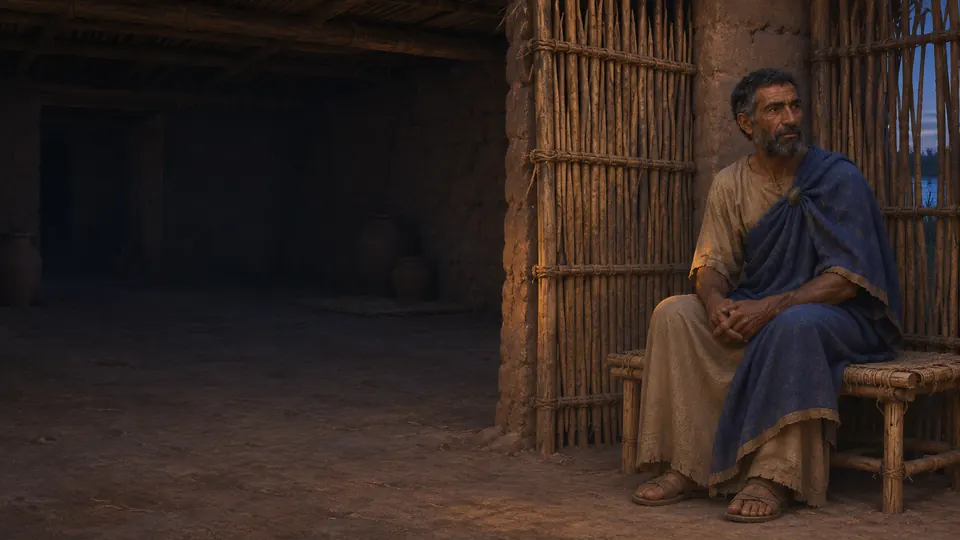
After the gods resolve to send a flood, Enki does not simply announce that he has broken their oath. Instead, he addresses a reed wall so that Atrahasis can hear a warning: abandon the house, build a boat and save life. The texts refer to constructing and sealing the vessel with bitumen and to carrying people and animals aboard. Yet the details of its occupants, exact dimensions and form do not all survive equally well in the Old Babylonian tablet. Bracketed editorial restorations and features familiar from the later UtnapishtimUtnapishtimThe flood hero of Standard Babylonian Gilgamesh, granted exceptional life with his wife by the gods. He tells Gilgamesh how he survived; his name overlaps with Atrahasis and Ziusudra traditions without making their narratives identical.Glossary · Click to read the explanation narrative in Gilgamesh must be kept distinct from securely preserved lines.[6]
The device sets up a striking paradox. Enki does not cancel the disaster but ensures that human life continues through a warning given to one person. The hero's wisdom is part of his narrative role, not evidence for the dates of his life or for an archaeologically discovered ark.[6]
Flood, mourning and offering
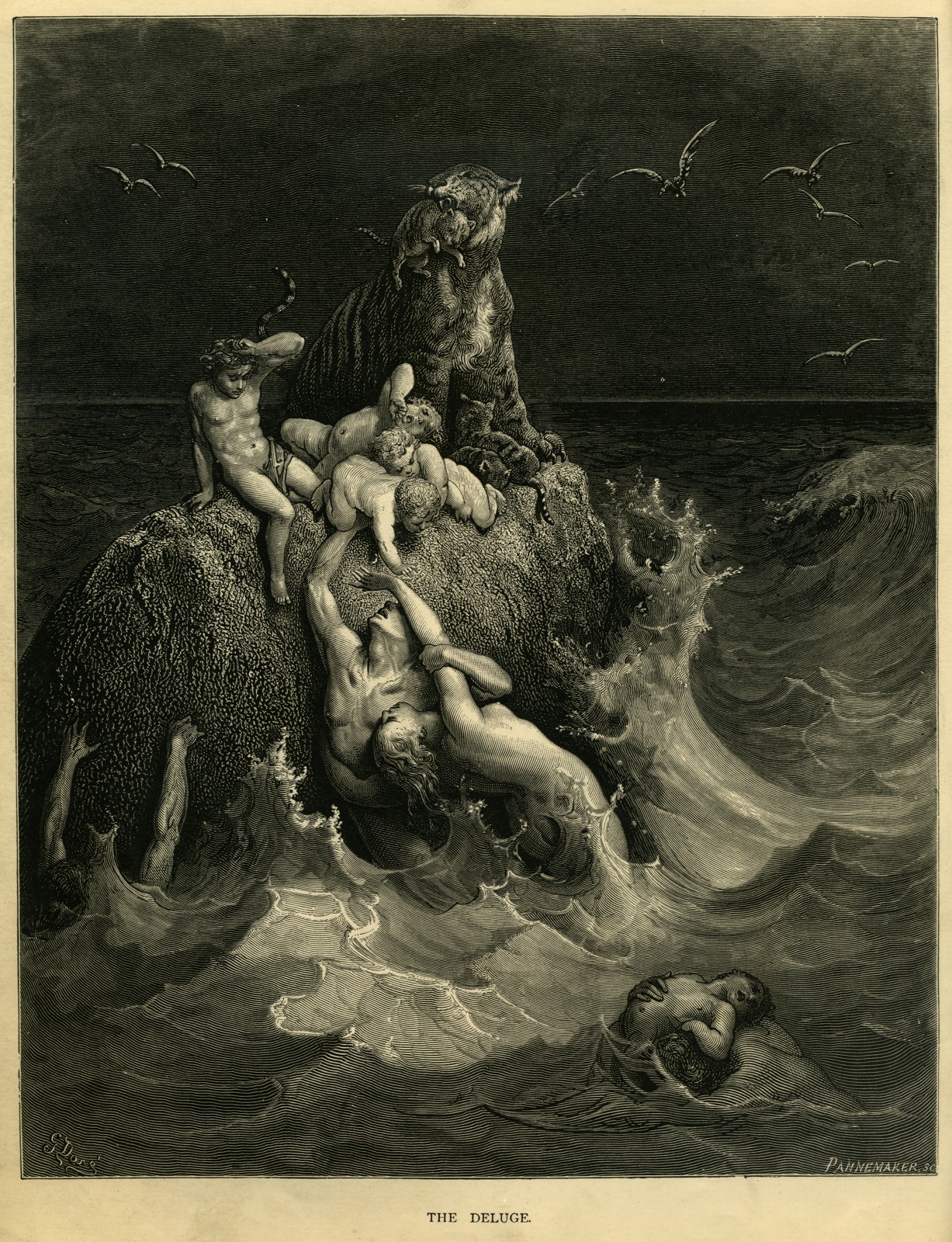
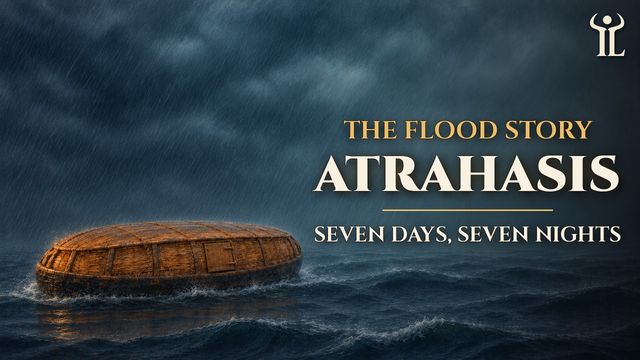
The third tablet describes the destruction caused by the waters and explicitly mentions a storm lasting “seven days and seven nights.” Nintu laments the human beings she had helped create. Meanwhile the gods themselves are portrayed as thirsty and hungry, a literary sign of their dependence on humans and their offerings. Divine reactions are not uniform: Enlil's anger stands alongside the birth goddess's grief and Enki's defence of survival.[7]
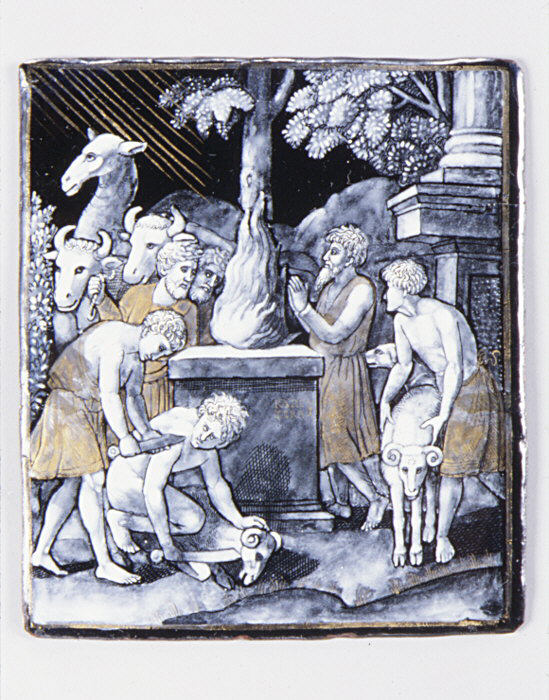
After the waters, fragments preserve traces of an offering and the gods gathering around it. A considerable portion between the flood and that scene, however, is missing or damaged. The release of birds to test whether the waters have receded is not an extant scene in this passage of the Old Babylonian Atrahasis tablet. Suggestions that such an episode filled the gap are comparative hypotheses, not the reading of preserved cuneiformCuneiformWriting with wedge-shaped signs, developed from Mesopotamian recording traditions and used for several languages from the third millennium BCE.Glossary · Click to read the explanation signs.[7][1]
After the flood: restrictions on birth
Enlil sees the boat and objects that a human escaped the divine assembly's decision. The gods then deliberate on the survivors' future. The ending, some of it damaged or restored, introduces constraints on population: women who bear children and others who do not, the child-snatching figure Pāšittu, and categories of priestesses associated in the text with restrictions on marriage or childbirth. These measures answer the story's initial dilemma of increasing numbers and noise; they are not a verified inventory of universal practices throughout Mesopotamian history.[8]
A passage concerning the assignment of “death” is partly reconstructed and must not be made into certain proof that all humans were immortal before the flood. Nor does the preserved Old Babylonian ending explicitly grant Atrahasis the personal immortality associated with Utnapishtim in the later Gilgamesh account. Merging the two conclusions without signalling the distinction changes the meaning of the older composition.[8][10]
The tablets, their dates and the cover image
The colophon at the end of tablet three identifies it as the last tablet of a three-tablet work and counts 1,245 lines in all. This is the ancient scribe's total, not the number legible today. The copy names its scribe, Ipiq-Aya, and dates itself to the twelfth regnal year of Ammi-saduqa, approximately the seventeenth century BCE depending on the chronological scheme. Such evidence dates an important Old Babylonian copy, not necessarily the first composition of the epic.[6][2]
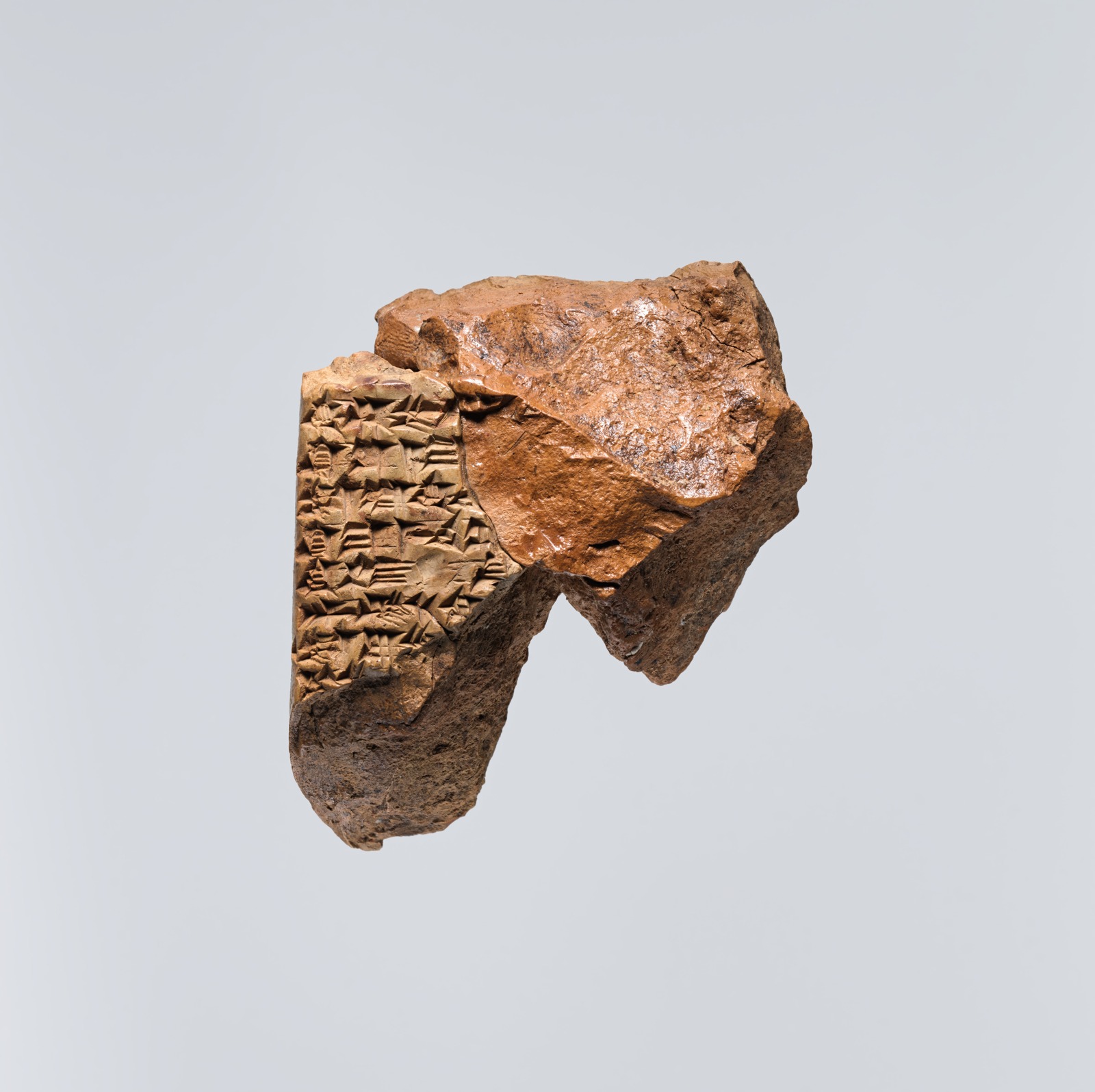
The Cuneiform Digital Library Initiative catalogues the composite witness P285811, linked to museum objects including BM 78942; editors may combine evidence from further tablets. The cover itself reproduces a different, genuine object, Metropolitan Museum of Art 86.11.378a, dated approximately to the seventh–sixth centuries BCE. The museum's description identifies Utnapishtim on its reverse. It is a later witness to a flood tradition, not a photograph of Ipiq-Aya's Old Babylonian manuscript; the thumbnail cannot authenticate every line of a modern composite edition.[2][3][9]
For this object’s documentation, photograph and limits of preservation, see the record for fragment MMA 86.11.378a. That record describes the physical witness; this entry addresses the epic and its hero.
Related traditions: Ziusudra and Utnapishtim
Sumerian literature relates another flood survivor named ZiusudraZiusudraA literary king-priest in the fragmentary Sumerian Flood Story (ETCSL 1.7.4). He survives by boat, sacrifices, and receives divine life from An and Enlil in Dilmun. The surviving copy is Old Babylonian; his historicity is unproven.Glossary · Click to read the explanation. Tablet XI of the Epic of GilgameshEpic of GilgameshA Babylonian literary work with multiple recensions, preceded by separate Sumerian poems on Uruk’s king and Enkidu. Its standard form explores friendship, death, the flood and the limits of seeking eternal life.Glossary · Click to read the explanation features UtnapishtimUtnapishtimThe flood hero of Standard Babylonian Gilgamesh, granted exceptional life with his wife by the gods. He tells Gilgamesh how he survived; his name overlaps with Atrahasis and Ziusudra traditions without making their narratives identical.Glossary · Click to read the explanation, who recounts survival and receives an exceptional destiny after the flood. These three names should not be treated simply as alternate spellings for one archaeologically attested person. They designate related characters in literary traditions that influenced and reworked one another. In Atrahasis, the flood concludes a story about human creation and numbers; in Gilgamesh, the account is embedded in the hero's quest to escape mortality.[10]
Shared boats, offerings and survivors do not turn all tablets into one document. The later Met artifact bears Utnapishtim's name in a piece catalogued within the Atrahasis tradition. This is evidence for textual contact and overlapping versions or labels, not proof that compositions of all periods reproduce the same words.[3][10]
Comparing the Book of Genesis
These Mesopotamian traditions share narrative motifs with the story of NoahNoahNoah is the flood-story figure in Genesis and a prophet in the Qur’anGlossary · Click to read the explanation in the Book of GenesisBook of GenesisHebrew book of the Torah containing Noah’s flood, survival offering and covenant with living creatures.Glossary · Click to read the explanation: destruction by water, warning to a chosen survivor, a vessel preserving life and an offering afterwards. The differences matter equally. In Atrahasis, the gods react to population and noise; in Genesis, human wickedness and violence are central. Atrahasis closes with restrictions on human reproduction, whereas Genesis affirms multiplication and describes a covenant following the catastrophe. Literary parallels do not establish that one particular worldwide geological flood occurred.[11]
Some specialists, notably John DayJohn Day, Old Testament scholarOld Testament scholar who discussed Eden’s serpent and Babylonian traditions in a 2015 article.Glossary · Click to read the explanation, argue that the connections between Genesis and the Atrahasis tradition go deeper than links to Gilgamesh XI alone because both set creation and flood within a primeval history. But a proposed literary dependenceLiterary dependenceA historical relation in which a text was composed using another text or version; similarity alone cannot establish its direction.Glossary · Click to read the explanation does not in itself show the exact path, agents or dates of transmission. Direct influence, indirect inheritance and editorial transformations require separate evidence; hypothetical restoration of missing tablet lines must remain hypothetical.[1][11]
Reading an incomplete ancient composition
This entry is an account of the epic and its witnesses, not a publication of its complete text. The review consulted Akkadian transliterations, English translations, variant readings and gaps in the university-based SEAL corpus; CDLI and museum catalogues for individual objects; and comparative scholarship for historical interpretation. The classic Lambert–Millard edition and Nathan Wasserman's more recent study were identified through accessible publication records and previews; their complete books were not read for this review. The notes indicate how much of each source was consulted.[4][12][13]
Atrahasis is valuable precisely because it connects human creation, catastrophe and renewed life within a sustained reflection on relations between humanity and the gods. A responsible reading keeps the layers of written evidence separate, rather than allowing a modern translation or a photograph of a later tablet to stand for every word of the earliest recoverable work.[8][9]
References and notes (13)
- John Day, “The Mesopotamian Origin of the Biblical Flood Story,” TheTorah.com, 22 October 2020, updated 9 October 2026. Entire online article, particularly “The Atrahasis Epic,” “Dependent on the Atrahasis Epic, Not the Gilgamesh Epic,” “Counting Parallels,” and “Noah and Atrahasis.” Birds in the Atrahasis gap are Day’s conjecture, not an extant text; the transmission path is unsettled. Return to the text ↑
- Cuneiform Digital Library Initiative (CDLI), artifact record P285811, Old Babylonian Atrahasis. P285811 catalogue entry: composite witness, joined object numbers, period and uncertain reported provenance (Sippar); metadata read, not the complete underlying physical manuscript. Return to the text ↑
- The Metropolitan Museum of Art, collection object 86.11.378a, a fragment of Atrahasis; Open Access image. Object description, dating to approximately the seventh–sixth centuries BCE, measurements, obverse and reverse (naming Utnapishtim), and public-domain image status; a later witness. Return to the text ↑
- Sources of Early Akkadian Literature (SEAL), “Atraḫasis I (all periods),” Hebrew University; transliteration, English translation, witnesses and commentary. Selected translated/transliterated passages and variants: tablet I 1–65; 180–275 (especially 223–230, Wē/Alla and clay); 255–275; 352–397 (noise/plague). Not a complete line-by-line reading of the whole database page. Return to the text ↑
- SEAL, “Atraḫasis II (all periods),” edited Akkadian text, English translation and manuscript variants. Selected English translation sections A–E, particularly A 1–20 (1,200 versus 3,600 years, noise, rain withheld) and the famine episodes; not the complete lexical apparatus. Return to the text ↑
- SEAL, “Atraḫasis OB III (Sippar),” edited Akkadian transliteration and English translation. Tablet III, cols. i–ii, particularly i 11–38 and ii 28–55: reed-wall warning, boat, bitumen and passengers; selected translated/transliterated passages, including bracketed restorations. Return to the text ↑
- SEAL, “Atraḫasis OB III (Sippar),” flood and offering passages. Tablet III, cols. iii 11–54, iv 1–25, lacunae before v, and v 30–49: Nintu’s mourning, seven days and nights, offering with editorial restorations; no preserved bird-release scene. Return to the text ↑
- SEAL, “Atraḫasis OB III (Sippar),” post-flood decree and colophon. Tablet III, cols. vi 5–49, vii 1–11 and viii 18–31: divine debate, reproductive limits, restored reference to death, 1,245-line colophon, Ipiq-Aya and Ammi-saduqa year 12; bracketed matter is editorial. Return to the text ↑
- British Museum, collection record for BM 78942, Old Babylonian Atrahasis tablet. Collection record and object identity, including association with the composite tablet; catalogue metadata only, no physical inspection or full reading of all joins. Return to the text ↑
- Ira Spar, “Flood Stories,” The Metropolitan Museum of Art, contextual essay. Sections on Atrahasis, Ziusudra and the Gilgamesh tradition; read for contextual comparison, not treated as an edition of a single tablet or evidence that the Old Babylonian ending bestows immortality. Return to the text ↑
- Shalom E. Holtz, “The Flood Story in Its Ancient Near Eastern Context,” TheTorah.com, 19 October 2014, updated 7 October 2026. Complete online essay, especially “The Flood Story in Context 1–2,” “Why a Flood?” and “The Relationship Between the Human and the Divine,” with its notes; comparative analysis, not geological proof. Return to the text ↑
- W. G. Lambert, Alan R. Millard and Miguel Civil, Atra-Hasis: The Babylonian Story of the Flood, with the Sumerian Flood Story, Eisenbrauns publisher listing. Publisher metadata, bibliographic description and contents listing only. The entire book was not accessible or read; no unverified page citations. Return to the text ↑
- Nathan Wasserman, The Flood: The Akkadian Sources: A New Edition, Commentary, and a Literary Discussion, Orbis Biblicus et Orientalis 290 (2020), JSTOR book entry. Title, bibliographic metadata, contents and publicly visible previews only. The full book requires access and was not read. Return to the text ↑
Suggest a correction · Suggest a source for this record
Cite this record
IL Archive, «Atrahasis: Epic and Hero», https://ilarchive.com/en/entities/atrahasis
Continue reading