Entity · Text or methodological concept
Literary borrowing
A reference page linking a name, group, or concept to the materials that discuss it.
Reuse of earlier verbal or narrative material: its evidence and limits, with distinctions between direct borrowing, common sources and mediation.
Estimated reading time: 7 min Published Last reviewed:
Share article
Text
Introduction
Literary borrowing is the use, in a new work, of material recognisably related to an earlier text or tradition. The writer may repeat words, recast a scene, or give a familiar formula a different meaning. Similarity alone does not establish borrowing, and a relationship between two works need not involve direct copying. This entry explains how wording, context, translation and transmission help test an argument, through a close verbal echo in Latin poetry and an explicitly attributed scriptural quotation.
What does “borrowing” cover?
Here literary borrowing is a broad descriptive label, related in this discussion to Arabic «الاقتباس الأدبي» and French emprunt littéraire; it does not claim that every scholarly discipline defines those terms identically. A quotation may repeat earlier words and name its authority; verbatim copying preserves the wording; paraphrase alters the expression while retaining an idea; allusion or literary imitation asks readers to recognise a verbal or thematic echo. Two metaphors or images resembling one another are not, simply for that reason, evidence of a historical transfer.
The distinction from literary dependenceLiterary dependenceA historical relation in which a text was composed using another text or version; similarity alone cannot establish its direction.Glossary · Click to read the explanation matters. Dependence makes a broader claim about one work drawing upon another in its construction, whereas one local borrowing can be identified without proving that the entire work depends on its apparent source. Intertextuality is broader still: it includes relationships activated in reading even where no direct channel of transmission can be traced. With oral narratives and works surviving in multiple versions, a catalogue of shared motifs cannot reconstruct a chain of copying by itself; a common antecedent or change during retelling may explain them. These are methodological distinctions, not a mechanical test settling every case. [1]
An unattributed verbal echo: Catullus and Virgil
In poem 66 the Latin poet Catullus gives a voice to a lock of Queen Berenice's hair, now separated from her. Line 39 reads in the Latin text published by Dickinson College Commentaries: [2]
Our translation is: “Unwillingly, O queen, I left the crown of your head.” The speaker is a lock of hair, grammatically feminine in Latin, and the place of separation is the head. Catullus' poem is a Latin reworking of the story of Berenice's Lock, earlier treated by the Greek poet Callimachus of CyreneCallimachus of CyreneThird-century-BCE Greek poet whose Hymn to Delos evokes Apollo's birth.Glossary · Click to read the explanation in the third century BCE. The Latin poem should not be mistaken for a photographic copy of a wholly surviving Greek original.
In Book 6 of Virgil's epic Aeneid, the hero Aeneas speaks to the shade of Dido, queen of Carthage, whom he abandoned. He says at line 460: [3]
Our translation is: “Unwillingly, queen, I left your shore.” Word order, rhythm and much of the wording are strikingly alike. Yet Virgil changes the feminine invita to masculine invitus, and vertice (“crown of the head”) to litore (“shore”). A separated lock has become a departing hero; the earlier image is redirected towards a different, tragic emotional situation. The unusually precise verbal match, together with the earlier date of Catullus' poem, strongly favours a deliberate literary echo over a generic coincidence. It does not, by itself, reconstruct every stage through which the underlying tale travelled. [4]
This is where evidence for the presence of an allusion must be separated from explanations of what it does. Gregory Nagy treats the Catullan echo as clear and proposes a wider network reaching through Callimachus to Greek traditions about Ariadne. The size and specific pathway of such a network remain interpretive proposals, not deductions compelled by the two similar lines. The local imitation is strongly supported; the precise artistic motive and any further intermediaries are more debatable. [5]
An attributed quotation with a translation difference: Hosea and Matthew
In the HebrewHebrewA Northwest Semitic language of the Canaanite group, encompassing Iron Age epigraphy, Biblical, Rabbinic, medieval and Modern Hebrew; its scripts and pronunciations changed over time.Glossary · Click to read the explanation Book of HoseaBook of HoseaHebrew prophetic book listing new moon and Sabbath among festivals whose cessation is announced.Glossary · Click to read the explanation, a collection of prophetic writings, chapter 11 begins by recalling Israel as a beloved child called from Egypt. The following short extract reproduces the consonantal wording of Hosea 11:1 in the Masoretic tradition; it is not claimed to be a transcription of a particular manuscript: [6]
Our contextual translation is: “And out of Egypt I called my son.” In the immediate passage, “my son” refers to Israel, expressly named at the beginning of the verse; the parental imagery continues in the following verses. Recollection of an event within the prophetic discourse is not a date for the Book's composition, nor does the line, read alone in its earlier setting, describe a later individual's journey.
The Gospel of MatthewGospel of MatthewOne of the New Testament’s four Gospels, from the late first century CE, relating inherited law and Jesus’ sayings.Glossary · Click to read the explanation, by contrast, takes up the wording at 2:15 in the story of Jesus' stay in Egypt and return, introducing it as fulfilment of words spoken “through the prophet” without naming Hosea in that sentence. The Greek text displayed in Nestle's 1904 edition reads: [7]
Our translation is: “Out of Egypt I called my son.” The attribution formula makes this an announced quotation; its textual source is identified by comparison with Hosea. But this does not make the two passages' contextual meanings identical. Matthew reapplies an earlier discourse about Israel within his narrative about Jesus. That is an act of interpretation in the later work, not independent proof that Hosea's original passage spoke about that particular journey.
Translation matters to the evidence. The standard Greek SeptuagintSeptuagintA name for the varied ancient Greek translations and writings associated with Jewish scripture; beginning with the Torah, the texts differ across books and manuscripts.Glossary · Click to read the explanation text of Hosea 11:1 does not have Matthew's exact wording. Its relevant phrase reads: [8]
Our translation is: “Out of Egypt I summoned his children.” The Septuagint has a compound verb meaning “summon” and the plural “his children”; Matthew has “I called” and singular “my son”, agreeing more closely in these respects with the Hebrew than with the displayed Septuagint wording. It would therefore be wrong to describe Matthew's version as a verbatim copy of that Greek text. A revised Greek form and a fresh rendering closer to Hebrew are among the routes scholars discuss; the comparison cannot establish either one with certainty. [9]
The date of a story, a text and a surviving manuscript
- Eighth century BCE and later: Hosea evokes the political and religious world of the northern kingdom of Israel in the eighth century BCE. Much scholarship accepts material from that era, while allowing later additions and redaction. The exodus is an event recalled by the religious story, not a date at which Hosea 11 was composed. [10]
- Third century BCE: Callimachus wrote his Hellenistic account of Berenice's lock. Its reception and reshaping lie between that Greek work and the Latin versions; this entry does not present an unbroken manuscript chain.
- Middle and final decades of the first century BCE: Catullus' Latin treatment preceded Virgil's, while the Aeneid was composed approximately between 29 and 19 BCE. The adventures of Dido and Aeneas belong to the legendary time of the story and cannot date the writing of the epic.
- Late first century CE, approximately: Matthew's Gospel is commonly dated to about 80–90 CE. This scholarly estimate is neither a date for its childhood narrative nor the date of a surviving copy. [11]
- Fourth century CE: Codex Sinaiticus is a fourth-century Greek witness preserving the complete New Testament; it is not the original manuscript of Matthew. [12]
- Late fourth to fifth century CE: Important early witnesses of Virgil, including the Palatinus, Romanus and Mediceus codices, belong to this period. Their ages are not the date of the Aeneid's composition. [13]
- Fourteenth century CE: The notable Oxford copy of Catullus' poems, MS. Canon. Class. Lat. 30, is dated to the third quarter of that century. It documents transmission of much older poetry, not when the poetry was written. [14]
How should a claim be tested?
- Specify the passage: compare identifiable words, their order or a definite scene, rather than two book titles; record differences and omissions alongside matches.
- Assess distinctiveness and context: a long, unusual formulation with meaningful changes is stronger evidence than a widespread theme such as a king, a departure or the sea. Read before and after the quotation to identify its speaker and addressee.
- Separate the layers of mediation: consider each language, available translations, proposed composition dates and surviving textual witnesses. Do not attribute the reading of a critical composite edition to a single manuscript or imagine that a modern back-translation recovers a lost original.
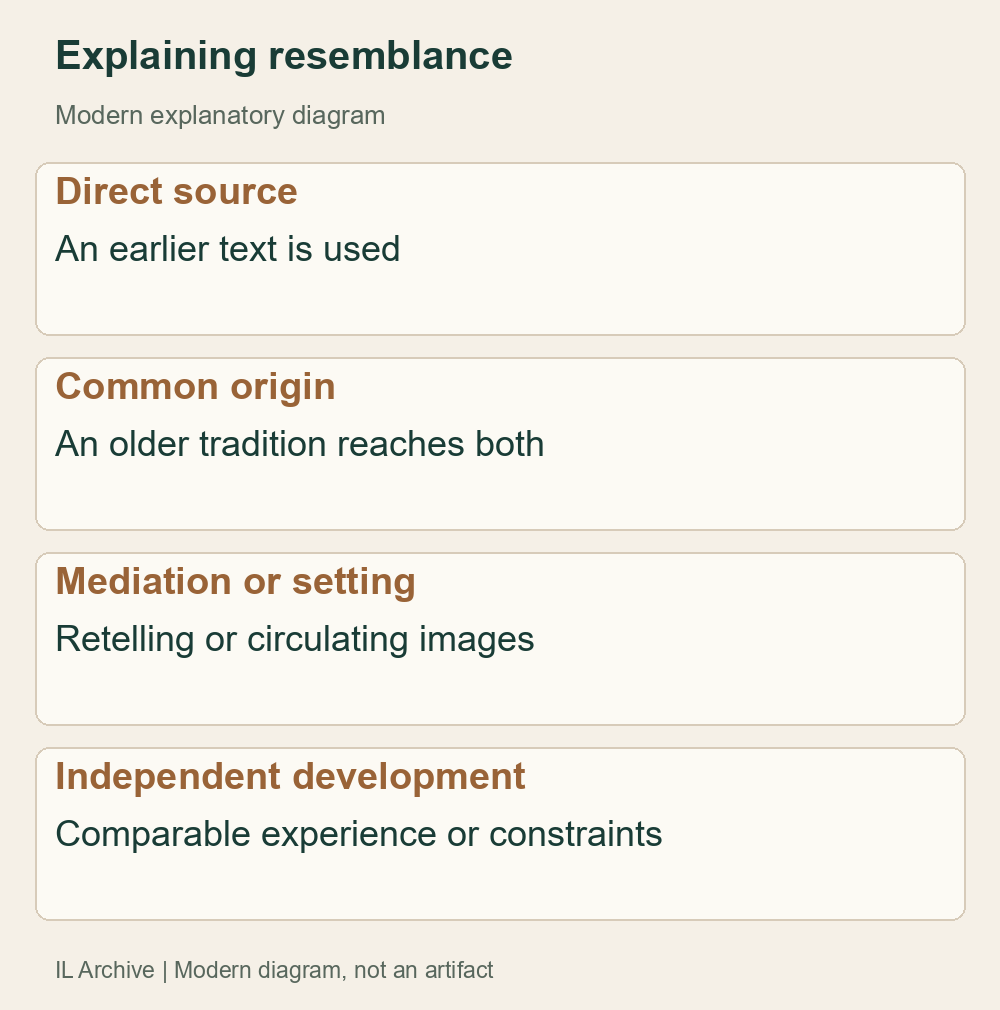
- Test alternatives: ask whether common ancestry, oral retelling, familiar formulas, intermediaries or independent developmentIndependent developmentSimilar narrative or cultural elements arising in different settings without historical transmission of the specific feature between them; a testable explanation, not a default assumption when records of borrowing are absent.Glossary · Click to read the explanation fit the evidence, and distinguish the supported explanations from possibilities.
The Catullus–Virgil comparison makes a strong case for a specific verbal imitation. Matthew's attribution makes his reuse of Hosea clear, while leaving the precise route of his Greek wording under investigation. Neither example licences calling every resemblance a quotation, and the descriptive term borrowing does not impose an automatic modern charge of plagiarism on ancient practice. The accompanying diagram outlines alternative explanations of similarity, not a documented route for either of these passages.
References and notes (14)
- Emily West, “The Transformation of Cyavana: A Case Study in Narrative Evolution”, Oral Tradition 31/1 (2017), pp. 77–122. Journal abstract only; the full article and Tigay (1993) were not directly read. Return to the text ↑
- Catullus, poem 66, Latin text in Dickinson College Commentaries. Lines 39–40 in context, lines 35–40; line 39 was directly checked. Return to the text ↑
- Virgil, Aeneid 6, Latin text accompanying Wendell Clausen’s reading (1997), Harvard Department of the Classics. Lines 450–474, especially 456–463 and 460; directly read. Return to the text ↑
- Ingo Gildenhard, Virgil, Aeneid, 4.1–299, Cambridge: Open Book Publishers, 2012. Interpretive essay on allusion, print pp. 265–266; PDF page bearing print p. 265 inspected visually; not the whole book. Return to the text ↑
- Gregory Nagy, “Virgil’s verse invitus, regina … and its poetic antecedents”, in More modoque (2013), pp. 155–165; online at Harvard CHS. Opening argument, Catullus 66.39/Virgil 6.460 and the “window reference” proposal, printed pp. 155–158; not the entire essay. Return to the text ↑
- Hosea 11:1, Masoretic Hebrew text, Mechon Mamre. Hosea 11:1–4; the Hebrew wording of verse 1 directly checked. Return to the text ↑
- Matthew 2:15, Greek New Testament, Eberhard Nestle (1904), as displayed at BibleHub. Entire verse 2:15, including its attribution formula and quoted Greek words; directly read. Return to the text ↑
- Septuagint Hosea 11:1, Alfred Rahlfs, rev. Robert Hanhart, Septuaginta, Deutsche Bibelgesellschaft (2006). Verse 11:1 directly checked against 11:2; only a short Greek excerpt reproduced. Return to the text ↑
- Seong-Kwang Kim, “The Use of Hosea 11:1 in Matthew 2:15”, The Korean Journal of Old Testament Studies 25/3 (2019), pp. 102–129. Print pp. 102–106, including the synoptic table; PDF pp. 103–104 visually inspected; transmission alternatives on p. 104; not the full pp. 102–129. Return to the text ↑
- Society for Old Testament Study (SOTS), “Hosea”. “Date and authorship” and parental imagery in Hosea 11; reference entry directly read. Return to the text ↑
- Daniel J. Harrington, “Gospel of Matthew”, Oxford Bibliographies in Biblical Studies (2010). Freely accessible introduction only, especially the approximate 85–90 CE date; subscription-only remainder not consulted. Return to the text ↑
- Codex Sinaiticus Project, “Date” and “About Codex Sinaiticus”. Project dating/overview pages (fourth century); no claim to have collated Matthew 2:15 from manuscript photographs. Return to the text ↑
- Yale University Library, “The Aeneid at the Beinecke”: early manuscripts and dates. Digitized-manuscripts list: Palatinus late 4th/early 5th, Romanus 5th, Mediceus 5th centuries; catalogue metadata, not leaf collation. Return to the text ↑
- Oxford, Bodleian Library, MS. Canon. Class. Lat. 30, Biblissima/Digital Bodleian catalogue. Catalogue title and third-quarter fourteenth-century date; no claim to have transcribed the manuscript leaf. Return to the text ↑
Suggest a correction · Suggest a source for this record
Cite this record
IL Archive, «Literary borrowing», https://ilarchive.com/en/entities/literary-borrowing
Continue reading