Entity · Concept
Angel / Divine Messenger
A reference page linking a name, group, or concept to the materials that discuss it.
Hebrew malʾakh means messenger, human or celestial according to context; the word alone proves neither wings nor origin from a particular Canaanite god.
Text
Function before classification
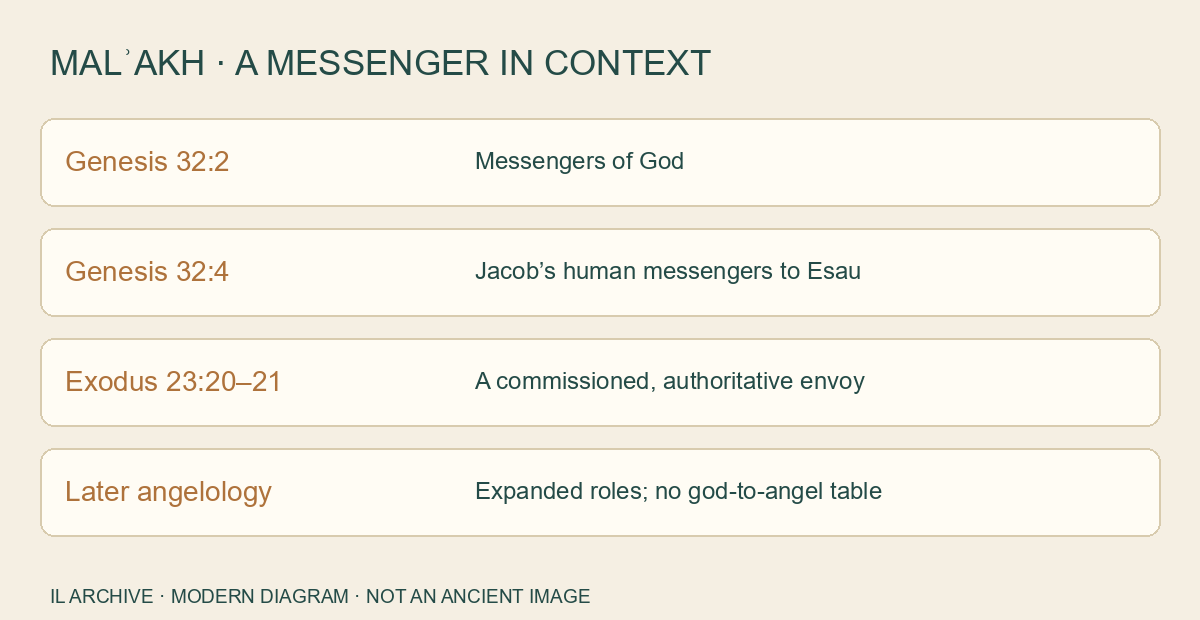
Malʾakh means messenger or envoy. HebrewHebrewA Northwest Semitic language in the Canaanite group, with ancient and modern forms.Glossary · Click to read the explanation Genesis 32:2–4 places God’s envoys and Jacob’s messengers to Esau in the same context. The word alone does not determine the envoy’s nature; sender and role determine the reading.[1]
An envoy’s authority
Exodus 23:20–21 depicts an envoy guarding and leading the group, with authority associated with the divine name. Subordination does not mean powerlessness. Neither every winged being nor every council member should be called malʾakh without textual evidence.[2]
Later written angelology
Annette Reed studies written angelologyAngelologyStudy and organization of angels and heavenly beings: names, ranks and roles within particular traditions, without assuming one fixed system.Glossary · Click to read the explanation and demonologyDemonologyStudy or organization of harmful powers, names, origins and roles within specific traditions; no single doctrine or claim about existence beyond the text is assumed.Glossary · Click to read the explanation in the third-century BCE context. This concerns literary organization and knowledge, not the first heavenly messenger or every ancient god becoming an angel.[3]
The image is a modern lexical comparison, not a documented angel’s portrait.
References and notes
- Hebrew Bible / Bible hébraïque — Genesis 32:2–4 (Hebrew numbering). Mechon-Mamre, Hebrew text and JPS 1917 English translation. Hebrew vv.2–4 (1–3 in other translations): God’s envoys, then Jacob’s messengers. Both use malʾakh/malʾakhim according to context; bodily form not inferred from the word. Return to the text ↑
- Hebrew Bible / Bible hébraïque — Exodus 23:20–21. Mechon-Mamre, Hebrew text and JPS 1917 English translation. Verses 20–21: protective, guiding envoy with authority tied to the divine name. Neither a powerless messenger nor evidence for obligatory wings. Return to the text ↑
- Annette Yoshiko Reed (2020). Rethinking Scribalism and Change in Second Temple Judaism. Demons, Angels, and Writing in Ancient Judaism, chapter 2, pp. 87–131. doi:10.1017/9781139030847.004. Publisher abstract only: third-century BCE proposal for beginnings of angelology/demonology in Aramaic literature, writing and knowledge. Full chapter not read; not a date for the first belief in an angel. Return to the text ↑
Research history
Substantive changes are retained here. Minor copy edits remain in the internal operational log.
-
Substantive record update
Suggest a correction · Suggest a source for this record
Cite this record
IL Archive, «Angel / Divine Messenger», Edition 2, https://ilarchive.com/en/entities/angel-messenger