Study
The Ark of the Covenant: A Throne without a Statue?
An extended study of a topic, with evidence and references.
Cherubim, kapporet, voice and cloud: what texts say about Yahweh’s presence, and what remains interpretation in comparisons with thrones and Egyptian shrines.
Share article
Text
The question left by the sacred space
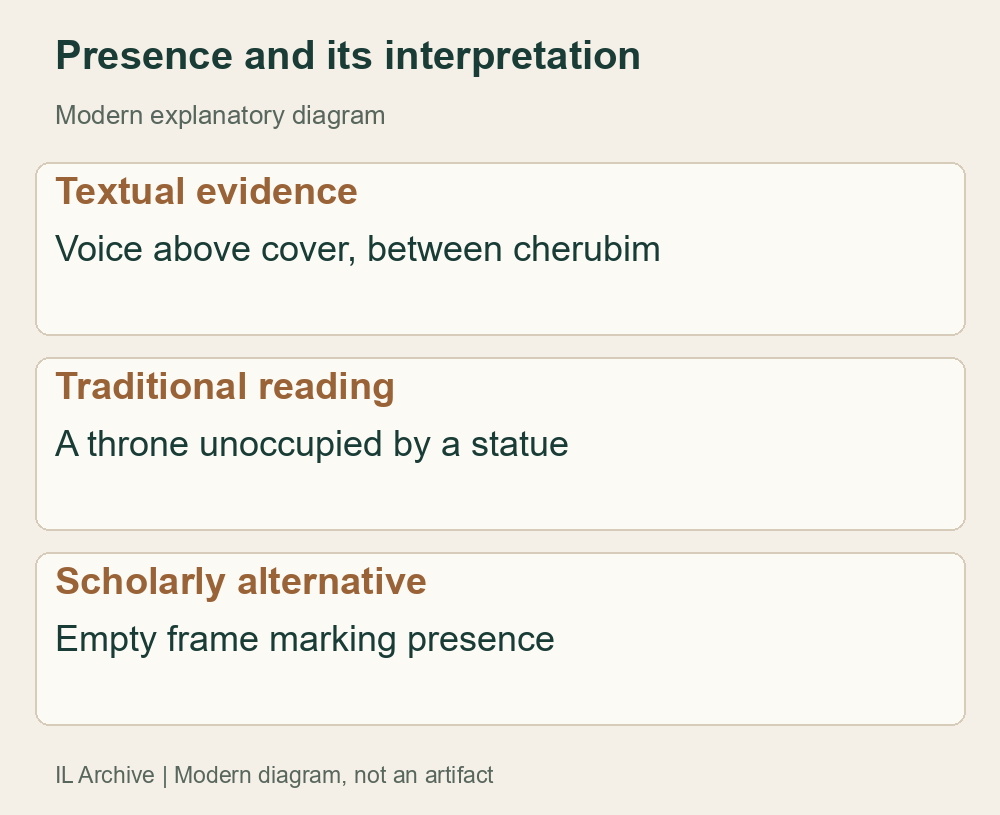
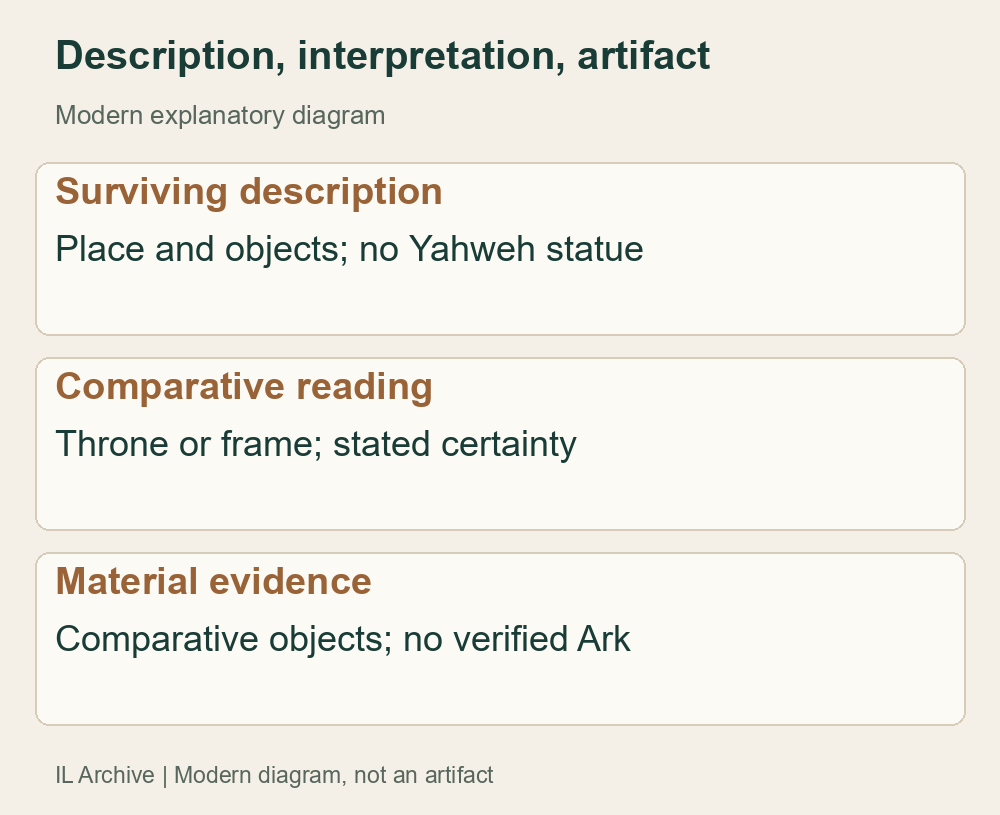
At the center of the holiest space described in Israelite worship traditions stands a gilded chest, a cover and two winged beings. The description places no statue of YahwehYahwehThe divine proper name written YHWH in the Hebrew Bible.Glossary · Click to read the explanation between them. It connects that location with speech, encounter and presence. Was the Ark an unoccupied throne, or does the word throne interpret an arrangement that the texts never describe so precisely? [1][4]
The question matters because absence of a divine statue does not mean absence of sacred material objects. Wood, gold, wings and ritualRitualAn organised or distinguished practice meaningful to a community; it may leave traces, but its form alone does not reveal an associated doctrine.Glossary · Click to read the explanation remain. Yet this is a literary and religious description, not an excavation report of a surviving Ark. We must distinguish textual statements, comparative interpretation and material evidence.
What was the Ark of the Covenant?
The Ark of the CovenantArk of the CovenantPortable sacred chest in Hebrew texts, keeping testimony and associated with presence; no verified original artifact in this study.Glossary · Click to read the explanation, in HebrewHebrewA Northwest Semitic language in the Canaanite group, with ancient and modern forms.Glossary · Click to read the explanation ʾaron habberit, is a portable sacred chest associated with covenant and divine presence in the sanctuary. Calling it an ark should not make us imagine a coffin or confuse it with NoahNoahNoah is the flood-story figure in Genesis and a prophet in the Qur’anGlossary · Click to read the explanation’s vessel. Similar wording in some translations does not make the two objects identical. [2]
Biblical presentation combines two functions: keeping the testimony that binds the deity to the community, and marking a place of encounter and speech. A document chest alone is therefore an inadequate description, as is a statue or chair. The historical question concerns how custody and presence meet in one sacred arrangement. [1][4]
A chest of wood and gold
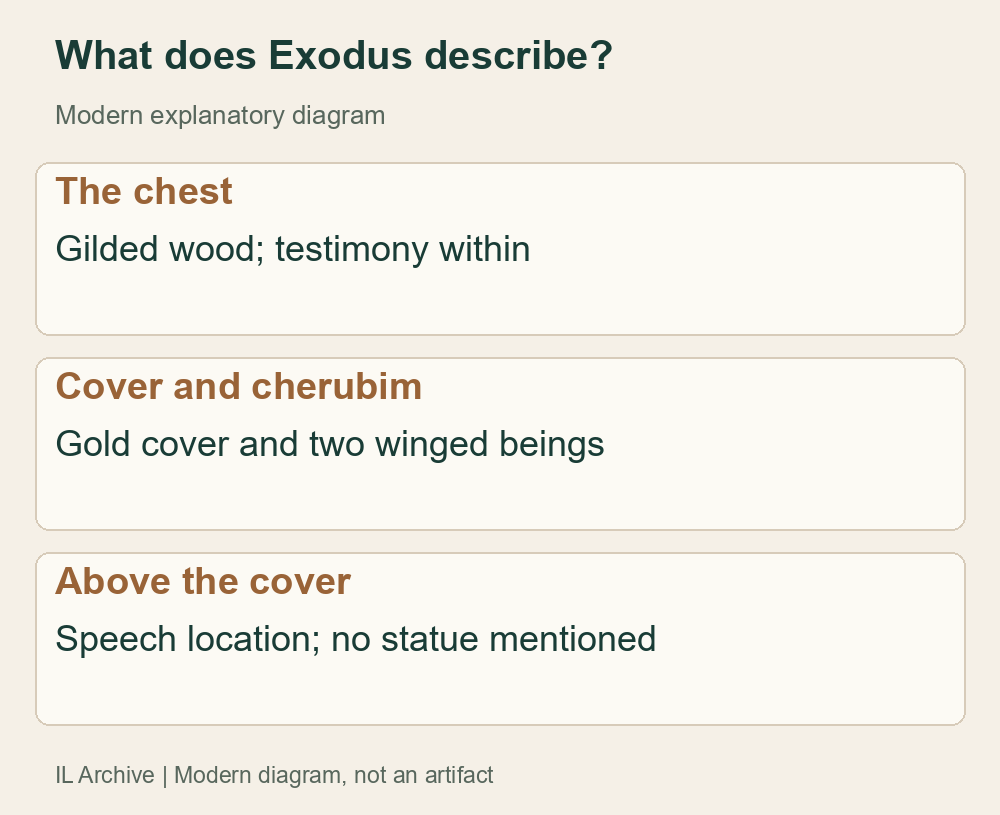
Exodus 25 provides a detailed description: acacia wood, gold covering inside and outside, and a gold molding. Length is two and a half cubits; width and height are each one and a half. These are textual dimensions, not measurements taken by an archaeologist from a discovered object. Converting them to centimeters depends on the cubit assumed. [1]
The details make the sacred object distinctly material. It can be manufactured, carried and installed in a room. They do not date the first Ark or prove that the surviving description was written at the time of the narrated events. Narrative setting, composition date and the date of a hypothetical historical object remain separate questions.
Four rings are explicit; pole count needs care
Exodus specifies four gold rings and gilded acacia poles inserted for carrying the Ark, with instructions that they remain in place. The familiar reconstruction uses two long poles, but the text gives no explicit number. Two poles should therefore not appear among directly stated facts without being identified as a reconstruction. [1]
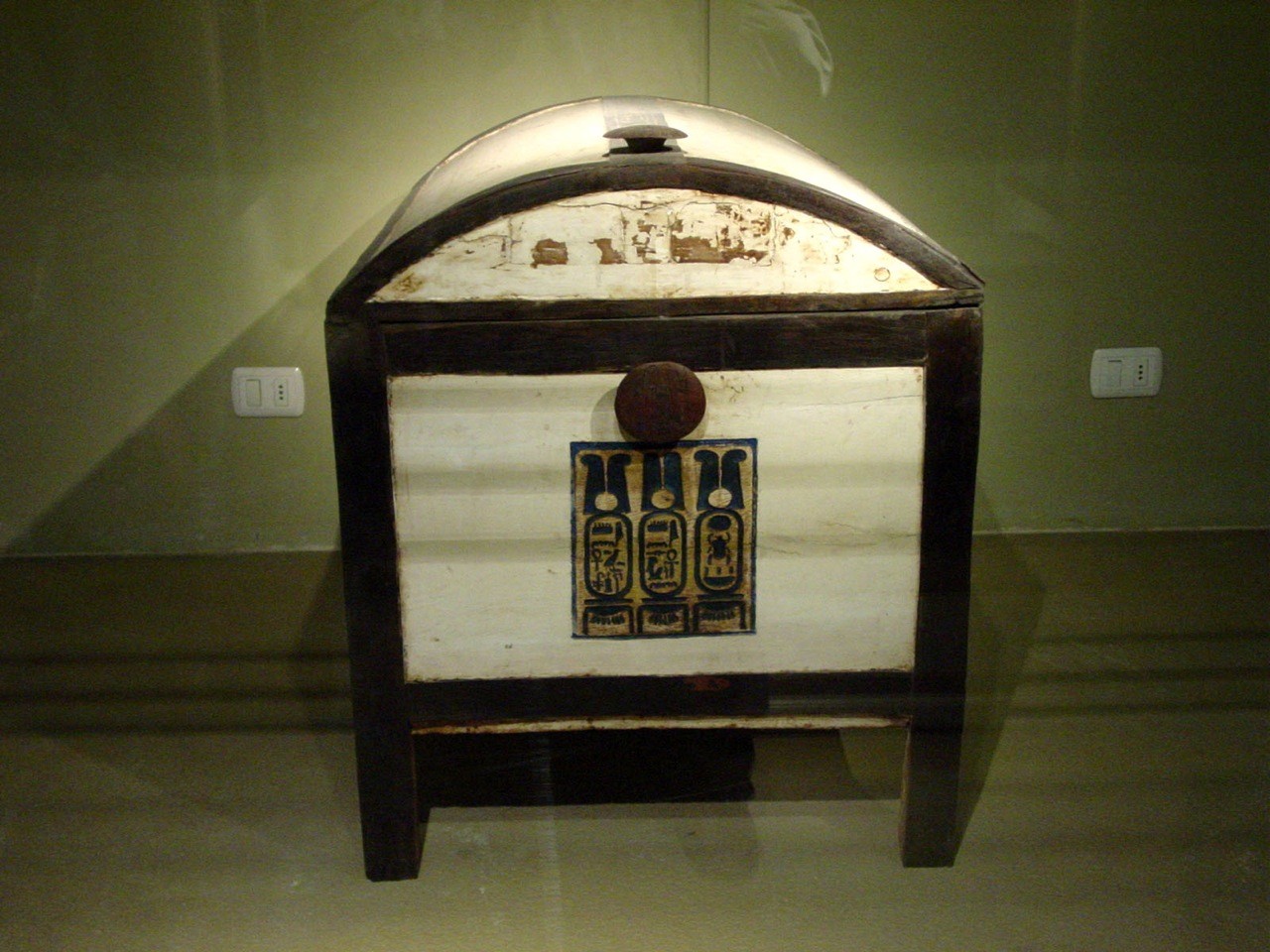
Raanan Eichler proposes four poles by comparison with a chest from TutankhamunTutankhamunEighteenth-dynasty king, formerly Tutankhaten, associated with renewed royal support for traditional cults.Glossary · Click to read the explanation’s tomb featuring sliding carrying equipment. This is a research proposal, not a definitive archaeological correction of the Ark. The chest photograph included here is contextual; it is not identified as Carter object 32 discussed in that study. [3]
Kapporet: cover and ritual location
The gold cover is called kapporetKapporetGold Ark cover linked with cherubim and speech in Exodus and atonement ritual in Leviticus; “seat” in translation does not prove a chair.Glossary · Click to read the explanation, kappōret. It is sometimes translated as an atonement cover or mercy seat. The word seat in a translation does not prove an identifiable chair. Exodus describes a cover bearing two cherubCherubimBeings or figures with guarding and sacred functions in Hebrew texts, at the tree-of-life access and on the ark; not equivalent to every heavenly messenger.Glossary · Click to read the explanation figures, with encounter and speech located above it. [1]
Leviticus 16 connects it with incense and blood ritual. It is more than a practical lid preventing access to a chest: it has a particular ritual importance. Yet one word should not absorb every later interpretation. Cover, atonement location and a hypothesized throne are not automatically equivalent descriptions. [5]
The cherubim are not Yahweh’s portrait
In Exodus the cherubimCherubimBeings or figures with guarding and sacred functions in Hebrew texts, at the tree-of-life access and on the ark; not equivalent to every heavenly messenger.Glossary · Click to read the explanation are two golden winged beings at the cover’s ends, their faces directed toward one another and the cover. It does not say that each has two faces or provide a complete bodily anatomy. We should not automatically fill the gaps from Ezekiel’s visions or later art showing winged infants. [1]
The familiar identification as human-headed winged lions is contested; Eichler argues for winged humans. Possibilities should be presented without declaring a settled form. Position, wings and facial orientation are clearer in Exodus, as is the fact that these figures are not identified there as statues of Yahweh. [11]
The voice above the cover
Exodus 25:22 associates the space above the cover, between the cherubim, with meeting MosesMosesCentral figure in Exodus, Torah traditions and the Qur’an; childhood accounts differ in detail.Glossary · Click to read the explanation and speaking to him. Numbers 7:89 repeats this small geography of speech. Neither scene describes Moses hearing a statue’s mouth or instructs the manufacture of a divine body in the center. That absence is clear within the description. [1][4]
But no statue is mentioned is more accurate than an empty space was excavated. The first is a textual finding; the second needs different material evidence. Silence also does not make this description representative of every Israelite practice. Presence without a statue described here is a strong conclusion with a defined scope.
Cloud and incense: manifestation and screen
Leviticus 16:2 connects manifestation with a cloud above the cover; 16:13 makes an incense cloud screen the cover. Not every reference to cloud necessarily describes the same incense. Expressions and functions differ. Both passages nevertheless restrict approach to the sacred location rather than presenting an exposed image for everyone to inspect. [5]
At Exodus’s end and in the temple dedication in Kings, cloud and glory fill the space and prevent entry or service in that scene. Presence is not simply absence: it acts within the narrative, filling the place and obstructing access. It need not be represented by a visible statue. [6]
When the Ark entered battle
In 1 Samuel 4, the people of IsraelAncient IsraelA name for an ancient population and later historical traditions, attested on the Merneptah Stele.Glossary · Click to read the explanation fetch the Ark from Shiloh after defeat, hoping for deliverance. Its arrival produces a great shout, and the Philistines interpret it as a god’s arrival in the camp. This is not the language of a neutral container: the characters connect the Ark with presence and power. [7]
Yet the story ends in Israel’s defeat and the Ark’s capture. It does not support treating possession as an automatic guarantee of victory. An object can signify sacred presence while the narrative denies that humans control the deity simply by carrying it into battle. Again, the evidence concerns the story’s logic, not independent field documentation of every detail.
“Enthroned on the cherubim”: text and translation
Samuel uses yōšēḇ hakkeruḇîm, frequently translated as sitting or enthroned on the cherubim. The Hebrew formula itself contains no explicit preposition meaning on. Sitting, dwelling and the relationship to the cherubim belong to interpretation; a familiar translation does not settle the issue. [7][11]
A royal reading has force within the broader evidence connecting Yahweh with sanctuary and throne. But it supplies no engineering drawing. Do the wings form a seat, provide protection or establish a frame? We should not convert the expression directly into a particular chair construction and then treat that construction as a known artifact.
The traditional reading: throne and footstool
A common interpretation understands the cherubim as parts of a throne unoccupied by a statue, with the chest serving as the deity’s footstool. It draws on royal and divine imagery from the ancient Near EastAncient Near EastA historical and geographical term covering Mesopotamia, the Levant and neighbouring ancient societies.Glossary · Click to read the explanation, showing winged creatures around thrones. Comparison makes the model intelligible, but does not prove every winged creature serves the same seating function. [9]
1 Chronicles 28:2 associates Ark and divine footstool, without providing a detailed construction plan. Isaiah 66:1 calls earth the footstool and heaven the throne. Not every occurrence therefore identifies a particular chest. The traditional model is an influential synthesis of several witnesses, rather than one statement excluding all alternatives. [8]
Covenant at the deity’s feet
Treaty comparisons help explain the conjunction of document and divine authority. Noegel discusses evidence for placing covenant writing at divine feet in Egyptian and Hittite contexts. Within a footstool interpretation of the Ark, storing the tablets below could signify a deity witnessing relationship and obligation. [9]
This explains a symbolic context, not a demonstrated chain of transmission. Resemblance does not prove a particular chest copied a particular rite or resolve the cherubim’s function. The comparison establishes that sacred documents and the sovereign’s presence could be combined within the region’s cultures.
A modern alternative: an empty frame
Not all researchers accept the throne model. In The Ark and the Cherubim, Eichler proposes an empty frame and rejects throne or footstool interpretations. This is an alternative scholarly position documented in the publisher’s description, not a new universal consensus. [10]
The difference matters: an unoccupied throne evokes a king imagined sitting even without a manufactured statue; a frame emphasizes marking a place of presence. Absence of a visible image does not automatically settle how worshippers conceived the deity’s body. Both readings are presented without turning either into archaeology or claiming all the book’s arguments were read.
Cover cherubim and temple-room cherubim
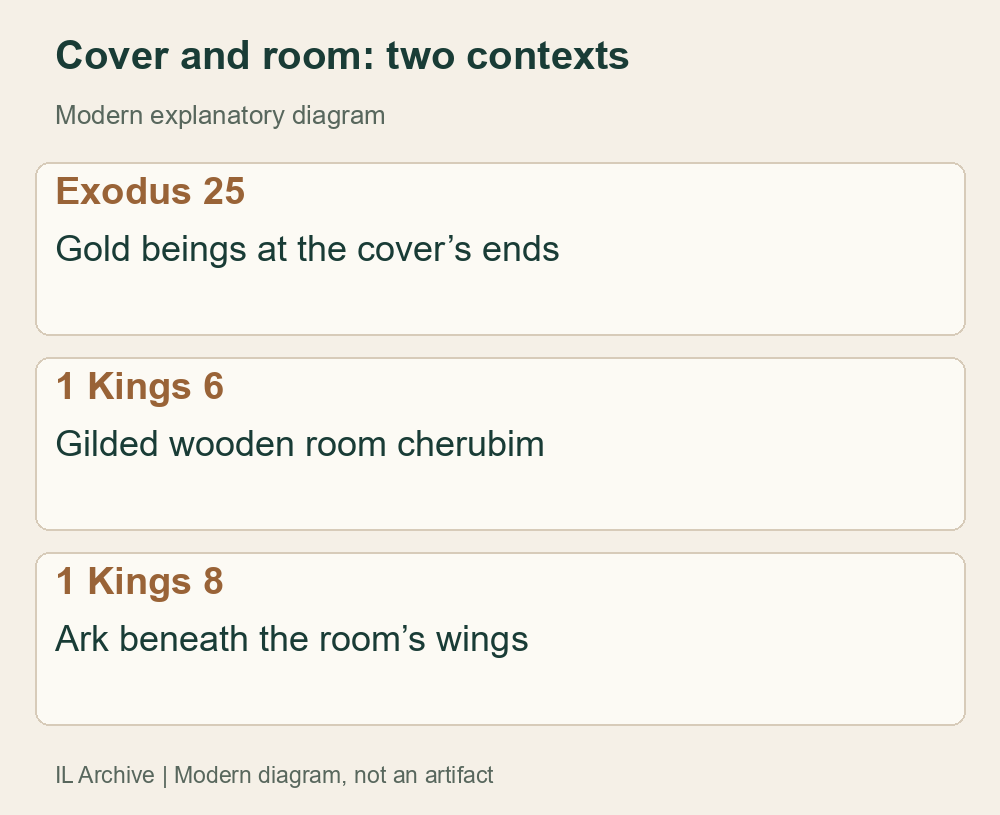
Exodus describes two golden beings at the cover’s ends. 1 Kings 6 describes two large cherubim inside the Holy of HoliesHoly of HoliesInnermost sacred space in sanctuary descriptions; Kings places the Ark under room cherubim. Textual concept, not an excavated site identified here.Glossary · Click to read the explanation, made of gilded olivewood and each ten cubits high. Their wings extend across the room; in Kings 8 the Ark is installed beneath them. [1][12]
These are different contexts, scales and arrangements. They should not be silently combined into one image labeled the Ark as excavated by archaeologists. Comparison and discussion of the traditions’ relationship are possible, but preserving distinctions is essential. The diagram compares wording and spatial roles without reconstructing an original appearance.
The sanctuary was not devoid of images
Kings describes cherub, palm and floral carvings on temple walls and doors. The sculpted cherubim are themselves manufactured images. The absence of a described Yahweh statue therefore cannot become a claim that the worship portrayed here prohibited every image and every art form. [12]
The necessary distinction is between figures or symbols surrounding the sacred space and a representation of the deity as the object of worship. A room can be rich in imagery while its description lacks a central Yahweh statue. This does not remove questions about prohibition and historical practice; it makes them more specific.
Egypt: portable shrine and sacred bark
Scott Noegel compares the Ark with Egyptian sacred barks carrying a small shrine and divine image in processions, proposing them as a possible model for its origin. Carrying, procession and oracular associations provide parallels. But an Egyptian bark is not the Ark’s chest, and a divine image within some shrines is a significant difference. [9]
Egyptian origin is therefore attributed to its advocate, not presented as a settled discovery. A photograph of furniture from a royal tomb does not prove ritual borrowing either. Its value is to show an actual ancient Egyptian chest with identity and limits stated, instead of presenting a modern illustration as the original Ark.
Curtain and shrine: what survives materially?
Madeleine Mumcuoglu and Yosef Garfinkel discuss portable clay shrines and curtains. One comparison is an Abydos shrine, CG 70041, associated with surviving textile dated to the twelfth century BCE. It shows that screening a shrine was materially feasible in the region’s ancient world. [13]
Identifying certain clay ribbons as curtains nevertheless remains an iconographic proposal; not every ribbon is a curtain. The shrine does not establish the Ark’s form or contents. Comparison is strongest in documenting objects and screening practices; their transmission to Israel requires further evidence.
What was inside the chest?
Exodus orders the testimony deposited in the Ark. In Deuteronomy 10, Moses makes a wooden chest and places the tablets within. Then 1 Kings 8:9 says the Ark contains only the two stone tablets. These passages give the covenant document a clear central position in the presentation of its contents. [1][14][12]
Descriptions in the PentateuchTorah / PentateuchGenesis, Exodus, Leviticus, Numbers and Deuteronomy: Mosaic corpus with a compositional history. Torah can also mean teaching or law beyond these five books.Glossary · Click to read the explanation do not agree in every detail; Deuteronomy does not repeat all the gilded arrangement of Exodus here. Their literary relationship and editing can be studied, but difference alone proves no particular evolution of an archaeological chest. Each description must first be read in context before reconstructing the history behind it.
Manna and Aaron’s staff: preserve the difference
Hebrews 9:4 includes the manna vessel, Aaron’s staff and tablets among the Ark’s contents. Exodus 16 and Numbers 17 describe preserving manna and staff before the testimony. Kings emphasizes the tablets alone. These differences should not disappear into a claim that every text supplies an identical list. [15][12]
Religious interpretation may harmonize times or locations, but historical research should identify where textual statement ends and harmonization begins. Numbers also has different verse numbering:17:25 in Hebrew corresponds to 17:10 in many English translations. A precise reference prevents an otherwise correct citation from appearing contradictory or missing. [15]
Did the Ark conceal a statue?
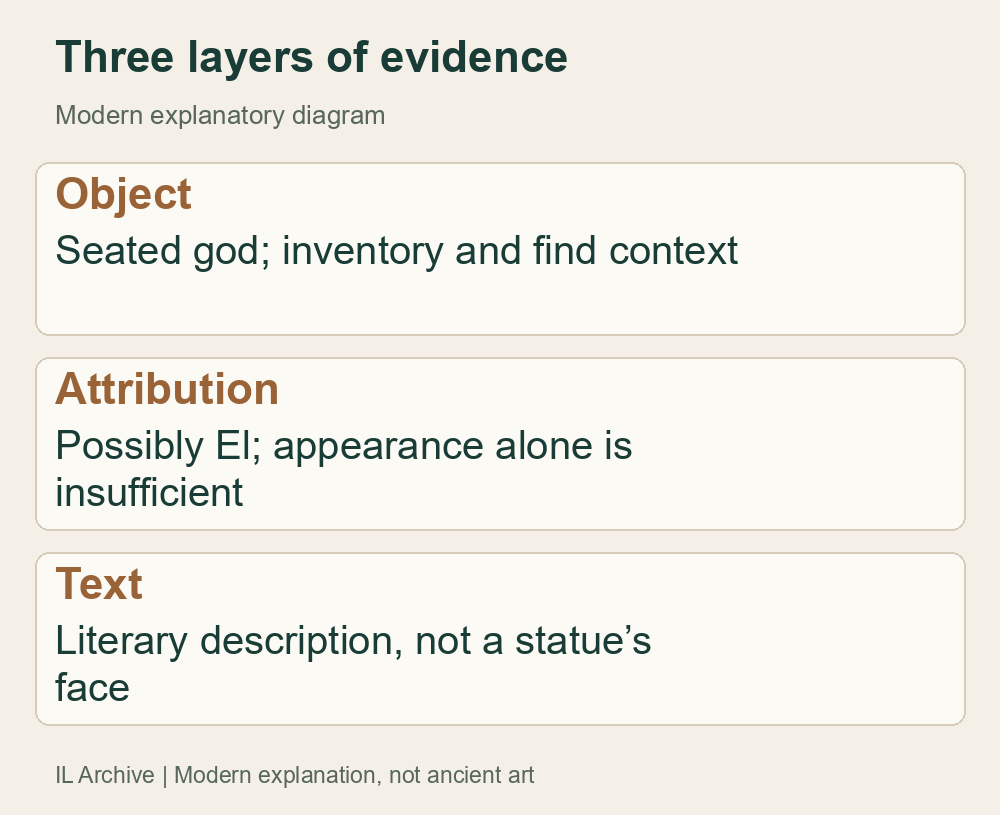
One can hypothesize that at an undocumented stage the chest held a statue or divine symbol, or that its description was later reinterpreted. Comparison with an Egyptian shrine containing an image does not establish that history. The texts examined here narrate no removal of a Yahweh statue; their explicit contents emphasize testimony and tablets. [1][12][14]
An unpreserved history remains distinct from proof of it. The documented evidence used here includes no verified original Ark whose contents can be checked, nor an inscription identifying an internal Yahweh image. Equally, textual absence does not establish that every phase of Israelite history lacked statues. Evidentiary limits apply in both directions.
Archaeology supplies context, not every missing detail
Egyptian furniture, clay shrines and winged imagery illuminate a world familiar with carrying, concealing and framing sacred objects. Resemblance does not turn them into the Ark. A photograph of a real artifact first supplies information about that artifact, then supports comparison within stated limits. [3][9][13]
The same principle applies to narrative locations such as Shiloh, Beth Shemesh and Kiriath-jearim: documenting a site or building does not prove that one particular object stood inside. Modern artistic imagination must also be separated from scholarly reconstruction. Diagrams here organize evidence and interpretations rather than inventing a missing original Ark’s appearance.
A divine body in language is not necessarily a statue
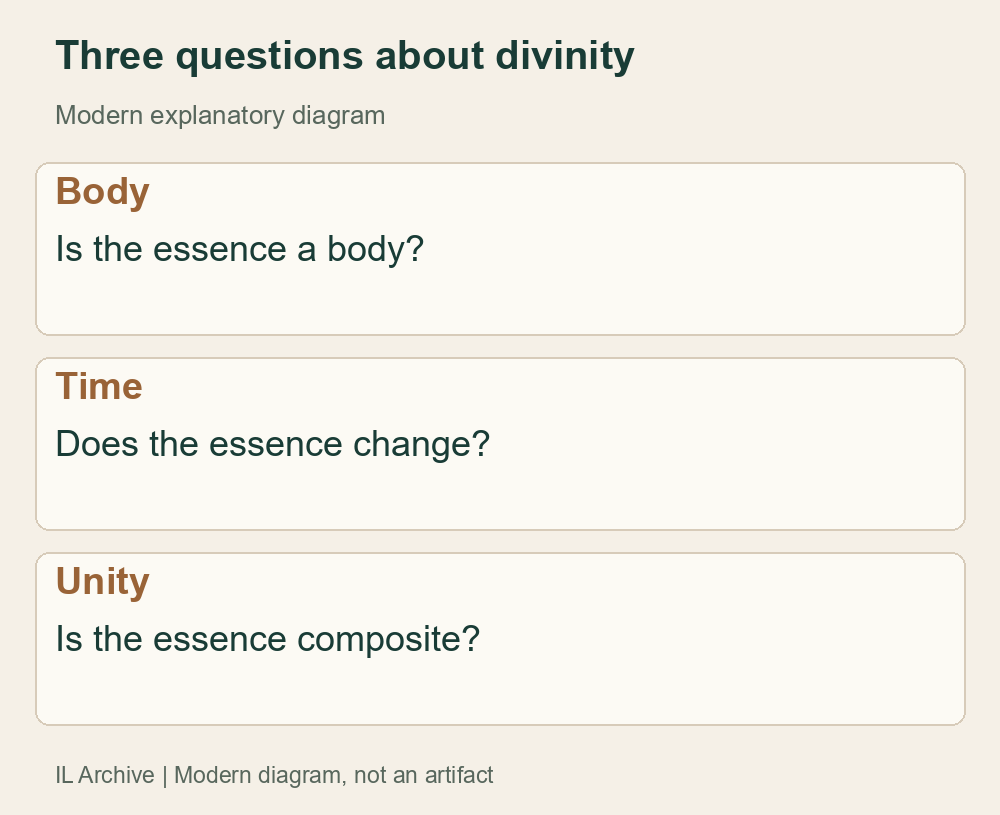
Hebrew texts speak of Yahweh’s face, hand and back, notably in Exodus 33. This belongs to the study of anthropomorphismAnthropomorphismRepresenting a thing or being with human features, such as arms, hands and dress. The term describes a form, without establishing an ordinary human or divine identity.Glossary · Click to read the explanation. It does not prove the speaker was looking at a cult statue, while a statue’s absence from the Ark description does not establish an entirely disembodied conception of the deity. [16]
A divine figure in poetry or vision differs from a manufactured sacred body installed in a temple. Bodily imagination can coexist with refusal to make its statue. A throne without a statue therefore cannot abbreviate the claim that the deity was no longer conceived in any form. The question concerns ritual representation of presence, not every textual expression about God.
Aniconism: define the term’s scope
AniconismAniconismAvoidance of divine images in a particular practice or tradition; not inferred solely from an unidentified artifact.Glossary · Click to read the explanation can describe a practice in which a deity is not represented by a cult statue or image. It does not automatically prohibit all decoration, equal monotheismMonotheismBelief in a single God as the only deity, rather than merely the highest among several gods.Glossary · Click to read the explanation or establish image-free worship in every Israelite home and sanctuary. The Ark description is a particular textual case whose limits should be retained. [1][12]
In that case, cherubim, gold, cover and ritual create a strongly sensory sacred location, while no manufactured Yahweh body is mentioned at its center. Presence without a divine statue can therefore be studied without making worship immaterial or reducing a long, diverse history to one principle applied everywhere.
Words inside, presence above
The texts permit a compelling interpretation: tablets inside the chest, speech above the cover and between the cherubim. Written covenant meets a presence addressing the community. The Ark can thus be understood as keeping and renewing a relationship, rather than as an impoverished substitute for a missing statue. [1][4][14]
This symbolic contrast is no timeline proving a definitive human transition from image to word. Imagery and ritual remained, and the texts do not all belong to one date. The scene alone also does not establish when every worshipper understood Yahweh as the only deity. Dating monotheism is a broader question than the Ark’s arrangement.
Degrees of certainty
Textually, Exodus describes a gilded chest, cover and two cherubim, locates speech above the cover between them, and gives no instruction for a Yahweh statue there. Kings describes large room cherubim and figured decoration, and names only the tablets inside the Ark. These are specific reading results. [1][4][12]
Throne or footstool interpretation is influential and contested; an empty frame is an alternative. Direct Egyptian origin, a removed hidden statue, or an uninterrupted history of every change are not established here. Comparative archaeology documents chests, shrines, carrying and concealment, but does not replace a verified original Ark. [9][10][13]
The Ark: presence does not depend on a statue
“A throne without a statue?” remains useful with its question mark intact. It captures a powerful traditional reading while allowing an interpretation as a frame or encounter space. The firmer conclusion is not a chair we can confidently draw, but that key texts locate Yahweh’s presence without describing his statue between the cherubim. [1][4][10]
Matter, surrounding images and ritual do not disappear. What is absent from the description is a manufactured divine body at the center. Chest, covenant, wings, voice and cloud remain. This constructs a place for sacred presence without requiring a claim that the Ark was found or reducing Israel’s entire history to a simple progression from statue to abstraction.
References and notes
- Exodus 25:10–22. Hebrew text, Sefaria. Wood, gold, dimensions, rings, poles, cover, cherubim and speech location. Pole count not explicit. Textual description, not documentation of an excavated object. Return to the text ↑
- Raanan Eichler (2017). “Ark of the Covenant.” Oxford Bibliographies. DOI: 10.1093/obo/9780195393361-0245. Public introduction only: portable chest, covenant documents, divine presence and sanctuary location. Restricted portions were not read in full. Return to the text ↑
- Raanan Eichler (2016). “The Poles of the Ark and Tutankhamun’s Chest.” TheTorah.com. No explicit pole count; author proposes four sliding poles, comparing Carter object 32. Research proposal; the contextual photograph here is not identified as that chest. Return to the text ↑
- Numbers 7:89. Hebrew text, Sefaria. Speech heard above the cover between the cherubim; no Yahweh statue described there. Return to the text ↑
- Leviticus 16:2, 13–14. Hebrew text, Sefaria. Appearance in a cloud over the cover, incense cloud and blood rite. Distinguish expressions and roles rather than equating every cloud with incense. Return to the text ↑
- Exodus 40:34–35; 1 Kings 8:10–11. Hebrew text, Sefaria. Cloud and glory in the tent and temple dedication. Literary depictions of presence, not photographic records of archaeological events. Return to the text ↑
- 1 Samuel 4:3–11; 2 Samuel 6:2. Hebrew text, Sefaria. Shiloh procession, defeat and capture; yōšēḇ hakkeruḇîm. The formula contains no explicit “on” preposition; enthronement translation is contextual. Return to the text ↑
- 1 Chronicles 28:2; Isaiah 66:1. Hebrew text, Sefaria. First connects Ark and footstool; second calls earth the footstool and heaven the throne. The term alone does not establish one material blueprint. Return to the text ↑
- Scott B. Noegel (2015). “The Egyptian Origin of the Ark of the Covenant.” In Israel’s Exodus in Transdisciplinary Perspective, pp.223–243. DOI: 10.1007/978-3-319-04768-3_17. Pp.223–229: Ark description, conventional interpretation, sacred barks, images, procession, oracle and covenant texts at divine feet. Egyptian origin is Noegel’s hypothesis, not conclusive archaeology. Not the entire chapter. Return to the text ↑
- Raanan Eichler (2021). The Ark and the Cherubim. Forschungen zum Alten Testament 146. Mohr Siebeck. DOI: 10.1628/978-3-16-159264-5. Publisher description: rejection of throne/footstool model and proposal of an empty frame. Documents the announced position, not a full reading of the book’s arguments. Return to the text ↑
- Raanan Eichler (2016). “What Kind of Creatures Are the Cherubim?” TheTorah.com. Form survey, sitting/dwelling formula, criticism of winged-sphinx identification and proposal of winged humans. Contested identification, not a verified original object. Return to the text ↑
- 1 Kings 6:23–35; 8:6–9. Hebrew text, Sefaria. Gilded olivewood room cherubim ten cubits high; cherub, palm and floral decoration; Ark under wings, only two tablets within in 8:9. Return to the text ↑
- Madeleine Mumcuoglu and Yosef Garfinkel (2020). “Was a Sacred Curtain (Parokhet) Depicted on Portable Shrines in the Ancient Near East?” Religions 11(9),469. DOI: 10.3390/rel11090469. Comparative shrines and curtains; AbydosCG 70041 with associated textile, twelfth century BCE. Clay-ribbon curtains are an iconographic proposal. Does not adopt the erroneous Hatshepsut date in figure 3 caption. Return to the text ↑
- Deuteronomy 10:1–5. Hebrew text, Sefaria. Moses makes a wooden chest and deposits the tablets. Description differs from Exodus; does not by itself date either tradition or the object. Return to the text ↑
- Hebrews 9:1–5; Exodus 16:33–34; Numbers 17:25 (Hebrew numbering, often 17:10 in English). Hebrews 9:4 includes manna, staff and tablets; Torah passages place manna/staff “before” the testimony. Difference retained without imposing one harmonization. Article paraphrases, not a modern-translation quotation. Return to the text ↑
- Exodus 33:20–23. Hebrew text, Sefaria. Face, hand and back language; bodily description does not establish a cult statue or its absence throughout Israelite history. Return to the text ↑
Suggest a correction · Suggest a source for this record
Cite this record
IL Archive, «The Ark of the Covenant: A Throne without a Statue?», Edition 1, https://ilarchive.com/en/studies/ark-throne-without-image
Continue reading

![Gold coin of Ptolemy II, Alexandria, ca. 261–246 BCE; the illustrated obverse bears Arsinoe II’s head. Context for Hellenistic Egypt, not a portrait of Philo or proof of a Torah translation commission. [24]](/media/1436)