Study
Did El Have an Image?
An extended study of a topic, with evidence and references.
Between the tentatively identified seated figurine and the elder described in texts: separating artifact attribution from literary appearance, and comparing El with the Ancient of Days without inventing a transmission route.
Share article
Text
When we look for an image of ElEl at UgaritA deity prominent in West Semitic traditions, especially as head of the divine family in Ugaritic texts.Glossary · Click to read the explanation, head of the divine household at UgaritUgaritAncient city and kingdom at Ras Shamra on the Syrian coast, flourishing between the fourteenth and early twelfth centuries BCE and preserving multilingual archives.Glossary · Click to read the explanation, we encounter a paradox. Texts give him hair, a beard, a body and gestures, yet identifying him on a particular artifact is much harder. Did he have a statue? How can a god described so vividly remain disputed in images?
Two questions within “image”
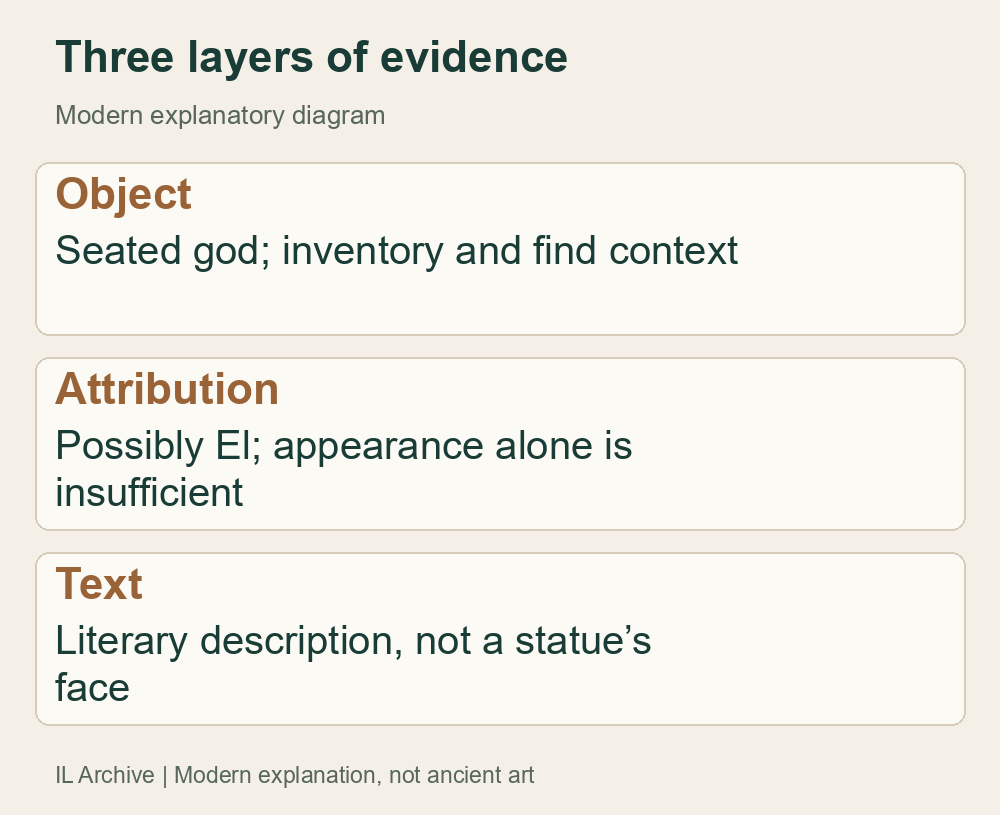
The first question is archaeological: do we have an object demonstrably depicting El? The second is literary: do the texts imagine him in a describable form? The second has a clearer answer. Failure to identify a statue does not erase the form described in stories, and a literary description does not securely name every statue that resembles it.
Why is identification difficult?
IconographyIconographyStudy of images, their attributes and contexts; resemblance alone does not prove identity.Glossary · Click to read the explanation studies visible attributes and their contexts. Thrones, beards and crowns can belong to several figures. The Metropolitan Museum’s overview explains that El’s identification among excavated images is unclear, and that some seated men might represent another god or a deified king.[1] This concerns identification; it does not demonstrate that El was never depicted.
A seated god with an inventory number
A prominent candidate is a bronze figurineFigurineSmall three-dimensional representations of people, animals or other beings. Size and appearance alone do not establish a toy, portrait, ritual object or deity; manufacture, discovery context and use require study.Glossary · Click to read the explanation covered in gold foil: excavation number RS 23.394, museum number S3573. The Virtual Museum of Syria labels it a seated god, possibly El, dates it to 1400–1300 BCE and gives its height as 13.5 cm. Its record places the find in Ugarit’s southern city and lists Damascus Museum in its 2011 information.[2]
Matching both numbers prevents confusion with similar objects. The accompanying photograph is licensed for reuse, but the image file’s confident identification as El is not decisive evidence. Our caption preserves the catalogue’s uncertainty. The 2011 entry also does not verify the object’s present whereabouts.
What is missing from the identification?
The catalogue consulted provides no inscription naming the figure El. The seated pose, rich clothing and beard make comparison with the divine father reasonable, but not certain. “Possibly El” therefore expresses an attribution based on a combination of features, rather than hesitation over a securely known name.
Horns are not an identity card
The catalogue interprets holes above the ears as sockets for horns once attached to the headdress.[2] Such an attribute can support a divine identification without identifying El alone. We must also separate surviving features from a proposed reconstruction: the original horns are not visible in this photograph.
The texts provide another kind of evidence
The Baal CycleBaal CycleA group of Late Bronze Age Ugaritic religious texts recounting Baal’s conflicts, relationships with the gods and the building of his palace.Glossary · Click to read the explanation and other Ugaritic texts allow us to study El’s literary appearance. We use KTUKTU: Ugaritic Text ReferencesAbbreviation for a modern scholarly corpus of alphabetic cuneiform texts; its numbers are references, not dates.Glossary · Click to read the explanation numbers, modern references to a text collection rather than ancient titles written on the tablets.[11] What emerges is a character in narrative, not a blueprint for a lost statue.
A gray head and beard
In KTU 1.3 V, AnatAnatAn active and violent goddess in Ugaritic literature; pressures El over Baal’s palace and addresses him with paternal and wisdom language.Glossary · Click to read the explanation threatens to spill blood over El’s gray head and beard. The passage has gaps and restorations, but gray hair is clear in the annotated translation.[3] Age becomes tangible: the character has a head and beard that can be addressed and threatened. The text does not preserve the length of that beard or the details of his face.
“Father of Years”: an epithet requiring interpretation
The epithet ʾab šnm is often translated as Father of Years. Theodore Lewis also records an alternative reading connected with Šunama.[4] The epithet alone should not be treated as a definitive statement of age. Gray hair, fatherhood and wisdom together support an image of seniority even while the particular expression remains debated.
Bull El need not have a bull’s head
The epithet ṯr ʾil, Bull El, accompanies father and king. Lewis reads these titles together as language of potency, virility and sovereignty.[4] Turning an epithet into a particular animal image requires further evidence. He also discusses a bronze bull as a possible representation associated with El; this is an interpretive attribution, not grounds for naming every Ugaritic bull after him.
A body that enacts authority
Characters approach El’s dwelling, address him and negotiate. His permission remains important in the story of BaalBaalStorm god and protagonist of Ugarit’s Baal Cycle; exercises active kingship while El retains importance and authorizes the palace.Glossary · Click to read the explanation’s palace, with AthiratAthiratA high-ranking goddess commonly understood as El’s consort in Ugaritic texts; associated with the progenitress epithet and the palace intercession.Glossary · Click to read the explanation acting as intermediary.[3] Literary embodiment is therefore more than ornament: it makes the patriarchal head present within the council’s relationships. Authority does not require its bearer to be the story’s most active warrior.
A god who drinks
In KTU 1.114, El hosts a feast for the gods and drinks to the point of collapse. The scene describes a body vulnerable to loss of balance, rather than an abstract force. Scholars interpret its conclusion as therapeutic material concerning the effects of intoxication.[5][6] This vivid literary portrayal is not a record of a historical event or a complete account of religious belief.
The marziḥu is not a synonym for all this drunkenness
The text is connected with the marziḥuMarziḥuA banqueting institution or association in Ugaritic documents, with religious functions not reducible to one ritual.Glossary · Click to read the explanation, a banqueting association or institution. Christopher Hays cautions against expanding the scene’s implications: the feast is initially described with another word, and neither the dead nor the Rephaim appear among its guests.[5] El’s intoxication cannot establish that every marziḥu gathering communicated with the dead, or that drunkenness defined the institution.
An elder who can father children
KTU 1.23 portrays El in a sexual and procreative setting that leads to the birth of sons. Lewis discusses hand, staff and scepter as suggestive language whose details admit different readings.[4] We need not turn every word into an anatomical term. Nevertheless, successful procreation resists reducing El to a powerless old man. Seniority and reproductive potency coexist in this character.
A narrative body is not a survey of everyone’s beliefs
Hair, beard, drinking, kinship and emotion belong to anthropomorphic portrayalAnthropomorphismRepresenting a thing or being with human features, such as arms, hands and dress. The term describes a form, without establishing an ordinary human or divine identity.Glossary · Click to read the explanation. They do not establish how every Ugaritian understood these descriptions, or which were taken literally. We should distinguish poetic language from modern theories about divine nature, and literary appearance from the form of an image used in worship.
Failed identification does not prove a ban on images
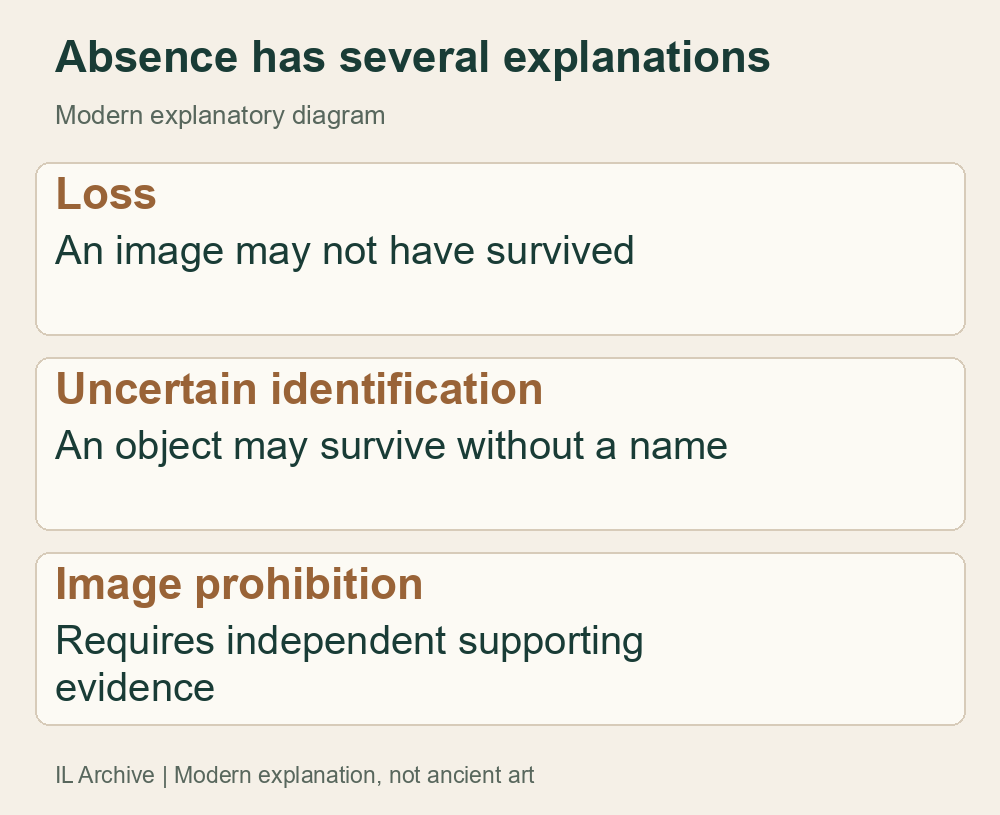
AniconismAniconismAvoidance of divine images in a particular practice or tradition; not inferred solely from an unidentified artifact.Glossary · Click to read the explanation, or avoiding images, differs from a researcher’s inability to name an object. Images may be lost, statues may lack inscriptions and divine attributes may overlap. We cannot infer a prohibition against depicting El from the absence of an agreed identification in the sources reviewed here. Negative evidenceNegative evidenceFailure to find an expected trace can test a hypothesis when preservation and investigation make discovery expectable; not every absence is evidence.Glossary · Click to read the explanation requires an account of what should have survived and how it could have been found.
The Ancient of Days in Daniel
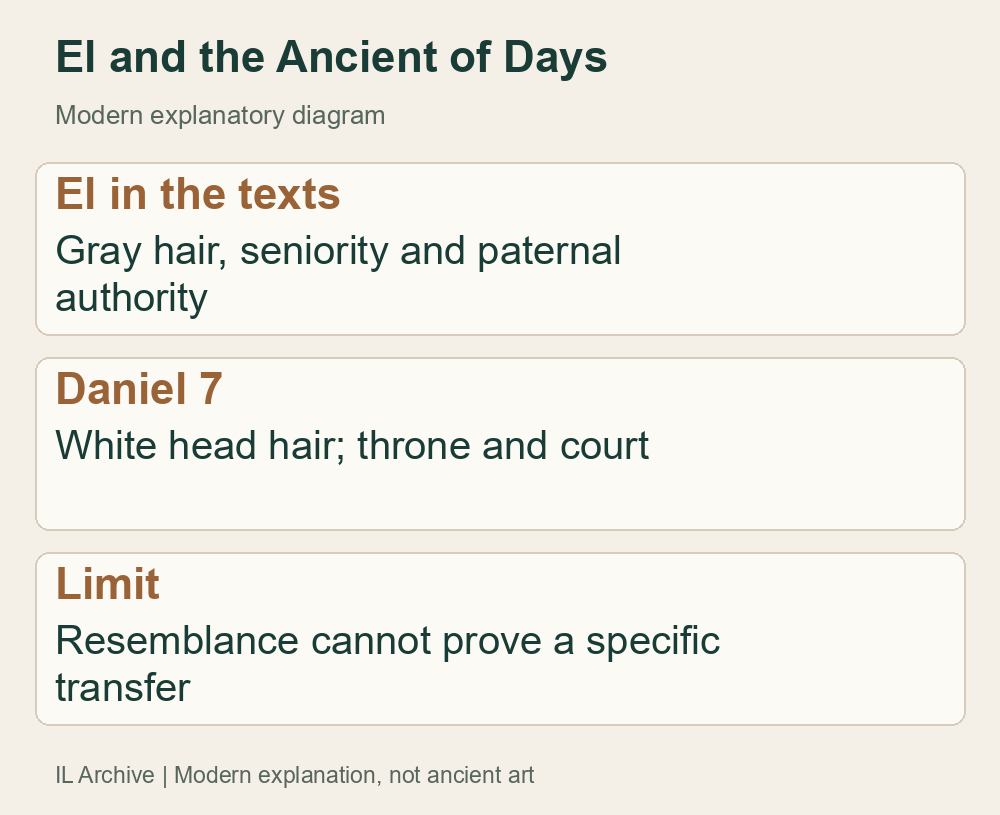
In Daniel 7:9–10, the Ancient of DaysAncient of DaysDesignation of the divine figure with white hair, throne and court in Daniel7.Glossary · Click to read the explanation appears seated, with white clothing, hair like wool, a fiery throne, heavenly attendants and a court.[7] The passage describes the hair of his head, not a white beard. This embodied image conveys the antiquity of authority within a vision, but does not call the figure the Ugaritic El.
A meaningful comparison across a long interval
Gray hair, seniority and heavenly authority make the comparison meaningful. Yale’s study guide discusses this connection as part of the vision’s background.[8] Yet many centuries separate Ugarit’s tablets from Daniel’s Hellenistic form. Resemblance supports investigation into continuity and reinterpretation; it does not prove that Daniel’s author received a particular tablet or copied the face of a statue.
The hypothesis of Yahweh “coming of age”
In YahwehYahwehThe divine proper name written YHWH in the Hebrew Bible.Glossary · Click to read the explanation’s Coming of Age, Jason Bembry proposes a trajectory from YahwehYahwehThe divine proper name written YHWH in the Hebrew Bible.Glossary · Click to read the explanation as a youthful warrior to the aged divine figure in Daniel, with a role for El’s traditions.[9] The published book description is used here to identify the thesis; the whole book is not claimed read. It offers an interpretive model for asking how the language of divine authority changed.
Why does the model remain debated?
Klaas Spronk’s review finds the comparisons interesting but stresses problems of dating and demonstrating relationships between texts. He challenges linking El’s age to weakness, especially given successful procreation in KTU 1.23.[10] Different texts do not automatically form a single ordered biography: young, then old, then impotent.
We cannot draw El’s known face
A modern artist could combine beard, gray hair, throne and clothing. The result would still be a modern choice, not a documented recovery of El’s face. This study therefore uses a photograph of the candidate object with a cautious caption, alongside diagrams explaining the evidence. None presents an invented divine likeness as an archaeological discovery.
What can be stated confidently?
The texts certainly give El human, paternal and royal attributes. RS 23.394 is catalogued as a seated god, with a possible attribution to El. Its precise identity, the appearance of El’s cult images and the route by which an elderly divine figure reached Daniel require different degrees of caution. Lack of agreement over an image is not the same as absence of ancient depiction.
Clear in the story, disputed on the artifact
Did El have an image? He certainly has a literary appearance, and scholars attribute some objects to him. The sources used here do not provide a material image whose identification is unanimously secure. That distinction is central: we can study how the texts portray him without claiming to know his face on a particular statue.
References and notes
- Ira Spar (2009). The Gods and Goddesses of Canaan. The Metropolitan Museum of Art. El paragraph: uncertain seated-image identification; possible unidentified god or deified king. Not a universal archaeological inventory or proof of an image ban. Return to the text ↑
- Virtual Museum of Syria. Seated God Figurine (possibly El). RS 23.394 / Damascus S3573; southern city of Ugarit; 1400–1300 BCE; 13.5 cm; bronze/gold foil, horn sockets and 2011 Damascus Museum data. El attribution tentative. Separate CC0 photograph used, not the protected catalogue image. Return to the text ↑
- Jeffery B. Lloyd (1994). The Goddess Anat: An Examination of the Textual and Iconographic Evidence from the Second Millennium B.C. University of Edinburgh doctoral thesis. Selected pp. 182–185, 191–192, especially KTU 1.3 V, threatened gray head/beard, restorations and palace mediation. Whole thesis not claimed read. Return to the text ↑
- Theodore J. Lewis (2022). God (ʾIlu) and King in KTU 1.23. In “Like ʾIlu Are You Wise”: Studies in Northwest Semitic Languages and Religions in Honor of Dennis Pardee. SAOC 73. Selected pp. 31, 34–36, 40, 42; p. 34 n. 17: Father of Years or Šunama; p. 40: father/bull/king and procreation, n. 55 tentative bull figurine. Sexual language allusive, details debated; no human sacred-marriage reconstruction. Return to the text ↑
- Christopher B. Hays (2011). Death in the Iron Age II and in First Isaiah. FAT 79. Printed pp. 116–117 in a 23-page scholarly extract; p. 117 is PDF page 18, not 13, because of file order. Banqueting institution/property/functions, KTU 1.114, limits of drunkenness inference and absent dead/Rephaim. Whole book not read. Return to the text ↑
- Klaas Spronk. The Incantations. In Handbook of Ugaritic Studies, chapter 5. Section 5.5, PDF p. 16, printed p. 285: KTU 1.114 as intoxication story with a remedy and proposed human recipe. Functional interpretation, not a preserved statement about every use of the tablet. Return to the text ↑
- Daniel 7:9–10. King James Version, Bible Gateway. Daniel 7:9–10: white clothing, head hair like wool, throne and court; no beard in the description. Article paraphrases the passage rather than quoting an Arabic translation. Return to the text ↑
- Yale Bible Study. Daniel the Dreamer – Study Guide (Daniel 7). Vision and interpretation: Ancient of Days, comparison with El and Hellenistic/Antiochus IV setting. Historical interpretation; no proof of a particular tablet’s transmission or a statue’s face. Return to the text ↑
- Jason Bembry (2011). Yahweh’s Coming of Age. Eisenbrauns. Published description and contents only: youthful warrior to aged god and Canaanite tradition. Whole book not claimed read; thesis critically discussed in the next reference. Return to the text ↑
- Klaas Spronk (2013). Review of Jason Bembry, Yahweh’s Coming of Age. Bibliotheca Orientalis 70, 179–181; author’s two-page version. Complete two-page author version: dating/textual relationships, critique of El’s alleged impotence and KTU 1.23. Draft date precedes publication; PDF page numbers not equated with published pagination. Return to the text ↑
- Edition des ugaritischen poetischen Textkorpus (EUPT), Göttingen. Bibliographische Abkürzungen. KTU1, KTU2/CAT, KTU3 entries: editors Dietrich, Loretz and Sanmartín; editions 1976, 1995, 2013. Reference system checked, not all texts in the editions read. Return to the text ↑
Suggest a correction · Suggest a source for this record
Cite this record
IL Archive, «Did El Have an Image?», Edition 1, https://ilarchive.com/en/studies/did-el-have-an-image
Continue reading