Entity · Concept
Ancient of Days
A reference page linking a name, group, or concept to the materials that discuss it.
- Names
- Ancient One · ʿattīq yōmīn
Aramaic title for the divine figure seated in judgement in Daniel 7. The entry compares Ugaritic El imagery and later Jewish and Christian reception, without presuming identity or proven transmission.
Estimated reading time: 6 min Published Last reviewed:
Share article
Text
Introduction
“Ancient of Days” designates the enthroned judge in the heavenly court of Daniel 7. Where do the imagery of white hair, fire and opened books come from, and how does it compare with ancient Levantine divine imagery and later Jewish and Christian readings? This entry begins with the Aramaic passage, then distinguishes textual evidence from proposed analogies and later interpretations.
The title and its language
Biblical Aramaic calls the figure ʿattīq yōmīn (עַתִּיק יוֹמִין), rendered “Ancient of Days” or “Ancient One.” In Daniel 7:9, 13 and 22, the phrase designates a divine figure within a vision; it is not independently attested here as the proper nameProper nameA name that identifies a particular person, place, group, or entity in context, unlike a common noun denoting a class. Spelling alone may not settle the distinction.Glossary · Click to read the explanation of another god. He must also be distinguished from the figure later approaching him “like a son of man,” that is, like a human being.[3]
The heavenly court
DanielDaniel in the biblical bookDaniel is the Jewish sage and visionary in the biblical book bearing his name.Glossary · Click to read the explanation, the literary visionary of the Book of DanielBook of DanielA book combining court tales of wisdom and deliverance with visions of kingdoms and the future, formed in stages.Glossary · Click to read the explanation, sees four beasts rising from the sea. In the explanation of the chapter these stand for successive royal powers. The scene then shifts from the threatening kingdoms to a heavenly tribunal: thrones are placed, the Ancient of Days sits down, his garments are white as snow and the hair of his head is like pure wool. His throne flames, its wheels blaze, a fiery stream flows before him, countless attendants stand ready, and the books of judgment are opened.[1]
White hair conveys antiquity, majesty and wisdom in this vision; the books belong to the language of judicial reckoning. The passage does not describe a beard. Beards sometimes supplied by later artists belong to their interpretation of the scene, not to the wording of Daniel 7:9–10.
The cloud-borne figure and the kingdom
In verses 13–14 someone “like a son of man” arrives with the clouds of heaven, is brought before the Ancient of Days and receives everlasting dominion. The narrative gives the two figures different actions: one sits and judges, while the other approaches and receives power. In the chapter's own explanation, the “holy ones of the Most High,” and then the “people of the holy ones of the Most High,” inherit the kingdom (7:18, 22, 27).[4]
Interpreters disagree over how the cloud-borne figure relates to those holy ones. Readings include a collective personification, an angelic representative—sometimes connected with MichaelMichael / MīkālA name meaning “Who is like God?”, borne by humans and an angel. The angel protects Daniel’s people, is called archangel in Jude and fights the dragon in Revelation. The Qurʾan names Mīkāl without assigning a task; later traditions develop different roles.Glossary · Click to read the explanation—and a distinct heavenly individual. Later traditions also develop messianic readings. The singular appearance of the figure alone cannot settle those competing interpretations.
Narrative setting and composition
The story places Daniel's dream in the first year of Belshazzar, within the sixth-century BCE Babylonian setting. Historical-critical scholarship, by contrast, commonly dates the apocalyptic visions in Daniel 7–12 to the crisis under the Seleucid ruler Antiochus IV EpiphanesAntiochus IV EpiphanesAntiochus IV Epiphanes was a Seleucid king who ruled from175 to164 BCE.Glossary · Click to read the explanation, especially about 167–164 BCE. The “little horn” is commonly read in relation to this king's persecution and interference with religious times and law. This is a proposed date for the literary layer, not a verified date of a historical dream, and it need not apply uniformly to the earlier court stories.[5]
Throne and fire within the Hebrew Bible
The fiery throne and its wheels recall other biblical throne visions, particularly Ezekiel 1:15–28, with its wheels, heavenly beings, radiant throne and fire. The compositions are not identical: Ezekiel elaborates the movement of a heavenly chariot, whereas Daniel concentrates on a court of judgment passing sentence on beast-like empires. Shared visual language permits comparison without establishing a lost physical model for the scene.[6]
Comparing El and Baal
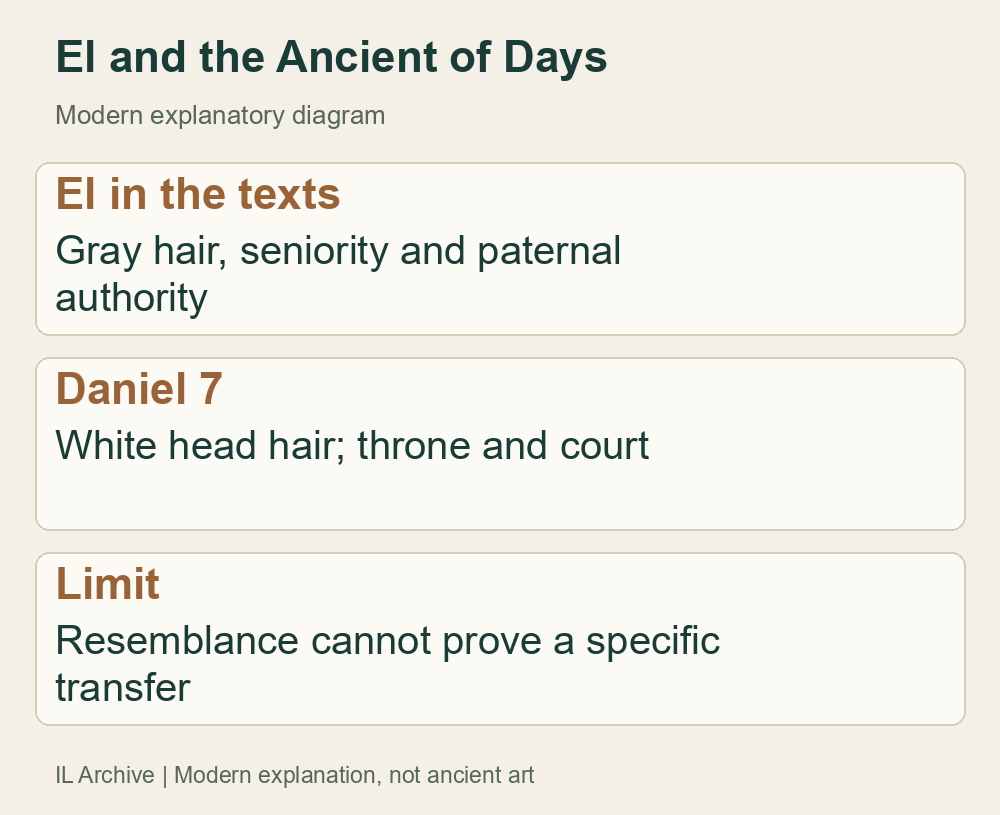
The Ugaritic high god ElElEl is a senior deity in Late Bronze Age Ugaritic texts, portrayed as father of the divine family and a council authority, alongside his consort Athirat. This entry does not cover every linguistic use of El.Glossary · Click to read the explanation is portrayed in texts as an elder with paternal authority and wisdom; particular passages evoke his grey hair and beard, while the epithet “Father of Years” is discussed by scholars. Daniel likewise joins white hair with the authority of an aged judge. Researchers therefore compare the figures, and also compare the cloud-borne visitor with BaalBaalUgaritic storm god and warrior king who defeats Yamm, builds his palace with El’s consent and confronts Mot. References to El and Dagan as fathers do not define a single genealogy.Glossary · Click to read the explanation, the storm god described in Ugaritic tradition as the rider on the clouds. The Yale Bible Study guide sets out these ancient resonances while emphasizing Daniel's distinct interpretation.[2]
These are literary and historical parallels, not evidence that the Ancient of Days simply is the Ugaritic El or that a specific statue was copied. A research website reproduces a limited excerpt from John Day's discussion of the relevant Ugaritic and biblical lines; neither that excerpt nor resemblance alone can establish a precise transmission route.[7]
Later Jewish debate about the thrones
A passage in the Babylonian Talmud, Chagigah 14a, discusses why Daniel 7:9 speaks of “thrones” in the plural. It preserves a view attributed to Rabbi Akiva assigning one to God and another to David, and objections that interpret the two as justice and righteousness, or as a throne and footstool. The discussion demonstrates diverse later Jewish exegesis; it is not evidence that all second-century BCE readers interpreted the verse in the same way.[8]
First Enoch and the transformed scene
In the Parables of 1 EnochFirst EnochA composite Second Temple Jewish apocalyptic collection on the Watchers, parables, celestial cycles, historical visions, and judgment, preserved complete in Geʽez.Glossary · Click to read the explanation, especially chapter 46, the white-haired “Head of Days” stands beside another figure called the “Son of Man.” The echo of Daniel is clear, but the work develops the second figure's role within its own apocalyptic and messianic setting. The comparison here uses the published English translation of R. H. Charles; it does not claim inspection of an Ethiopic manuscript.[9]
The Parables are often dated broadly around the turn from the first century BCE to the first century CE, though their precise dating and textual transmission remain debated. For Peter Schäfer's specialist discussion, only the publisher's abstract was available in this review, not the full chapter.[10]
Christian rereading
In RevelationBook of RevelationChristian apocalypse commonly dated in its present form to the late first century CE, reusing earlier scriptural imagery.Glossary · Click to read the explanation 1:13–14, someone “like a son of man” has head and hair white as wool and eyes like flame. This Christian vision draws together attributes associated in Daniel with the arriving humanlike figure and with the Ancient of Days; its own context identifies the visionary figure with Christ. It is a later literary reapplication, not proof that all these meanings were already fixed in the original composition of Daniel.[11]
Visual reception and the limit of representation
An illuminated folio of the Silos Apocalypse dated 1109 CE, British Library Add MS 11695, folio 240, depicts the Ancient of Days amid the four beasts. It documents medieval reception of Daniel, not an eyewitness portrait from the period of the book's composition. The digitized file is listed as CC0, but it is not reproduced here.[12]
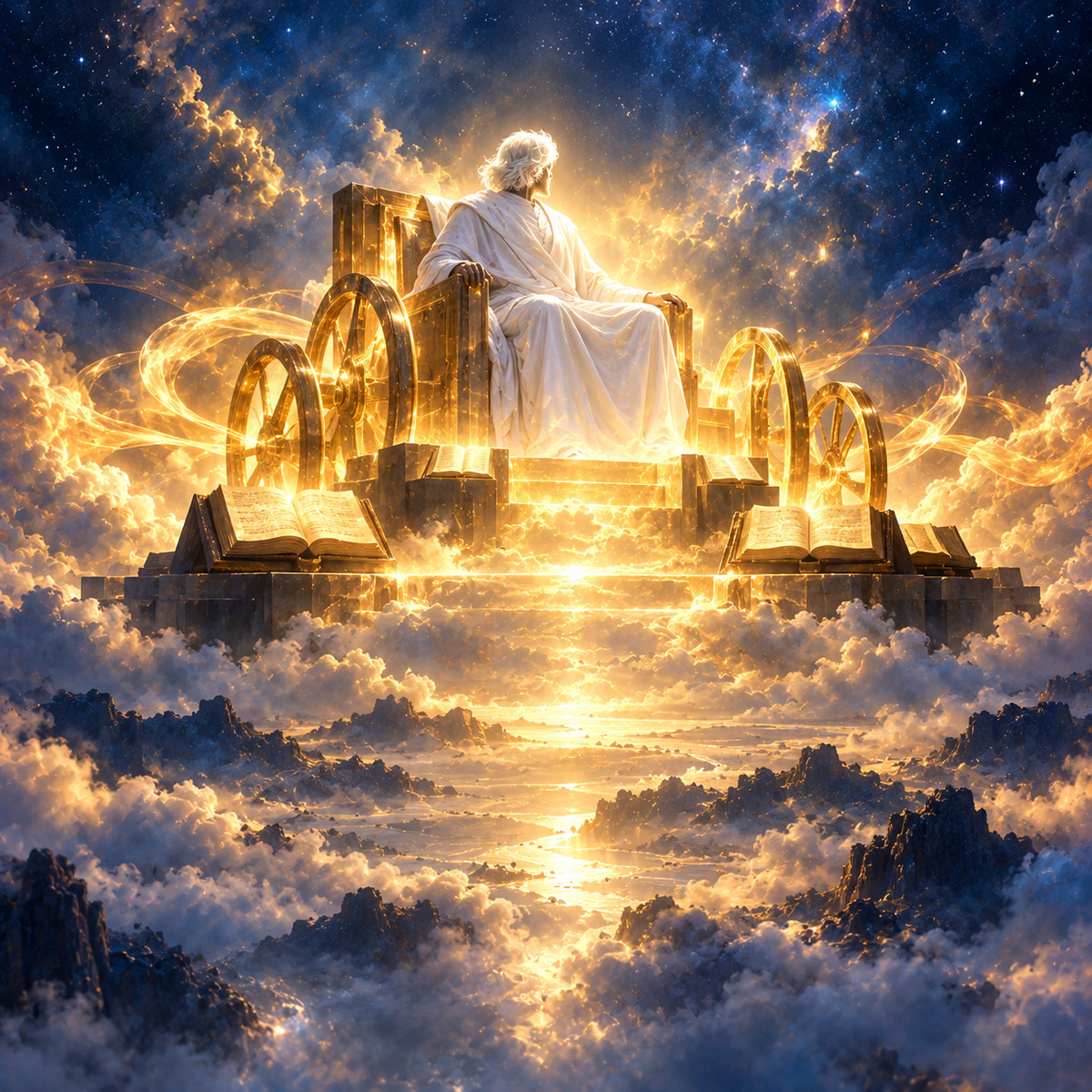
The cover is a modern AI-generated symbolic illustration of throne, fire and books: neither an archaeological object nor a historically verified reconstruction or portrait of God or El. The vision's central claim is that heavenly judgment limits earthly empires; comparisons with older motifs and later religious readings remain meaningful only when the original text and subsequent interpretation are kept distinct.
References and notes (12)
- Book of Daniel, 7:9–10, King James Version (KJV), Bible Gateway; descriptive details compared with the Aramaic displayed by Sefaria. Daniel 7:9–10: white garment, head hair, throne, wheels, fire and books; no beard. Passage examined, not the whole Bible. Return to the text ↑
- Yale Bible Study, “Daniel the Dreamer – Study Guide,” section “Daniel 7,” Yale Divinity School. The published “Daniel 7” section was read, including “Mythic Allusions,” “Interpretation,” and “The Holy Ones of the Most High.” Return to the text ↑
- Daniel 7:9, 13, 22; Aramaic text and English translation on Sefaria, checked for the wording ʿattīq yōmīn. Daniel 7:9, 13 and 22 only: title and distinction from the humanlike figure. Return to the text ↑
- Daniel 7:13–14, 18, 21–22, 26–27, Aramaic text and English translation on Sefaria. Verses on dominion granted to the cloud-borne figure and the holy ones/their people in vision and interpretation. Return to the text ↑
- Carol A. Newsom, “Daniel,” Oxford Bibliographies in Biblical Studies (2010); published introduction only, supplemented by Yale’s Daniel guide. Available “Introduction”: literary strata and dating the apocalypses to the 168–164 BCE crisis; not the entire article. Return to the text ↑
- Ezekiel 1:15–28, King James Version (public-domain translation), Bible Gateway. Verses 15–28 only: wheels, living beings, throne, radiance and fire. Return to the text ↑
- John Day, Yahweh and the Gods and Goddesses of Canaan (2000), pp. 18–19, excerpt reproduced on intertextual.bible alongside KTU 1.3 V; original book not read in full. Reproduced excerpt of pp. 18–19: “Father of Years,” grey-haired El and comparison with Daniel; no direct collation of the Ugaritic tablet. Return to the text ↑
- Babylonian Talmud, Chagigah 14a:4–6, Hebrew passage and English translation on Sefaria. Discussion of old and young imagery, plural thrones, Rabbi Akiva, objections, throne and footstool. Return to the text ↑
- 1 Enoch 46:1–8, R. H. Charles’s English translation on Wikisource; no Ethiopic original was collated. Published English translation of chapter 46: Head of Days and Son of Man and their respective roles. Return to the text ↑
- Peter Schäfer, “The Son of Man–Enoch in the Similitudes of the Ethiopic Book of Enoch,” in Two Gods in Heaven (2020), pp. 45–53; publisher’s abstract only. Publisher abstract only: proposed date around the turn of the era and relationship to Daniel; pp. 45–53 not accessed. Return to the text ↑
- Revelation 1:13–14, King James Version (KJV), Bible Gateway, compared directly with Daniel 7:9, 13. Verses 13–14 only: humanlike figure, white hair, eyes and fire. Return to the text ↑
- British Library, Silos Apocalypse, Add MS 11695, fol. 240 (1109 CE); Wikimedia Commons file description and CC0 declaration. Metadata and preview inspected; original download unsuccessful. File description: Daniel 7:2–10, Petrus, British Library, CC0; preview seen; image not reproduced here. Return to the text ↑
Suggest a correction · Suggest a source for this record
Cite this record
IL Archive, «Ancient of Days», https://ilarchive.com/en/entities/ancient-days
Continue reading