Entity · Religious text
First Enoch
A reference page linking a name, group, or concept to the materials that discuss it.
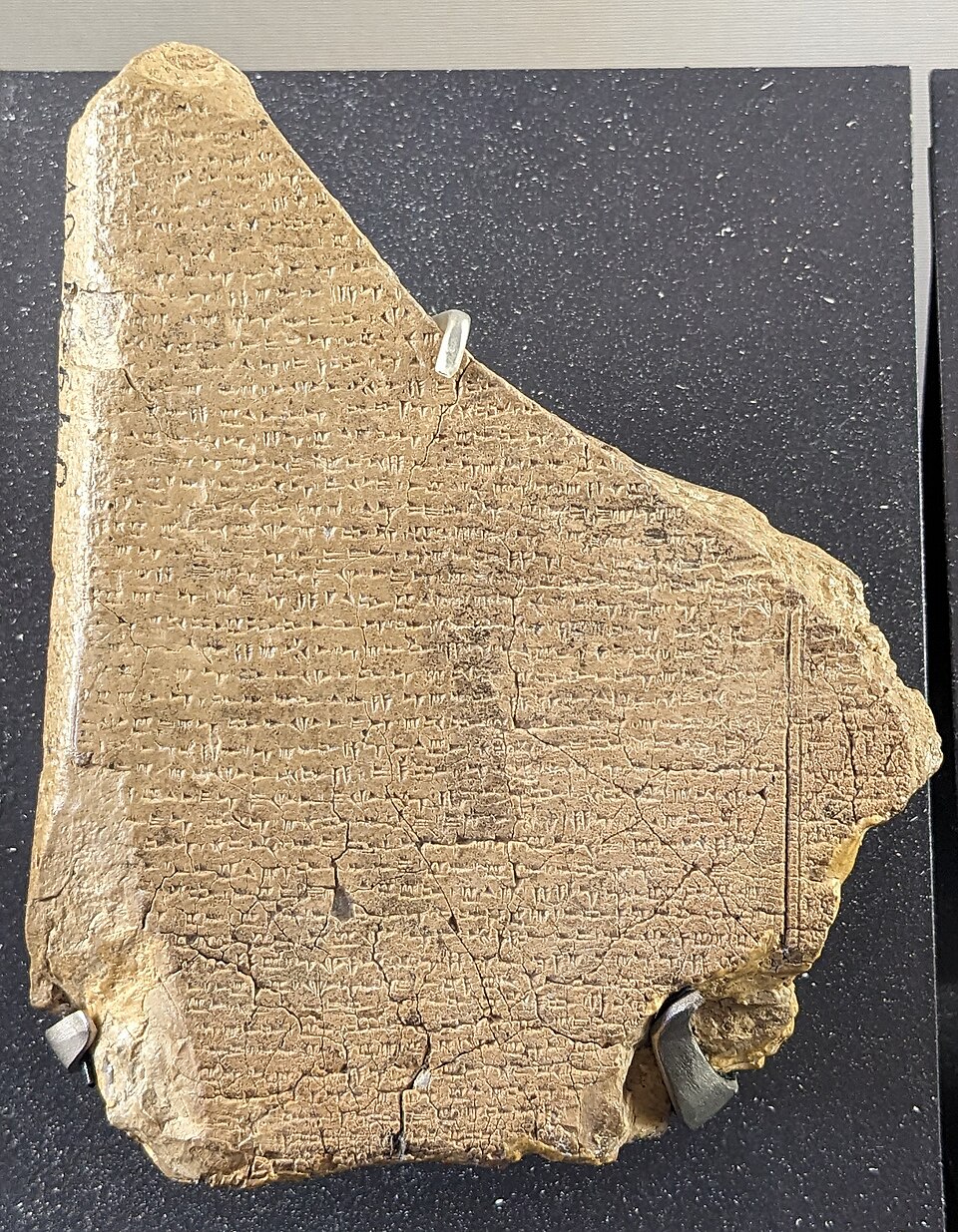
1 Enoch is a multi-layered Jewish apocalyptic collection from the Second Temple period; the entry presents its five divisions, Qumran fragments and Geʽez transmission, and compares the wording of 1 Enoch 1:9 with Jude 14.
Estimated reading time: 9 min Published Last reviewed:
Share article

Text
Introduction
1 Enoch (the First Book of Enoch) is a collection of Jewish apocalyptic writings attributed to Enoch son of JaredEnoch son of JaredEnoch son of Jared is a figure in the genealogy of Genesis 5, seventh when counted from Adam.Glossary · Click to read the explanation, the figure placed before the Flood in the Book of GenesisBook of GenesisHebrew book of the Torah containing Noah’s flood, survival offering and covenant with living creatures.Glossary · Click to read the explanation. It is not a book demonstrably written by that character in the story's time. Rather, literary traditions developed and came together in stages during Second Temple JudaismSecond Temple JudaismDiverse Jewish traditions between the rebuilding of Jerusalem’s temple around 515 BCE and its destruction in 70 CE: institutions, diaspora, groups and texts, with distinctions between events, composition, manuscripts and the limits of evidence.Glossary · Click to read the explanation. This entry introduces its five principal divisions and examines their dates, manuscripts, and transmission from Aramaic and Greek into Geʽez (classical Ethiopic), separating the visions' claims from what surviving evidence can establish. [1][24]
Name, identity, and boundaries
Books written under Enoch's name invoke NoahNoahNoah is the flood-story figure in Genesis and a prophet in the Qur’anGlossary · Click to read the explanation's ancestor who “walked with God” in Genesis 5:21–24 and whom later literature turned into a recipient of heavenly, historical, and judicial mysteries. Attribution within the narrative is a literary claim, not a historical document establishing authorship by someone living before the Flood. “1 Enoch” is a modern designation distinguishing this collection from “2 Enoch”, chiefly transmitted in Old Slavonic, and the later HebrewHebrewA Northwest Semitic language of the Canaanite group, encompassing Iron Age epigraphy, Biblical, Rabbinic, medieval and Modern Hebrew; its scripts and pronunciations changed over time.Glossary · Click to read the explanation work conventionally called “3 Enoch”. These are not additional chapters of one continuous book. [1][24]
The received Geʽez arrangement comprises 108 chapters. Its conventional division into five major parts is useful for orientation, but does not imply that each part is internally uniform or that the collection was assembled at one moment. In particular, chapters 91–108 interweave epistles and exhortations, an apocalypse of history, the story of Noah's birth, and an eschatological ending, each with its own compositional and textual questions. [4]
Five divisions: what is in them?
The Book of the WatchersBook of the WatchersOpening unit of 1 Enoch (chapters 1–36), concerning the Watchers’ descent, offspring and judgment, Enoch’s mission and cosmic journeys; a composite work with multiple textual witnesses.Glossary · Click to read the explanation (1–36). Beginning with a declaration of judgment, it expands the brief account of the “sons of God” and human women in Genesis 6:1–4 into a story of heavenly WatchersWatchersDesignation of a heavenly being in ancient Jewish literature: a holy messenger in Daniel, but a rebellious group in First Enoch. It is not automatically equivalent to demons or giants’ spirits.Glossary · Click to read the explanation who descend to earth. ShemihazahShemihazah: leader of the WatchersShemihazah is a leader of the Watchers in 1 Enoch, associated with their collective oath and binding until judgment.Glossary · Click to read the explanation leads a collective oath on Mount Hermon, and the Watchers father giants with human women; the episode concerning Asael/AzazelAsael / AzazelAsael is a punished angelic teacher in First Enoch; Azazel is a name whose referent in the wilderness rite of Leviticus 16 is disputed. Later traditions connect them, without establishing one unchanging identity across all witnesses.Glossary · Click to read the explanation adds the teaching of harmful knowledge. This is not a verbatim reproduction of Genesis, and its diverse narrative elements need not stem from a single invariant source. [6] After the giants' destruction, chapter 15 explains their surviving spirits as a source of continuing affliction: a particular narrative response to the origins of evil, not a historical report about angels. Chapters 17–36 then follow Enoch's journeys to mountains, the edges of the world, and places of imprisonment and judgment. [7]
The Parables or Similitudes (37–71). Three major visionary discourses concern divine justice, the “Chosen One,” and the “Son of Man” near the “Head of Days”; chapter 46 pictures a righteous figure with power over oppressive kings. There is a clear literary connection to the humanlike figure in DanielBook of DanielA book combining court tales of wisdom and deliverance with visions of kingdoms and the future, formed in stages.Glossary · Click to read the explanation 7, but the identity of the figure at the close of the Parables and the section's editorial history remain disputed. Specialist research generally favors a Jewish origin near the transition from the first century BCE to the first century CE. The absence of this section from known Qumran fragments cannot by itself establish a much later Christian origin. [8][9]
The Astronomical Book (72–82). The angel UrielUrielHebrew name containing “El,” borne by humans in Chronicles and an angel in 1 Enoch and 4 Ezra. Roles vary by text; no Ugaritic divine origin is established.Glossary · Click to read the explanation instructs Enoch about the movements of sun and moon, horizon portals, and seasons in a schematic 364-day year that orders weeks and festivals. Chapter 72:32 states that total explicitly. The “gates” are not a modern astronomical diagram, nor is the Geʽez wording identical to every ancient Aramaic form: research on manuscripts 4Q208 and 4Q209 finds different textual and computational forms within the astronomical tradition itself. [10][11]
The Book of Dream Visions (83–90). Two dreams address the coming Flood and then narrate something resembling Israel's history in the “Animal Apocalypse”: humans, rulers, and peoples appear as bulls, sheep, predators, and birds, while shepherds are made answerable for their treatment of the flock. The horned ram resisting birds of prey in chapter 90 is usually read against the Maccabean struggles of the second century BCE. Yet neither every number nor each symbol can securely be matched to a particular ruler or year; the vision is not a plain chronological register. [12][13]
The Epistle of Enoch and its conclusions (91–108). Moral admonitions and warnings against injustice are interwoven with the “Apocalypse of Weeks,” which divides history into ten symbolic periods. In the received Geʽez sequence its opening is at 93:1–10 and its continuation at 91:11–17. Qumran evidence helps investigate an earlier order without proving the arrangement of every part of the collection. The unusual birth of Noah is narrated in 106–107, followed by an eschatological appendix in chapter 108. Loren Stuckenbruck treats these as distinguishable writings within the final section, not one epistle written at a sitting. [20][21][4]
Narrative time, composition time, and manuscript time
In the story, Enoch lives before the Flood; that is not the date of a chapter's composition. The following dates are approximate, vary by component, and must not automatically be applied to the entire anthology:
- Approximately third–second centuries BCE: early strata of the Watchers and the astronomical traditions are commonly placed in this period, with some components perhaps earlier. Their internal diversity resists a single year of origin. [15]
- Approximately 200–150 BCE: the copying date assigned to the Aramaic parchment 4Q201 in the Library of Congress documentation. It gives a latest possible date for the texts preserved on that copy, not a date for the creation of all of 1 Enoch. [14]
- Second century BCE: portions of the Dream Visions and Epistle are associated with conflicts in Hellenistic Judaea. Identifying the ram's horn in its historical setting is better supported than converting every symbolic detail into a dated event. [13][4]
- Late first century BCE–first century CE: an influential proposed range for the Parables, subject to significant qualifications. Their absence from discovered Qumran fragments is absence from the surviving sample, not conclusive proof that the work did not exist at the time. [9]
- First centuries CE and later: Jude quotes Enoch in the first century CE; scattered Greek leaves survive, including a fourth-century Greek papyrus and a later Greek manuscript of the Watchers. The continuous collection has come down complete in later Geʽez manuscripts. The date of none of these witnesses is automatically the date of the text it transmits. [3][22][16]
What have the languages and manuscripts preserved?
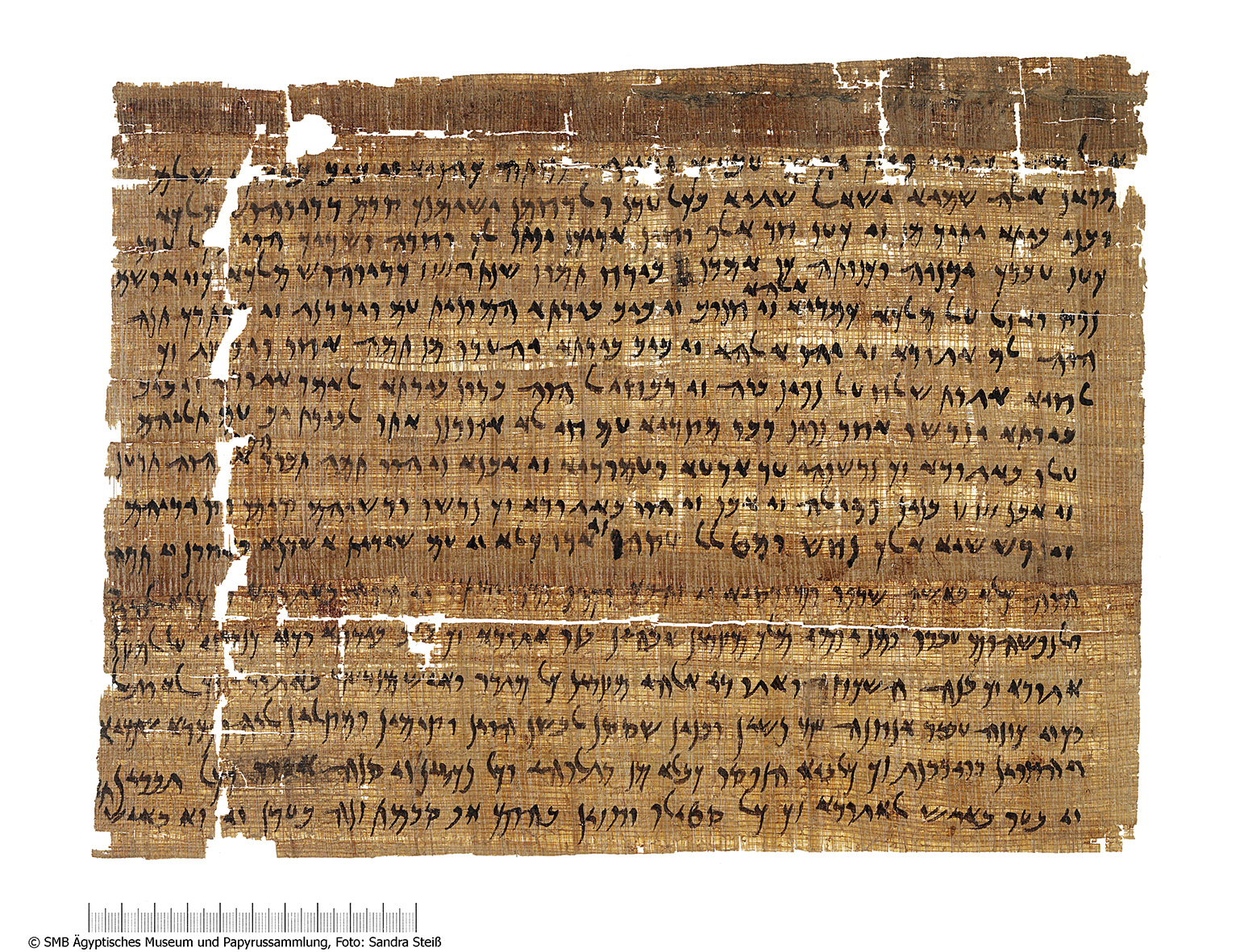
The Dead Sea ScrollsDead Sea ScrollsManuscript collections from the Judaean Desert, best known through Qumran: diverse works, languages and textual forms, with copying distinguished from composition.Glossary · Click to read the explanation from QumranQumranArchaeological site northwest of the Dead Sea near manuscript caves; its settlement and the groups who deposited the scrolls are studied together but not assumed identical. It is not synonymous with all Dead Sea Scrolls.Glossary · Click to read the explanation preserve Aramaic fragments older by centuries than our complete copies. The Library of Congress identifies 4Q201 as parchment copied approximately 200–150 BCE, containing a portion of the Enochic traditions. 4Q204 preserves part of 1:9, but sections of its wording have been reconstructed by comparison with other witnesses. The entire Greek sentence must therefore not be represented as a verbatim surviving Aramaic reading. Nor does the failure to find the Parables among known fragments establish their place or time of composition on its own. [14][15]
Greek witnesses include Codex Panopolitanus (P. Cair. 10759), which preserves much of the Book of the Watchers and is commonly dated to the sixth century CE, as well as papyri of other sections. The complete continuous text underlying the usual chapter division survives in Geʽez, the language of the Ethiopian copying tradition. Its passage into Geʽez probably involved a Greek intermediary; this does not mean every part moved through an identical, unchanging chain. The Garrett Ethiopic 42 manuscript at Princeton illustrates the much later Ethiopian history of copying, rather than supplying a pre-Christian copy. [15][16]
The difficulty extends beyond missing leaves. Comparing 4Q208 and 4Q209 in the astronomical material reveals plurality of texts and calculations, so projecting the present Geʽez formulation backward into a single earliest Aramaic stage requires argument passage by passage. The existence of an ancient fragment does not prove that today's complete Geʽez collection, chapter for chapter and in the same order, already existed when it was copied. [11]
A short textual test: 1 Enoch 1:9 and the Epistle of Jude
Flemming and Radermacher's published Greek edition prints the following expression at 1 Enoch 1:9. It is an edited text of a Greek witness, not an imagined verbatim transcription of the Qumran scroll: [5]
Sense translated: “For he comes with his myriads and his holy ones.” The verse announces judgment against the impious; it is a literary proclamation addressed to humanity, not an event externally witnessed by the text's author.
Jude 14, in Greek, offers wording that is related but not identical: [3]
Sense translated: “Look, the Lord came among his holy myriads.” Jude names Enoch and continues in verse 15 with judgment; this is an explicit quotation. But the shift from “comes” to “came,” from “with” to “among/in,” and the changed expression for the holy ones preclude treating it as a letter-perfect duplicate of the surviving Greek Enoch text. Timothy A. Lee (2025) argues that Jude may have used a Greek revision more closely aligned with Aramaic, comparable in some features to kaige revision. This remains a scholarly hypothesis alongside an author's adaptation or the use of another textual form. The fragmentary, partly restored 4Q204 text cannot on its own settle the cause of the differences. [15]
The dead and resurrection: an example of divergent views
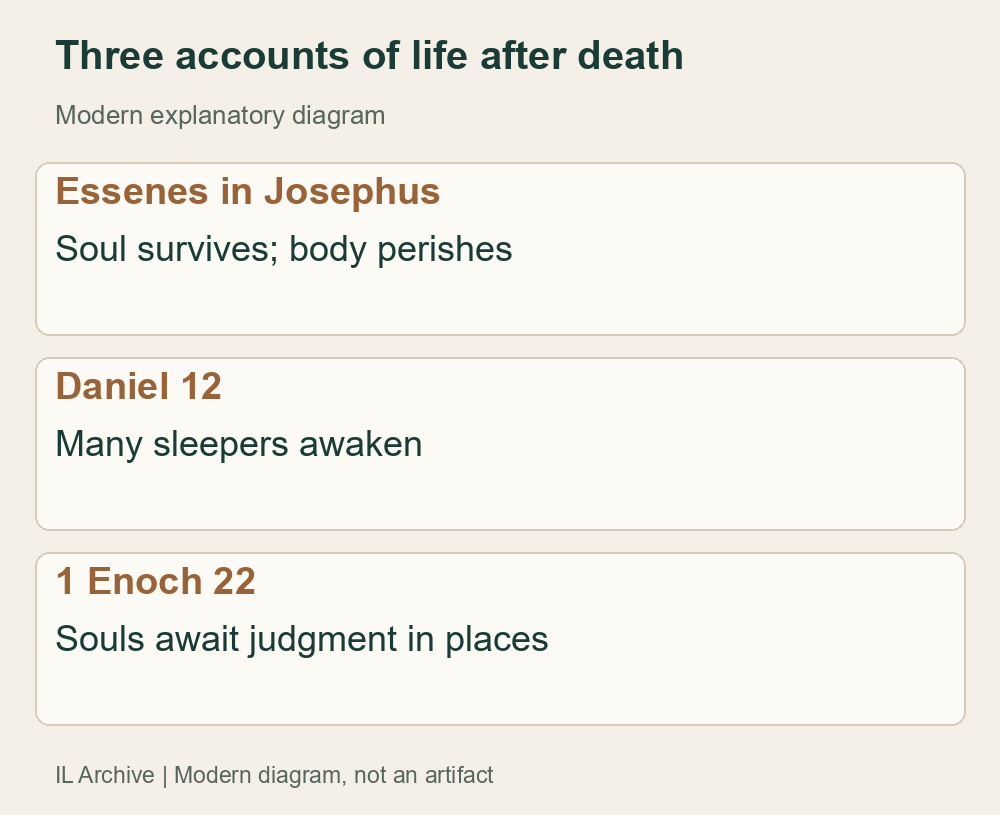
In chapter 22 the angel RaphaelRaphael / RephaelRaphael means “God has healed,” a name borne by a human in Chronicles and an angel in Tobit and 1 Enoch. In Tobit he accompanies the travelling son, helps heal the father and presents prayer before God; in Enoch he executes judgment and explains the places of the dead. Similarity of names does not settle his relationship to Israfil.Glossary · Click to read the explanation leads Enoch to a mountain containing places where the spirits of the dead gather pending judgment. Charles's edition describes four hollows, and its Greek reading marks one as bright and three as dark, with distinctions among the spirits. Yet the edition places Geʽez and Greek readings alongside one another where their details sometimes differ. Not every description should be flattened into a single fixed wording, and this waiting place is not simply the final judgment itself. [2]
This differs from DanielBook of DanielA book combining court tales of wisdom and deliverance with visions of kingdoms and the future, formed in stages.Glossary · Click to read the explanation 12:2, in which many sleeping in the earth's dust “awake,” and from Flavius JosephusFlavius JosephusFirst-century Jewish historian who retold older narratives, including Abraham’s test, in Jewish Antiquities.Glossary · Click to read the explanation's account of EsseneEssenesA Second Temple Jewish movement known especially through Josephus and Philo; evidence supports a Qumran connection without identifying every Essene or manuscript with one uniform community.Glossary · Click to read the explanation beliefs, according to which bodies perish but souls endure. Comparison helps show the diversity of Jewish language about what follows death; it does not establish a single linear development from a cavern of souls to bodily resurrection, and Josephus cannot be made to speak for every Jew. The following figure is a modern editorial comparison, not a diagram copied from an Enoch manuscript. [19][18]
Reception, scriptural standing, and limits of inference
Jude's use of Enoch as prophecy attests the tradition's importance to that author. It does not establish that the complete 108-chapter collection was a universally agreed canon among early Jewish or Christian groups. Conversely, Ethiopian and Eritrean Orthodox Tewahedo biblical traditions include Enoch among their scriptures, unlike most other Jewish and Christian scriptural lists. Circulation, quotation, and inclusion in a particular community's canon are distinct historical questions. [3][17][23]
The historical value of 1 Enoch is not that it verifies the Watchers' descent or accurately maps the physical cosmos. It shows how ancient Jewish writers construed the origins of evil, divine justice, calendrical order, and the story of their people. Manuscripts substantiate particular textual forms and evidence of circulation; rebuilding literary strata or identifying political symbols requires reasoned, revisable judgments. The discussion does not give every hypothesis equal standing, but leaves changes in textual form, differences in component dates, and the limits of the surviving evidence visible to the reader. [1][24][11][13]
References and notes (24)
- Annette Yoshiko Reed, “Angelic Descent and Apocalyptic Epistemology,” in Fallen Angels and the History of Judaism and Christianity, Cambridge University Press, 2005; publisher’s chapter summary only. Chapter 1, printed pp. 24–57; only the publisher summary was read, not those pages Return to the text ↑
- R. H. Charles, The Book of Enoch, public-domain English translation with parallel Greek (Gg) and Ethiopic (E) readings, chapter 22. 1 Enoch 22:1–14, Gg/E variants; printed pp. 48–49 in the display Return to the text ↑
- The Epistle of Jude, verses 14–15; Nestle Greek New Testament (1904) as reproduced by OpenBible; short Greek extract directly from v. 14. Jude 14–15; Greek v. 14 read in Nestle 1904 edition Return to the text ↑
- Loren T. Stuckenbruck, 1 Enoch 91–108: A Commentary, de Gruyter, 2007; publisher overview of its five units only. Publisher’s description of the five components of chapters 91–108; no inaccessible pages claimed Return to the text ↑
- Johann Flemming and Ludwig Radermacher, eds., Das Buch Henoch / Apocalypsis Enochi (Leipzig, 1901), Greek chapter 1 at Perseus. 1 Enoch 1:1–9, especially v. 9; printed Greek critical text, not an Aramaic facsimile Return to the text ↑
- R. H. Charles, The Book of Enoch, chapter VI: Shemihazah, Mount Hermon, and the Watchers’ oath. 1 Enoch 6:1–8; printed p. 35 displayed Return to the text ↑
- R. H. Charles, The Book of Enoch, chapter XV, concerning the spirits of the giants after the death of their bodies. 1 Enoch 15:8–12 in Charles’s translation Return to the text ↑
- R. H. Charles, The Book of Enoch, chapter XLVI, “Head of Days,” “Son of Man,” and the kings. 1 Enoch 46:1–8; printed pp. 64–65 shown Return to the text ↑
- Peter Schäfer, “The Son of Man–Enoch in the Similitudes,” in Two Gods in Heaven (Princeton, 2020); publisher abstract only. Chapter 5, printed pp. 45–53; ABSTRACT ONLY Return to the text ↑
- R. H. Charles, The Book of Enoch, chapter LXXII, solar portals and the year. 1 Enoch 72:1–37, especially 72:32; printed pp. 97–98 shown Return to the text ↑
- Eshbal Ratzon, study of the Aramaic Astronomical Book manuscripts 4Q208 and 4Q209, Revue de Qumrân (2019); publisher abstract only. PUBLISHER ABSTRACT on 4Q208/4Q209 only; full article not read Return to the text ↑
- R. H. Charles, The Book of Enoch, chapter XC: ram, seventy shepherds, and judgment. 1 Enoch 90:6–19 and 90:20–38; displayed printed pp. 126–128 Return to the text ↑
- Antti Laato, “The Chronology in the Animal Apocalypse of 1 Enoch 85–90,” Journal for the Study of the Pseudepigrapha 26/1 (2016), pp. 3–19; ABSTRACT ONLY. Publisher abstract, not the complete printed pp. 3–19 Return to the text ↑
- Library of Congress, “The Qumran Library: Scrolls,” exhibit entry “The Enoch Scroll,” for Aramaic parchment 4Q201. 4Q201 object label: copy date ca. 200–150 BCE and material; 1993 exhibition Return to the text ↑
- Timothy A. Lee, “Jude’s use of a kaige edition of Enochic scripture,” Journal for the Study of the Pseudepigrapha 34/3 (2025), open access; Greek–Aramaic comparison. Introduction, textual comparison incl. 4Q204, discussion of ὅτι/ἰδού and σύν/ἐν, and conclusion Return to the text ↑
- Princeton University Library, “Ethiopic Manuscripts in the Princeton University Library” (2014), institutional discussion of Garrett Ethiopic 42. Garrett Ethiopic 42 manuscript discussion, not a facsimile collation Return to the text ↑
- Eritrean Orthodox Tewahedo Church, Diocese of the USA and Canada, “Canonized Books,” Old Testament list. Old Testament list, item 14: Enoch Return to the text ↑
- Flavius Josephus, Jewish War 2.154–158, Greek text after Benedikt Niese with parallel translations at GreekDoc; Essenes, not Pharisees. Jewish War book II, §§154–158; Greek and aligned versions Return to the text ↑
- Daniel 12:2, Hebrew text at Sefaria, with available translations; compared without extended modern copyrighted quotation. Daniel 12:2, Hebrew verse and displayed translations Return to the text ↑
- R. H. Charles, The Book of Enoch, chapter XCIII, opening of the Apocalypse of Weeks. 1 Enoch 93:1–10; printed p. 133 shown Return to the text ↑
- R. H. Charles, The Book of Enoch, chapter XCI continuation on a separate page, eighth through tenth weeks. 1 Enoch 91:12–17 on the separate page; compositionally follows 93:1–10 Return to the text ↑
- Catalog description for P. Chester Beatty XII, leaf 3 verso, P.Mich.inv. 5552, University of Michigan; fourth-century attribution and public-domain tag; image NOT incorporated. Specific image catalog metadata (identity, institution, date), not a reading of the papyrus text Return to the text ↑
- Ethiopian Orthodox Tewahedo Church, official “The Bible” page, Old Testament list including Enoch at item 14. Official Old Testament book list, item 14 Return to the text ↑
- John C. Reeves, “Enoch, Books of,” Encyclopaedia Iranica VIII/5 (1998; updated 2013), printed pp. 453–455. Full online entry: names, languages, composite nature, distinction from 2 and 3 Enoch Return to the text ↑
Suggest a correction · Suggest a source for this record
Cite this record
IL Archive, «First Enoch», https://ilarchive.com/en/entities/first-enoch
Continue reading