Entity · Figure
Raphael / Rephael
A reference page linking a name, group, or concept to the materials that discuss it.
Raphael means “God has healed”: a human name in Chronicles and an angelic name in Tobit and 1 Enoch. This entry examines healing, mediation and textual differences, distinguishing them from later art and from Israfil.
Estimated reading time: 5 min Published Last reviewed:
Share article
Text
Introduction
Raphael’s name evokes healing, but a shared name does not make all its bearers one figure. This entry distinguishes a human name in the HebrewHebrewA Northwest Semitic language of the Canaanite group, encompassing Iron Age epigraphy, Biblical, Rabbinic, medieval and Modern Hebrew; its scripts and pronunciations changed over time.Glossary · Click to read the explanation Bible from the angel who helps a family in Tobit, then follows his roles in 1 EnochFirst EnochA composite Second Temple Jewish apocalyptic collection on the Watchers, parables, celestial cycles, historical visions, and judgment, preserved complete in Geʽez.Glossary · Click to read the explanation and his portrayal in art. The question is what the evidence says about the name and its bearer’s functions, rather than what similarity of names alone might suggest.
A name borne by a human and an angel
Raphael, Hebrew רְפָאֵל, is a theophoric nameTheophoric nameA personal name including a deity’s name or another divine element, often as part of a short sentence or invocation, interpreted in its original language and context.Glossary · Click to read the explanation: a name containing a divine element. It combines the healing root r-p-ʾ with El, meaning “God has healed.” In 1 Chronicles 26:7, Rephael is a son of Shemaiah in a family of Temple gatekeepers: a human in a genealogical and occupational setting, not an appearance of the angel. Some English translations use Rephael here and Raphael for the angel. This spelling distinction helps readers distinguish the bearers; it does not establish two separate etymologies.[1][2]
Raphael in the story of Tobit
The Book of TobitBook of TobitJewish story of a family in Assyria, combining adversity, prayer, journey and almsgiving, and naming Ahiqar.Glossary · Click to read the explanation is a Jewish tale of adversity, prayer, travel and healing. Its events unfold in the world of Assyrian exile, whereas the New American Bible introduction places its probable composition in the early second century BCE. The story’s setting is not its date of composition.[5]
In the narrative, TobitTobit, father of TobiasThe father healed of blindness in Tobit, not the traveling son.Glossary · Click to read the explanation is the father who has lost his sight, TobiasTobias, son of TobitThe traveling son in Tobit and Sarah’s husband; he treats his father under Raphael’s guidance.Glossary · Click to read the explanation his travelling son, and Sarah daughter of RaguelSarah daughter of Raguel in TobitTobias’s wife in the narrative, not Sarah the wife of Abraham.Glossary · Click to read the explanation the woman whose previous husbands were killed by the demon Asmodeus. Raphael is sent in answer to Tobit’s and Sarah’s prayers to heal them, and accompanies the son on his journey.[6] He instructs Tobias to keep a fish’s heart, liver and gall: the heart and liver are used to repel the demon, the gall to treat the father’s eyes.[7] When Asmodeus flees, Raphael pursues and binds him; on returning home, the son treats his father under the angel’s guidance.[8][9] These are actions within the story, not a medical report or a remedy to follow.
Before the family recognizes an angel, he introduces himself in 5:13 as Azarias (Azariah), son of Hananias, one of their relatives. The reader knows his identity from 5:4, while the family accepts him as a hired human guide; the revelation in chapter 12 therefore changes their understanding of the preceding journey.[13]
At the end, Raphael reveals his identity, recalls presenting Tobit’s and Sarah’s prayer before God, and identifies himself as one of seven angels. He attributes his actions to God’s will rather than an independent initiative. His role combines companionship, healing and mediation.[3]
Why specify the textual form?
Tobit survives in different Greek forms. A New English Translation of the SeptuagintSeptuagintA name for the varied ancient Greek translations and writings associated with Jewish scripture; beginning with the Torah, the texts differ across books and manuscripts.Glossary · Click to read the explanation (NETS) distinguishes a shorter version, G I, from a longer G II, represented chiefly by the fourth-century CE Greek Codex Sinaiticus. Tobit 12:15 displays their difference in the description of the seven angels. These are excerpts, not the complete verse:[3][14]
- G I: οἳ προσαναφέρουσιν τὰς προσευχὰς τῶν ἁγίων, “who present the prayers of the holy ones.” The text then mentions their entry before the Holy One’s glory.
- G II: οἳ παρεστήκασιν καὶ εἰσπορεύονται ἐνώπιον τῆς δόξης κυρίου, “who stand and enter before the glory of the Lord.”
The Greek is taken from an electronic presentation of Rahlfs’s text; the second excerpt’s wording was also checked against the Codex Sinaiticus project’s transcription of folio 37.8v. We display edited, accented spelling, not the parchment’s letterforms or abbreviations. Raphael’s presentation of prayer occurs in 12:12 in both versions. The difference at 12:15 therefore neither removes mediation from the longer narrative nor warrants conflating every witness into one wording.[3][14][15]
Earlier witnesses support preference for a longer underlying text: Qumran Cave 4 yielded four fragmentary Aramaic copies of Tobit and one Hebrew copy, dated by Fitzmyer, as reported by Di Lella, to approximately 100 BCE–50 CE. They generally agree with G II, not with every letter of it; the Old Latin’s relationship to the longer text provides further support. Di Lella and the scholarly majority he describes therefore favor G I as an abridgment and reworking, while acknowledging defenders of its priority, including Deselaers and Gross. This is an argument from witnesses and narrative structure, not a vote between equally supported versions or a claim that Sinaiticus has no scribal errors. The date range concerns Qumran copies, not the story’s composition or a complete surviving copy of 12:15.[3]
Healing and judgment in 1 Enoch
1 EnochFirst EnochA composite Second Temple Jewish apocalyptic collection on the Watchers, parables, celestial cycles, historical visions, and judgment, preserved complete in Geʽez.Glossary · Click to read the explanation is a collection of Jewish apocalyptic writings: revelations concerning the heavenly world and judgment. The editors of the Hermeneia translation date the probable present form of its Book of the WatchersBook of the WatchersOpening unit of 1 Enoch (chapters 1–36), concerning the Watchers’ descent, offspring and judgment, Enoch’s mission and cosmic journeys; a composite work with multiple textual witnesses.Glossary · Click to read the explanation to the middle or late third century BCE.[10] In 10:4–8 Raphael is ordered to bind AsaelAsael / AzazelAsael is a punished angelic teacher in First Enoch; Azazel is a name whose referent in the wilderness rite of Leviticus 16 is disputed. Later traditions connect them, without establishing one unchanging identity across all witnesses.Glossary · Click to read the explanation, the rebellious angel associated with teaching evil, and heal the earth. In 22:1–4 he explains to the visionary EnochEnoch son of JaredEnoch son of Jared is a figure in the genealogy of Genesis 5, seventh when counted from Adam.Glossary · Click to read the explanation, to whom the writings are attributed, where the dead await judgment. Healing here extends to a damaged world, and Raphael also interprets its hidden geography; these are not episodes from Tobit.[11]
Composition must be distinguished from transmission. The Hermeneia editors describe Aramaic remains from Qumran and Greek portions in two manuscripts of the fourth and fifth/sixth centuries CE; one of their textual ranges is 1:1–32:6, which includes the passages discussed here. The complete collection survives in Geʿez; the Ethiopic manuscripts available to scholars described in the introduction date from the fifteenth–twentieth centuries. Late copies do not automatically imply late composition, but explain why the critical translation compares languages and uneven witnesses rather than a complete surviving Aramaic original.[10]
Later art and the limits of comparison
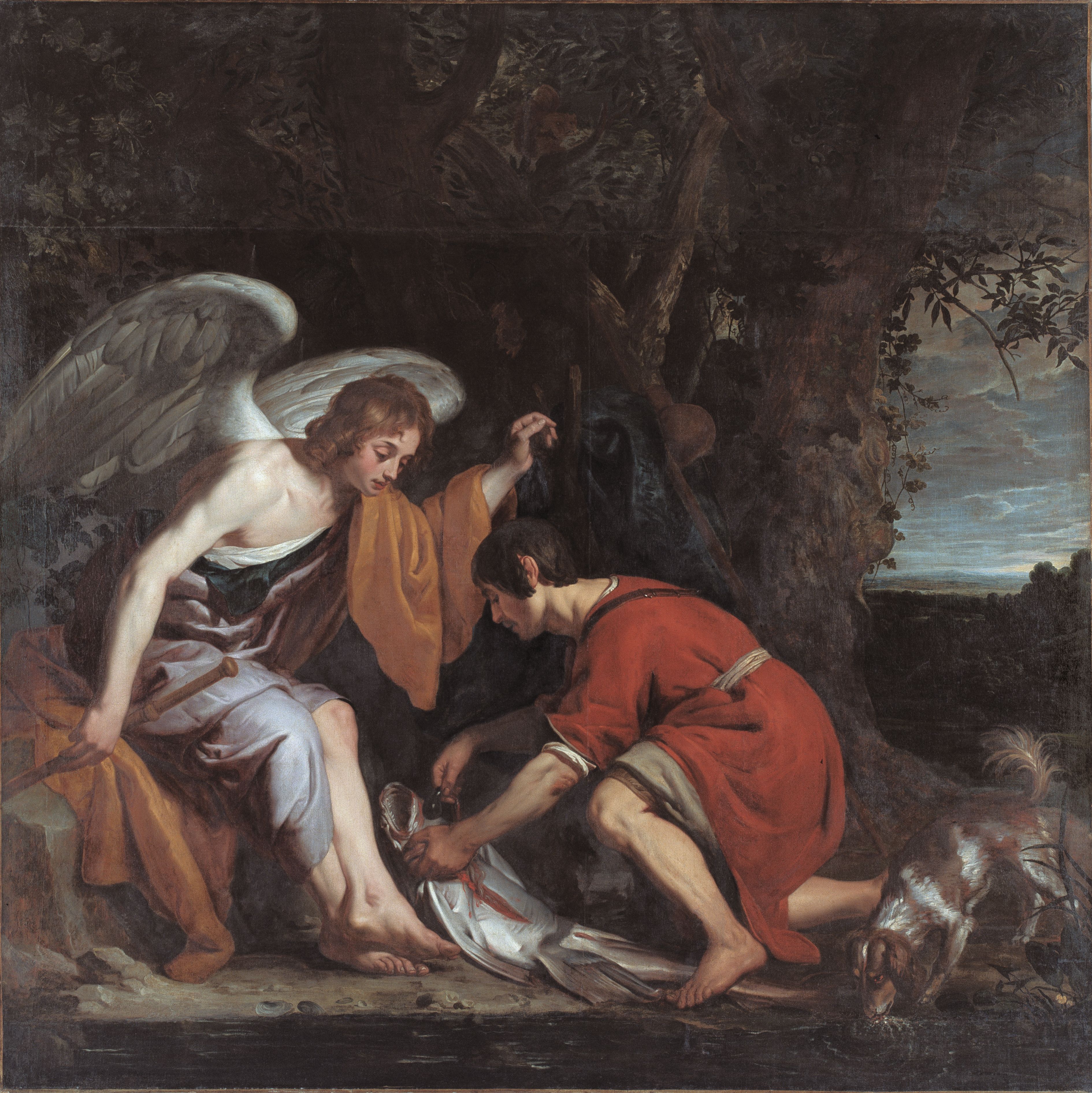
Gaspar de Crayer’s painting Tobias and the Angel, about 1618, shows Raphael beside Tobias as the young man cuts open the fish. It is a much later European artistic reading of the story, not an ancient image of the angel or documentation of the event.[12]
Israfil, by contrast, is known in Islamic tradition for sounding the trumpet at the resurrection. The Turkish Encyclopaedia of Islam notes that his name does not occur explicitly in the QuranThe QuranThe central scripture of Islam, consisting of 114 Arabic surahs; its study distinguishes Quranic discourse from manuscript history, reading traditions, and historical inference.Glossary · Click to read the explanation and that its origin is uncertain. Raphael should not automatically be renamed Israfil, and resemblance of names alone cannot settle their historical relationship.[4] Likewise, El in Raphael establishes the name’s structure; by itself it does not show that the angel was once an independent deity.
References and notes (15)
- Strong and Brown–Driver–Briggs, רְפָאֵל, entry 7501, reproduced on Bible Hub. Lexical sections: formation, meaning and human bearer; not the added devotional commentary. Return to the text ↑
- 1 Chronicles 26, Hebrew text and Jewish Publication Society translation (1917), Mechon-Mamre. 26:1–8, especially v.7: Rephael son of Shemaiah in the gatekeepers’ genealogy. Return to the text ↑
- Alexander A. Di Lella, “Tobit,” A New English Translation of the Septuagint (NETS), 2007; file revised in 2009. Pp.456–458: introduction to the Greek forms; pp.473–474: 12:1–22 in G II and G I, especially 12:12–15,18. Translations of edited texts, not a direct reading of all manuscripts. Return to the text ↑
- Lütfullah Cebeci, “İsrâfil,” TDV İslâm Ansiklopedisi 23 (2001), pp.180–181, electronic entry. Definition and opening paragraphs on Israfil’s function, absence of his name from the Quran and uncertain etymology. Return to the text ↑
- New American Bible Revised Edition, introduction to Tobit, USCCB. Paragraphs on probable composition, narrative setting and literary form; the date is the introduction’s estimate, not a certainty. Return to the text ↑
- Tobit 3, New American Bible Revised Edition, USCCB. 3:7–17: Sarah, Asmodeus, the two prayers and Raphael’s mission. Return to the text ↑
- Tobit 6, New American Bible Revised Edition, USCCB. 6:2–9,16–18: the fish and instructions, using this translation’s numbering. Return to the text ↑
- Tobit 8, New American Bible Revised Edition, USCCB. 8:1–8: expulsion and binding of the demon, and the couple’s prayer. Return to the text ↑
- Tobit 11, New American Bible Revised Edition, USCCB. 11:1–15: return and restoration of the father’s sight; the son applies the treatment under Raphael’s guidance. Return to the text ↑
- George W. E. Nickelsburg and James C. VanderKam, 1 Enoch: The Hermeneia Translation, revised edition, Fortress, 2012, Introduction. Pp.1–3: composition of the collection, the Book of the Watchers and the probable date of its present form. P.13, Translation: languages, witness dates and limits of the Aramaic remains. Return to the text ↑
- Nickelsburg and VanderKam, 1 Enoch: The Hermeneia Translation, 2012, publisher’s Book of the Watchers excerpt. 10:4–8, p.28; 22:1–4, p.42; also 9:1–11,20:1–8 and the context of chapter 22. Critical translation combining witnesses, not one manuscript’s text. Return to the text ↑
- Museum of Fine Arts Ghent, Gaspar de Crayer, Tobias and the Angel, c.1618, S-13. Object record: artist, date and subject; published image and IIIF manifest 6328. Return to the text ↑
- Tobit 5, NABRE, USCCB; compare both NETS versions. 5:4–15, especially 13: assumed identity Azariah; note on 5:4. Return to the text ↑
- Alfred Rahlfs, Septuaginta (1935), Greek text displayed by The Koine Bible. 12:12,15, G I; G II: https://www.thekoinebible.com/text/rahlfs/tobit-sinaiticus-recension/12.html . Greek excerpts independently translated, not the site’s English rendering. Return to the text ↑
- Codex Sinaiticus project, electronic transcription of Tobit. Quire 37, folio 8 verso; Tobit 12:12–15. Electronic transcription wording checked, not an independent palaeographical collation of the parchment image. Return to the text ↑
Suggest a correction · Suggest a source for this record
Cite this record
IL Archive, «Raphael / Rephael», https://ilarchive.com/en/entities/raphael
Continue reading