Study
The Sent-Away Goat: Leviticus and Ancient Rites of Removing Evil
An extended study of a topic, with evidence and references.
How does a rite transfer sins or impurity to a bearer sent away? Leviticus, Samuha, and Ambazzi, the argument for shared Syro-Anatolian tradition, and later interpretations of the goat and Azazel.
Estimated reading time: 9 min Published Last reviewed:
Share article
Text
Introduction
How did a goat sent into the wilderness become the bearer of a community’s sins? How does this rite in LeviticusLeviticusA Torah book concerning offerings, priesthood, and purity; chapter 16 describes sanctuary purification and a living goat carrying iniquities away.Glossary · Click to read the explanation relate to practices of removing evil among the HittitesHittitesAncient people and kingdom of Anatolia, dominating much of Anatolia and northern Syria around 1650–1200 BCE.Glossary · Click to read the explanation and across AnatoliaAnatoliaAnatolia is the region occupying the Asian part of present-day TurkeyGlossary · Click to read the explanation and the LevantThe LevantThe Levant is a regional name for lands along the eastern MediterraneanGlossary · Click to read the explanation? This study compares actions, words, and purposes in each witness, examines the argument for a shared ritualRitualAn organised or distinguished practice meaningful to a community; it may leave traces, but its form alone does not reveal an associated doctrine.Glossary · Click to read the explanation tradition, and follows changing interpretations of the goat and Azazel.
We distinguish second-millennium BCE Hittite copies, biblical instructions whose priestly layers are variously dated, the Mishnah compiled around 200 CE, and Christian interpretation from the late first or early second century CE. This sequence identifies the source of each detail: live dispatch, the crimson strip, the cliff, and the goat interpreted as Christ. [1][3][4][9][10][11][12][15]
One image, witnesses from different periods
The goat carrying sins is a familiar image, but it sometimes combines details from distant sources. Leviticus has a goat sent alive into the wilderness; the Mishnah adds a crimson strip and cliff; Enochic literature presents a figure named Azazel associated with corruption and punishment. Identifying each detail’s source helps trace the image’s formation and changes.
The comparative question concerns transferring iniquity or impurity to a bearer removed from the community. The bearer may be an animal or a small object; accompanying words and destination differ. Each procedure therefore needs its context before being grouped with others.
Two goats performing different tasks
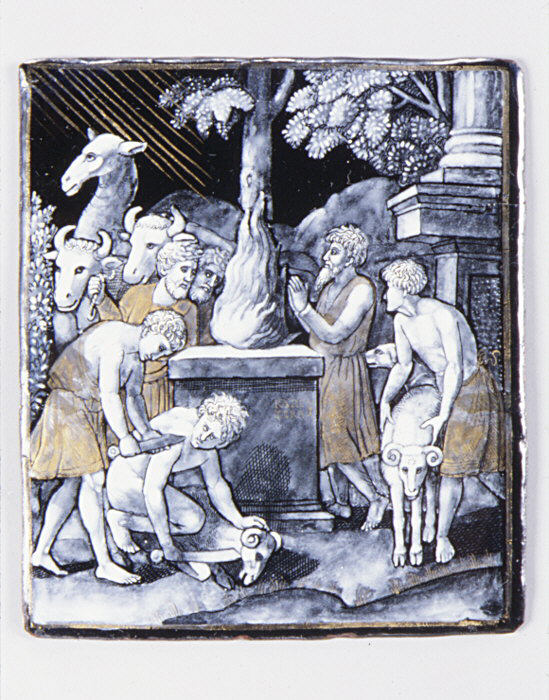
Leviticus 16 connects instructions for entering sacred space with the deaths of two sons of AaronAaron, priest in the biblical narrativeMoses’s brother and a priest in biblical narrative; Leviticus 16 assigns him sanctuary purification and confession over the living goat.Glossary · Click to read the explanation, the priest and MosesMosesCentral figure in Exodus, Torah traditions and the Qur’an; childhood accounts differ in detail.Glossary · Click to read the explanation’s brother in the biblical narrative. It regulates his entry behind the curtain. A bull concerns Aaron and his household, and two goats are assigned by lot alongside other offerings: one falls to YHWHYahwehThe proper name of Israel’s deity, written יהוה (YHWH), the Tetragrammaton. Its exact ancient pronunciation is not directly preserved; texts and inscriptions witness its history.Glossary · Click to read the explanation, the other to Azazel. [1]
The goat for YHWH is slaughtered, and its blood helps purify the sanctuary from Israel’s impurities, transgressions, and sins. The other remains alive. After purifying the sanctuary, tent of meeting, and altar, Aaron puts both hands on its head, confesses the community’s sins, and a designated man sends it into the wilderness. The goat carries the iniquities to a cut-off land. [1]
The sequence combines purification of sacred space with removal of what the living goat carries. Pushing it from a cliff belongs to the later Mishnaic account. The chapter’s ending connects the occasion to the tenth day of the seventh month, self-affliction, and abstention from work: this is the setting of the Day of AtonementYom Kippur — Day of AtonementJewish observance on 10 Tishrei; Leviticus 16’s sanctuary purification and two-goat rite are distinct from later Mishnaic accounts and from fasting, prayer and repentance.Glossary · Click to read the explanation in these instructions. [1]
Scholars differ over the date of the priestly layers to which this text belongs. Some place material before the Babylonian exileBabylonian exileJudean deportations to Babylonia and the kingdom’s collapse in the early sixth century BCE; several phases, not everyone removed or returned at once.Glossary · Click to read the explanation of the sixth century BCE; others see its completed formulation in the exile or early Persian period. Composition and editorial history are distinct from the time in which the instructions are placed in Moses’s mouth. [15]
What is transferred to the animal?
Confession, placing iniquities on the goat’s head, and carrying them away are explicit features of the ritual account. The animal acts as bearer: the purpose is to remove sins from the community’s sphere, rather than make it morally responsible for human behavior. [1]
This aspect is called ritual removalRitual removalAnalytical term for expelling impurity, harm, or ominous danger from a protected domain; it does not equate transfer, expulsion, slaughter, and destruction.Glossary · Click to read the explanation: taking what is considered harmful out of a place or community needing purification. The term helps compare curses, harmful speech, and impurity in other texts, while preserving differences between those categories.
Crossing outward and returning also have conditions. The goat’s sender washes clothes and body before entering the camp, as does the person burning the slaughtered animals’ remains outside. The instructions connect spatial movement with ritual condition, clarifying relations between community, sacred space, and the outside. [1]
The bird returning to the field
Leviticus 14 offers a comparison within the TorahTorah / PentateuchThe first five books of the Jewish and Christian Bible: Genesis, Exodus, Leviticus, Numbers and Deuteronomy. They combine narrative and law from creation to Moses’ death; in Jewish usage, “Torah” can also encompass a wider body of authoritative teaching.Glossary · Click to read the explanation itself. Purifying a person after an affliction has healed involves two living clean birds. One is killed over living water in an earthen vessel; the other, with additional materials, is dipped in its blood and released into the field after sprinkling. A related arrangement recurs for purifying a house. [2]
Like the goats, this procedure combines a killed animal and another released alive outside. Its details differ: the living bird touches blood, whereas Leviticus 16 describes two hands and communal confession over the goat’s head. The comparison reveals varied procedures within the biblical collection.
The affliction is called ṣaraʿat, a category occurring in contexts of bodies, houses, and garments. Its older translation as “leprosy” does not itself identify a particular modern disease. Our concern here is the text’s classification of purity and affliction and the procedure following recovery. [2]
Anatolia: animals and a boat carrying harm away
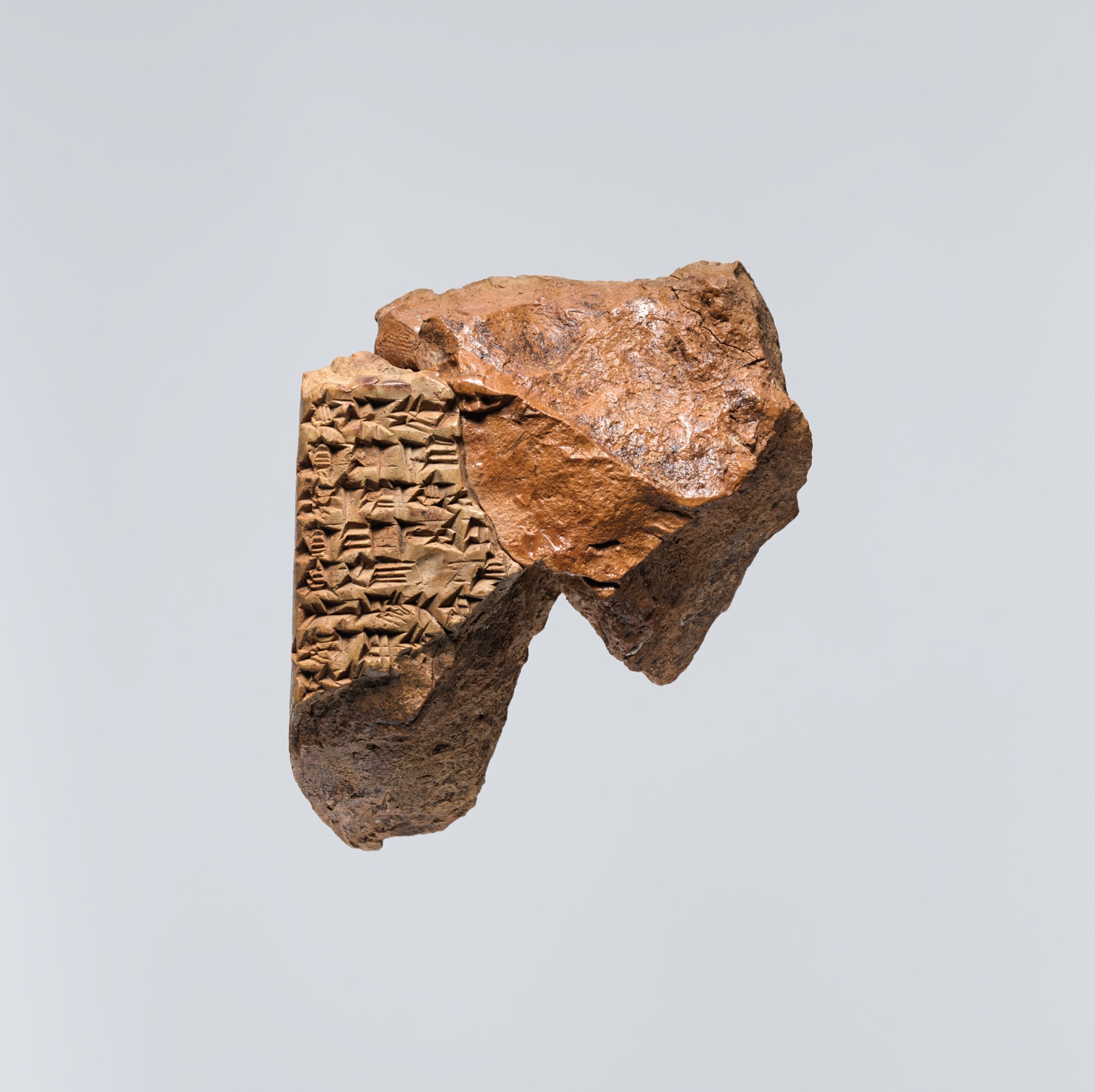
The Hittite Samuha ritualSamuha purification ritualA Hittite purification text, CTH 480.1, removing harmful speech, curse, and impurity by boat and animals in temple and royal contexts.Glossary · Click to read the explanation, catalogued as CTH 480.1, describes removing harmful speech, false oaths, curses, and impurity. It concerns temple, king, and queen and is preserved in Hittite textual traditions from the second half of the second millennium BCE. [3][5]
Small objects representing oath and curse are put in a boat carried into the river. The accompanying words compare the river’s removal of the boat to harm disappearing without return. Animals are then released as substitutes carrying what afflicted the sacred sphere. The rite combines different means of removal and includes purification of the deity and royal beneficiaries. [3]
In the Ambazzi ritualAmbazzi ritual of removing harmA Hittite rite attributed to a female ritual expert, CTH 391.1; tin passes from beneficiaries to a mouse released to carry harm away.Glossary · Click to read the explanation, CTH 391.1, tin is bound to the beneficiaries with a bowstring, then transferred to a mouse released far away to carry the harm. The edition’s introduction distinguishes a New Hittite copy from linguistic traditions probably reaching back to the Middle Hittite period. The copy’s date therefore does not alone establish the practice’s beginnings. [4]
Noga Ayali-DarshanNoga Ayali-DarshanA scholar of Semitic languages and ancient Near Eastern myth; her 2020 essay examines Syro-Anatolian evidence for the sent-away goat rite.Glossary · Click to read the explanation, a scholar of Semitic languages and ancient Near Eastern myth, reads words accompanying the mouse’s release as presenting it to the divine powers named, alongside its role as a bearer of evil. The edition’s introduction outlines a larger rite with multiple offerings. Transfer and removal remain the comparison’s basis, while animals, materials, and beneficiaries differ from the communal confession in Leviticus. [4][5]
The argument for a shared ritual tradition
Ayali-Darshan argues that the distribution of these practices supports an inherited Syro-Anatolian tradition. She distinguishes this from assuming direct Israelite borrowing from a particular Hittite text. Her evidence includes a rite from the archives of EblaEblaAncient city at Tell Mardikh, southwest of Aleppo, Syria. Its Palace G archives illuminate third-millennium BCE administration, language, and cult; the site has later occupation phases.Glossary · Click to read the explanation in the twenty-fourth century BCE, followed by second-millennium texts. The Ebla example is presented here through her quotation and study. [5]
Her argument rests on the procedure’s distribution and its combination of transferring harm to a living bearer and sending it into an uninhabited sphere. She also gives a reading of KTU 1.127 from UgaritUgaritAncient city and kingdom at Ras Shamra on the Syrian coast, flourishing between the fourteenth and early twelfth centuries BCE and preserving multilingual archives.Glossary · Click to read the explanation in which people lead a goat away during danger; her footnote records an alternative rendering of the verb as “see afar.” This witness’s interpretation remains part of the discussion rather than an agreed translation. [5]
Converging evidence can support inherited tradition or regional transmission without a named carrier at every step. Dating witnesses and comparing words, actions, and circulating settings makes the argument more precise. Calling all this a “Babylonian origin” would obscure the different locations and languages of Anatolian, Levantine, and Mesopotamian witnesses.
Azazel between text and interpretation
Azazel occurs in the lots and the goat’s dispatch without biography, appearance, or genealogy in Leviticus 16. The parallel between what belongs to YHWH and Azazel leads some scholars to favor a wilderness being; other readings concern place, removal, or the sent-away animal. [1][6]
Anna AngeliniAnna AngeliniA scholar of Greek literature and ancient religious imagery, including the demonic in the Septuagint and interpretations of Azazel.Glossary · Click to read the explanation, a scholar of Greek literature and religious imagery in the SeptuagintSeptuagintA name for the varied ancient Greek translations and writings associated with Jewish scripture; beginning with the Torah, the texts differ across books and manuscripts.Glossary · Click to read the explanation, argues for a divine and then demonic dimension and traces changing reception. Conversely, the publisher’s description of Judit M. BlairJudit M. BlairA Hebrew Bible scholar whose 2009 book examines terms such as Azazel without presupposing demonic identities.Glossary · Click to read the explanation’s De-Demonising the Old Testament presents her challenge to presupposed demonic identities for certain terms. Our account of Blair’s position rests on that description rather than the whole book. [6][7]
In First EnochFirst EnochA composite Second Temple Jewish apocalyptic collection on the Watchers, parables, celestial cycles, historical visions, and judgment, preserved complete in Geʽez.Glossary · Click to read the explanation 10, in the Charles translation used here, God commands RaphaelRaphael / RephaelRaphael means “God has healed,” a name borne by a human in Chronicles and an angel in Tobit and 1 Enoch. In Tobit he accompanies the travelling son, helps heal the father and presents prayer before God; in Enoch he executes judgment and explains the places of the dead. Similarity of names does not settle his relationship to Israfil.Glossary · Click to read the explanation to bind AzazelAsael / AzazelAsael is a punished angelic teacher in First Enoch; Azazel is a name whose referent in the wilderness rite of Leviticus 16 is disputed. Later traditions connect them, without establishing one unchanging identity across all witnesses.Glossary · Click to read the explanation under rocks in the wilderness, associating him with the world’s corruption and punishment. The narrative presents a more defined character, and wilderness, rocks, and bearing sins invite comparison with Leviticus’s rite. [8]
Angelini reads the Enochic narrative as interpretive background for Azazel’s presence in the wilderness. We distinguish that reading from the rite’s age: a later narrative can explain an earlier text’s reception without alone dating the beginnings of all its details. [6]
The crimson strip and cliff in the Mishnah
The MishnahMishnahThe Mishnah is a rabbinic compilation assembled around 200 CE, organizing teachings and discussions by topic.Glossary · Click to read the explanation, a collection of Jewish instructions and discussions compiled around 200 CE, mentions a crimson strip at the sent-away goat’s head in Yoma 4:2. In Yoma 6:6 it is divided between a rock and the goat’s horns; the animal is pushed backward from the cliff, its limbs coming apart during the fall. [9][10]
The collection preserves traditions about earlier worship. Its compilation date differs from the age of each practice described, while cliff and strip expand on Leviticus’s live-dispatch instructions. That expansion can be studied as a history of practice, memory, and organization.
It also helps distinguish the “sent-away goat” from the modern metaphor “scapegoat.” The latter can designate a person blamed for others’ actions; ritual witnesses instead specify the animal, its burden, departure, and fate.
Christian interpretation and a nineteenth-century image
Chapter seven of the Epistle of BarnabasEpistle of BarnabasAn early Christian text usually placed in the late first or early second century CE; chapter 7 interprets the two goats as figures of Christ.Glossary · Click to read the explanation reads both goats as figures of ChristJesus ChristJesus Christ is Christianity’s central figure, who lived in the first century CEGlossary · Click to read the explanation, connecting humiliation, crimson coloring, and suffering with the passion and later appearance. The relationship is declared within the source: the author offers a Christian interpretation of ritual details. [11]
The epistle is generally placed in the late first or early second century CE, with disagreement over precise date and place; it differs from the later Gospel of Barnabas. Its account belongs to an ancient Christian dispute over interpreting the law, and can be read beside Leviticus and the Mishnah as evidence for reception and changing meaning. [12]
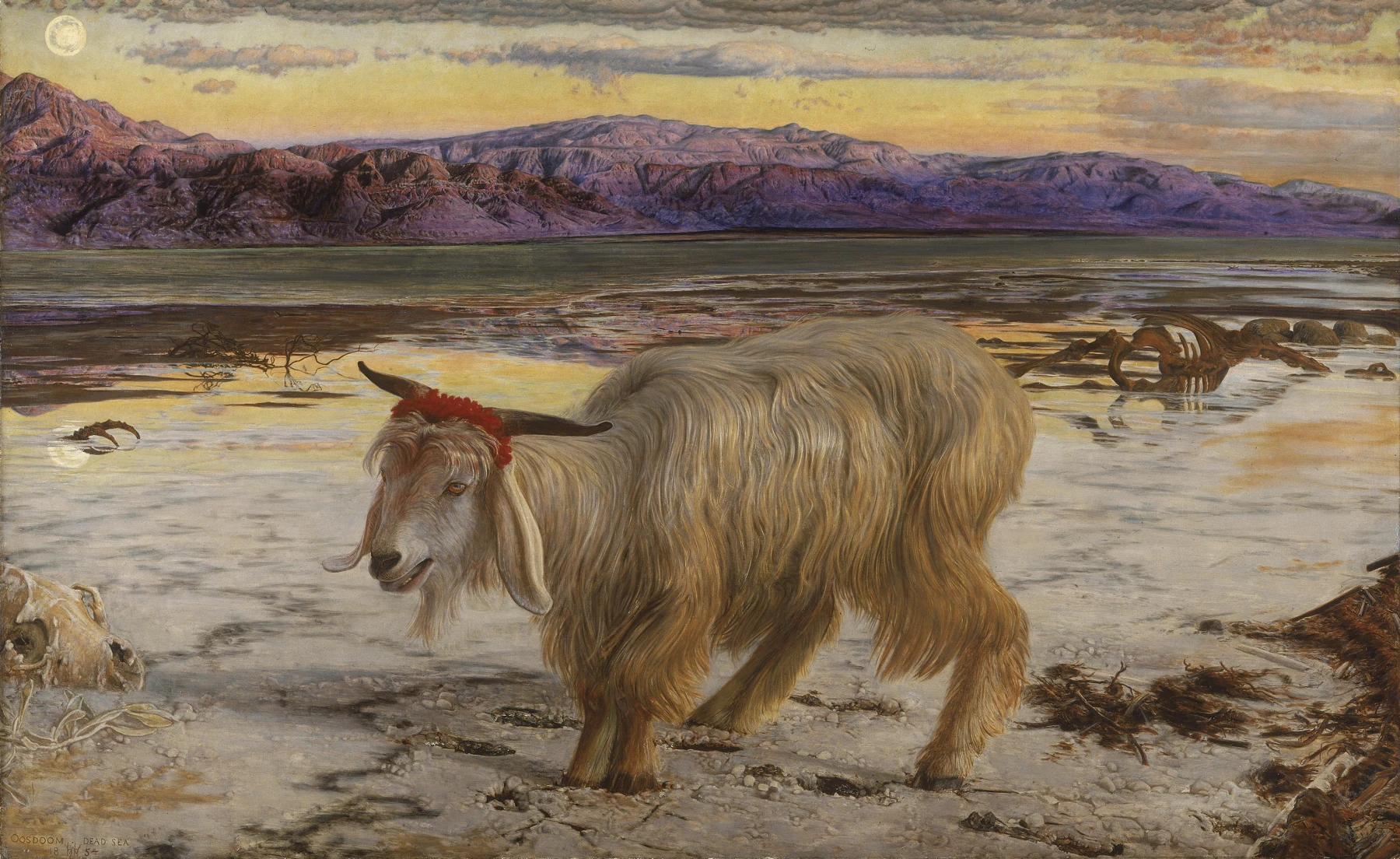
Centuries later, William Holman HuntWilliam Holman HuntWilliam Holman Hunt (1827–1910) was a British artist and co-founder of the Pre-Raphaelite Brotherhood.Glossary · Click to read the explanation’s The Scapegoat depicts an animal in a Dead SeaDead SeaThe Dead Sea is a salt lake in the Jordan Rift Valley, near sites where ancient manuscripts were foundGlossary · Click to read the explanation landscape with a red strip. The Lady Lever painting belongs to the mid-1850s; the museum’s official shop card describes it as a work of 1854. The image used here reproduces the old painting, rather than an archaeological photograph of the rite. [13][14]
The picture combines text, later traditions, and artistic choices in one scene. Its historical value becomes clearer as evidence for nineteenth-century interpretation, distinguished from the rite’s appearance in each earlier source.
What do the witnesses support?
- Leviticus 16 clearly distinguishes the slaughtered goat’s blood purifying sacred space from the living goat carrying iniquities outside.
- Hittite texts describe several means of removing harm, including animals and carried objects; words and beneficiaries differ between rites.
- The comparison supports Ayali-Darshan’s argument for inherited Syro-Anatolian tradition, while dependence on a particular text and its transmission route remain more specific questions than shared function.
- Azazel’s original identity, some readings, and the age of layers preceding surviving copies remain disputed.
- Barnabas offers explicit Christian interpretation, and Hunt’s painting illustrates later artistic reception.
Comparison thus extends beyond finding one origin for the goat. It traces how societies constructed boundaries between inside and outside, made an animal or object carry what they wanted removed, and later reinterpreted that movement. Each conclusion has its evidence and degree of certainty.
Continue reading: Resemblance and the limits of borrowing, Judaism between exile and Christianity, How the adversary became Satan, Sacrifice and covenant after the flood.
References and notes (15)
- Leviticus: two goats, lots, blood, confession, dispatch, washing, and annual occasion. Leviticus 16:1–34, Hebrew and English. Return to the text ↑
- Leviticus: purification of person and house with two birds; procedures differ from the goat rite. Leviticus 14, especially 1–9,49–53. Return to the text ↑
- S. Görke and S. Melzer, scholarly translation of the Samuha ritual: boat and animal removal in royal and temple contexts. CTH 480.1,2016 edition; §§1–23, especially 20–22. Return to the text ↑
- B. Christiansen, scholarly introduction to Ambazzi: procedure, witnesses, and dating. Reference to the introduction rather than the full primary translation. CTH 391.1, introduction 7 February 2017, outline, traditions, dating. Return to the text ↑
- Noga Ayali-Darshan,2020: argument for inherited Syro-Anatolian tradition. Ebla mediated through her quotation; disputed KTU 1.127 reading in note 16. The Scapegoat Ritual and Its Ancient Near Eastern Parallels,2020; body and note 16. Return to the text ↑
- Anna Angelini,2021: divine and demonic interpretations of Azazel and reception of the name. Interpretive positions attributed to the author. Is Azazel a Goat, Place, Demon, or Deity?,2021; name, Enoch, reception. Return to the text ↑
- Judit M. Blair, De-Demonising the Old Testament,2009: publisher description of contextual analysis; not a complete reading of the book. Mohr Siebeck,2009, publisher description and book metadata. Return to the text ↑
- First Enoch 10, historical translation by R. H. Charles: Azazel, Raphael, rocks, corruption, and punishment. 1 Enoch 10:1–22, especially 4–8. Return to the text ↑
- Mishnah Yoma 4:2, Hebrew and Sefaria English: crimson strip and goat’s head; version metadata: William Davidson Edition. Mishnah Yoma 4:2, Sefaria public text API. Return to the text ↑
- Mishnah Yoma 6:6: dividing the strip, cliff, and animal’s fate. Mishnah Yoma 6:6, Hebrew and English. Return to the text ↑
- Epistle of Barnabas 7, historical Roberts–Donaldson translation: explicit Christian interpretation of goats, crimson, and suffering. Epistle of Barnabas, complete chapter VII. Return to the text ↑
- Historical overview of Barnabas: proposed range 80–120 CE and disputed date/provenance; not a reading of all listed studies. EarlyChristianWritings, dating and provenance overview. Return to the text ↑
- National Museums Liverpool official shop card for Hunt’s Lady Lever painting, identifying it as 1854. A museum shop description, not the scholarly collection catalogue. National Museums Liverpool, The Scapegoat card description. Return to the text ↑
- Image identity and rights: Lady Lever LL 3623, faithful reproduction of an old public-domain work, not archaeological photography of Leviticus’s rite. Commons file,3716×2280; PD-Art and Public Domain Mark 1.0. Return to the text ↑
- Baruch A. Levine,2014, note 2 compares pre-exilic and exilic/early Persian dating of priestly material, rather than dating every individual rite. The Meaning of Degel and the Elusive History of the Levites, note 2. Return to the text ↑
Suggest a correction · Suggest a source for this record
Cite this record
IL Archive, «The Sent-Away Goat: Leviticus and Ancient Rites of Removing Evil», https://ilarchive.com/en/studies/scapegoat-and-ancient-purification
Continue reading