Entity
Ritual removal
A reference page linking a name, group, or concept to the materials that discuss it.
An analytical category for removing impurity, harm or an evil omen from a protected realm. It compares the sent-away goat with Hittite and Mesopotamian texts, separating release, destruction, sacrifice and purification.
Estimated reading time: 9 min Published Last reviewed:
Share article
Text
Introduction
Why do some rites carry something harmful beyond a house or city, while others wash a body or burn a substance and preserve its ashes? RitualRitualAn organised or distinguished practice meaningful to a community; it may leave traces, but its form alone does not reveal an associated doctrine.Glossary · Click to read the explanation removal is an analytical name for actions through which ancient communities sought to change their relationship to impurity, curses, illness, or danger. This article asks what is removed, how it is transferred, which boundary it crosses, and what happens to its bearer. It neither classifies every removal as a sacrifice nor treats every purification as a remedy for moral wrongdoing.
The best-known example is the live goat in LeviticusLeviticusA Torah book concerning offerings, priesthood, and purity; chapter 16 describes sanctuary purification and a living goat carrying iniquities away.Glossary · Click to read the explanation 16. Its significance becomes clearer beside the bird in Leviticus 14 and texts from AnatoliaAnatoliaAnatolia is the region occupying the Asian part of present-day TurkeyGlossary · Click to read the explanation, Syria, and MesopotamiaMesopotamiaHistorical region associated with the Tigris and Euphrates: Uruk, Ur, Eridu, cuneiform, Sumer, Akkad, Babylon and Assyria, their languages and cults, and the limits of archaeological evidence.Glossary · Click to read the explanation. The comparison is between witnesses preserved in different textual strata, not necessarily between ceremonies documented as having occurred exactly as prescribed. [1][2][3]
What “ritual removal” means
The term designates an intentional action that expels an unwanted element from a domain to be protected. That element can be an object or substance associated with impurity, or harm conceived as a curse or ominous sign. The carrier may be a living animal, something thrown away, or a substitute figurineFigurineA small shaped object depicting a human, animal or abbreviated form, in clay, stone or another medium. Its form alone does not establish its use; manufacture, handling traces and find context matter.Glossary · Click to read the explanation made and destroyed. What makes the cases comparable is a change in the location or effect of a threat, not the identity of their instruments or causes. David P. WrightDavid P. WrightHebrew Bible and ancient Near Eastern law and ritual scholar, professor emeritus at Brandeis.Glossary · Click to read the explanation investigated this family of procedures under the heading of disposing of impurity. His book title, however, does not imply that every witness is a version of the same rite. [3]
It is also necessary to separate ritual impurityRitual impurityA religious status regulating contact with the sacred, especially in Leviticus and Numbers. Causes, duration, and remedies vary by context; it does not necessarily imply sin, disease, or diminished dignity.Glossary · Click to read the explanation, which in biblical law can follow ordinary bodily conditions, from moral defilement attributed to condemned actions. Jonathan Klawans has emphasized this distinction in his research on ancient Judaism. Consequently, bathing after contact with something classified as impure does not itself confess a sin; nor does dispatching a bearer of evil establish that the person concerned committed a crime. [2]
Sending away, slaughter, and burning are not equivalent
A rite can be analysed through successive questions: who identifies the danger? Is it transferred through touch, words, or the tying of a thread? Does the bearer depart alive, or is it killed before or after removal? Does the rite seek to protect a person, purge a sacred place, or neutralize an omen? Divergent answers show why release is not synonymous with slaughter. Burning may destroy an unwanted object or produce a substance intended for subsequent purification.
Scholars also disagree about aspects of biblical sacrificial action. Jacob MilgromJacob MilgromJewish biblical scholar (1923–2010), noted for studies of Leviticus, priestly traditions, purity and offerings.Glossary · Click to read the explanation stressed the effect of the purification offering's blood upon the sanctuary, while Roy Gane has examined and challenged parts of that account, including how pollution reaches the sanctuary and how expiation addresses it. This identifies a scholarly problem; it does not reduce a detailed disagreement to a settled conclusion. [4]
The two goats in Leviticus 16
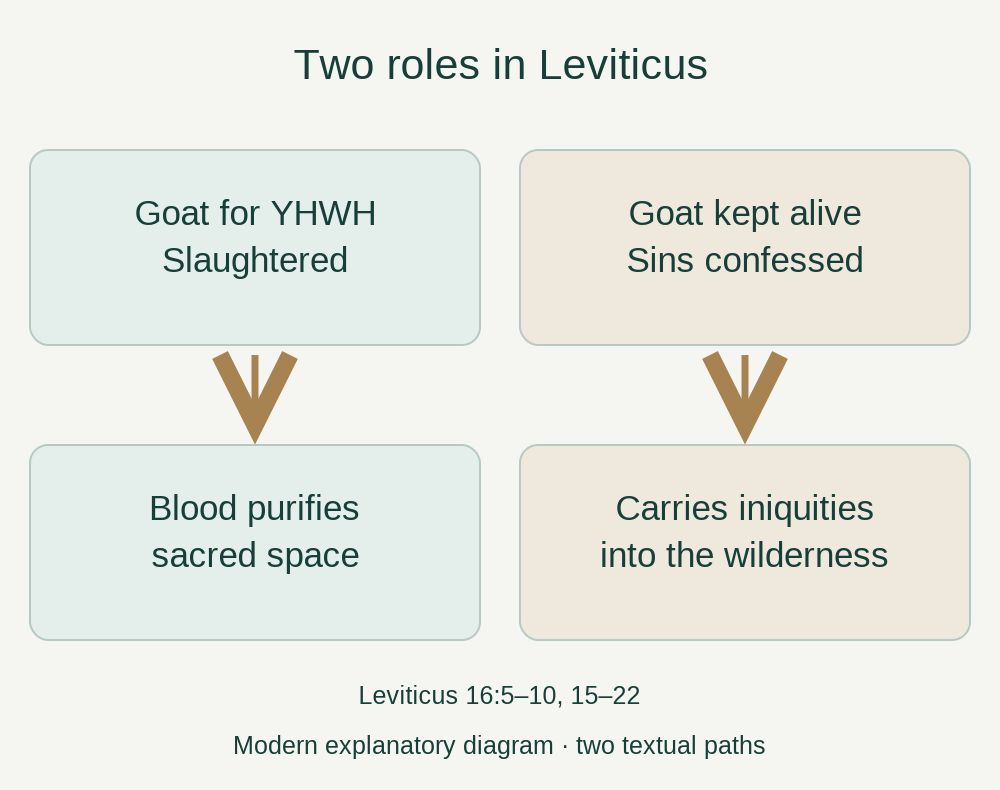
The chapter sets out a rite associated with Yom Kippur, the Day of AtonementYom Kippur — Day of AtonementJewish observance on 10 Tishrei; Leviticus 16’s sanctuary purification and two-goat rite are distinct from later Mishnaic accounts and from fasting, prayer and repentance.Glossary · Click to read the explanation. Two goats are presented before the Lord and assigned by lot: one for the Lord, to be offered as a purification offering, and one for Azazel, to remain alive and be dispatched to the wilderness. Before the latter is sent away, a distinct procedure takes place within the sanctuary: blood is applied to purge the holy place, tent, and altar of the Israelites' impurities and transgressions. Aaron then lays both hands on the live goat, confesses the community's iniquities over it, places them upon its head in the language of the account, and sends it with an appointed agent to a remote land. The agent must wash clothes and body before returning. [1]
These are related but different processes: the slaughtered goat's blood addresses the sanctuary, while the live goat bears confessed iniquities away from the inhabited domain. The chapter also orders the remains of certain offerings to be burned outside the camp; this removes sacrificial material rather than dispatching a living animal. Likewise, the HebrewHebrewA Northwest Semitic language of the Canaanite group, encompassing Iron Age epigraphy, Biblical, Rabbinic, medieval and Modern Hebrew; its scripts and pronunciations changed over time.Glossary · Click to read the explanation verb kipper, frequently rendered “make atonement,” must be understood in relation to its object and context, rather than as the name of a single technique in every passage. [1][4]
Azazel and the goat's fate: an unresolved question
Azazel appears in Leviticus 16:8, 10, and 26 as the counterpart to the assignment of the other goat. Its interpretation remains disputed: does it refer to a wilderness-associated being, a rugged destination, or removal itself? The parallel lots support the argument that it is a proper nameProper nameA name that identifies a particular person, place, group, or entity in context, unlike a common noun denoting a class. Spelling alone may not settle the distinction.Glossary · Click to read the explanation, but they do not settle how that destination functions in the rite. Dominic Rudman has proposed reading the wilderness as a sphere into which forces disruptive to the community's order are expelled. This is an interpretation, not a specification of an identifiable geographical site. [18]
Leviticus 16 does not say that the goat is pushed from a cliff; it orders its dispatch and release in the wilderness. The MishnahMishnahThe Mishnah is a rabbinic compilation assembled around 200 CE, organizing teachings and discussions by topic.Glossary · Click to read the explanation, a rabbinic compilation put together around 200 CE, describes in Yoma 6:4–6 an escort, a divided crimson strip, and the goat's being pushed down a precipice. It documents a later layer of interpretation; its entire scenario cannot be silently read back into the biblical prescription. The strip, too, is absent from Leviticus 16 itself. [6]
The bird in Leviticus 14 and the ashes in Numbers 19
Leviticus 14 prescribes purification for a person recovered from a scaly skin condition and, elsewhere in the chapter, for a house after the affliction has ceased. One bird is killed and its blood is used with fresh water, cedar, hyssop, and crimson material; the second bird is released alive into the open country. In the house rite it is sent beyond the town. There is no confession of sins over the bird's head, and the release is not described as the slaughter of a sacrifice. The suggestion that the living bird bears away impurity is a plausible comparative inference, not an explicit statement of the kind made about the goat's bearing iniquities in Leviticus 16. [7][5]
Numbers 19 offers a different configuration. A red heifer is slaughtered and burned outside the camp; its ashes are gathered in a clean place and retained for the preparation of water used in purification from corpse impurity. No live animal is sent away: burning instead produces a material for later use, while participants must observe washing requirements. Thus the words “outside the camp” alone do not identify a rite's function. [8]
Syrian and Anatolian witnesses: affinities and limits
An interpretation published from a tablet in the archives of EblaEblaAncient city at Tell Mardikh, southwest of Aleppo, Syria. Its Palace G archives illuminate third-millennium BCE administration, language, and cult; the site has later occupation phases.Glossary · Click to read the explanation, generally dated to the third millennium BCE, describes a goat released towards the steppe while a funerary place is purified before a royal ceremony. Noga Ayali-Darshan reports the passage on the basis of the edition ARET XI 12, lines 39–40; the Eblaite tablet and its language have not been independently collated in this review. Even on the proposed reading, the rite is not an annual public confession of wrongs. [9]
The Šamuha purification ritualSamuha purification ritualA Hittite purification text, CTH 480.1, removing harmful speech, curse, and impurity by boat and animals in temple and royal contexts.Glossary · Click to read the explanation, preserved in the Hurro-Anatolian traditions of the second millennium BCE, describes releasing animals that are said, in ritual speech, to carry away harmful words, a false oath, curses, or impurity from the divine presence and the ritual beneficiaries. The label nakušši provides a functional link with dispatching, but the technical term does not have an entirely uniform use in other documents. [10]
In the Ambazzi ritualAmbazzi ritual of removing harmA Hittite rite attributed to a female ritual expert, CTH 391.1; tin passes from beneficiaries to a mouse released to carry harm away.Glossary · Click to read the explanation, attributed to a Hittite female ritual specialist, a thread enclosing a small piece of tin is moved from the clients to a mouse, which is released towards distant places. The release formula also addresses two minor deities to receive what is carried, so the destination and intended recipient matter as well as the expulsion. The carrier is thus a mouse, the transfer includes material tying and spoken words, and the target is harm or affliction. These are precise comparative features, not proof that the biblical goat was borrowed directly from this text. Details of both Hittite examples were accessed here through published translations and scholarly commentary, not through independent editions of the original tablets. [11][5]
Ugarit: the importance of one disputed verb
A comparative study cites KTU 1.127 from UgaritUgaritAncient city and kingdom at Ras Shamra on the Syrian coast, flourishing between the fourteenth and early twelfth centuries BCE and preserving multilingual archives.Glossary · Click to read the explanation as instructing people to take a goat far away when a town or its inhabitants suffer disaster. Yet a verb in this short passage has been translated differently: “lead [it] far off” competes with a reading meaning “see from afar.” If the action changes, the passage's evidential force for a sending-away rite changes too. This is therefore a possible, textually contested parallel, not confirmed evidence that can fill gaps in Leviticus 16. [12]
Mesopotamia: averting an omen is not always bearing a sin
AkkadianAkkadianAn ancient East Semitic language written in cuneiform from the third millennium BCE; its varieties include Babylonian and Assyrian, and it served in international diplomacy.Glossary · Click to read the explanation namburbi texts show that an apotropaic ritual might respond to an omen foretelling future misfortune. Richard Caplice discusses destroying or obstructing an ominous object and making a substitute figure onto which danger is transferred before its disposal, sometimes in a river. Such operations need not involve an animal released alive, still less a community-wide confession of transgressions. The manuscripts discussed in Caplice's introduction belong predominantly to the first millennium BCE; their dates cannot automatically be assigned to the first occurrence of every similar practice. [15]
The University of Texas presentation of the Hittite Tunnawi ritual also shows that purification could involve a riverbank, clay, objects passed over the beneficiary, and spoken formulas, without every action amounting to a “scapegoat” scene. The Metropolitan Museum of Art, for its part, explains how incantation, medicine, cult, and omen-reading overlapped within the expertise of first-millennium-BCE Mesopotamian practitioners. These points help discipline comparison rather than make unlike procedures interchangeable. [16][17]
From painting to modern metaphor
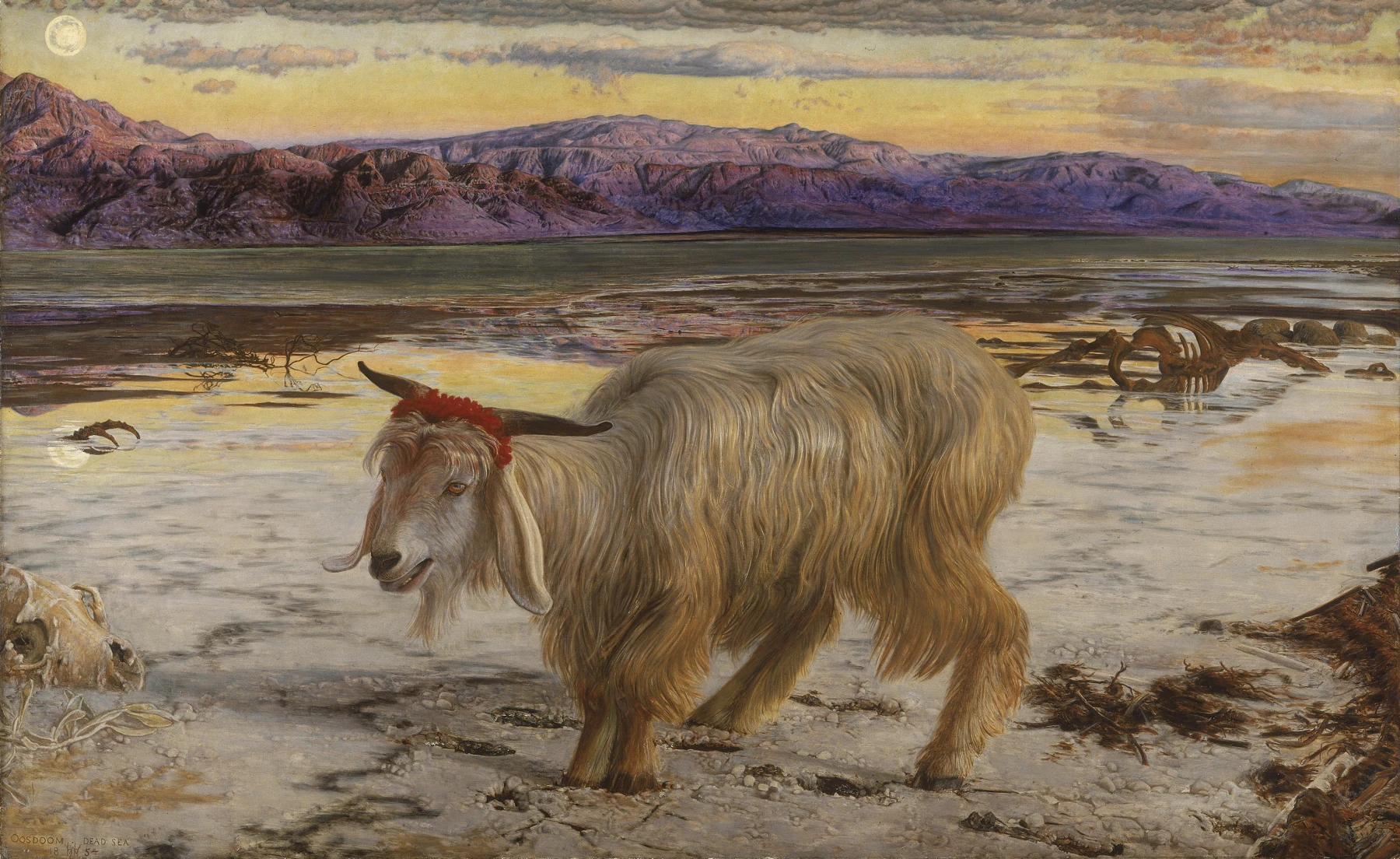
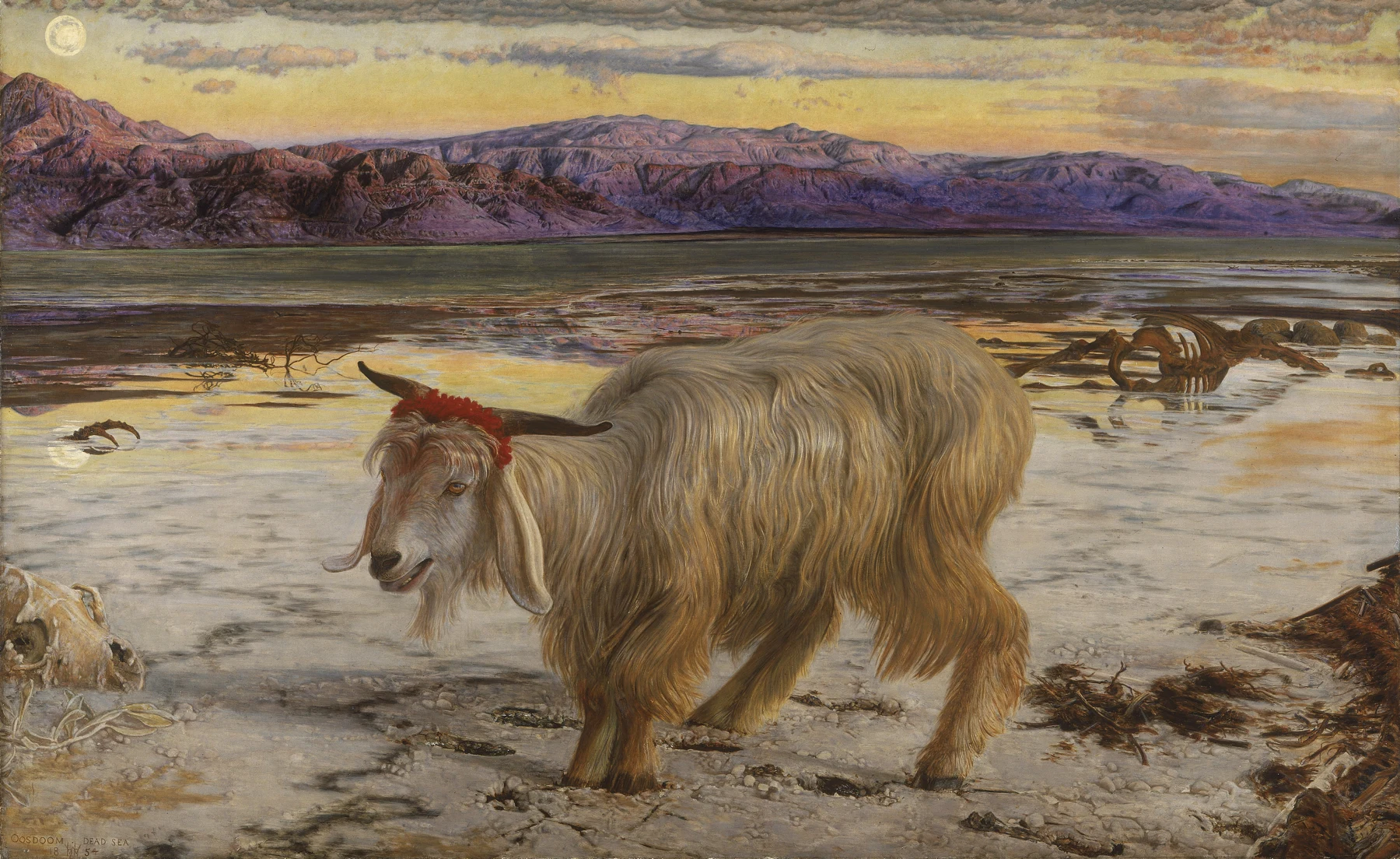
William Holman Hunt's The Scapegoat depicts a solitary animal beside saline water, with hills beyond. Painted in the 1850s, the version in the Lady Lever Art Gallery, accession LL 3623, is distinct from the smaller version in Manchester. Information from National Museums Liverpool and Art UK confirms the Lady Lever identification and its catalogue date of 1854. [13][19]
The image is evidence of Victorian artistic reception, not a record of an ancient Israelite ceremony. The reproduction used here is identified on Wikimedia Commons as a faithful image of a two-dimensional public-domain artwork. Likewise, modern uses of “scapegoat” for someone unfairly blamed are broader social metaphors: they do not turn every ancient impurity-transfer rite into the collective persecution of an individual or an act of sacrificial killing. [14][3]
How a comparison should be tested
For each case, six matters need recording: the source and the date of its witness; the type of harm; the officiant; the mechanism of transfer; the destination; and the bearer's fate. If an element is missing from a source, it must not automatically be supplied from another one. It is reasonable to say that some Syrian and Anatolian texts share with Leviticus a pattern of dispatch outside a protected realm. Demonstrating direct transmission between two particular compositions requires closer chronological, contact, and linguistic evidence than similarity alone. Ayali-Darshan places the cases within a wider regional tradition: a valuable historical interpretation, but not a documentary chain of specific quotations. [5][3]
“Ritual removal” is useful, in short, as a testable analytical category. It brings evidence together to sharpen questions, and then restores to each rite its own language, function, and historical context, retaining differences among transport, release, destruction, sacrifice, and purification. [2][4]
References and notes (19)
- Leviticus 16:1–34, read in full in parallel Hebrew/English display. It distinguishes lots, blood purgation, confession, release, washing and annual observance; it does not prescribe pushing the goat off a cliff. Interpretation used the English translation alongside the Hebrew display, not an independent Hebrew philological edition. Leviticus 16:1–34; especially 5–10, 15–22, 26–34 Return to the text ↑
- Jonathan Klawans, “Ritual and Moral Impurity in the Hebrew Bible,” in Impurity and Sin in Ancient Judaism (Oxford UP, 2000), chapter 1, pp. 21–42. Publisher abstract and contents examined, not the full chapter; distinguishes bodily ritual impurity from moral defilement. Jonathan Klawans, Impurity and Sin in Ancient Judaism (Oxford University Press, 2000), chapter 1, pp. 21–42; publisher abstract only Return to the text ↑
- David P. Wright, The Disposal of Impurity: Elimination Rites in the Bible and in Hittite and Mesopotamian Literature, SBL Dissertation Series 101 (Scholars Press, 1987). Bibliographic catalogue consulted, not the full book; used to identify the comparative domain rather than to attribute inaccessible page-level findings. David P. Wright, The Disposal of Impurity (Scholars Press, 1987), SBLDS 101, bibliographic catalogue only Return to the text ↑
- Roy E. Gane, Cult and Character: Purification Offerings, Day of Atonement, and Theodicy (2005), chapters 7–8, 12–13. Only online chapter excerpts and descriptions were examined; Gane’s discussion of Milgrom is not presented as a scholarly consensus. Roy E. Gane, Cult and Character (Eisenbrauns, 2005), chs. 7–8, 12–13, online chapter excerpts only Return to the text ↑
- Noga Ayali-Darshan, “The Scapegoat Ritual and Its Ancient Near Eastern Parallels,” TheTorah.com (29 April 2020; displayed update 6 October 2026). Main article and relevant notes read. Regional comparison and shared-tradition argument are the author’s analysis, not a new collation of cuneiform sources here. Noga Ayali-Darshan, TheTorah.com (2020; page updated 2026-10-06), main text and relevant numbered notes Return to the text ↑
- Mishnah, Yoma 6:4–6; Hebrew alongside English translation examined for the escort, crimson strip and cliff. The Mishnah is a rabbinic compilation around 200 CE, not the text of Leviticus 16. Mishnah Yoma 6:4–6; Hebrew text and English translation at Sefaria Return to the text ↑
- Leviticus 14:1–8 and 42–53, English text, with Hebrew parallel checked for 52–53. Slaughtering one bird, releasing the second, and the house case are explicit; transfer of impurity onto the living bird remains an inference. Leviticus 14:1–8 and 42–53; English text, with Hebrew 52–53 cross-check Return to the text ↑
- Numbers 19:1–14 (English): heifer slaughtered and burned outside camp, ashes preserved for preparation of water used after corpse contact. Passage read; not the entire book of Numbers. Numbers 19:1–14, English text Return to the text ↑
- Ayali-Darshan (2020), “An Eblaite Goat Ritual,” citing ARET XI 12:39–40. Scholarly account read; Ebla tablet and ARET edition not directly examined. No assumption of an annual confession of moral sins. Ayali-Darshan (2020), “An Eblaite Goat Ritual”; reported ARET XI 12:39–40 Return to the text ↑
- Ayali-Darshan (2020), “A Multi-animal Ritual from Hatti,” on Šamuha CTH 480.1. Quoted translation and discussion of the limits of nakušši read; no direct Hittite/Hurrian tablet collation. Ayali-Darshan (2020), “A Multi-animal Ritual from Hatti”; Šamuha, CTH 480.1, through quoted translation Return to the text ↑
- Ayali-Darshan (2020), “A Mouse Ritual from Hatti,” Ambazzi CTH 391.1. Thread, tin and dispatch of the mouse follow a published scholarly translation, not a new reading of Hittite. Ayali-Darshan (2020), “A Mouse Ritual from Hatti”; Ambazzi CTH 391.1 via published translation Return to the text ↑
- Ayali-Darshan (2020), “An Ugaritic Goat Ritual,” note 16, KTU 1.127; contrasts “lead far off” with “see afar,” citing Dietrich/Loretz and Pardee. Neither the tablet nor those editions were directly consulted. Ayali-Darshan (2020), “An Ugaritic Goat Ritual”, note 16; KTU 1.127 and rival reading Return to the text ↑
- National Museums Liverpool, official shop page for The Scapegoat (1854), identifying the Lady Lever work and painting setting. It is a museum shop description, NOT a directly accessed object catalogue; distinction from Manchester checked against Art UK. National Museums Liverpool shop, Scapegoat greeting card, Lady Lever painting (1854); identification page, not object catalogue Return to the text ↑
- Wikimedia Commons exact file page, 3716×2280 JPEG, LL 3623, PD-Art and Public Domain Mark 1.0 for faithful reproduction of a public-domain two-dimensional work. Local JPEG is archived under its own hash; existing WebP is asset 1886. No new claim of byte-level identity with the remote file. Wikimedia Commons file page: The Scapegoat, 3716 × 2280 JPEG; PD-Art / Public Domain Mark 1.0; LL 3623 Return to the text ↑
- Richard I. Caplice, The Akkadian Namburbu Texts: An Introduction (Undena, 1974): selected introduction paragraphs in PDF viewer pages 1, 5–6, especially witness dates, destruction, obstruction, and substitution. Not the entire monograph and not original Akkadian tablet readings. Richard I. Caplice, The Akkadian Namburbu Texts: An Introduction (Undena, 1974), introduction, PDF pp. 1, 5–6 (selected passages) Return to the text ↑
- University of Texas at Austin, “The Ritual of Tunnawi (Middle Hittite),” lesson presentation and introduction to section 6 examined; not the complete Hittite transcription or all the ritual sections. University of Texas at Austin, The Ritual of Tunnawi (Middle Hittite), lesson 10, introductory paragraphs and section 6 presentation Return to the text ↑
- Miriam Said, “Mesopotamian Magic in the First Millennium B.C.,” Metropolitan Museum of Art, 1 Dec. 2018. Opening discussion of practitioners, omens, cult and medicine read; not the complete illustrated essay. Miriam Said, Metropolitan Museum of Art, 2018, opening paragraphs on first-millennium Mesopotamian magic Return to the text ↑
- Dominic Rudman, “A Note on the Azazel-goat Ritual,” ZAW 116.3 (2004), pp. 396–401. Publisher abstract only, proposing a symbolic interpretation of wilderness; not the full article. Dominic Rudman, “A Note on the Azazel-goat Ritual”, ZAW 116.3 (2004): 396–401; publisher abstract only Return to the text ↑
- Art UK, “Artists and places: naturalism in nature in the 1850s ...”, entries on Hunt. Lady Lever version dated 1854 (87 × 139.8 cm); smaller Manchester version dated 1854–55. Relevant entries read. Art UK, “Artists and places: naturalism in nature ...”, entries for Hunt’s Lady Lever and Manchester versions Return to the text ↑
Suggest a correction · Suggest a source for this record
Cite this record
IL Archive, «Ritual removal», https://ilarchive.com/en/entities/ritual-removal
Continue reading