Study
Jonah and the Marine Creature: From Inanna and Jason to Christian Reception and the Qur’an
An extended study of a topic, with evidence and references.
Comparing Jonah’s great fish with Inanna’s descent, Oannes and Jason’s image, then tracing Gospel, artistic and Qur’anic reception; distinguishing resemblance and hypotheses from explicit reuse.
Share article
Text
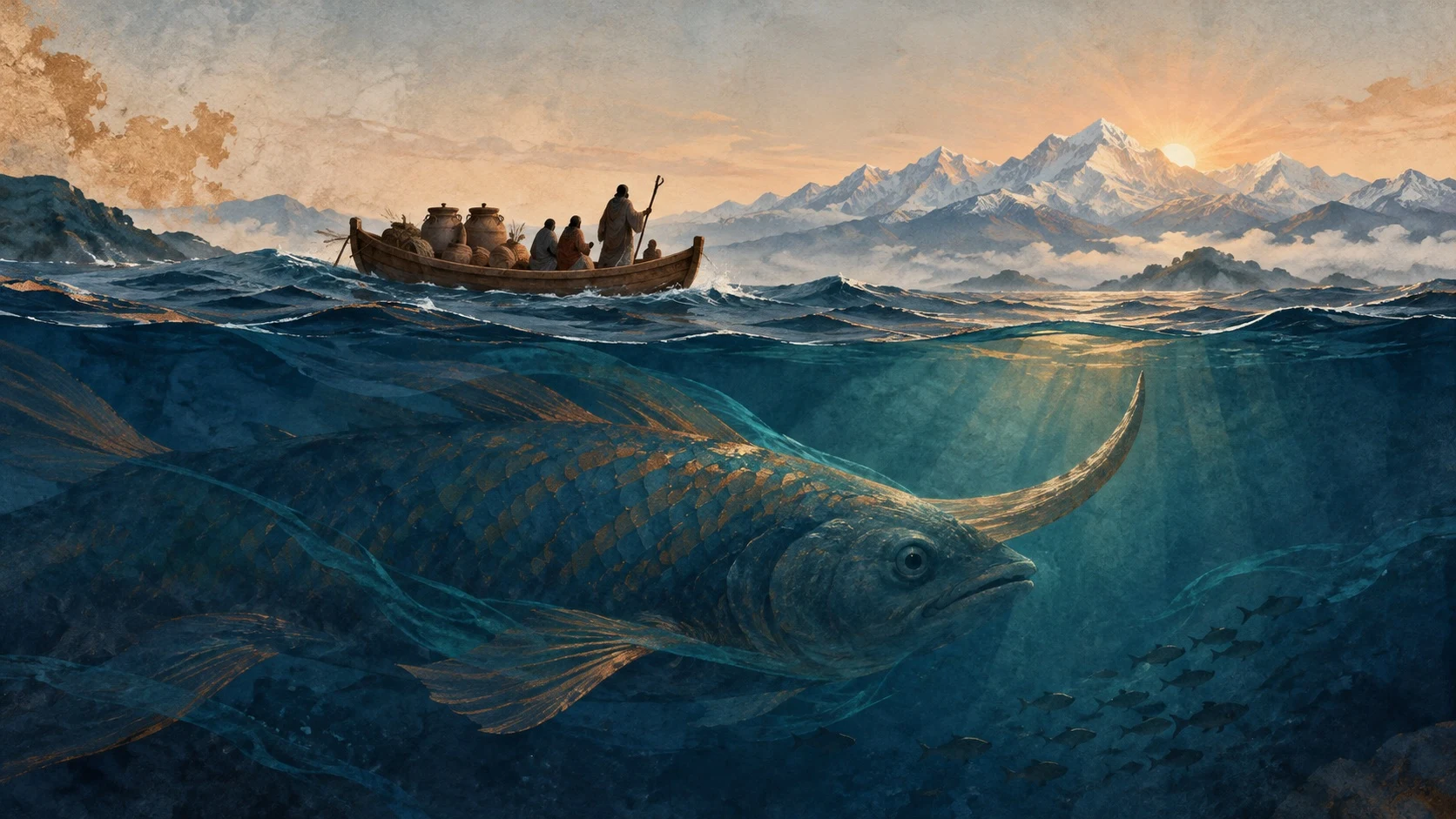
A man flees aboard a ship, a storm threatens the sailors, lots identify the person responsible, and someone is thrown into the sea and swallowed by a large creature before returning to dry land. This image has made Jonah, known in the Qur’an as YunusJonah / YunusProphetic figure in Jonah and the Qur’an; distinguish the Kings notice from the book’s composition and later reception.Glossary · Click to read the explanation, one of the best-known religious figures whose story can be compared with ancient narratives.
Yet a single image does not establish an origin. A Babylonian sage emerging from the sea is not necessarily a man swallowed by a fish, and a Greek hero emerging from a serpent’s mouth does not necessarily perform the prophet’s role. Scenes of deliverance can resemble one another while the stories giving them meaning differ.
We therefore begin with the texts. What happens in Jonah? What do Mesopotamian and Greek witnesses share with it? And where do we actually have evidence that a later reader or artist reused its story?
The prophet’s time and the book’s time
Second Kings 14:25 mentions Jonah son of Amittai, associated with Gath-hepher, during the reign of Jeroboam son of Joash, or Jeroboam II. The notice concerns the restoration of Israel’s borders; it does not narrate the journey to NinevehNineveh and KuyunjikNineveh is an ancient Assyrian city near Mosul in northern Iraq; Kuyunjik is one of its archaeological moundsGlossary · Click to read the explanation or the fish episode. The prophet’s name in this setting does not automatically date the composition of the book bearing his name. [5]
The character’s time within the narratives differs from the time the book took shape. Gildas Hamel proposes a fifth- or fourth-century BCE composition for Jonah. This is a scholarly estimate, not a date established by an author’s autograph. We do not use it to settle the dating debate or build a supposed borrowing route from Greece. [7]
We must also identify the version. Here we distinguish the Masoretic HebrewHebrewA Northwest Semitic language in the Canaanite group, with ancient and modern forms.Glossary · Click to read the explanation text, its ancient Greek translation, and the story’s use in the Gospels and the Qur’an. Differences between these witnesses belong to the inquiry; they should not be concealed to produce a single homogeneous story.
The story extends beyond the fish
YahwehYahwehThe divine proper name written YHWH in the Hebrew Bible.Glossary · Click to read the explanation commands Jonah to go to Nineveh. Instead, he goes down to Joppa and boards a ship for Tarshish in flight. When the storm strikes, the sailors each call upon their god, throw out cargo, and then cast lots. Jonah tells them that he worships the God who made sea and dry land and asks them to throw him into the sea. They nevertheless first try to reach shore and pray before carrying out his request. The narrative does not portray them simply as ruthless people disposing of a stranger. [1]
After deliverance, the commission comes again. Jonah warns Nineveh; its people and king fast, and animals enter the scene of fasting and sackcloth too. The text connects the cancellation of punishment with God seeing their actions and their turning away from evil and violence. The king is unnamed: assigning him the name of a particular Assyrian ruler would introduce information absent from the book. [3]
In chapter 4 Jonah becomes angry at mercy itself, explaining that he fled because he knew God was merciful and would relent from disaster. The plant, worm and hot wind follow, and the book ends with a question about compassion for a great city containing people and animals. It records no answer from Jonah. [4]
This is crucial: returning from the sea allows the mission to continue, but does not resolve the prophet’s problem. Jonah’s deliverance leads him to a test of his attitude toward the deliverance of others. Reducing the book to a man inside a fish removes the relationship between mercy and anger that shapes its ending.
A great fish or a sea monster?
The Hebrew uses dag gadol, a great fish. Yahweh appoints the creature to swallow Jonah, who remains inside for three days and three nights. He then commands it to cast the prophet onto dry land. The passage is numbered 2:1–11 in the Hebrew presentation used here; its opening corresponds to 1:17 in many Christian editions and its ending to 2:10. [2]
The book supplies no anatomical description establishing a modern animal species. More significantly, the fish is not an opponent defeated by the prophet. It acts at God’s command, preserving him from drowning and releasing him. The episode therefore differs in function from the battles against sea or dragon discussed in Leviathan and Lotan.
The ancient Greek translation calls the creature kētosKētos: marine creatureGreek word for the marine creature in Jonah and Matthew; alone it establishes neither a modern species nor the story’s origin.Glossary · Click to read the explanation, rendered by NETS as a great sea monster. Matthew 12:40 uses a form of the same Greek word. A later translation’s choice of “sea monster” or “whale” does not establish that the Hebrew text identified a whale in its modern zoological classification. [6][12]
Another difference deserves attention. Jonah 3:4 gives Nineveh forty days in Hebrew, whereas NETS presents three days in the ancient Greek. This concerns Nineveh’s deadline, not the three days spent inside the marine creature. Preserving the distinction prevents two numbers with different functions from being conflated. [3][6]
The belly of Sheol and Inanna’s descent
Jonah’s prayer evokes sea, depth, the roots of mountains, and the earth’s gates or bars, including a cry from the belly of SheolSheol: a Hebrew term for the realm of the deadHebrew textual term involving death, descent and lost return; it does not automatically mean later punitive Gehenna.Glossary · Click to read the explanation. It represents deliverance from the realm of death, rather than merely discomfort inside an animal. Yet death language in a prayer does not itself amount to an explicit prose report that Jonah died and was resurrected. [2]
Ekaterina Kozlova compares these images with underworld traditions, including InannaInanna / IshtarProminent Mesopotamian goddess with a major centre at Uruk, whose parentage and cult traditions vary rather than forming one fixed genealogy.Glossary · Click to read the explanation’s descent, within a ritualRitualAn organised or distinguished practice meaningful to a community; it may leave traces, but its form alone does not reveal an associated doctrine.Glossary · Click to read the explanation and literary reading of the passage. This modern interpretation should be distinguished from proof that a particular text was borrowed. [8]
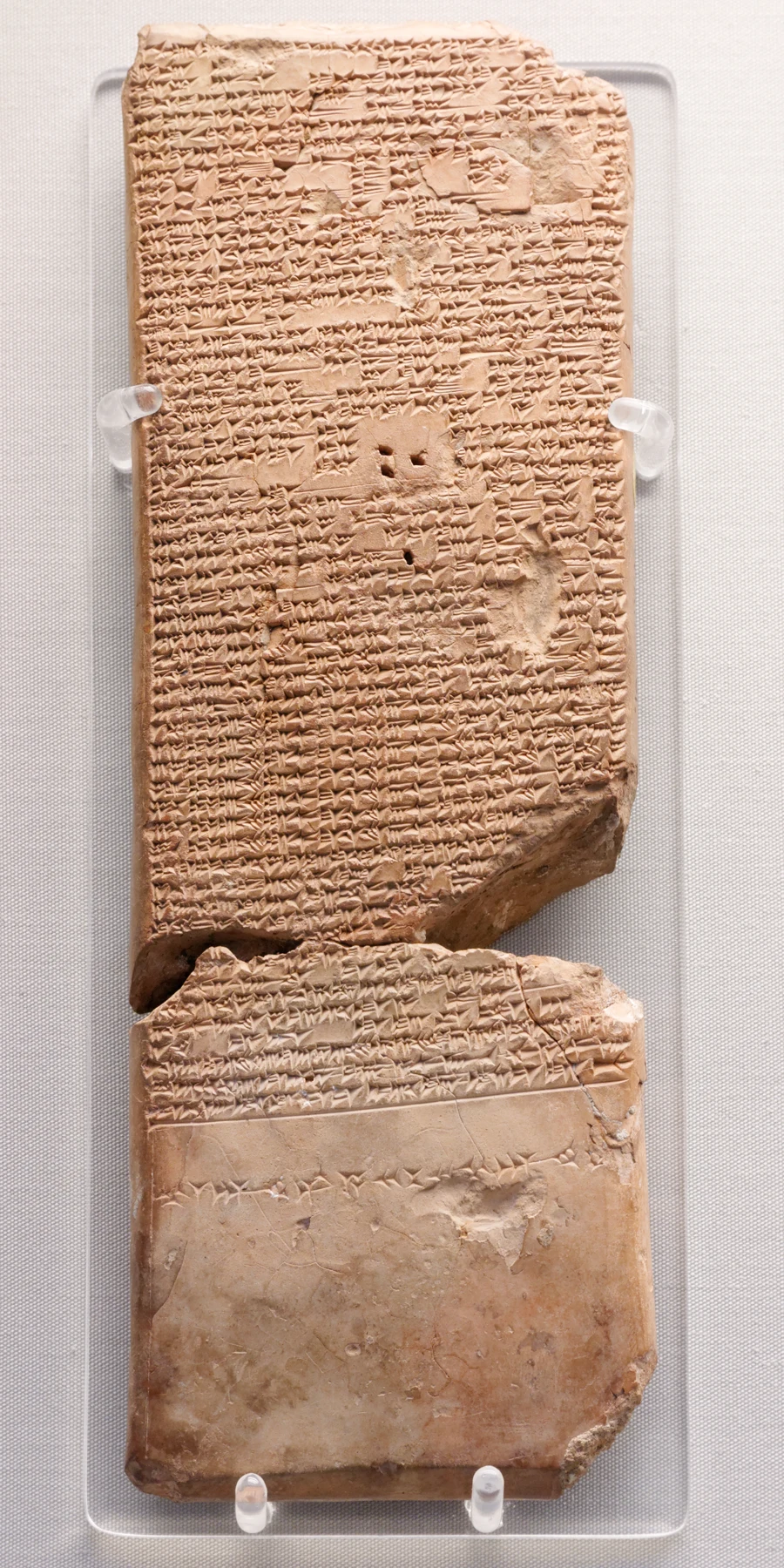
In the Sumerian descent narrative, underworld judges condemn Inanna and she becomes a hanging corpse. After three days and three nights her minister NinshuburNinshuburInanna’s attendant in the Sumerian descent, following her instructions and seeking help during her absence.Glossary · Click to read the explanation begins seeking help; her restoration follows through a sequence with its own conditions. The phrase does not necessarily mean that her entire stay in the underworld lasted only three days. [9]
There is thus a resemblance in descent, death and return imagery, and in a duration appearing within the action. There are also major differences. Inanna is a goddess entering a realm with its own rulers; the narrative explicitly describes her death, and her release requires addressing a substitute. Jonah is a fleeing prophet praying to his God, whose command the fish executes. His book contains neither an underworld court nor the selection of a substitute to rescue him.
Comparison helps us understand imagery recognizable to ancient Near Eastern audiences. The witnesses examined here do not, however, supply a Sumerian version of Jonah or a documented chain of transmission between the texts. For the Mesopotamian narrative in detail, see Inanna and Ishtar’s Descent.
Oannes: a sage from the sea, not Jonah under another name
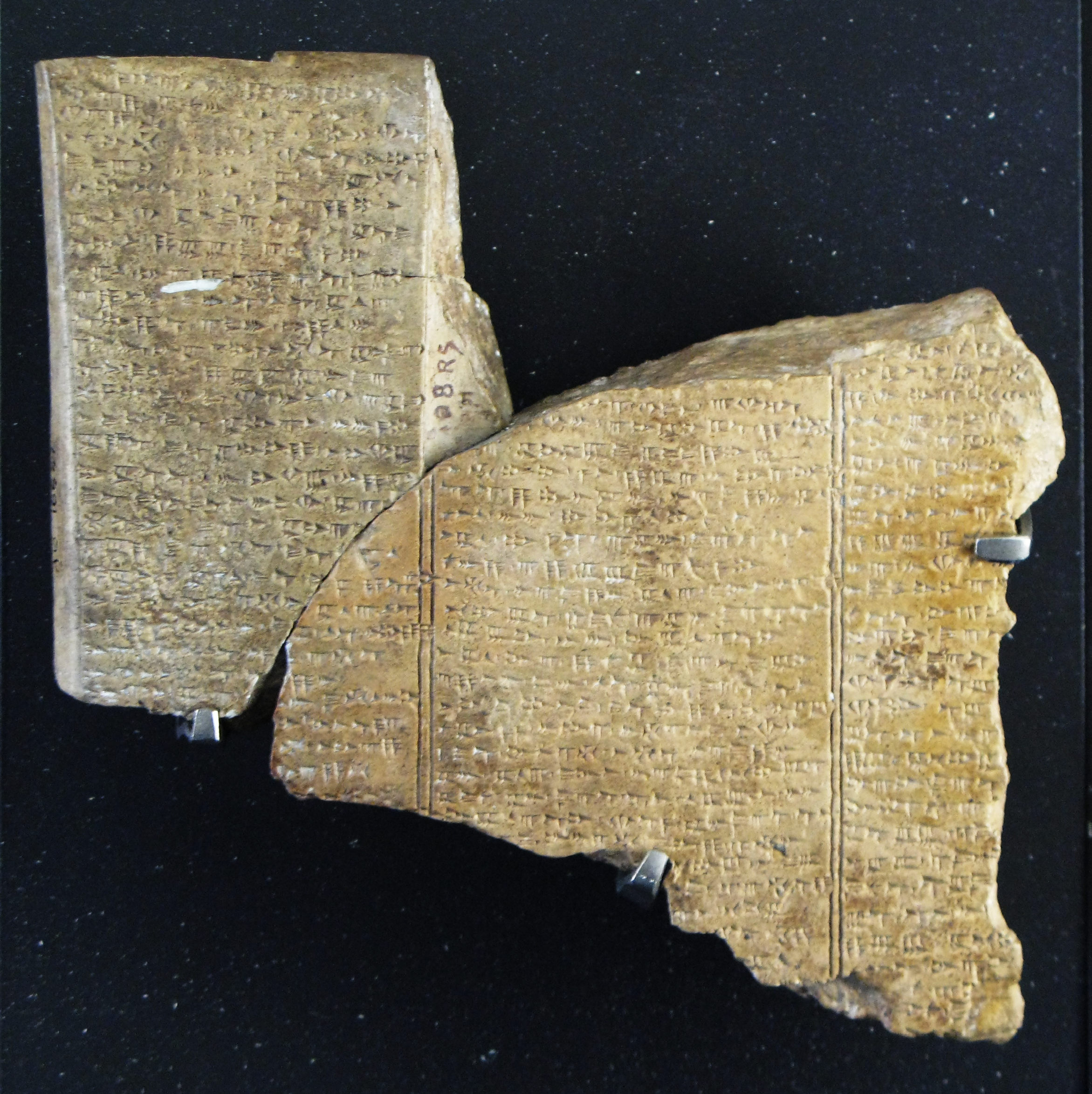
In his introduction to Assyrian and Babylonian scholarly letters, Simo Parpola reproduces Berossus’s description of Oannes: a fish-shaped creature with human parts, emerging from the sea to teach writing, crafts, cities, temples and laws before returning at night. He explains its connection to Uanna, one of the ancient sages in cuneiformCuneiformWriting with wedge-shaped signs, developed from Mesopotamian recording traditions and used for several languages from the third millennium BCE.Glossary · Click to read the explanation tradition. Our witness is the translated excerpt and its discussion, not a complete reading of Berossus’s lost original book. [10]
This is an important account of the origins of knowledge and civilization, but its structure differs. Oannes is himself the wise creature, rather than a human prophet inside a fish. His daily emergence to teach and nightly return do not match flight, storm, lots and a commission to Nineveh.
Nor does a phonetic resemblance between “Oannes” and “Jonah” establish an etymology. The source discusses Oannes in relation to Uanna; it gives no sequence turning Jonah’s name into a version of it. The sea can be investigated as a setting for wisdom and deliverance, but claiming “Jonah is Oannes” exceeds the evidence presented.
Jason in the serpent’s mouth
A more striking visual witness exists: a Greek cup attributed to Douris, in the Vatican Museums, depicts Jason emerging from a huge serpent’s mouth beside Athena and the Golden Fleece. The museum catalogue dates it to approximately 480–470 BCE. It is an actual ancient image, not a modern drawing devised to prove a resemblance. [11]
Hamel proposes that some Jason traditions may have been reworked in Jonah, drawing on the image and comparisons of names and details. We present this as his proposal, not an agreed conclusion. [7]
The image establishes that a Greek tradition depicted a hero emerging from a large creature’s mouth. It does not narrate Jonah: its framework is the Golden Fleece, Athena and a guardian serpent, rather than Nineveh, the prophet’s prayer and divine mercy toward a city. Nor does the cup alone establish that the book’s author saw it or knew the narrative represented by its image.
We also cannot fill everything the image leaves unstated with details from later Greek texts and treat the result as one earlier story. Each witness must first be dated and its actual content established, before sequence, wording and contact routes are tested. The possibility of encounters between Mediterranean cultures makes the hypothesis investigable; it does not establish the transfer of this scene.
When evidence for reception becomes clearer
The evidential situation changes in Matthew 12:38–42. The text explicitly names Jonah, compares his stay in the marine creature with the Son of Man’s stay in the heart of the earth, and then mentions the Ninevites’ repentance. Here the relationship is not inferred from vague similarity: the writer expressly reads the earlier story in a new framework. [12]
Luke 11:29–32 connects Jonah’s sign with the Ninevites and repentance at his proclamation, without giving Matthew’s three-day formula in this passage. That difference must be preserved rather than assigning the same wording to every witness. [13]
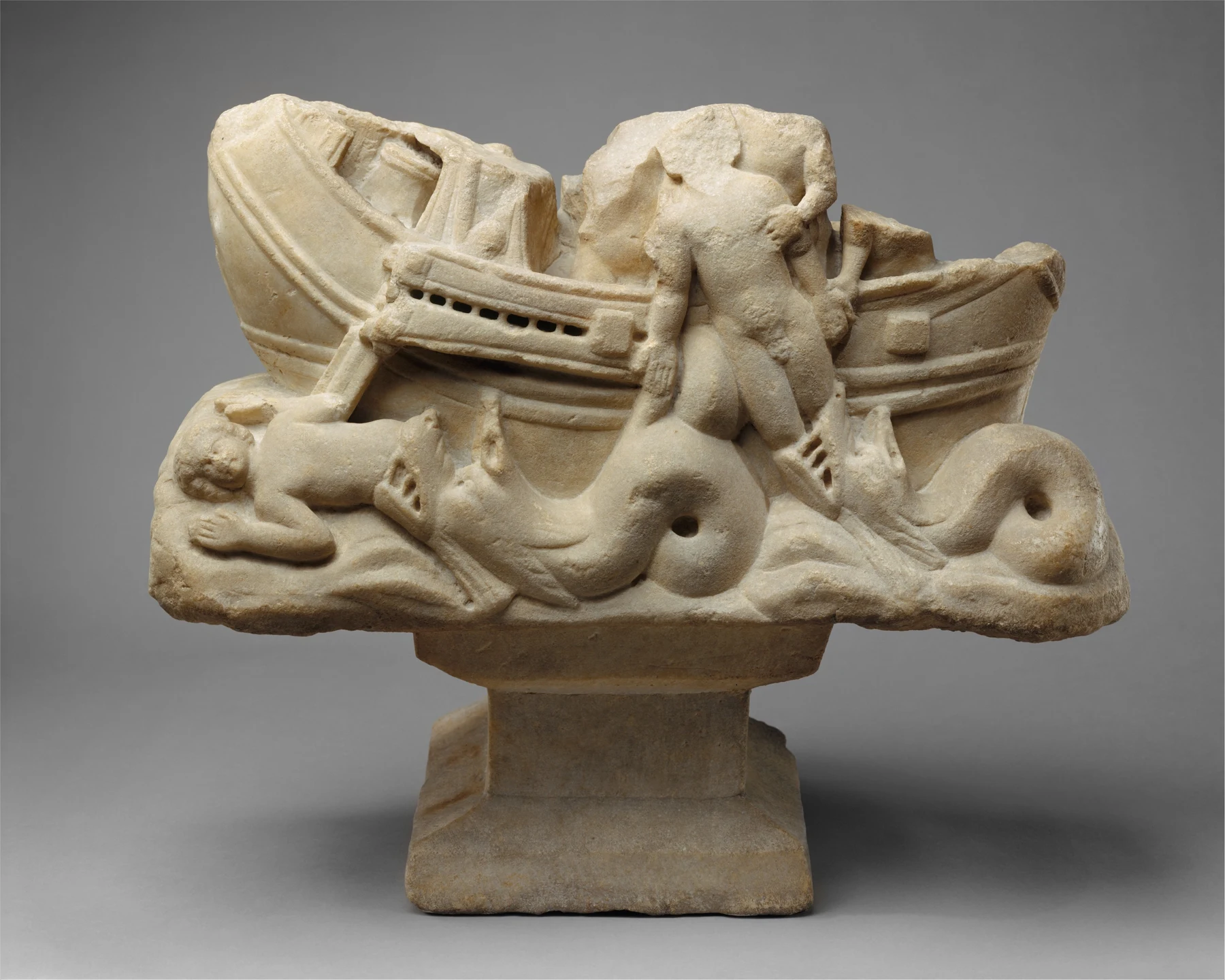
This study’s main photograph also documents reception: an early fourth-century CE Roman marble table base at the Metropolitan Museum depicts Jonah being swallowed and cast out by a marine creature in a classical artistic form. Its accession number is 77.7, and the photograph is public domain. [18]
The object establishes that a Christian artist could express Jonah’s story through older marine imagery. It is not an artifact from the prophet’s time, evidence that his book was composed in the fourth century, or proof that a Greek serpent supplied the Hebrew text’s source. The history of the story and that of its later representation are separate questions.
Yunus in the Qur’an: continuities and changes
In al-Saffat 139–148, Yunus is identified as a messenger, followed by the ship, lots, the fish’s swallowing, glorification of God and deliverance. He is cast onto open ground while sick, a gourd plant grows over him, and his mission to a hundred thousand or more and their belief are mentioned. This passage neither names the city Nineveh nor specifies a three-day stay. Details it does not state should not be imported from another story or later interpretation. [14]
Here the plant appears after deliverance during illness, whereas Jonah’s plant follows the city’s repentance and tests the prophet’s anger and compassion. The narratives share elements, but their order and functions are not identical. The Arabic word al-hut does not by itself require matching a modern zoological classification to the Hebrew expression.
Al-Anbiya 87–88 presents Dhu al-Nun, his prayer in darkness and rescue from distress. Al-Qalam 48–50 uses the companion of the fish in a discourse on patience, grace and election, while Yunus 98 mentions the faith of Jonah’s people and removal of punishment. These passages serve distinct functions; they are not one detailed retelling of the Hebrew book. [15][16][17]
The Qur’an certainly addresses a character and story known in earlier traditions, and comparison reveals both shared elements and changes. But this comparison alone does not identify one specific Hebrew or Greek version behind every expression, or a single oral intermediary for each detail. Written traditions, teaching and circulating stories are possibilities requiring further evidence; none should be selected as though its route were documented.
Levels of evidence and the map’s limits
- Textually certain: the Hebrew book narrates the great fish, three days, prayer and deliverance, followed by Nineveh’s commission and mercy. It is not a battle in which the prophet defeats a monster. [1][2][3][4]
- Certain within their witnesses: Inanna’s descent contains death, return and a three-day phrase; Oannes is a fish-shaped sage teaching civilization; the Greek cup depicts Jason with a serpent. Their differences prevent their merger into a single origin story. [9][10][11]
- Possible and disputed: marine and descent traditions, or Jason scenes, may have contributed to Jonah’s formation. These witnesses do not identify a direct borrowing route.
- Certain in reception: Matthew invokes Jonah by name, Christian art depicts him afresh, and the Qur’an presents Yunus within discourse on mission, prayer and deliverance. Later readings do not therefore all duplicate their predecessors. [12][14][18]
- Unproven: Jonah is Oannes; the cup proves that the book’s author copied a Greek story; or every marine creature swallowing a person derives from a single origin.
The value of inquiry lies in seeing what each text does with the image. The sea can be a realm of wisdom; a serpent’s mouth can belong to a hero’s adventure; a fish’s belly can allow a prophet to resume his mission, subsequently becoming a sign in Christian reading or part of Qur’anic discourse on prayer and grace. Comparative history traces these uses and tests their transmission; it does not turn resemblance into a predetermined verdict.
Further reading: Similarity and Borrowing, Manu, the Fish and the Flood, Leviathan and Lotan, and Inanna and Ishtar’s Descent.
References and notes
- Complete Jonah 1 read in Hebrew and facing English; Hebrew numbering, not an original-manuscript inspection. Jonah 1:1–16; Hebrew numbering Return to the text ↑
- Complete Jonah 2 read in Hebrew and facing English; Hebrew numbering, not an original-manuscript inspection. Jonah 2:1–11; Hebrew numbering Return to the text ↑
- Complete Jonah 3 read in Hebrew and facing English; Hebrew numbering, not an original-manuscript inspection. Jonah 3:1–10; Hebrew numbering Return to the text ↑
- Complete Jonah 4 read in Hebrew and facing English; Hebrew numbering, not an original-manuscript inspection. Jonah 4:1–11; Hebrew numbering Return to the text ↑
- 14:23–29 read in full; the prophet’s border-restoration notice differs from the Nineveh and fish narrative. 2 Kings 14:23–29, especially 25 Return to the text ↑
- Introduction p.777 and complete Ionas pp.804–805 read; Nineveh’s differing deadline checked. Neither the whole Twelve nor the Greek critical apparatus read. George E. Howard, NETS, The Twelve Prophets; introduction p. 777 and Ionas pp. 804–805 Return to the text ↑
- Complete revised article and figure consulted; dating and Jason link attributed as hypotheses, not consensus. Gildas Hamel, Taking the Argo to Nineveh: Jonah and Jason in a Mediterranean Context; revised 25 April 2014, pp. 1–20 and figure p. 21 Return to the text ↑
- Pages1–6 and start7 read, especially underworld comparison; not the complete article. Volume dated2020, online publication2021. Ekaterina E. Kozlova, Jonah 2: A Death Liturgy for the Doomed Prophet, JHS 20 (2020), article 5; posted 15 February 2021; pp. 1–6, start of 7 Return to the text ↑
- Translation lines134–294 read, especially death, help sought after three days and return conditions; not the whole text or original tablets. ETCSL c.1.4.1, Inana’s descent to the nether world; translation lines 134–294, especially 164–175 and 217–289 Return to the text ↑
- Introduction XVIII–XIX read, including translated Berossus excerpt and Uanna discussion; not the whole volume or lost Berossus book. Simo Parpola, Letters from Assyrian and Babylonian Scholars, SAA10 (1993), introduction XVIII–XIX, PDF pp.13–14 Return to the text ↑
- Museum description read and available indexed catalogue metadata checked; direct catalogue inaccessible. Image is visual evidence, not proof Jonah’s author knew it. Vatican Museums, Attic Kylix attributed to Douris: Jason; MV.16545.0.0, ca.480–470 BCE Return to the text ↑
- Complete KJV passage read; Greek12:40 checked for kētos, not the whole Gospel or its manuscripts. Matthew12:38–42; Greek12:40 at https://biblehub.com/text/matthew/12-40.htm Return to the text ↑
- All four KJV verses read; differing sign formulation preserved without generalizing across every textual witness. Luke11:29–32; KJV column Return to the text ↑
- Specified Arabic verses and English translation read; not the complete surah or commentary. Explanatory translation additions are not Arabic verse wording. al-Saffat37:139–148 Return to the text ↑
- Specified Arabic verses and English translation read; not the complete surah or commentary. Explanatory translation additions are not Arabic verse wording. al-Anbiya21:87–88 Return to the text ↑
- Specified Arabic verses and English translation read; not the complete surah or commentary. Explanatory translation additions are not Arabic verse wording. al-Qalam68:48–50 Return to the text ↑
- Specified Arabic verses and English translation read; not the complete surah or commentary. Explanatory translation additions are not Arabic verse wording. Yunus10:98 Return to the text ↑
- Object77.7 description, metadata, photograph and public-domain notice checked; evidence of later Christian art, not the prophet’s time. Metropolitan Museum, Table Base with Jonah Swallowed and Cast Up by the Big Fish;77.7, Roman, early300s CE Return to the text ↑
Suggest a correction · Suggest a source for this record
Cite this record
IL Archive, «Jonah and the Marine Creature: From Inanna and Jason to Christian Reception and the Qur’an», Edition 1, https://ilarchive.com/en/studies/jonah-and-sea-monster-stories
Continue reading