Entity
Kētos: the sea creature in language, myth and art
A reference page linking a name, group, or concept to the materials that discuss it.
- Names
- cetus · ketos · kētos · κῆτος
- Region
- Ancient Greek-speaking Mediterranean; Greek biblical tradition; Roman Asia Minor (artistic reception)
Kētos (κῆτος) is a Greek word for a large sea creature or mythical monster, not a single zoological species. Its literary, artistic, Septuagint and Gospel uses show how meanings and images changed.
Estimated reading time: 6 min Published Last reviewed:
Share article
Text
Introduction
What did the Greeks mean by kētos, and why does the word occur in the story of Jonah and in later Christian art? This entry follows the term through several settings: a large sea creature in ordinary language, a monster in myth, a choice made in the Greek Bible, and a form reworked by artists. Keeping these kinds of evidence distinct helps us understand a word without forcing it into a modern zoological species or using it to prove the origin of a narrative.
Contents
- What does kētos mean?
- Two distinct monsters in Greek myth
- The creature in Greek art
- “Great fish” in HebrewHebrewA Northwest Semitic language of the Canaanite group, encompassing Iron Age epigraphy, Biblical, Rabbinic, medieval and Modern Hebrew; its scripts and pronunciations changed over time.Glossary · Click to read the explanation Jonah, kētos in Greek Jonah
- The same Greek word in another biblical setting
- Matthew 12:40 and the translation “whale”
- The Roman cover image and Christian reception
- What is established, and what remains uncertain?
What does kētos mean?
The Greek noun κῆτος (kētos) is neuter; its plural is κήτη (kētē). Liddell–Scott–Jones records senses ranging from a large fish or fearsome sea creature to identifiable marine animals. Depending on the passage, “large sea creature,” “sea monster” or the older translation “whale” may be appropriate; the ancient word is not identical to the modern biological category of cetaceans. It is related to Latin cetus and to later scientific and astronomical naming, but these later uses do not turn every ancient kētos into a whale. [1]
Early Greek poetry also uses the word broadly. The Homeric lexicon identifies dangerous creatures of the sea and notes its application to seals in parts of the OdysseyOdysseyGreek epic attributed to Homer, following Odysseus’s return after the Trojan War.Glossary · Click to read the explanation; elsewhere the word appears in a description of marine dangers alongside dolphins and other animals. These passages demonstrate semantic breadth. They are not exact zoological identifications, nor proof that every ancient picture represents the same species. [3]
Two distinct monsters in Greek myth
In the mythographic LibraryBibliotheca, Greek mythographic collectionGreek work by an unknown author, probably late first or second century CE, organizing divine and heroic genealogies.Glossary · Click to read the explanation, Andromeda, daughter of King Cepheus, is exposed to a sea monster after her mother Cassiopeia's boast offends the sea-nymphs. Perseus intervenes, kills the monster and rescues her. The story calls the setting “Ethiopia” in the geography of Greek myth, which should not simply be equated with the boundaries of the present-day state. Its kētos is a narrative agent of danger and rescue, not an observed marine animal. [4]
In a separate story set around Troy, PoseidonPoseidonSea god in Greek traditions and an influential figure in the Iliad and Odyssey.Glossary · Click to read the explanation sends a marine creature because King Laomedon has failed to pay the promised wages. His daughter Hesione is offered to the monster; HeraclesHeracles, Greek heroA hero of Greek traditions, also known as Hercules; rescues Alcestis in Euripides’ play, while other witnesses depict his apotheosis.Glossary · Click to read the explanation kills it and saves her, but Laomedon again fails to honour his promise. The two narratives share the threatened maiden and heroic rescue but differ in location, protagonists and cause. Similar plot patterns do not make them the same event or demonstrate that either one furnished the original story of Jonah. [5]
The creature in Greek art
Images of kētos predate Christian art. The Metropolitan Museum of Art holds a small terracotta vessel in the creature's form, dated to the second half of the seventh century BCE and cautiously attributed to CreteCreteGreek island in the eastern Mediterranean, associated in Hesiod with hiding the infant Zeus.Glossary · Click to read the explanation or South Italy. Its leonine head, pronounced teeth, ears, scales and fins reveal an ancient composite design, not a naturalistic portrait of a whale. [10]
John Boardman describes successive artistic formulas for the twisting-bodied, long-snouted creature, seen in rescue stories and in other marine scenes. In a specialist study of canine traits in ancient marine monsters, Ryan Denson identifies mammal-like ears, snouts and limbs in some representations of kētos. He proposes that they reflect ancient perceptions of “sea dogs.” This is an interpretation of artistic imagery and cultural categories, not evidence that an actual marine beast had canine legs. [9][11]
“Great fish” in Hebrew Jonah, kētos in Greek Jonah
In the Book of JonahBook of JonahA four-chapter Hebrew book about a fleeing prophet, rescue, Nineveh’s mission, and the final question of mercy.Glossary · Click to read the explanation, JonahJonah / YunusProphetic figure named Jonah son of Amittai in Kings and the Book of Jonah, corresponding to Yunus in the Qur’an; distinguish each narrative, its composition and reception.Glossary · Click to read the explanation is swallowed at God's command by a דָּג גָּדוֹל (dāg gādōl), literally a “great fish,” for three days and three nights. The fish subsequently returns him to dry land. In the Hebrew numbering shown by Mechon-Mamre, the swallowing is at Jonah 2:1; in many English Bibles it is Jonah 1:17, with corresponding shifts in the prayer and conclusion. The Hebrew wording of the swallowing does not say kētos. [2]
The SeptuagintSeptuagintA name for the varied ancient Greek translations and writings associated with Jewish scripture; beginning with the Torah, the texts differ across books and manuscripts.Glossary · Click to read the explanation, the ancient Greek translation tradition of the Hebrew scriptures, instead has κήτει μεγάλῳ (“a great sea creature”) in Jonah 2:1 and κήτους when naming its belly. In Greek numbering, the creature releases Jonah at 2:11. NETS opts for “great sea monster,” while older translators, including Brenton, chose “whale.” These renderings of a Greek word do not establish three different animals. For this review the complete Greek chapter and an indexed NETS excerpt were consulted, not a critical manuscript apparatus or the full NETS PDF. [6][7]
The same Greek word in another biblical setting
Greek GenesisBook of GenesisHebrew book of the Torah containing Noah’s flood, survival offering and covenant with living creatures.Glossary · Click to read the explanation 1:21 uses τὰ κήτη τὰ μεγάλα for the great aquatic creatures made by God. Its Hebrew counterpart is הַתַּנִּינִם הַגְּדֹלִים (hattannīnīm haggədōlīm), not the noun “fish” used in Jonah. The Greek translators thus used the same word family for passages with different Hebrew expressions and literary purposes. That does not identify all the creatures concerned as one mythic being. [8]
Matthew 12:40 and the translation “whale”
In the Gospel of MatthewGospel of MatthewOne of the New Testament’s four Gospels, from the late first century CE, relating inherited law and Jesus’ sayings.Glossary · Click to read the explanation 12:38–42, the story of Jonah provides the “sign of Jonah.” Verse 40 uses the genitive τοῦ κήτους, comparing Jonah's three days and nights inside the creature with the Son of Man's three days and nights “in the heart of the earth.” The comparison is narrative and theological; it is not an attempt to distinguish a zoological species. [13]
The King James Version translates the noun as whale. This is evidence for the history of English biblical wording, not grounds for imposing the modern biological sense on the Greek. Neither does Matthew's wording show that its author intended the sea monster from Andromeda or Hesione. [12]
The Roman cover image and Christian reception
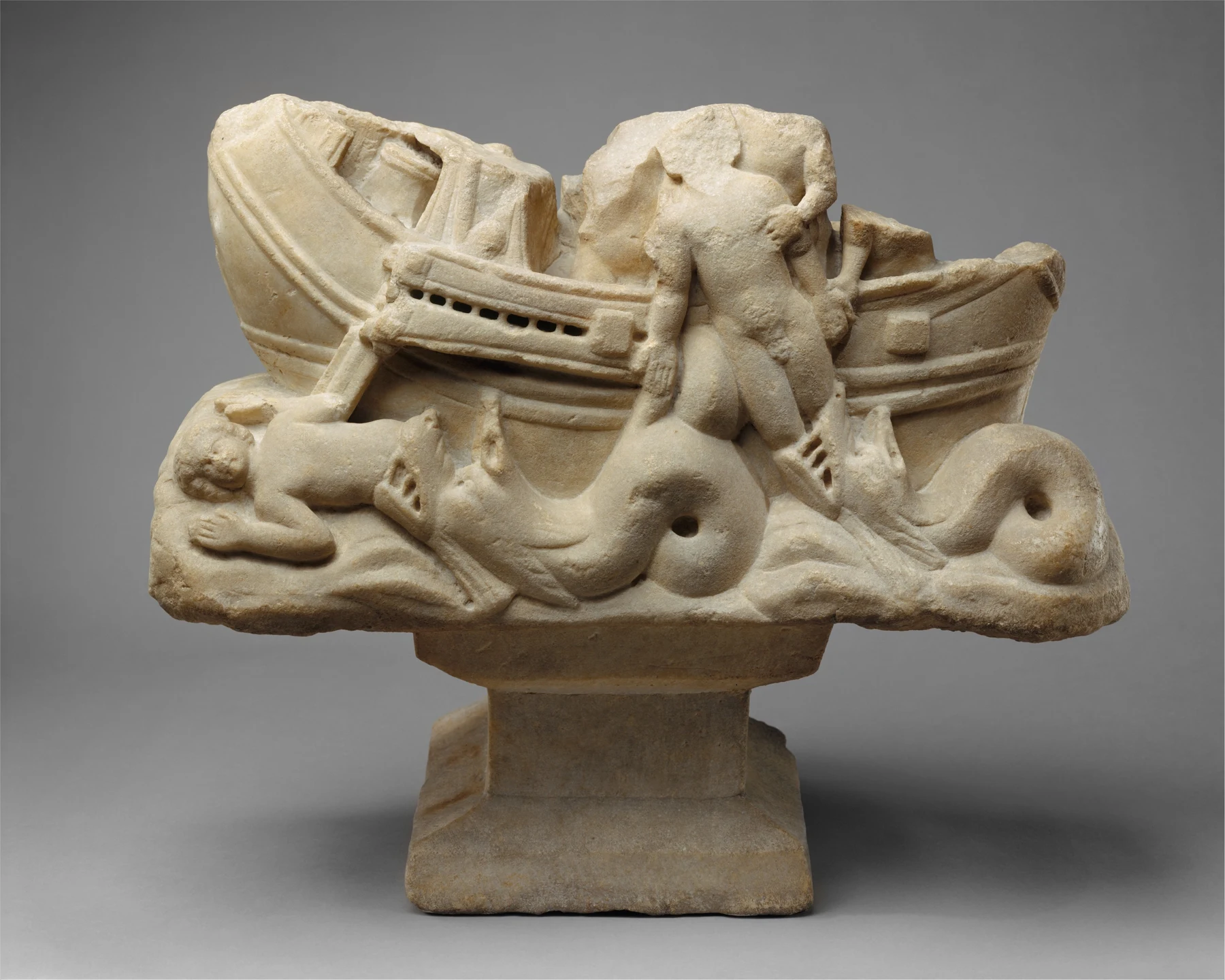
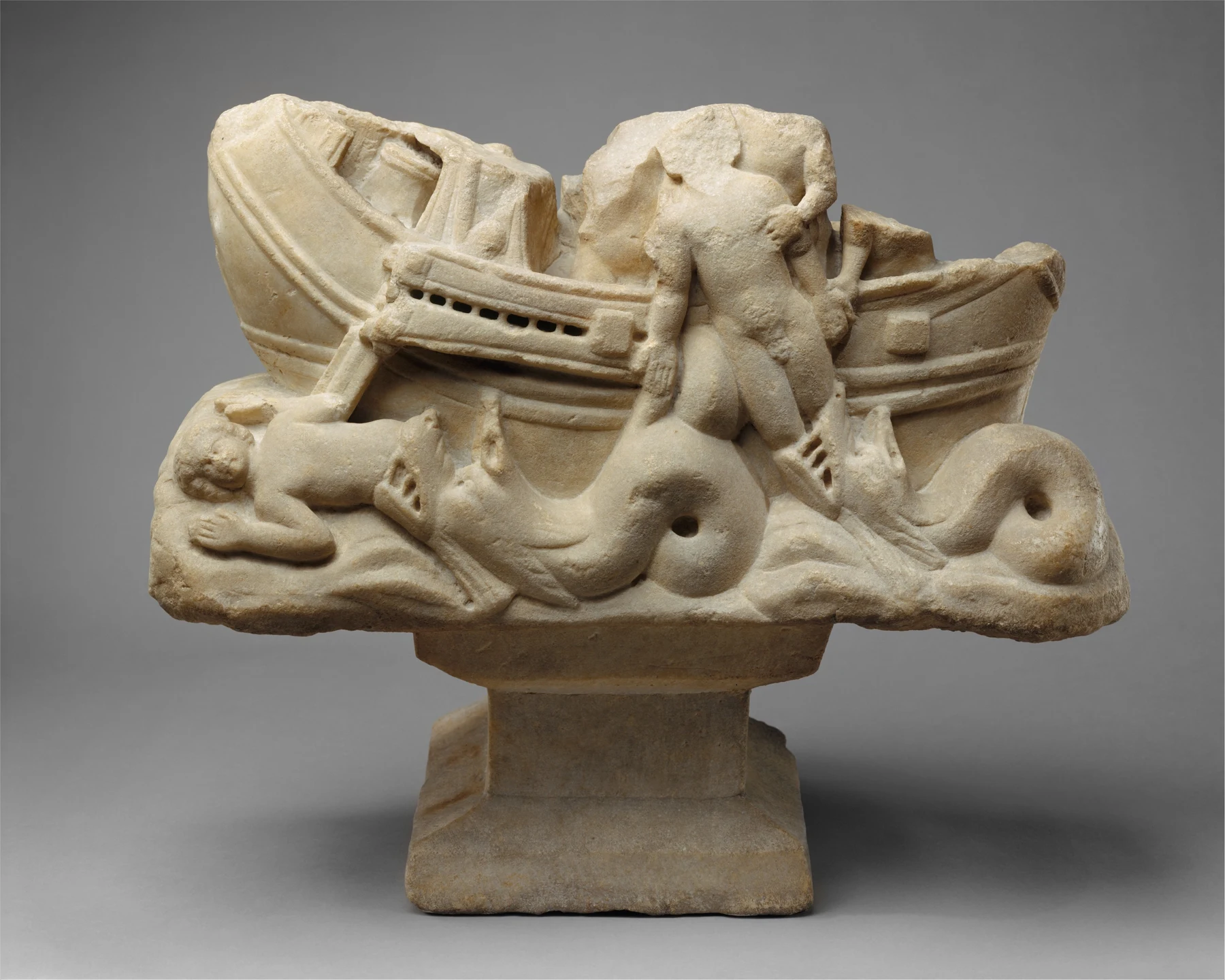
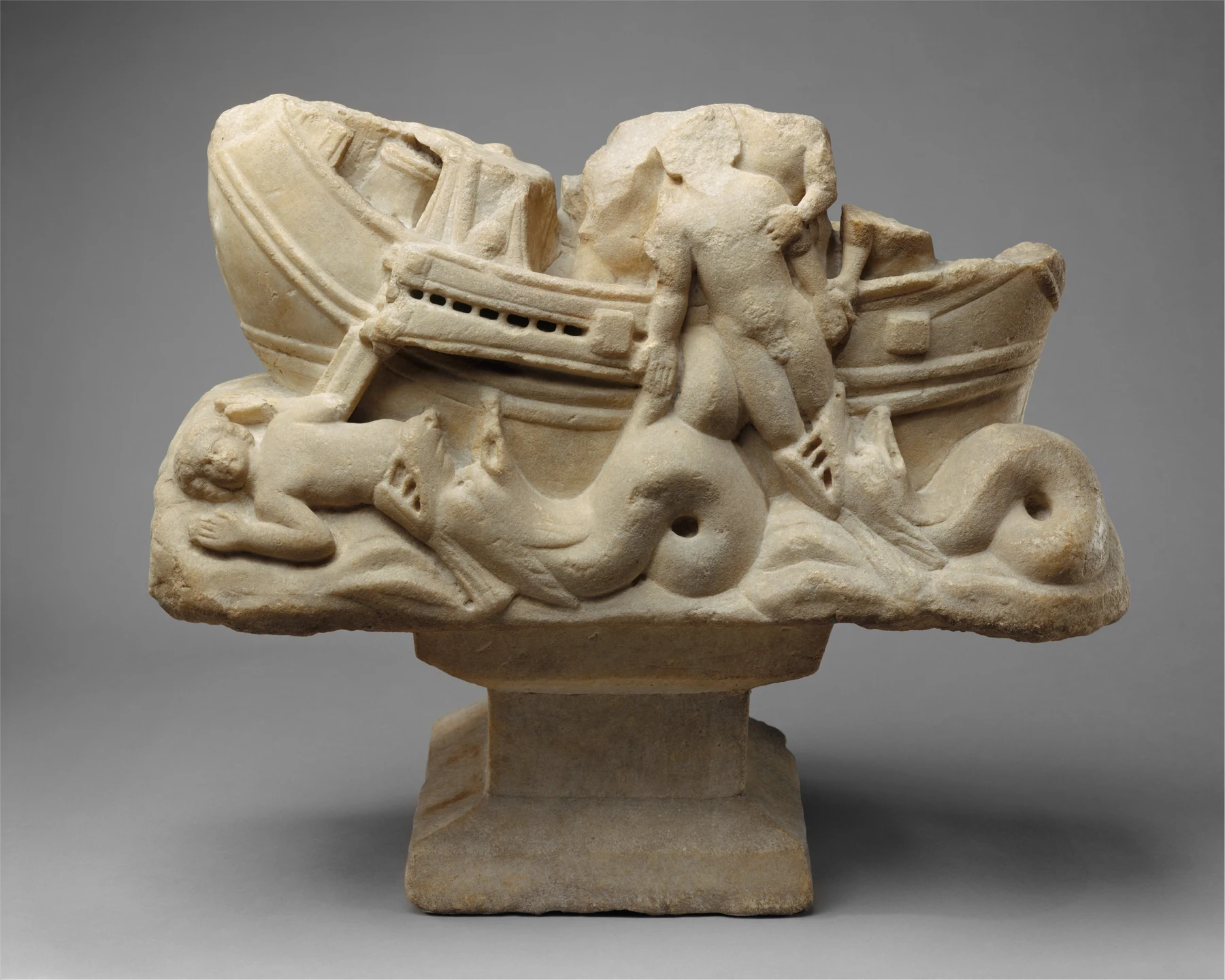
The cover is a photograph of a Roman marble table base made in Asia Minor in the early fourth century CE and found at Tarsus. It is Metropolitan Museum object 77.7. Its carving includes a ship and Jonah being swallowed and released by a twisting, fantastic sea creature. The museum explicitly describes the figure as a classical ketos and interprets the scene within Christian reception of Jonah. The photographed object is authentic; its representation is centuries later than the scriptural tradition it retells. [18]
The abstract of a study by Stefano Riccioni traces artistic changes from the monsters of Greek heroes to depictions of Jonah and later medieval forms. This helps explain how a familiar image could illustrate a different religious narrative. It does not, by itself, establish that Jonah's story originated from a Greek myth. Only the institutional abstract, not the entire Italian article, was read for this review. [15]
What is established, and what remains uncertain?
Distinguishing word, animal, image and narrative function prevents several false equations. Archaeologists have identified the bone of a real whale in an ancient Athenian context, reminding us that Mediterranean encounters with whales were not merely imaginary. Yet that find cannot identify Jonah's fish or dictate the shape of each mythical monster. Another archaeological study, available here only in abstract, proposes a different identification for a skull shown on a vase connected with Hesione; the proposal is a hypothesis about a particular image, not a consensus about kētos as a whole. [14][19]
We can establish a polysemous Greek word, distinct mythological and artistic examples, its use in Greek Jonah and Matthew, and later Christian images adapting older forms. The biological identity of Jonah's fish, the narrative's first origin and any specific route of borrowing remain questions which neither the noun nor the fourth-century sculpture can settle alone.
References and notes (17)
- Liddell, Scott and Jones, A Greek-English Lexicon, s.v. κῆτος; the published Logeion entry was read, including its literary, seal, cetacean and constellation senses. Whole displayed κῆτος lexicon entry; references Od. 12.97, 4.446–452 and Aristotle HA 566b2. Return to the text ↑
- Hebrew Jonah 2 and facing JPS English, Mechon-Mamre; the online chapter was read in full, not an original manuscript. Jonah 2:1–11, Hebrew numbering; 2:1 = conventional English 1:17, and 2:11 = 2:10. Return to the text ↑
- R. J. Cunliffe, Homeric lexicon, s.v. κῆτος at Scaife/Perseus; entry and indexed Od. 4.452 and 5.421 excerpts checked, not the complete epics. Entry κῆτος; references Iliad 13.27, 20.147; Odyssey 4.443–452, 5.421, 12.97. Return to the text ↑
- Pseudo-Apollodorus, Library 2.4.3, Andromeda and Perseus; read in J. G. Frazer’s English translation at Perseus, not the full Library. Library 2.4.3, Andromeda and Perseus rescue narrative. Return to the text ↑
- Pseudo-Apollodorus, Library 2.5.9; the Greek excerpt on the Trojan sea monster was read at the University of Exeter and compared with Frazer’s translation; no manuscript collation. Library 2.5.9; Poseidon’s kētos, Hesione’s exposure, and Heracles’ rescue. Return to the text ↑
- George E. Howard, Ionas in A New English Translation of the Septuagint (NETS), Oxford electronic second printing (2009); the indexed Jonah 2:1 excerpt was checked, but the complete PDF timed out. Pages 777 and 804–805 were NOT independently reread in this review. NETS, indexed excerpt of Ionas 2:1 only; remainder of PDF inaccessible. Return to the text ↑
- German Bible Society, Septuagint as edited by Rahlfs–Hanhart (2006); the displayed Greek Jonah 2 was read in full, without the critical apparatus or manuscript collation. Greek Ionas 2:1–11, displayed IONAS 2, with attention to verse numbering. Return to the text ↑
- Septuagint Genesis 1:21 and its Hebrew counterpart; the one verse was compared in an indexed BiblIndex search excerpt and in a separately published Hebrew text; the full BiblIndex page did not load, and no full textual study was read. Genesis 1:21, τὰ κήτη τὰ μεγάλα versus הַתַּנִּינִם הַגְּדֹלִים. Return to the text ↑
- John Boardman, “The Iconography of Sea Monsters,” Biblical Archaeology Society; the full short online sidebar was read, including Greek and Christian iconography. Displayed short essay, paragraphs on kētos iconography and Jonah. Return to the text ↑
- The Met, “Terracotta vase in the form of a ketos (sea monster),” object 2009.529; catalogue identification, qualified attribution, date and description read, not physically examined. Met 2009.529, second half of seventh century BCE; Crete or South Italy. Return to the text ↑
- Ryan Denson, “Caerulean Hounds and Puppy-Like Voices,” Classical Quarterly 73.2 (2023), 520–531, published online 2024; introduction, “The Canine Elements of the Kêtos,” relevant comparisons and conclusion read online, not all references. Section “THE CANINE ELEMENTS OF THE KÊTOS” and conclusion; DOI 10.1017/S0009838823000915. Return to the text ↑
- Matthew 12:38–42 in the King James Version via BibleGateway; the English passage was checked for its “whale” in 12:40; the Greek text is separately documented. Matthew 12:38–42 (KJV), especially 12:40; not the whole Gospel. Return to the text ↑
- Greek Matthew 12:40, SBL Greek New Testament (2010), BibleGateway; the Greek verse and immediate Matthew 12:38–42 context checked, not manuscripts or the whole Gospel. Matthew 12:40, ἐν τῇ κοιλίᾳ τοῦ κήτους, within 12:38–42. Return to the text ↑
- John K. Papadopoulos and Deborah Ruscillo, “A Ketos in Early Athens,” American Journal of Archaeology 106.2 (2002), 187–227; publisher abstract only, full article paywalled and not read. Publisher abstract: fin-whale scapula from an Athenian well, discarded ca. 850 BCE. Return to the text ↑
- Stefano Riccioni, “Dal kētos al sēnmurv?”, Hortus Artium Medievalium 22 (2016), 130–144; institutional abstract only, not the full Italian text or plates. Institutional abstract, changes in kētos imagery from Antiquity to Christian and medieval art. Return to the text ↑
- The Met, “Table Base with Jonah Swallowed and Cast Up by the Big Fish,” object 77.7 (website ID 468759); object record, photographs and Public Domain notice checked; attached image inspected full size and at 340 px. Met object 77.7; Roman marble, early fourth century CE, made in Asia Minor, found at Tarsus. Return to the text ↑
- Stephen Croft, “The Trojan Ketos on the Hesione Vase,” American Journal of Archaeology 129.1 (2025), 119–132; journal abstract only, including a proposed equid attribution of a painted skull; full article not read. Publisher abstract, Boston Hesione Vase 63.420 and proposed equid identification of the depicted skull. Return to the text ↑
Suggest a correction · Suggest a source for this record
Cite this record
IL Archive, «Kētos: the sea creature in language, myth and art», https://ilarchive.com/en/entities/ketos-sea-creature
Continue reading