Study
Esther and Persian Court Traditions: What Does Comparison Establish?
An extended study of a topic, with evidence and references.
A comparison of Esther with Persian court evidence and survival tales, distinguishing the story’s chronology and its Hebrew, Old Greek and Alpha endings.
Estimated reading time: 9 min Published Last reviewed:
Share article
Text
Introduction
How does Esther’sEsther, the biblical queenThe Jewish heroine of Esther, portrayed as becoming queen and intervening to save her community at the Persian court.Glossary · Click to read the explanation story resemble other accounts of survival at royal courts? What does knowledge of ancient Persia add to its interpretation? This study compares the narrative with evidence for Persian court life and with tales of a wise person or outsider who faces an accusation and a reversal of fortune. It also examines proposals connecting the protagonists’ names with Babylonian gods: where does comparison help, and where does the proposed connection remain uncertain?
We also compare the HebrewHebrewA Northwest Semitic language of the Canaanite group, encompassing Iron Age epigraphy, Biblical, Rabbinic, medieval and Modern Hebrew; its scripts and pronunciations changed over time.Glossary · Click to read the explanation text with two Greek traditions. God’s presence and some details of the ending change across these witnesses, revealing a story reinterpreted in different periods and communities. The aim is to understand the narrative’s history and construction while distinguishing its Persian setting from verification of its events.
A letter changes a community’s fate
A queen conceals her Jewish identity, her relative stands at the palace gate, and a powerful official can turn a personal quarrel into a decree threatening an entire people. Survival in the Book of EstherBook of EstherA book narrating Jewish communal survival at a Persian court and connecting its ending with Purim, preserved in differing Hebrew and Greek forms.Glossary · Click to read the explanation depends on entering at the right moment, disclosing an identity, and countering one royal letter with another. Court details matter because they create the danger and make its reversal possible.
Three times and three textual witnesses
The Hebrew narrative takes place under Ahasuerus, a name usually identified with Xerxes IXerxes I and AhasuerusAchaemenid king, 486–465 BCE, usually identified by name with Ahasuerus in Hebrew Esther.Glossary · Click to read the explanation, king of Persia from 486 to 465 BCE. The book’s composition is less certain. Shaul ShakedShaul ShakedShaul Shaked was a scholar of Iranian languages, Zoroastrianism and its contacts with Jewish traditions.Glossary · Click to read the explanation, a scholar of Iranian and Jewish languages and traditions, considers the third or second century BCE a possibility. That is a proposal about writing, distinct from the reign invoked by the story. [9][17]
Alongside the Masoretic Hebrew formMasoretic TextThe Hebrew Bible’s transmission tradition combining its consonantal text, transmitted vocalization and accentuation, and Masorah notes. The consonantal text has ancient roots; surviving codices that bring these layers together in their Masoretic form are medieval.Glossary · Click to read the explanation, two important Greek traditions survive: the Old Greek and the Alpha Text. The NETS translation presents them in parallel columns, introduced by Karen H. JobesKaren H. JobesBiblical Greek and Septuagint scholar, professor emerita at Wheaton; translator of the Esther traditions in NETS.Glossary · Click to read the explanation, a scholar of biblical Greek and the SeptuagintSeptuagintA name for the varied ancient Greek translations and writings associated with Jewish scripture; beginning with the Torah, the texts differ across books and manuscripts.Glossary · Click to read the explanation. The Old Greek calls the king Artaxerxes; Alpha uses Assyeros, corresponding to Ahasuerus. The versions differ in length and detail, and their relationship and stages of editing remain debated. [13]
We therefore distinguish the reign in which events are set, the writing or revision of the text, and the manuscripts that preserve it. A later copy can describe a king centuries earlier. A Greek addition can likewise reveal the story’s development without necessarily expressing something explicit in its Hebrew form.
The court constructed by the story
The book opens with a banquet and a display of wealth at SusaSusa, ancient ShushSusa is an archaeological city at Shush in southwestern present-day IranGlossary · Click to read the explanation, now Shush in southwestern IranIranIran is the modern country containing Shush, ancient SusaGlossary · Click to read the explanation, an important Achaemenid court center. Queen VashtiVashti in EstherThe queen whose refusal to appear and removal are narrated in Esther 1, before Esther’s selection.Glossary · Click to read the explanation refuses to appear. Advisers turn the disagreement into a threat to women’s obedience throughout the kingdom, and letters go out to the provinces. Chapter 1 relates her removal from the king’s presence; nudity or her execution are not stated there. [1]
Hadassah, or Esther, enters the women’s quarters and becomes queen. Esther 2:7 identifies her as Mordecai’sMordecai in EstherEsther’s relative and guardian in the story, who uncovers a plot, confronts Haman and rises at court.Glossary · Click to read the explanation cousin, whom he adopted after her parents died: he is her relative and guardian. At his direction she conceals her ancestry, while he discovers a plot against the king that is entered in the record. The opening joins concealed identity with service not yet rewarded. [2]
Mordecai refuses to bow to the influential official HamanHaman in EstherThe powerful court official opposing Esther and Mordecai, whose scheme to kill the Jews turns against him.Glossary · Click to read the explanation. The text mentions his Jewish identity. Haman then extends the quarrel to all Jews, accusing them of different laws and disobedience to royal commands. A decree authorizes the killing of young and old and women on a date chosen by lot. Administrative tools become instruments of danger: the royal seal, scribes, provincial languages, and couriers. [3]
Esther calls for fasting and risks entering the royal presence uninvited. She delays revealing her request through two banquets. Between them, a sleepless night and the reading of an old record produce an ironic reversal: Haman must honor Mordecai. When his scheme is exposed, he is killed on the wooden device prepared for his opponent. Delay, irony, and exchanged positions give the narrative its force. [4][5][6]
What does Persian history support?
The Achaemenid world was a multiethnic empire with extensive ranks, services, and communications. Muhammad A. DandamaevMuhammad A. DandamaevHistorian of ancient Iran and Mesopotamia (1928–2017), associated with the Russian Academy’s Institute of Oriental Manuscripts.Glossary · Click to read the explanation, a historian of ancient Iran and MesopotamiaMesopotamiaHistorical region associated with the Tigris and Euphrates: Uruk, Ur, Eridu, cuneiform, Sumer, Akkad, Babylon and Assyria, their languages and cults, and the limits of archaeological evidence.Glossary · Click to read the explanation, reconstructs court organization from inscriptions, documents, and Greek accounts. His material helps place features of Esther within a known Persian setting: officials’ access to the king, rewards for service, and attention to correspondence. [10]
In Histories 8.98, HerodotusHerodotusFifth-century BCE Greek historian whose account of the Persian Wars includes reports on peoples, court and empire.Glossary · Click to read the explanation, the fifth-century BCE Greek historian, describes men and horses relaying messages over successive stages. This independently attests a means of communication appropriate to Esther’s decrees, although his passage concerns another account and says nothing about Haman’s letter. [12]
Comparison also reveals differences. Herodotus 3.84 describes privileged palace access for an elite group and restrictions on royal marriage. This resembles the importance of those close to the king in Esther 1:14 but raises a question about choosing a queen outside the named families. These are two ancient accounts with their own purposes and sources, rather than identical copies of a single law. [11]
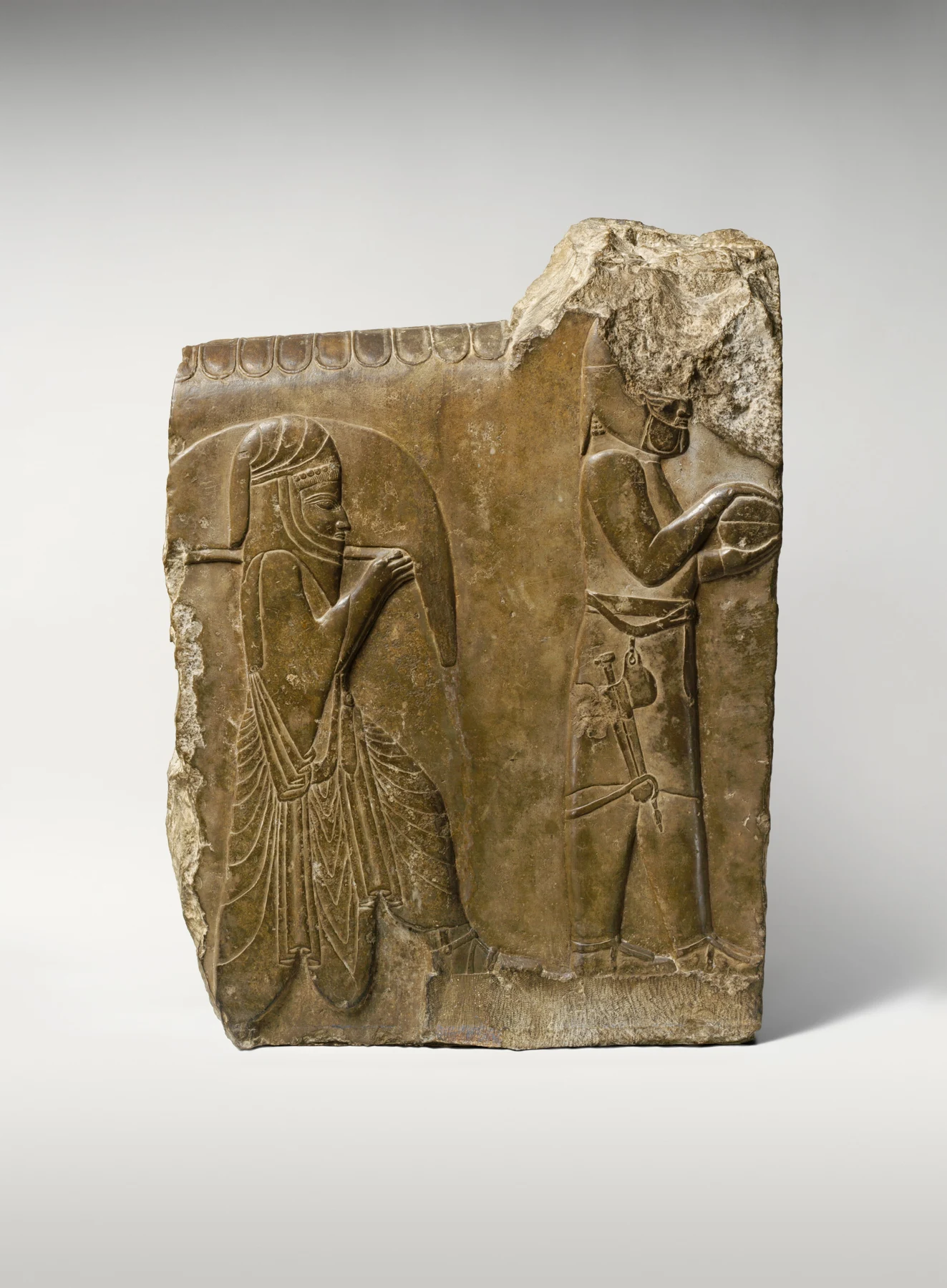
The study’s cover is a relief of servants carrying food and drink from PersepolisPersepolisAchaemenid royal center in southwestern Iran, begun by Darius I around 518 BCE.Glossary · Click to read the explanation, an Achaemenid royal center in southwestern Iran. The Met dates it to about 358–338 BCE, under Artaxerxes IIIArtaxerxes IIIFourth-century BCE Achaemenid king, more than a century after Xerxes I; the museum assigns the servants relief to his reign.Glossary · Click to read the explanation. It shows the representation of banquet service more than a century after Xerxes; it depicts neither Esther nor Haman nor their feast. [15]
Such correspondences help explain the setting; identifying the people and verifying the events remain separate questions. Esther 8:8’s rule that a sealed royal document cannot be revoked explains the protagonists’ resort to a counter-decree within the plot. Extending it into an unchanging law throughout Persian history would require broader evidence. [7]
Joseph, Daniel, and Ahiqar: what does comparison add?
Court talesCourt TaleAn analytical category for stories in which a sage or outsider faces tests of skill, loyalty, or survival at a royal court, through contest, accusation, or reversal; it does not establish one textual origin.Glossary · Click to read the explanation place a vulnerable person close to power and exposed to its dangers. DanielDaniel in the biblical bookDaniel is the Jewish sage and visionary in the biblical book bearing his name.Glossary · Click to read the explanation excels in interpretation and wisdom; AhiqarAhiqar the wise figureAhiqar is a wise figure in ancient Aramaic traditions.Glossary · Click to read the explanation faces slander; Esther relies on intercession, disclosed identity, and well-timed speech. The Daniel and Ahiqar study and the Joseph and Two Brothers study explore these contexts further.
Shared narrative functions take a distinctive form in Esther. An accusation threatens a whole people; favor is sought through banquets; deliverance turns on a recorded service and an identity disclosed at the decisive moment. The opponent must then honor the man he planned to kill. The story ends with an annual commemoration of communal survival rather than simply an individual’s promotion.
These similarities help locate the book in a familiar narrative world. Jewish connections with Babylonia and Persia could have enabled stories to circulate and be reshaped. Arguing for dependence on one particular tale, however, requires a more specific combination: a distinctive sequence or shared wording, an earlier witness, and plausible historical contact. The comparison presented here does not supply enough evidence to identify a single source for the plot.
Do the names conceal a Babylonian myth?
Scholars have discussed a connection between Mordecai’s name and the Babylonian god MardukMardukBabylon’s leading god, worshipped at Esagil and elevated in the Akkadian Enūma eliš. His symbols include a spade and mušḫuššu dragon. His earliest origins remain obscure; Nibiru is no evidence of a planetary homeland.Glossary · Click to read the explanation, and between Esther and IshtarInanna / IshtarA prominent Mesopotamian goddess whose Sumerian name Inanna became associated with Akkadian Ishtar across diverse traditions. She was associated with desire, war, royal authority and Venus, while local forms and genealogies varied among texts.Glossary · Click to read the explanation. These possible links in the history of names deserve investigation, but they differ from identifying the characters as renamed gods. Shaked found reconstructions of the story as a Babylonian or Elamite myth unpersuasive while retaining discussion of names and cultural setting. [9][16]
A name of religious origin can remain in use far beyond its original time and community. Interpreting Esther as a transformation of a particular myth would require comparing that myth’s events and character roles with Esther’s, alongside chronology and plausible contact. A name connection by itself does not reconstruct the proposed earlier tale.
How did Greek versions make God’s presence explicit?
God is not named explicitly in the Hebrew form. We find fasting, Mordecai’s expectation that relief will come from another place, and decisions and coincidences that reverse the outcome. Readers can understand divine providence behind these events, though the narrative does not state it where the Greek versions later expand the story. [4]
The Greek Additions to EstherGreek Additions to EstherSix units (A–F) embedded in Greek Esther: Mordecai’s dream and its meaning, two royal edicts, two prayers and Esther’s audience. Hebrew and Greek comparisons reveal variant forms and the limits of historical inference.Glossary · Click to read the explanation place a dream and its interpretation around the narrative in Additions A and F. B and E expand the royal letters. C includes the prayers of Mordecai and Esther, while D elaborates the queen’s approach and attributes the king’s change of disposition to God. Mordecai’s prayer explains his refusal to bow as defending divine glory: an explicit rationale beyond what Hebrew chapter 3 states. [13]
Jill MiddlemasJill MiddlemasHebrew Bible and reception scholar at the University of Gothenburg, studying Esther’s reinterpretation across time.Glossary · Click to read the explanation, a scholar of the Hebrew Bible and its reception, reads these changes as reinterpretation within communities inheriting the story. Here we can compare actual textual witnesses and observe religious emphasis being redirected. The sequence of editing and the precise relationship between the two Greek traditions nevertheless remain under investigation. [14]
Purim and the story’s ending
The book connects the name PurimPurimJewish festival connected in Esther with rescue and lots; the book’s explanation alone does not establish the first historical origin of every element.Glossary · Click to read the explanation with the lot cast by Haman. Esther 9:20–32 describes commemorating deliverance through feasting, joy, gifts of food, and aid to the poor. This is the narrative’s explanation of the festival. The historical emergence of all its elements is a broader question; proposed comparisons with Iranian festivals remain disputed. [8][9]
The ending also contains extensive violence. Esther 8:11 allows Jews to assemble and defend their lives, then uses language of killing and destruction against attacking forces, includes children and women, and permits plunder. Hebrew chapter 9 reports 75,000 killed in the provinces, in addition to those at Susa, and repeatedly says that no spoil was taken. Esther requests another day of fighting at Susa. The narrative thus combines survival, vengeance, and the expansion of new power. [7][8]
Numbers and some actions vary across the texts. In NETS, Old Greek 9:16 gives 15,000; the Alpha ending gives 70,100. Old Greek 9:10 mentions plundering, whereas 9:15–16 denies it. Each description belongs to its own passage rather than characterizing the entire version. These are real differences in the literary shaping of the ending, not figures from an independent archaeological census. [13]
A historical account preserves both the threatened community’s survival and the violence narrated after the reversal of power. Ethical and religious interpretations of this ending have varied over time, as Middlemas’s reception study illustrates. Describing an ancient text differs from passing judgment on present-day religious communities. [14]
What do the witnesses reveal?
Comparison shows Esther using the court world to tell a story about Jewish life within an empire. Who has access to the king? How can concealed identity become a means of deliverance? What happens when power passes from the enemy to the protagonists? Persian evidence and other court tales illuminate these questions, while precise composition dates and a single origin for the events remain open.
Hebrew–Greek differences provide clearer evidence for changes within the story itself, from making God’s role explicit to reshaping its ending. Connecting Esther with Ishtar and Mordecai with Marduk belongs to the discussion of names and proposed origins, at a different level of demonstration. Keeping these distinctions allows us to trace resemblance, shared traditions, and reinterpretation without treating all of them as established borrowing.
Further reading: Similarity Is Not Borrowing and Qumran and Textual Plurality, alongside the Joseph and Daniel studies linked above.
References and notes (17)
- Esther 1:1–22, Hebrew and facing English: banquets and Vashti’s refusal. Esther 1:1–22, Hebrew and facing English: banquets and Vashti’s refusal. Return to the text ↑
- Esther 2:1–23: names, kinship, adoption and discovery of the plot. Esther 2:1–23: names, kinship, adoption and discovery of the plot. Return to the text ↑
- Esther 3:1–15: refusal to bow, accusation and decree. Esther 3:1–15: refusal to bow, accusation and decree. Return to the text ↑
- Esther 4:1–17: fasting, the risk of royal entry and relief from another place. Esther 4:1–17: fasting, the risk of royal entry and relief from another place. Return to the text ↑
- Esther 5:1–14: royal entry, banquets and Haman’s scheme. Esther 5:1–14: royal entry, banquets and Haman’s scheme. Return to the text ↑
- Esther 6:1–14 and 7:1–10: service record, honor and reversal. Esther 6:1–14 and 7:1–10: service record, honor and reversal. Return to the text ↑
- Esther 8:1–17, especially 8:8 and 8:11: counter-decree within the narrative. Esther 8:1–17, especially 8:8 and 8:11: counter-decree within the narrative. Return to the text ↑
- Esther 9:1–32: Susa, provincial figures, spoil and Purim’s institution. Esther 9:1–32: Susa, provincial figures, spoil and Purim’s institution. Return to the text ↑
- Shaul Shaked, Esther, Book of, Encyclopaedia Iranica VIII/6,655–657, 1998, updated 2017: dating, setting and names. Shaul Shaked, Esther, Book of, Encyclopaedia Iranica VIII/6,655–657, 1998, updated 2017: dating, setting and names. Return to the text ↑
- M. A. Dandamaev, Courts and Courtiers i: In Pre-Islamic Iran, Iranica VI/4,356–359, 1993, updated 2013: court organization, household and officials. M. A. Dandamaev, Courts and Courtiers i: In Pre-Islamic Iran, Iranica VI/4,356–359, 1993, updated 2013: court organization, household and officials. Return to the text ↑
- Herodotus, Histories 3.84, G. C. Macaulay translation: access and marriage privileges in the Greek account. Herodotus, Histories 3.84, G. C. Macaulay translation: access and marriage privileges in the Greek account. Return to the text ↑
- Herodotus, Histories 8.98, Macaulay translation: relay couriers. Herodotus, Histories 8.98, Macaulay translation: relay couriers. Return to the text ↑
- Karen H. Jobes, Esther in NETS, 2007, introduction, pp. 424–425; Additions A–F and selected endings, especially pp. 438–440. Old Greek and Alpha are distinguished; the two full translations were not read. Karen H. Jobes, Esther in NETS, 2007, introduction, pp. 424–425; Additions A–F and selected endings, especially pp. 438–440. Old Greek and Alpha are distinguished; the two full translations were not read. Return to the text ↑
- Jill Middlemas, Esther in the eye of the beholder: Interpretation in antiquity and modern times, 2026: introduction,§1.1 and selected reception/violence passages, not the whole article. Jill Middlemas, Esther in the eye of the beholder: Interpretation in antiquity and modern times, 2026: introduction,§1.1 and selected reception/violence passages, not the whole article. Return to the text ↑
- Metropolitan Museum, Relief: two servants bearing food and drink,34.158, Persepolis, about 358–338 BCE; Harris Brisbane Dick Fund, 1934. Object record, photograph and public-domain metadata. Metropolitan Museum, Relief: two servants bearing food and drink,34.158, Persepolis, about 358–338 BCE; Harris Brisbane Dick Fund, 1934. Object record, photograph and public-domain metadata. Return to the text ↑
- Shaul Shaked, Haman, Iranica XI/6,629, 2003, updated 2017: character and proposed etymologies. Shaul Shaked, Haman, Iranica XI/6,629, 2003, updated 2017: character and proposed etymologies. Return to the text ↑
- UNESCO World Heritage, Persepolis, property 114: foundation and royal chronology, including Xerxes 486–465 BCE. UNESCO World Heritage, Persepolis, property 114: foundation and royal chronology, including Xerxes 486–465 BCE. Return to the text ↑
Suggest a correction · Suggest a source for this record
Cite this record
IL Archive, «Esther and Persian Court Traditions: What Does Comparison Establish?», https://ilarchive.com/en/studies/esther-and-ancient-court-narratives
Continue reading