Study
Joseph and the Tale of Two Brothers: A False Accusation in Egypt
An extended study of a topic, with evidence and references.
- Region
- Egypt and the Levant
A documented comparison of Papyrus D’Orbiney, Genesis 39 and Sūrat Yūsuf: a similar overture–refusal–accusation scene, but different garments, outcomes and uncertain pathways of transmission.
Share article
Text
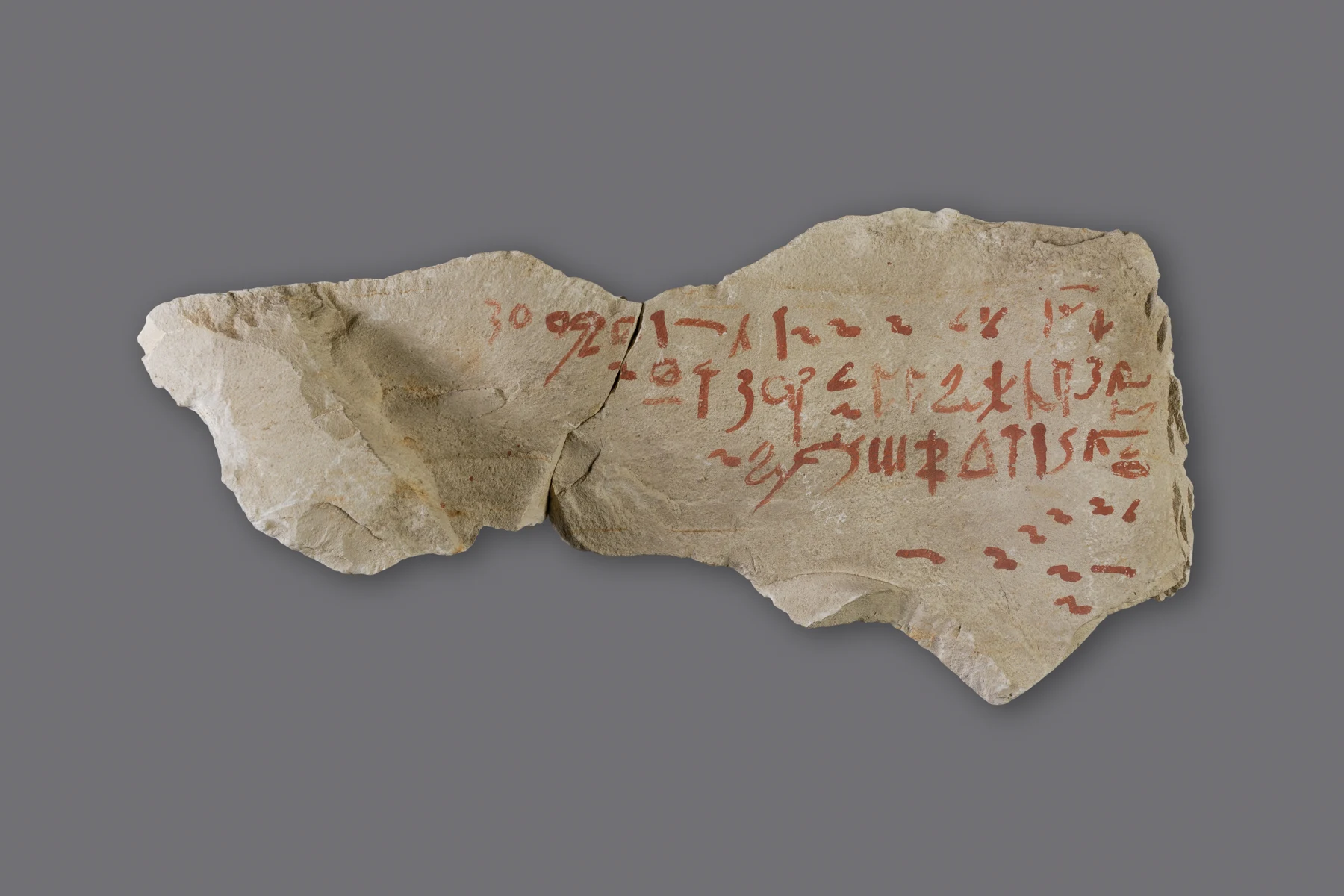
In an Egyptian papyrus written roughly 3,200 years ago, a young man rejects an offer from a woman in the household where he works. She reverses the encounter in her account to the householder, and his refusal puts his life in danger. Readers of Genesis know a similar scene: Joseph refuses his master's wife and goes to prison after her accusation. The resemblance is real, but it does not turn Joseph's story into a copy of the Egyptian papyrus. The surviving “Tale of the Two BrothersPapyrus D’Orbiney: Tale of the Two BrothersThe sole known Egyptian copy of Bata and Anubis’s tale, written by Inena in the Nineteenth Dynasty around 1215 BCE.Glossary · Click to read the explanation” witnesses an early Egyptian form of a narrative scene. No document preserves a path by which this particular tale reached Genesis 39, if a specific transmission occurred at all. [1][2][3]
A dated witness, not a birth certificate for the story
The manuscript called Papyrus D'Orbiney is British Museum EA10183. The museum assigns it to the Nineteenth Dynasty, dates its copying to about 1215 BCE and identifies its scribe as Inena. It is the only known copy of the tale. The museum considers the surviving written version probably close in date to the composition, but this is an assessment of a manuscript and its text, not evidence that no one told elements of the story earlier. Nor is the original discovery context of this group of papyri documented well enough to chart the story's circulation beyond Egypt. [1][2]
The account below is read in Miriam Lichtheim's translation; it is not an independent reading of every hieratic sign. The Egyptian tale is not an “early Joseph story” with changed names. Its figures are Anubis, the elder brother who has a house and wife, and Bata, the younger brother who lives with him, tends his cattle and works his fields. Bata's strength and industry form part of the opening before the attempted seduction. [3]
What happens to Bata?
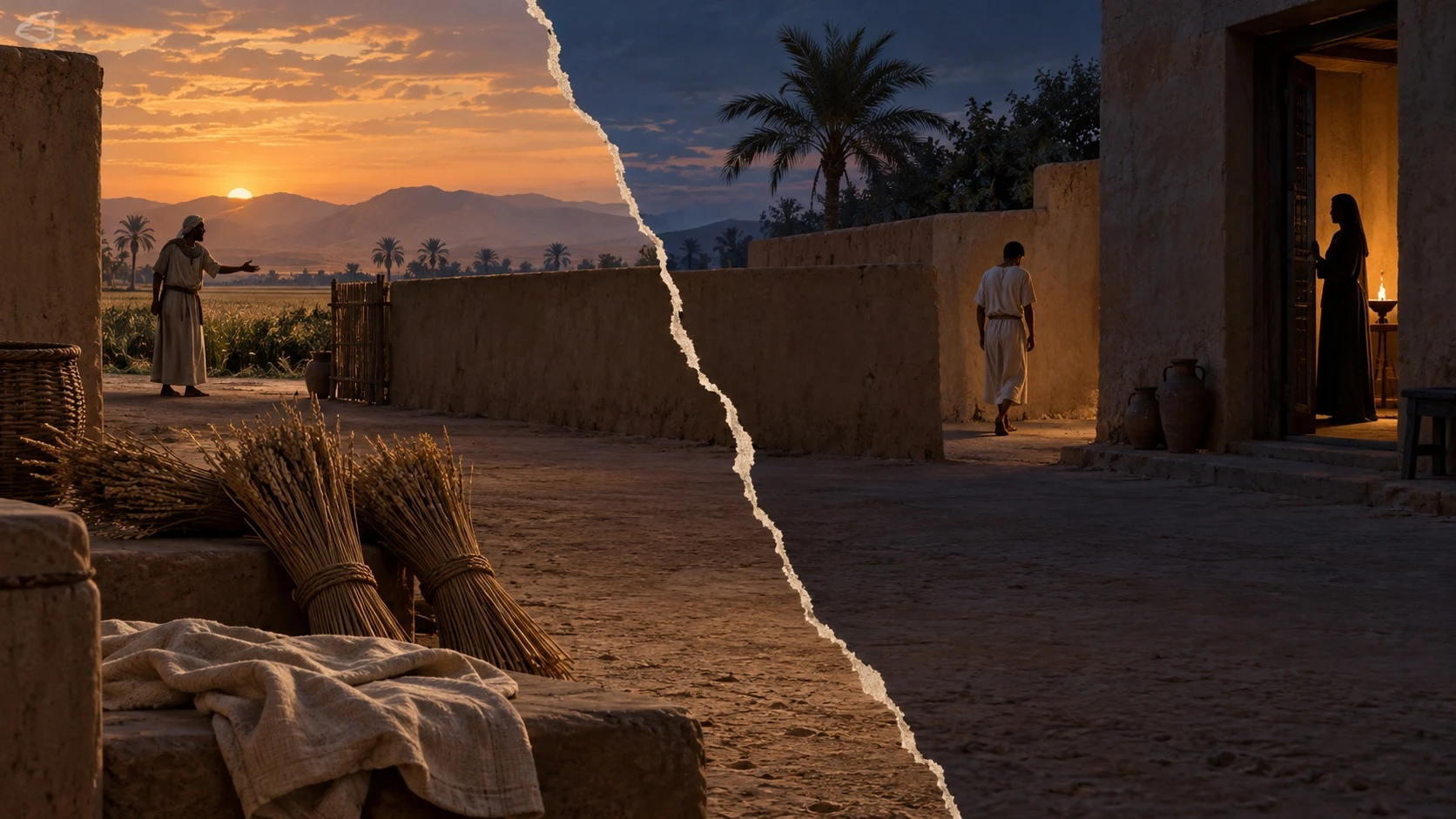
When Bata returns from the field to fetch seed, his elder brother's wife desires him and invites him to sleep with her. She offers to make fine clothes for him. He rebukes her: she is like a mother to him and his elder brother like the father who raised him. He returns to work without telling Anubis. Fearing exposure, the woman makes herself appear injured and tells her husband the opposite story: Bata, she says, proposed the encounter and struck her when she rejected him. Anubis initially believes her and waits with a weapon. Cattle warn Bata, who flees; a god then separates the brothers with crocodile-filled water. Bata explains the episode and, in a drastic attempt to prove his innocence, cuts off his own genitals before his brother. Anubis recognizes the deception, returns home and kills his wife. That closes the first accusation episode, not the entire “Tale of the Two Brothers.” [3]
The papyrus then moves far beyond anything in Joseph's episode. Bata departs, puts his heart in a tree, dies and is restored to life, takes the form of a bull and later of two trees, is born again, and eventually becomes king of Egypt. Removing these episodes and declaring the two whole plots identical would distort both works. Comparing one passage is useful if we continue to see the rest of its story. [3]
What happens to Joseph in Genesis?
In Genesis 39, Joseph is brought to Egypt as a purchased slave, and Potiphar places him over his household. The text describes his good looks. His master's wife then asks him to sleep with her. He refuses, pointing both to his master's trust and to the wrong it would be before God. She repeats the request. One day, when no other household men are present, she seizes his garment; he leaves it in her hand and escapes. She uses the garment as she accuses him first before the household and then before her husband of trying to assault her. Potiphar becomes angry and puts Joseph in prison. In the larger Joseph narrative, prison is a route toward dream interpretation, management of famine and reconciliation with his brothers, rather than the end of his journey. [4]
The stories therefore share a relatively precise sequence: a capable young man in the house of a socially superior man, a proposition by that man's wife, refusal, the woman's reversal of her own proposal into an accusation, and an initial response by the householder before the young man is heard. Yet in the Egyptian text the kinship relation makes the danger a rupture within a brotherly household. In Genesis, slavery and foreignness make the charge against a “HebrewHebrewA Northwest Semitic language in the Canaanite group, with ancient and modern forms.Glossary · Click to read the explanation slave” part of an imbalance of social power. Potiphar does not kill his wife; Joseph does not establish his innocence before Potiphar in this scene. [3][4]
Clothing does different work in the three texts
The shared “garment” sometimes looks like the strongest parallel. It needs to be checked as a narrative detail, however, rather than counted as a common object. In the Egyptian papyrus, the wife promises to make Bata beautiful clothes as part of her invitation. She does not retain his clothes as evidence of an alleged assault. In Genesis 39, the woman holds Joseph's garment after his flight and uses its presence with her to support the charge. In Qur'an 12, a later telling of the Joseph story rather than another version of Papyrus D'Orbiney, his shirt is torn from behind as both run toward the door. The direction of the tear becomes evidence against the woman's accusation. Imprisonment nevertheless follows later. A piece of clothing can occur in three accounts while serving three different narrative functions. [3][4][5]
The Qur'an does not call this woman “Potiphar's wife” in these verses. It refers to the woman in whose house Joseph lives and then to the wife of al-ʿAzīz. Reading the biblical name into the wording of these verses would be inaccurate. The sūra foregrounds Joseph's appeal to God, uses the torn shirt to test competing accounts, and then describes the story's spread among the city's women. These are choices of the Qur'anic narration. They belong to the long reception history of Joseph, and they are not independent evidence that its speaker or audience had read a thirteenth-century BCE Egyptian papyrus. [5]
Was Egypt the only home of this scene?
In book 6 of the *IliadIliadGreek epic attributed to Homer, narrating a phase of the Trojan War.Glossary · Click to read the explanation*, another recognizable sequence appears. Anteia propositions Bellerophon; he refuses; she falsely accuses him to her husband, King Proetus, who sends him to Lycia carrying a dangerous message. The details are not identical to the Egyptian or biblical scenes, but the sequence of overture, refusal and accusation extends beyond two works. Comparative literary studies use the name “Potiphar's wife motif,” or treat it as a recurring literary situation, to follow its changing forms. The conventional label does not mean that all occurrences sprang from Genesis. [6][12]
Susan Tower Hollis has warned that the widespread occurrence of such tale elements makes direct Egyptian borrowing equivocal, even though the similarity between Bata and Joseph is striking. Contact between Egypt and the LevantThe LevantThe Levant is a regional name for lands along the eastern MediterraneanGlossary · Click to read the explanation makes the movement of stories historically possible; possibility is not a chain of manuscripts. We have no preserved intermediate text linking D'Orbiney to Genesis 39, nor a rare verbatim match that establishes a direction of copying. The securely earlier Egyptian manuscript is an earlier surviving witness. It cannot show that Inena invented the motif or that every later use came from his copy. [7][1][3]
How far can chronology and comparison take us?
The date of Genesis 39 is itself under discussion. Bernd Schipper argues that the Joseph narrative as transmitted fits Late Period Egypt and the Jewish communities of the Persian era better than an immediate record of New Kingdom Egypt. Thomas RömerThomas RömerScholar of Hebrew Bible history and composition, holding the Biblical Milieux chair at the Collège de France.Glossary · Click to read the explanation proposes that the Joseph-and-Egyptian-wife episode was added to an earlier Joseph narrative to portray him as a model of wisdom, with comments on divine providence added in a further stage. By contrast, Nili Shupak proposes a layered history that gives the underlying story greater antiquity while recognizing redaction down to much later times. Jan Joosten also notes how disputed a linguistic dating of the Joseph story remains. These are published positions, not dates established by the papyrus. For the present study we checked the scholars' abstracts, not their complete articles. [8][9][10][11]
The conclusion can therefore be graded without judging the religious value of any text. It is certain that a late Nineteenth-Dynasty Egyptian papyrus preserves the rejected overture and false accusation before the biblical witnesses now available to us. It is also certain that Genesis 39 and Sūrat Yūsuf contain related scenes with significant structural differences. It is possible that Egyptian or wider eastern Mediterranean storytelling traditions contributed to the Hebrew episode. A claim that the author of Genesis 39 took wording or plot directly from this particular D'Orbiney papyrus, or that the Qur'an independently returned to it, remains unproven. The comparison matters because it reveals the long life of a narrative scene while compelling us to notice what each text made of it. [3][4][5][7]
References and notes
- The indexed museum catalogue was read in full, not images of the papyrus signs; direct opening failed. British Museum, Papyrus D’Orbiney EA10183/1, full indexed catalogue and curator synopsis Return to the text ↑
- Entire short university page read; it identifies the sole copy and limits the find context. UCL Digital Egypt, Ramesside manuscript group, complete page Return to the text ↑
- Translation, introduction and notes, pp. 203–211, read in extracted PDF text; hieratic original not read and some OCR is damaged. Miriam Lichtheim, “The Two Brothers,” Ancient Egyptian Literature II, pp. 203–211 Return to the text ↑
- All of Genesis 39:1–23 read in Hebrew and facing translation, especially 6–20. Genesis 39:1–23, vocalized Hebrew and facing English Return to the text ↑
- Arabic 12:23–30 and parallel English 23–35 read; not the entire sūra. Qur’an 12:23–35, Arabic 12:23–30 and parallel English 12:23–35 Return to the text ↑
- Iliad 6:156–190 read in Murray’s English; Greek original and rest of the epic not read. Iliad 6:156–190, A. T. Murray English translation, Scaife ATLAS Return to the text ↑
- Publisher listing/abstract and indexed excerpt checked, not all pp. 209–222; the author’s view on borrowing is attributed. Susan Tower Hollis, “Out of Egypt: Did Israel’s Exodus Include Tales?” (2015), abstract and indexed excerpt Return to the text ↑
- Publisher abstract only; Late Period thesis attributed to Schipper, not called consensus. Bernd U. Schipper, “The Egyptian Background of the Joseph Story” (2019), publisher abstract Return to the text ↑
- Publisher abstract only; Genesis 39 supplementation is attributed to Römer. Thomas Römer, “Genesis 39 and the Composition of the Joseph Narrative” (2019), publisher abstract Return to the text ↑
- Publisher abstract only; the paywalled article was not read. Nili Shupak, “The Joseph Story … from an Egyptological Perspective” (2025), publisher abstract Return to the text ↑
- Oxford repository abstract only; PDF request returned 403. Jan Joosten, “The linguistic dating of the Joseph Story” (2019), Oxford repository abstract Return to the text ↑
- University publication entry and abstract read, not the full paper. Maleki, Nazemi and Laguna Mariscal, “The scheme of Potiphar’s wife” (2020), university abstract Return to the text ↑
Suggest a correction · Suggest a source for this record
Cite this record
IL Archive, «Joseph and the Tale of Two Brothers: A False Accusation in Egypt», Edition 1, https://ilarchive.com/en/studies/joseph-and-two-brothers
Continue reading