Artifact
Papyrus D’Orbiney: Tale of the Two Brothers
An object record bringing together its image, metadata, rights, and context.
Unique hieratic witness to the tale of Anubis and Bata (c. 1215 BCE): from false accusation through an external heart, rebirth and kingship, with a critical Joseph comparison.
Estimated reading time: 10 min Published Last reviewed:
Share article
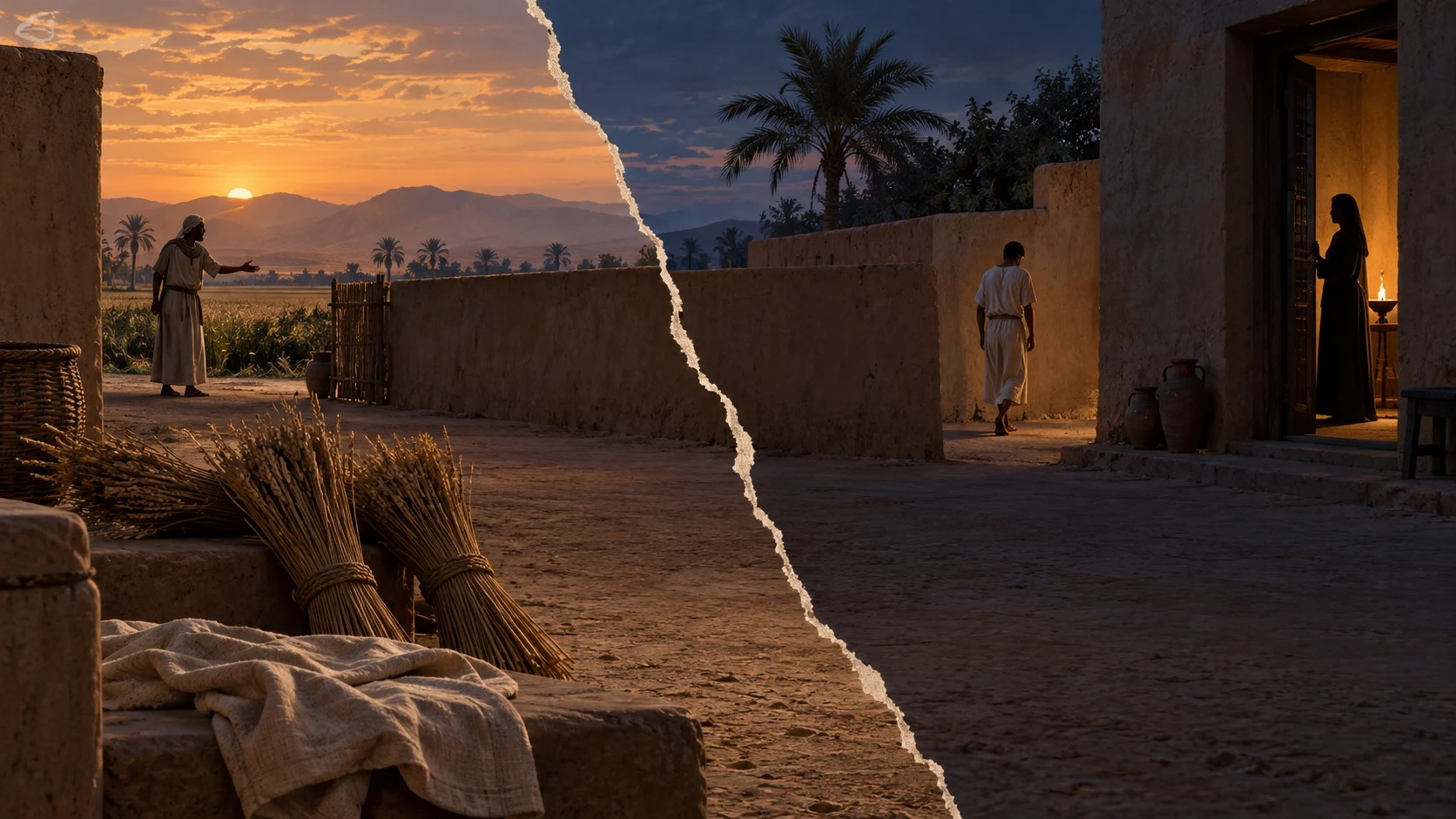
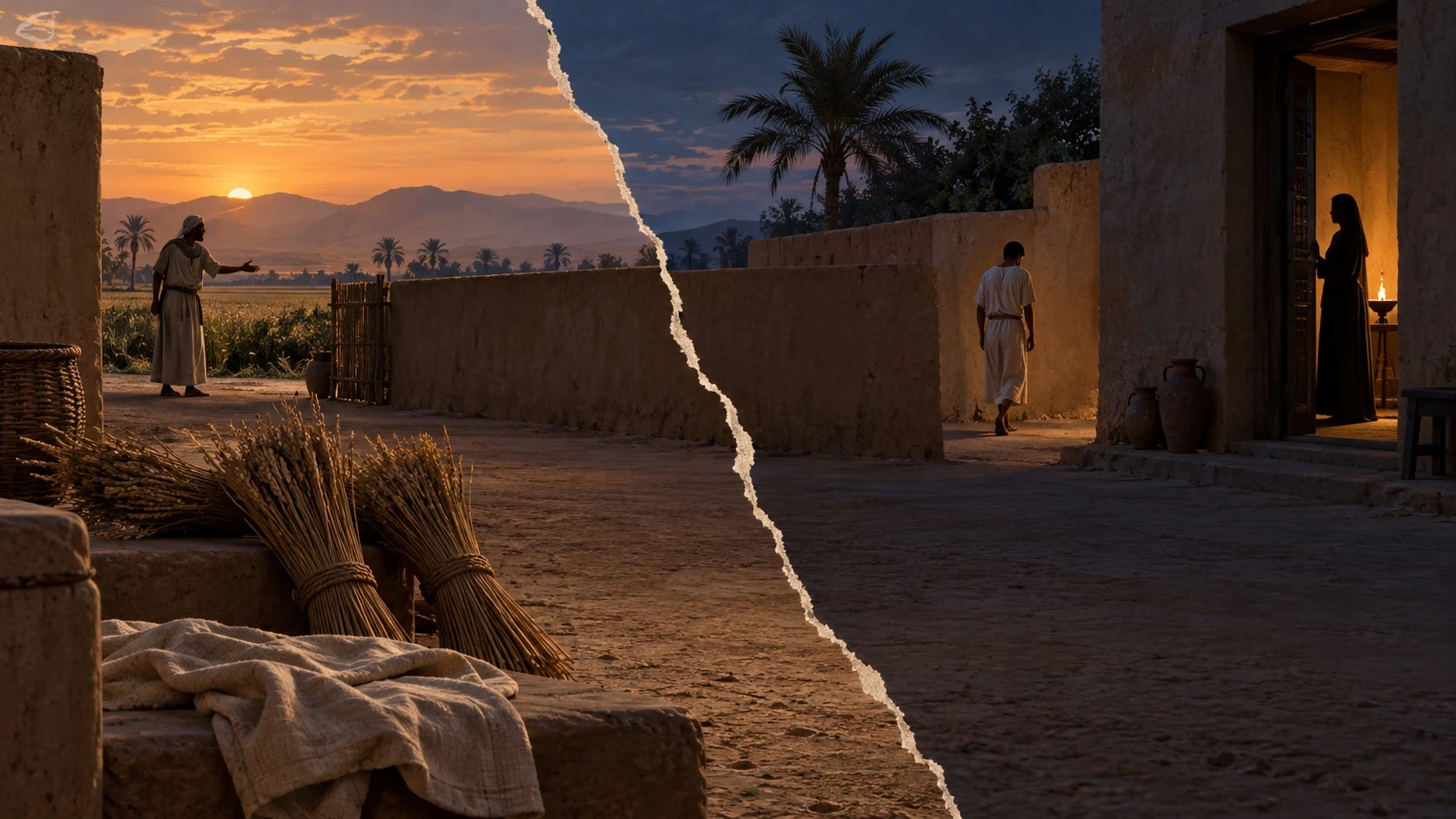
Illustration — not a photograph of the original object
IL Archive; editorial illustration generated with AI (2026) · CC0
Modern interpretive illustration of a household divided after Bata’s accusation; not a photograph of EA10183 or a verified historical reconstruction
Object details
- Title
- Papyrus D’Orbiney: Tale of the Two Brothers
- Rights
- CC0
Text
Introduction
Papyrus D’Orbiney, British Museum EA10183, is the only known Egyptian manuscript of the Tale of the Two Brothers, AnubisAnubis, Bata’s elder brotherElder brother called Anub or Anubis in the tale, initially believing his wife’s charge, then recognizing her deception.Glossary · Click to read the explanation and BataBata in the Tale of the Two BrothersYounger brother in the Egyptian tale preserved by D’Orbiney, accused and later transformed before attaining kingship.Glossary · Click to read the explanation. Its importance goes well beyond the attempted seduction and false accusation: separation, death and restoration, successive transformations, and the younger brother’s accession to kingship occupy the rest of the story. It is a physical New Kingdom manuscript transmitting literature, not a direct record of Egyptian household behaviour or proof of when every element of the tale first arose. [1][2][3]
The manuscript and the date of its copy
The surviving manuscript contains nineteen columns of literary Late Egyptian written in hieratic on papyrus, with black and red ink. The British Museum now houses its leaves in separate frames; the first is EA10183,1. The museum dates its production to approximately 1215 BCE, in the Nineteenth Dynasty. That dates the surviving witness, not necessarily the invention of the story in precisely that year. Although the catalogue considers composition and copying probably close in time, this remains an assessment, and the existence of one written copy cannot establish when any preceding oral telling began. [1]
The museum purchased the papyrus from Elizabeth d’Orbiney in 1857, giving the manuscript its modern name. Its catalogue associates it with other literary manuscripts in the same scribal hand and suggests a possible group provenance at Saqqara, near Memphis. That is a reconstruction of the group’s provenance, not a documented excavation record proving the findspot of this particular roll. University College London’s Digital Egypt likewise identifies the sole known copy while treating the manuscript group’s archaeological context cautiously. [1][2]
The scribe’s name and the limits of reading
The end of the tale names the scribe InenaInena, the D’Orbiney scribeEgyptian scribe of the late Nineteenth Dynasty, credited by the British Museum with the Two Brothers papyrus around 1215 BCE.Glossary · Click to read the explanation, followed by a protective warning invoking Thoth, the Egyptian god of writing. A brief memorandum after the colophon names Seti-Merneptah as crown prince, an additional clue used in dating the copy. It cannot demonstrate that Inena composed every part of the tale: a scribal name attached to a manuscript establishes responsibility for that witness, not authorship in the modern sense. [1][4]
The following short phrase is from column 19, line 9, in the normalized scholarly transliteration available in a digital edition; it is not an independent reading of the manuscript’s hieratic signs. [5]
It means approximately “made by the scribe Inena.” The normalized hieroglyphs and transliteration in that digital edition are editorial renderings, not the hieratic appearance of the papyrus itself. Scholarly translations commonly put restorations in square brackets and supplied scribal omissions in angle brackets. In the teaching handout reproducing Susan Hollis’s translation, however, curly-braced explanations were added by the handout’s compiler; they are not papyrus text. Neither modern supplements nor commentary should be cited as an intact ancient reading. [4][5]
From household to rupture
The narrative opens with two brothers of the same parents. Younger Bata lives with elder Anubis, working his fields and tending his cattle, in the position of a son. Line 1.1 gives their names in the edited Egyptian transliteration. [4][5]
That is, “The elder was named Anubis; the younger, Bata.” When Bata comes back for seed, Anubis’s wife proposes sexual intercourse. He rejects her by saying that she is like a mother and her husband like a father to him. She stages evidence of having been assaulted and accuses him instead. Anubis believes her and waits with a spear to kill him. Cattle warn Bata, who flees; Re-Harakhty sets a crocodile-filled waterway between the brothers. Bata explains what happened, then cuts off his penis and throws it into the water, where a fish swallows it. Realizing the deception, Anubis goes home and kills his wife. The bodily mutilation dramatizes Bata’s innocence and violent severance from the household; it is not evidence for a routine Egyptian judicial practice. [4]
The external heart and the second wife
Bata withdraws to the Valley of the Tree, rendered by Hollis as the Valley of the Pine; other editions use a different tree equivalent, so the translation alone cannot settle a precise botanical identification. He places his heart upon the tree’s flower and tells Anubis that felling the tree will kill him. Rescue will require finding the heart and placing it in cool water. This external organ belongs to the tale’s imagined causal world, rather than furnishing a medical account or a single uncontested Egyptian doctrine. [3][4]
At Re-Harakhty’s request Khnum fashions Bata a wife, and the Seven Hathors foretell her death by a blade. A lock of her hair reaches Egypt through the sea, and its fragrance enters the pharaoh’s clothing; the king sends for its owner. She becomes a woman of his court and demands that the tree holding Bata’s heart be cut down, so Bata dies. A foaming or spoiled drink warns Anubis. He searches for three years and discovers the heart in the fourth, then restores his brother to life with cool water. This rescue gives the older brother a crucial role in the second half; the initial vindication was not the narrative’s ending. [4]
Bull, trees, and kingship
After revival Bata takes the form of a remarkable bull, and Anubis brings him to the royal court. Bata’s second wife asks the king to slaughter the animal and let her eat its liver. Two drops of the bull’s blood grow into two persea trees by the palace gate. Bata speaks from a tree; the woman orders both cut down for furniture. A splinter enters her mouth, she becomes pregnant, and the child she bears is Bata reborn within the story’s logic. The woman who had been his wife thus becomes the mother who bears him, a reversal of kinship roles within the narrative, not a historical claim. The boy receives royal appointments, among them “King’s Son of Kush,” an administrative title not proof of royal parentage, and eventually becomes crown prince and succeeds the king. [4]
In the concluding scene Bata has his wife brought before his officers and judges her. The preserved passage does not explicitly state an execution or the method of punishment, notwithstanding the earlier prophecy of death by a blade. He appoints Anubis his own successor; the narrator gives Bata a reign of thirty years before his death. That duration and succession belong to story time, not an independently attested pharaonic reign. Certain words in modern translations, notably near the speaking trees, are editorially supplied; they should not be represented as fully preserved signs of the manuscript. [4]
Kinship, body, and royal power
Bata’s initial rejection relies on kinship: his elder brother stands in a father’s place, and his brother’s wife in a mother’s. The family relation then becomes lethal through an unverified charge before it is repaired by Anubis’s recovery of the heart and eventual succession. These two female antagonists cannot be read as demographic evidence about actual Egyptian women; each serves a different narrative transition from agricultural household to royal court. Genital injury, the displaced heart, and metamorphosis into bull, trees, and child construct a pattern of loss and regeneration, while accession to the throne brings that pattern into the sphere of political legitimacy. [4]
The story has been treated as a folktale, as a narrative rich in religious imagery of death and renewal, and as an exploration of kingship. The preserved plot gives reasons to examine each possibility: divine intervention and the external heart invite a regenerative reading; the crown prince and succession passages invite a political one. But it names no historical ruler whose biography matches Bata’s impossible adventures. Its literary, religious, and political functions may therefore overlap without proving that it encodes a particular political event. The reference to Hollis’s later specialist monograph is limited here to its publisher’s description; its chapters have not been claimed as read. [1][6]
Joseph: a shared motif is not proof of borrowing
The beginning resembles the story of JosephJoseph in Genesis and the Qur’anFigure whose story in Genesis and Sūrat Yūsuf combines enslavement, accusation, prison and advancement in Egypt.Glossary · Click to read the explanation in Genesis: a woman with household authority approaches a younger man, is rejected, and brings an accusation. The differences are decisive. Biblical Joseph is a servant in his master’s household; he escapes, leaving his garment in her hands, and is imprisoned. Bata is the owner’s brother, aided by talking cattle and a god, driven away through mutilation and ultimately reborn as king. In Qur’an 12:23–29, the shirt torn from behind and a witness’s test of where it tore are central to the evidence; neither appears in the opening of Papyrus D’Orbiney. The biblical garment, Qur’anic shirt, and Egyptian self-mutilation must not be fused into one textual episode. [4][7][8]
The Egyptian surviving manuscript predates the Qur’anic text by many centuries, yet priority of a manuscript alone cannot demonstrate direct literary transmission into Genesis or date every stage of the Joseph tradition. Thomas RömerThomas RömerScholar of Hebrew Bible history and composition, holding the Biblical Milieux chair at the Collège de France.Glossary · Click to read the explanation argues, in an available article abstract, that Genesis 39 was added to an earlier Joseph narrative; Bernd Schipper instead emphasizes a later Egyptian setting for the composite Joseph narrative, while Nili Shupak proposes earlier oral origins followed by substantial redaction. Those positions are reported from published abstracts, not from examination of the complete articles. The secure conclusion here is a shared narrative motifLiterary motifA narrative or imagistic element recurring within or across stories; its role and context matter, and repetition alone cannot prove borrowing.Glossary · Click to read the explanation with substantially different plots. Demonstrating a specific chain of borrowing would need closer textual links and a credible transmission history. [9][10][11]
A concise chronology and its uncertainties
- Inside the tale: Bata’s actions have no calendrical date; his thirty-year reign belongs to fictional narrative time.
- Around 1215 BCE: the museum dates the surviving hieratic manuscript to the Nineteenth Dynasty, partly with help from writing near its colophon. Near-contemporary composition is plausible, not proof of an original oral version. [1]
- Composition of the Joseph traditions: disputed; hypotheses about oral beginnings must be distinguished from the stages by which Genesis acquired its extant form. [9][10][11]
- Seventh century CE: the historical setting of the Qur’anic revelation, not of the Egyptian manuscript or the events within either narrative. [8]
- 1857 CE: the British Museum acquired the papyrus from Elizabeth d’Orbiney. [1]
The accompanying cover is a modern interpretive illustration of a divided household, not a photograph of EA10183 or an archaeologically documented reconstruction. Its narrative atmosphere does not serve as evidence for the appearance of the papyrus. [1]
Quick answers
What is Papyrus D’Orbiney?
It is the only known Egyptian manuscript of the Tale of the Two Brothers, Anubis and Bata, kept in the British Museum as EA10183. It is a New Kingdom manuscript of a literary story, not a record of everyday household behaviour. [1][2][3]
How old is the surviving copy?
The British Museum dates it to about 1215 BCE, in the Nineteenth Dynasty. That dates this copy, not necessarily when the story was first made up, and the copy cannot show when any earlier oral telling began. [1]
Where does the papyrus come from?
The museum bought it from Elizabeth d’Orbiney in 1857. Its catalogue suggests a possible group origin at Saqqara, near Memphis, but that is a reconstruction, not a documented excavation record for this roll. [1][2]
What happens in the story?
Anubis's wife falsely accuses the younger brother Bata, and Anubis believes her. Bata flees, dies, is restored, changes form several times, and is born again as a boy who becomes king. Within the story, he names Anubis his successor. [4]
Who was Inena, and did he write the tale?
Inena is the scribe named at the end of the tale. His name shows he was responsible for this copy, not that he authored every part of the story in the modern sense. [1][4]
References and notes (11)
- The indexed museum catalogue was read in full, not images of the papyrus signs; direct opening failed. British Museum, Papyrus D’Orbiney EA10183/1, full indexed catalogue and curator synopsis Return to the text ↑
- Entire short university page read; it identifies the sole copy and limits the find context. UCL Digital Egypt, Ramesside manuscript group, complete page Return to the text ↑
- Translation, introduction and notes, pp. 203–211, read in extracted PDF text; hieratic original not read and some OCR is damaged. Miriam Lichtheim, “The Two Brothers,” Ancient Egyptian Literature II, pp. 203–211 Return to the text ↑
- Susan Tower Hollis, The Ancient Egyptian “Tale of Two Brothers” (1990), English translation, pp. 5–15, reproduced in a George Mason University teaching handout; the translation, ending and colophon were checked, PDF pp. 5–12. Curly-brace glosses were added by the handout compiler. Papyrus columns 1.1–19.10; separate memorandum 20.1; PDF pp. 5–12 (source translation pp. 5–15) Return to the text ↑
- Mouseia, “The Tale of Two Brothers,” digital normalized Egyptian text, transliteration and English translation; passages 1.1 and 19.8–20.1 checked. This is not an independent epigraphic examination of the papyrus. Digital text, 1.1, 19.8–19.10 and separate 20.1 Return to the text ↑
- Susan Tower Hollis, The Ancient Egyptian Tale of Two Brothers: A Mythological, Religious, Literary and Historico-Political Study, 2nd ed. (Bannerstone, 2008). Publisher description and displayed contents only; the book itself was not read. Oxbow Books publisher description only, not monograph pages Return to the text ↑
- Genesis 39:7–20, especially 39:12–20; online KJV passage read at Bible Gateway, not a particular Hebrew manuscript. Genesis 39:7–20 (online KJV English text) Return to the text ↑
- Qur’an, Sūrat Yūsuf 12:23–29; online verses and accompanying English translation consulted, especially the shirt and the witness; not a later commentary. Qur’an 12:23–29 Return to the text ↑
- Bernd U. Schipper, “The Egyptian Background of the Joseph Story,” Hebrew Bible and Ancient Israel 8/1 (2019), pp. 6–23; publisher abstract only, not the article. Publisher abstract only; bibliographic pages 6–23 Return to the text ↑
- Nili Shupak, “The Joseph Story (Genesis 37–50) from an Egyptological Perspective: Multilayered Story or Exilic Novella?,” Journal of the American Oriental Society 145/2 (2025), pp. 349–368; research abstract only, not full article. Journal abstract only; bibliographic pp. 349–368 Return to the text ↑
- Thomas Römer, “Genesis 39 and the Composition of the Joseph Narrative,” Hebrew Bible and Ancient Israel 8/1 (2019), pp. 44–60; publisher abstract only, regarding proposed later insertion. Publisher abstract only; bibliographic pp. 44–60 Return to the text ↑
Archive records may be reviewed and refined as better evidence or sources become available. Suggest a correction
Suggest a correction · Suggest a source for this record
Cite this record
IL Archive, «Papyrus D’Orbiney: Tale of the Two Brothers», https://ilarchive.com/en/artifacts/papyrus-dorbiney-two-brothers
Continue reading
Related readings