Entity · Concept
Literary motif
A reference page linking a name, group, or concept to the materials that discuss it.
- Names
- Narrative motif
A recurring element within or across narratives: motifs are useful for analysis and indexing, but evidence of transmission depends on connected details, narrative function, and the dating of witnesses, as the Moses–Sargon comparison shows.
Estimated reading time: 6 min Published Last reviewed:
Share article

Text
Introduction
An image, incident, or relationship may recur in distant stories; the same image may also return several times within a single literary work. What counts as a literary motif? When does recurrence help us understand how a narrative is constructed, and when does it become evidence worth testing for a historical connection between texts?
This entry distinguishes the recurring element from a work's theme and from a tale type. It then examines the child in a basket in the narratives of MosesMosesCentral figure in Exodus, Torah traditions and the Qur’an; childhood accounts differ in detail.Glossary · Click to read the explanation and Sargon, keeping the surviving textual witnesses separate from the periods in which their protagonists are said to have lived. The aim is to test what the evidence permits, neither treating resemblance as proof nor rejecting it in advance. [1]
Guide to this entry
- Motifs within a work and across different works.
- Indexing, themes, and the distinction between a motif and a tale type.
- A comparison: basket and river in the accounts of Moses and Sargon.
- Dating the witnesses, evaluating connections, and changes in narrative function.
What is a literary motif?
A motif is a recognizable element capable of recurring: a child rescued from danger, a dream that anticipates events, or an object with a distinctive attribute. It may be an incident, image, sound, or relationship between characters. It need not carry the same meaning on every appearance. Repetition within a single work can establish rhythm or register changes in a character. The Oregon State University guide to literary terms describes this use of repeated patterns and distinguishes them from the broader themes to which they can contribute. [2]
In comparisons across works, folklore research uses motifs as units for describing what narrative variants share and how they diverge. Emily West, studying versions of a Sanskrit tale, cautions against using a checklist of likenesses as a mechanical test of whether one story borrowed from another: elements may move or change function even between versions known to be connected. [1]
Motif, theme, and tale type
A motif is a relatively specific feature: a sealed basket used to save a child. A theme, such as vulnerability, protection, or legitimacy, is a larger concern inferred from a work as a whole. A tale type, in folklore catalogues, is a recurring plot that may comprise several related motifs. The presence of one element does not by itself make two plots identical.
The folklorist Stith Thompson catalogued recurring story elements in his six-volume, revised and enlarged Motif-Index of Folk-Literature (1955–1958). Its reference numbers help locate comparable elements across sources. By contrast, the Aarne–Thompson–Uther (ATU) system classifies tales at the broader plot level. Harvard Library's research guide explains the value of these systems while noting the geographical limits of major indexes. A catalogue helps locate evidence; it is not an established map of every tale's transmission, and absence from a catalogue does not establish absence from tradition. [3] [4]
A comparison: the infant in a basket
In the Book of ExodusBook of ExodusTorah book recounting Israel’s departure from Egypt and containing different formulations of seventh-day rest.Glossary · Click to read the explanation (2:1–10), the mother of MosesMosesCentral figure in Exodus, Torah traditions and the Qur’an; childhood accounts differ in detail.Glossary · Click to read the explanation hides him for three months, then places him in a basket made from water plants and seals it with waterproofing materials. She puts the basket among the reeds at the bank of the Nile. His sister watches from a distance, and Pharaoh's daughter discovers the basket and has compassion for the child. Water is a setting of danger and rescue, but the passage does not say that the current carried the basket away. [5]
In the Sargon Birth LegendSargon Birth LegendAn Akkadian pseudo-autobiography of Sargon’s concealed birth, basket rescue and rise to kingship; its manuscripts are late and the date of composition disputed.Glossary · Click to read the explanation, Sargon of AkkadSargon of AkkadSargon of Akkad was a historical third-millennium BCE ruler and founder of the Akkadian dynasty; royal accounts of his campaigns must be distinguished from later stories of his birth and rise.Glossary · Click to read the explanation speaks in the first person in a literary account transmitted much later than his reign. An available translation describes a secret birth, a reed basket sealed with bitumen, and a baby set into the river; the current carries the basket to AqqiAqqi in Sargon’s birth storyAqqi is the irrigator who finds the child in the river and adopts him in Sargon of Akkad’s birth storyGlossary · Click to read the explanation, a water-drawer who rescues and raises the child, puts him to work as a gardener, and precedes the account of Sargon's rise to kingship. Mother, vessel, waterproofing, water, and rescue are comparable elements. Yet the basket's movement, the rescuer's identity, and the protagonist's political destiny differ. This description relies on a published English translation reproduced from an older edition; it is not our own translation from AkkadianAkkadianAn ancient East Semitic language written in cuneiform from the third millennium BCE; its varieties include Babylonian and Assyrian, and it served in international diplomacy.Glossary · Click to read the explanation. [6]
The surviving witness is not the story's date
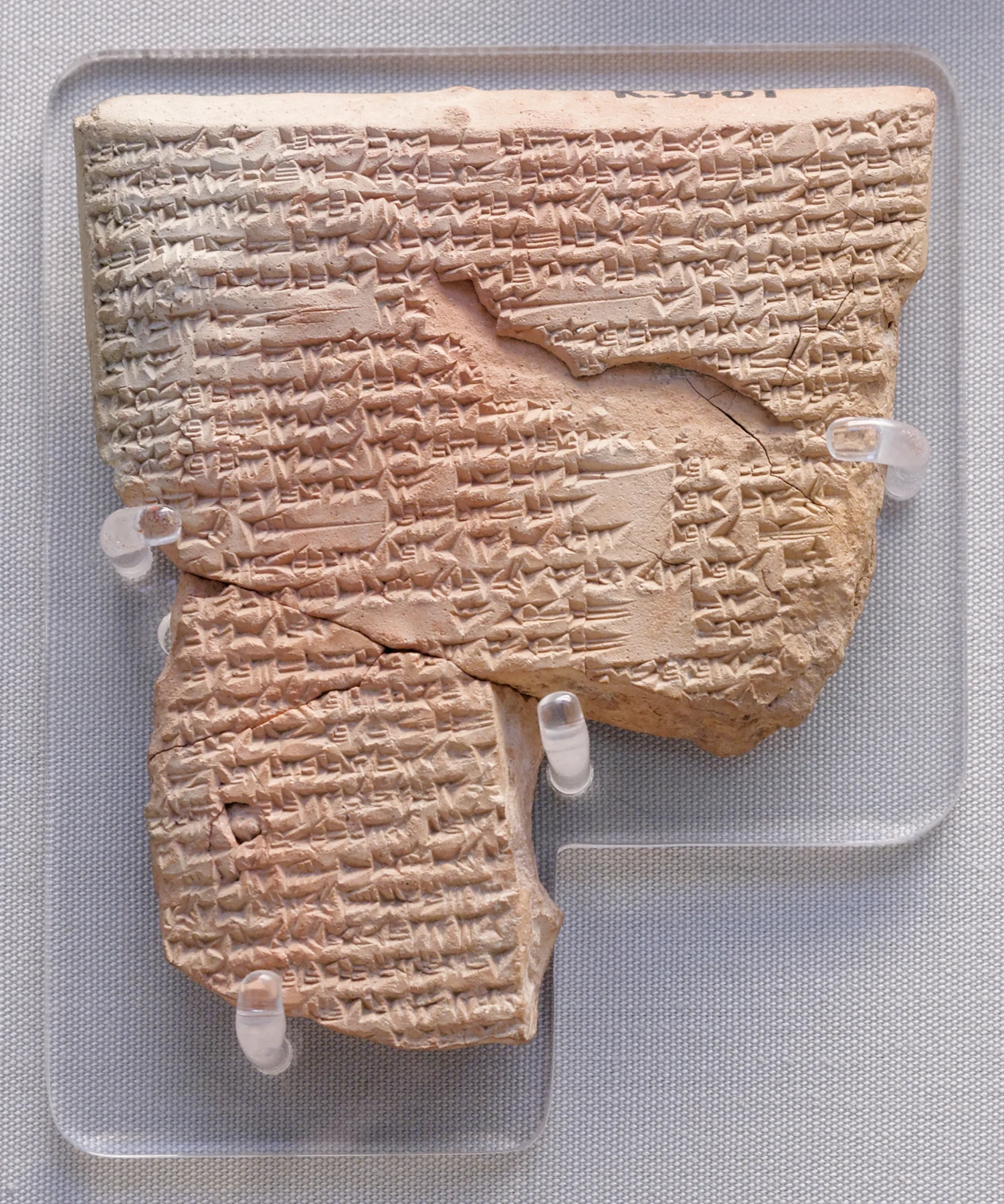
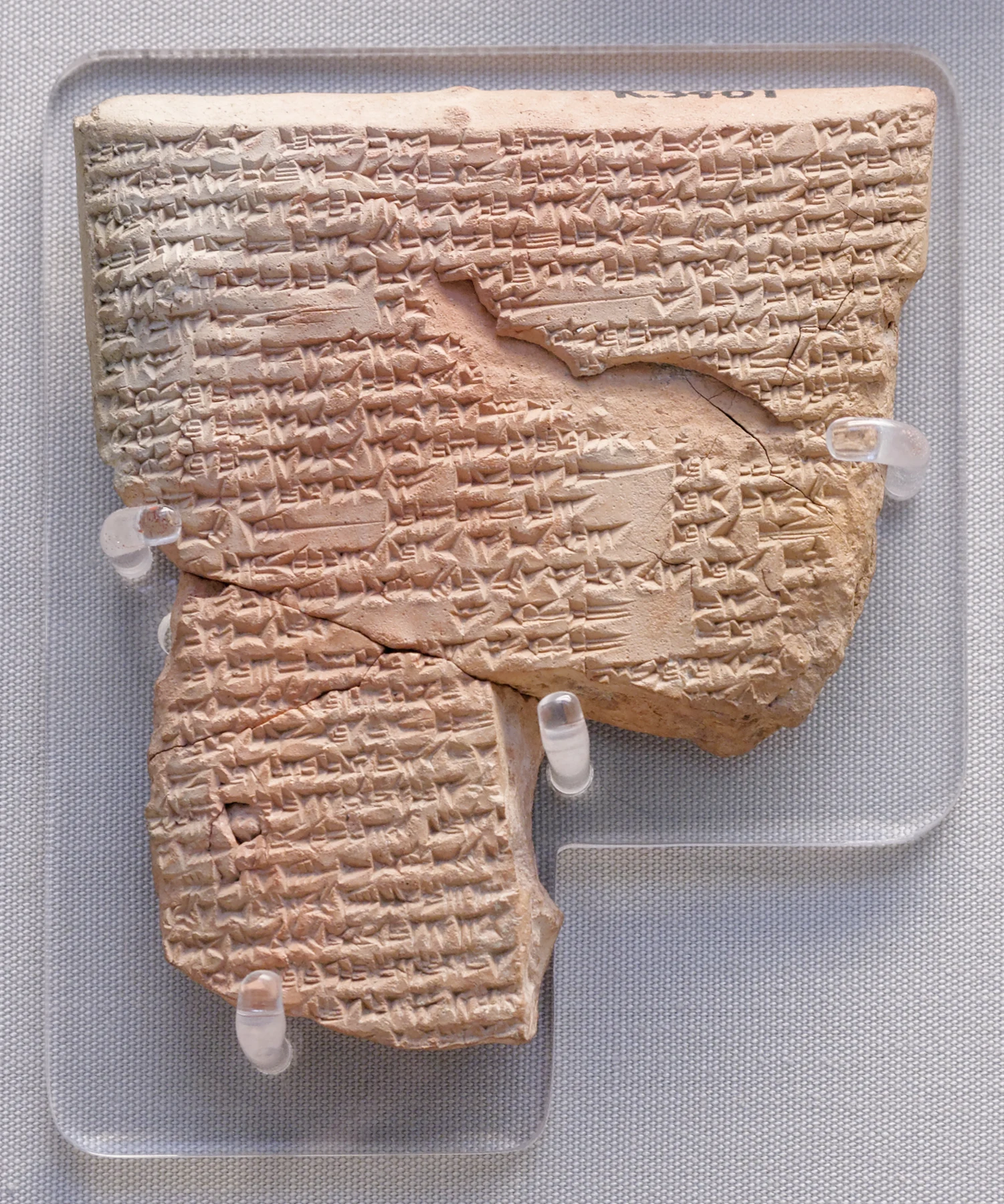
The historical Sargon was a ruler of the third millennium BCE. But tablet K.3401Sargon birth tablet K.3401Akkadian clay tablet from Nineveh preserving Sargon’s birth story in the Neo-Assyrian period, many centuries after the king’s lifetime.Glossary · Click to read the explanation, associated with his birth legend, is a Neo-Assyrian witness excavated at NinevehNineveh and KuyunjikNineveh is an ancient Assyrian city near Mosul in northern Iraq; Kuyunjik is one of its archaeological moundsGlossary · Click to read the explanation and held in the British Museum. CDLI records it as P365306, with the joining fragment Sm.2118. The museum describes it as a tablet fragment containing lines of a Sargon legend. The tablet's wording cannot therefore simply be dated to the historical king's lifetime. [7] [8]
Ancient literature may also be presented in a composite scholarly edition drawing on several damaged copies. The introduction to L. W. King's 1907 edition identifies K.3401, additional tablets, and marked restorations among the materials used to establish the published text. A photograph of K.3401 is not evidence that every word in a composite translation survives on that one fragment. Likewise, the date of the oldest extant copy establishes the existence of a witnessed form, not the initial date of every element in an earlier oral tradition. [9]
How should resemblance be weighed?
Compare the order and relationships of elements instead of simply counting matches. Basket, waterproofing, and river are not three wholly independent surprises: placing an infant on water creates a practical reason for a protective vessel. A parallel becomes more informative when an unusual detail or configuration is shared, when sequences and character roles can be compared, and when the historical setting permits contact. At the same time, a later retelling may alter characters, motivations, or locations; differences alone need not rule out a connection. [1]
In the present case one can investigate reuse of a narrative pattern, participation in broader shared traditions, or independent developmentIndependent developmentSimilar narrative or cultural elements arising in different settings without historical transmission of the specific feature between them; a testable explanation, not a default assumption when records of borrowing are absent.Glossary · Click to read the explanation of some features. These are explanatory possibilities, not established facts furnished by resemblance alone. That Sargon is earlier than Moses in the times ascribed to the protagonists cannot settle which written account, if either, borrowed from the other. The relevant chronology is that of textual composition, witnesses, and possible routes of circulation—not simply the dates of heroes.
When a motif changes function
Even when versions belong to the same tradition, a feature need not retain an identical role. In West's comparison of versions of the Sanskrit story of Cyavana and Sukanyā, an indexed passage describes how some tellings shift part of the negotiation with the divine Aśvin twins from the husband's instructions to the wife's own initiative. As a character's agency changes, the associated scene changes position and function. This is West's interpretation of the versions she examined, not an independent reading here of the Sanskrit originals. [1]
The direction of dependence is a further question, asked only after a possible literary relationship has itself been assessed. In the abstract of a study on inner-biblical allusion, Cooper Smith distinguishes the grounds for finding a relationship from criteria used to argue which text drew on which. His framework cannot simply be transferred to every world literature without testing, but it illustrates why the discovery of a shared motif does not settle priority or borrowing. [10]
A practical conclusion
First define the feature as each account actually presents it, including actor, outcome, and setting. Read its surrounding narrative, date textual forms and material witnesses separately, and examine both the feature's wider distribution and the alternatives to transmission. A connection may prove likely, remain open, or lack sufficient evidence for a common source. A motif's value lies in opening a testable question, not in assigning stories an ancestry merely because they share an element.
References and notes (10)
- Emily West, “The Transformation of Cyavana: A Case Study in Narrative Evolution,” Oral Tradition 31/1 (2017), pp. 77–122. Journal abstract and search-indexed extracts from the introductory discussion of comparison criteria and from printed p. 99 only; the complete PDF was not read. Tigay 1993 was not consulted directly. Return to the text ↑
- Elizabeth Delf and Marisa Williams, “What is a Motif?”, Oregon State Guide to English Literary Terms, 26 October 2021. The university webpage transcript was read in full, especially the definition, functions and motif/theme distinction; the video was not viewed. Return to the text ↑
- Harvard Library, “Folktale Classification and Structure,” GENED 1197 research guide. The complete research-guide webpage was read, including motif versus tale type, ATU and Motif-Index sections and index scope; not the full ATU catalogue. Return to the text ↑
- Indiana University Libraries, “Motif-Index of Folk Literature” (database and bibliographic description of Thompson’s 1955–1958 edition). The library description and print-edition bibliographic record were checked; the six volumes and subscriber-only database were not read. Return to the text ↑
- Exodus 2:1–10, Sefaria, displayed Hebrew and Revised JPS English translation (2023). Read the displayed English passage 2:1–10 and checked the Hebrew shown for 2:3 on the page; no independent Hebrew translation or manuscript collation was undertaken. Return to the text ↑
- Sargon legend, Fordham Internet Ancient History Sourcebook, reproducing George A. Barton, Archaeology and the Bible, 3rd ed. (1920), p. 310. The whole posted English translation (lines 1–30) and its source statement were read; not the Akkadian or Barton’s full book. The webpage heading’s “c. 2300 BCE” is not a tablet date. Return to the text ↑
- Cuneiform Digital Library Initiative (CDLI), P365306, K 03401 + Sm 2118, Nineveh, Neo-Assyrian literary tablet. Read the online artefact metadata, join, period and reference fields; no independent reading of cuneiform signs. Return to the text ↑
- British Museum collection record W_K-3401, K.3401, Neo-Assyrian Sargon legend tablet fragment from Kouyunjik. Checked the museum’s indexed object metadata (identity, period, findspot and dimensions); the full museum page returned HTTP 403 and was not read in full. Return to the text ↑
- L. W. King, Chronicles Concerning Early Babylonian Kings, vol. II (1907), appendix I, p. 87. Read a search-indexed extract of p. 87 explaining the composite witnesses and marked restorations; neither the full volume nor the rest of the appendix was visually inspected. Return to the text ↑
- Cooper Smith, “Inner-Biblical Allusion and the Direction of Dependence: Toward a Comprehensive List of Criteria,” Journal of Hebrew Scriptures 22 (2022), article 6, pp. 1–26. Only the DOAJ/Érudit abstract and bibliographic record were read; the article’s 26 pages and individual criteria were not read. Its scope is inner-biblical allusion. Return to the text ↑
Suggest a correction · Suggest a source for this record
Cite this record
IL Archive, «Literary motif», https://ilarchive.com/en/entities/literary-motif
Continue reading