Study
Moses and Sargon: the child in the basket and the limits of comparison
An extended study of a topic, with evidence and references.
- Timeline
- From 2300 BCE to 700 CE
Basket, bitumen, water and adoption: what actually connects Exodus 2 and Sargon’s legend? Witness dates, disputed dependence and the Qur’anic account examined separately.
Share article
Text
A child concealed by his mother, a plant-fibre container waterproofed with bitumen, river water, rescue, adoption, and an exceptional future: these elements occur in the childhood of MosesMosesCentral figure in Exodus, Torah traditions and the Qur’an; childhood accounts differ in detail.Glossary · Click to read the explanation in Exodus and in the Sargon Birth LegendSargon Birth LegendAkkadian account of a rescued infant’s ascent to kingship; surviving witnesses postdate Sargon of Akkad.Glossary · Click to read the explanation. The resemblance is real and deserves investigation. It does not, by itself, supply a history of transmission or testimony that one writer copied the other.
Precise comparison begins by defining its texts. Our main subjects are Exodus 1:22–2:10 and the AkkadianAkkadianAn ancient East Semitic language written in cuneiform in Mesopotamia.Glossary · Click to read the explanation birth narrative of Sargon of AkkadSargon of AkkadThird-millennium BCE king associated with later birth and ascent traditions.Glossary · Click to read the explanation. We then consider two Qur’anic passages about Moses’ childhood. We keep these accounts distinct. Literary comparison does not adjudicate religious belief or establish whether a particular historical person existed.
Which Sargon, and which date?
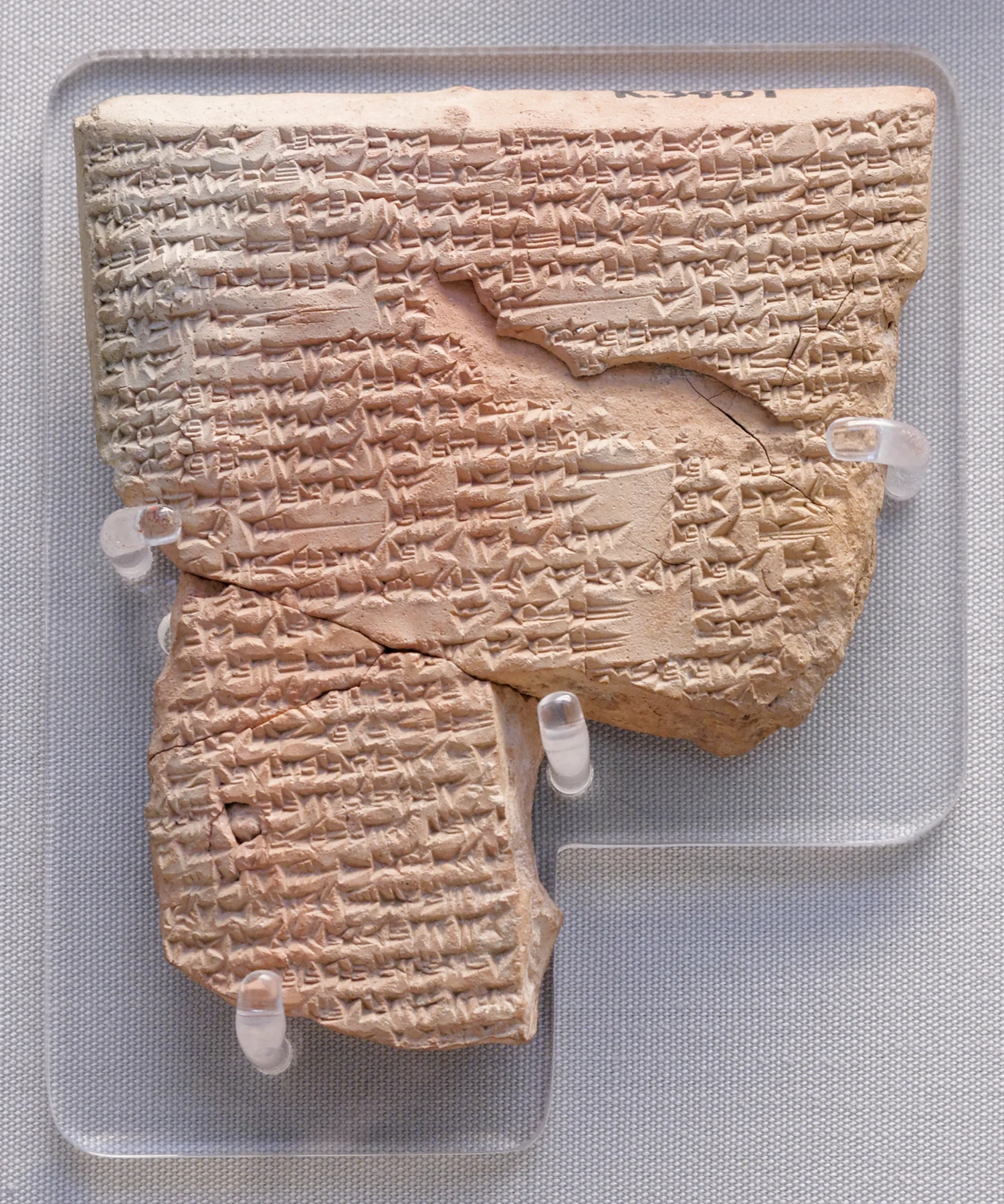
Sargon of Akkad was a third-millennium BCE king. The photographed tablet K.3401Sargon birth tablet K.3401Akkadian clay tablet from Nineveh preserving Sargon’s birth story in the Neo-Assyrian period, many centuries after the king’s lifetime.Glossary · Click to read the explanation, however, is a literary witness from Neo-Assyrian NinevehNineveh and KuyunjikNineveh is an ancient Assyrian city near Mosul in northern Iraq; Kuyunjik is one of its archaeological moundsGlossary · Click to read the explanation. CDLI assigns it to that context and records its join with Sm.2118. The time of the story’s protagonist differs from the time when the surviving account was copied. [3]
This distinction prevents a common mistake. Placing “about 2300 BCE” beside Sargon’s name does not show that the basket narrative before us was written then. We must date the witness, examine its language and transmission, and consider other copies before proposing a composition date. Oral antecedents are possible, but their possibility supplies no dated lost manuscript that we can cite as evidence.
What does the birth legend say?
The account speaks in Sargon’s voice. It identifies his mother with a title usually translated as a priestly office and says that he did not know his father. He is born secretly, enclosed in a plant-fibre basket sealed with bitumen, and placed in the river. Water carries him to AqqiAqqi in Sargon’s birth storyAqqi is the irrigator who finds the child in the river and adopts him in Sargon of Akkad’s birth storyGlossary · Click to read the explanation, the water-drawer, who raises him as a son and makes him a gardener. His subsequent ascent to kingship is connected with IshtarInanna / IshtarProminent Mesopotamian goddess with a major centre at Uruk, whose parentage and cult traditions vary rather than forming one fixed genealogy.Glossary · Click to read the explanation’s favour. [2][4]
The rescuer here is therefore a man who works with water, not a princess or a goddess discovering the basket. Ishtar enters the justification of Sargon’s rise rather than personally retrieving the infant. The king appears to recall his own past, but this literary form does not prove that the historical ruler wrote an autobiography.
Translations also differ. The historical version reproduced by Fordham uses an older rendering that describes the mother’s low status, whereas Jonathan Valk prints the Akkadian passage with its priestly designation. We read the older version for the narrative sequence and checked important details against a more recent reading. The mother’s title alone does not establish that she was a virgin, committed a specified crime, or faced a particular punishment requiring abandonment. [2][4]
Moses: a threatened child within a family
In Exodus, Pharaoh’s policy concerning the killing of newborn boys precedes the basket episode. The account then introduces the marriage of a man and woman of Levi’s house and the birth of a child whom his mother hides for three months. When concealment becomes impossible, she prepares a papyrus container, applies waterproofing materials, and places it among the reeds at the riverbank. His sister stands some distance away to watch what happens. [1]
Pharaoh’s daughter finds the container, sees the crying child, recognizes him as a HebrewHebrewA Northwest Semitic language in the Canaanite group, with ancient and modern forms.Glossary · Click to read the explanation, and takes pity. His sister offers to bring a nurse; the child’s own mother returns to feed him for wages. Later he grows and is brought to Pharaoh’s daughter, becoming her son. The account connects his name, Moses, with his rescue from the water. [1]
This is a specific account of danger, care, and a change in the child’s position. His father is unnamed at the beginning, but is present as the husband. That differs from Sargon’s explicit claim not to have known his father. A father’s lack of an active role in the rescue does not mean that the account describes a child of unknown paternity.
The baskets are not in the same position
Sargon’s story makes the river carry the infant to Aqqi. Exodus 2:3 says that the mother places the container among reeds at the bank, where Pharaoh’s daughter sees it. This passage does not narrate a long voyage in which the current delivers the basket to a distant palace. [1][4]
The detail may seem small beside the overall resemblance, but it changes the mechanism of rescue. In Exodus the sister remains close enough to intervene, and the mother returns to care for her child. Summarizing the scene as “thrown into the river and swept downstream” would remove part of the evidence under examination and add to the Hebrew account something familiar from another story.
Good comparison does not seek identical pictures at any cost. It also asks why each account gives the basket a different position, the rescuer a different role, and the infant a different continuing relationship with his original family.
Where is the resemblance strongest?
The relevant cluster extends beyond an infant and a river. Concealment, a plant-fibre container, bitumen, discovery, adoption, and future leadership together carry more weight than a general resemblance between difficult childhoods. The sequence of several elements makes literary connection a serious possibility to investigate.
Not every detail matches. Sargon’s account leads to a king recounting his ascent. Moses’ childhood leads toward a figure who confronts Pharaoh and takes a community out of Egypt. In Exodus, a woman of the ruling household helps preserve a child threatened by the king’s own policy. That description follows the narrative sequence; identifying it as a political message against a particular empire is a further interpretation.
If one account reworked the other, differences could form part of its literary project. Yet differences do not prove dependence either. A theory that explains similarity and dissimilarity with equal ease needs independent testing, lest it become impossible to challenge.
Was the legend composed under Sargon II?
Thomas RömerThomas RömerScholar of Hebrew Bible history and composition, holding the Biblical Milieux chair at the Collège de France.Glossary · Click to read the explanation advances a model connecting the birth account with the Neo-Assyrian period and reading Moses’ presentation through the appropriation and redirection of royal imagery. He proposes a seventh-century BCE Judean setting, then discusses the reshaping of Moses’ role in the Persian period. This is a scholarly reconstruction, not a date stated on the tablet. [5]
Grant Frame, in the introduction to his edition of Sargon IISargon IISargon II was an Assyrian king of the late eighth century BCE; ORACC dates his reign about 721–705 BCEGlossary · Click to read the explanation’s inscriptions, treats a composition in that king’s reign and a connection with his political ideology as possible but not conclusively established. [6] That attribution cannot therefore serve as a precise clock dating Exodus 2.
The proposal that a Judean writer knew a Sargonic tradition is distinct from the more specific proposal that he answered Sargon II’s propaganda at a named king’s court. The latter requires additional evidence about textual date, politics, and transmission. Disputed premises should not be combined and their resulting conclusion presented as certain.
Sargon had more than one story
The Sumerian composition *Sargon and Ur-Zababa* preserves another picture. Sargon appears as a court cupbearer, and his father is named La’ibum. The surviving sections do not recount the familiar basket episode; their gaps must not be filled automatically. [7]
The contrast shows that literary memories of the ruler were diverse. It does not demonstrate that a story absent from these fragments existed nowhere else. Historians can say that a detail is not preserved here. They cannot turn that observation into a claim that nobody in the period knew it.
For the same reason, we should not assemble everything ever told about Sargon into one consistent biography and then compare that construction with Moses. Each witness, its language, preservation, and actual contents must remain in view.
Can the rescued-child motif identify a source?
Angela Roskop Erisman also considers Horus hidden in reeds, while noting that the papyrus she cites is a late Ptolemaic witness. She proposes a political reading of Moses in relation to Hezekiah. These are interpretative models rather than demonstrated transmission routes. [8]
The comparison exposes a methodological problem. The long history of a divine tradition does not automatically date every detail in its surviving texts. Nor does a possible Egyptian background exclude a possible Mesopotamian one. Literature can operate in more than one cultural environment, but multiple available backgrounds increase the need to test a connection rather than removing it.
Foundling stories should also not become evidence that ancient societies lacked affection for children. Valk distinguishes exposure from general attitudes to infants and considers rescue and adoption within literary and social life. [4] A successful story about one survivor gives us no statistics for the fate of all children.
Moses’ name does not settle the comparison
Exodus 2:10 explains the name through rescue from water. David Zucker discusses a proposed Egyptian derivation from an element associated with birth or sonship alongside the Hebrew explanation in the narrative. [9] Even a persuasive linguistic derivation would not establish the basket story’s source.
A name’s origin, an author’s explanation of it, and the origin of the surrounding account are separate questions. A name with an Egyptian background could appear in a narrative reshaped in Hebrew. That possibility identifies neither the writer’s reading material nor the date of such an encounter.
The Qur’anic account has its own details
In al-Qasas 28:7–13, Moses’ mother is inspired to nurse him and, when afraid for him, place him in the water, with the promise of his return. Pharaoh’s household takes him up. Pharaoh’s wife intervenes against killing him and proposes taking him as a son. His sister follows him, he refuses wet-nurses, and he returns to his mother. The speaking woman here is not Pharaoh’s daughter in Exodus. [10]
Taha 20:38–40 mentions the chest, its placement in the water, its arrival at the shore, the sister’s intervention, and the child’s return to his mother. [11] Neither selected passage mentions papyrus or bitumen. Those details cannot be attributed to the Qur’an simply because they appear in Exodus or in Sargon’s legend.
This formulation deserves study within the history of Moses narratives. However, a possible literary relationship between Exodus 2 and Sargon does not prove direct transmission from an Akkadian tablet to the Qur’an. Such a claim needs its own examination of intermediaries, accounts, and dates. An arrow between two texts cannot simply be extended to every later narrative.
Six checks before claiming borrowing
- Chronology: distinguish historical Sargon, surviving copies, proposed composition, and the layers of Exodus. An ancient name does not date its text.
- Contact: Assyrian and Mesopotamian relations with the LevantThe LevantThe Levant is a regional name for lands along the eastern MediterraneanGlossary · Click to read the explanation make encounter possible. They do not prove that this passage’s writer read this particular copy.
- Specificity: the combination of plant-fibre container, bitumen, water, and rescue is more significant than a great hero’s unusual childhood alone.
- Structure: compare the functions of mother, sister, rescuer, adoption, and eventual outcome rather than isolating the basket.
- Route: no authorial statement names the source, and no identified intermediary manuscript joins the witnesses without a gap.
- Alternatives: oral traditions, Egyptian imagery, and shared social experience remain possibilities. Calling a motif common should not dismiss distinctive details without investigation.
These checks do not make transmission impossible. They identify what a transmission hypothesis must explain to become stronger than its alternatives.
What can we say?
Confirmed: the accounts share a recognizable cluster of rescue and adoption elements, with important differences in water, family, rescuer, and purpose. The surviving Assyrian witness is not contemporary with Sargon of Akkad.
Possible and influential in scholarship: a writer of Moses’ account knew and reworked a Sargonic tradition. Studies defend that possibility with different degrees of confidence. It does not establish verbatim copying or a particular transmission route.
Unproven: the surviving basket narrative existed in its present form around 2300 BCE; Sargon II certainly commissioned it; or resemblance settles Moses’ historicity or the Qur’anic account’s source.
Comparison opens questions about the making of a leader’s image. How does a threatened infant become someone to whom a community attributes an extraordinary destiny? How do family care, adoption, and divine favour become language for explaining that position? Answers begin with the texts we possess and extend beyond describing them as the same story with different names.
Reading scope: the Exodus passage, both Qur’anic passages, and the historical Sargon translation were read, with important details checked against more recent readings. The Sumerian ETCSL text was consulted. Selected pages of Römer, Frame, and Valk and passages of the two named articles were used; we do not claim to have read every book or complete critical edition.
Related reading
References and notes
- Complete passage read. Riverbank placement and the roles of sister, mother and Pharaoh’s daughter follow the text, not a composite retelling. Exodus 1:22–2:10; KJV, public domain Return to the text ↑
- Historical translation read in full and checked against newer readings. The page’s 2300 BCE label concerns the king, not the witness; its old rendering of the mother and reign length are not adopted. George A. Barton, Archaeology and the Bible, 3rd ed. (1920), p. 310; reproduced by Fordham Return to the text ↑
- Artifact, language, period and findspot metadata consulted. These describe a surviving witness, not a certain original composition date. The direct Museum page was inaccessible and is not claimed as read. CDLI P365306; K.3401 + Sm.2118; CT 13, pl. 42 Return to the text ↑
- Specified section on exposure and adoption read, including Akkadian lines 5–11 and their translation. Used to check the account and distinguish an individual case from social attitudes; the full article was not read. Jonathan Valk, JESHO 59 (2016), pp. 735–739, §3.5; Sargon Birth Legend 5–11 on p. 738 Return to the text ↑
- Birth and royal imagery discussion consulted in the stated pages. Sargon II attribution and Mosaic dating are presented as Römer’s model, qualified by Frame in the next note; the whole book was not read. Thomas C. Römer, “Moses, the Royal Lawgiver” (2013), selected discussion pp. 82–84 Return to the text ↑
- Dating and ideology paragraph read at the specified page. It states that assigning the legend to Sargon II’s reign is not conclusive. No claim to reading the complete inscriptions volume. Grant Frame, RINAP 2 (2021), Introduction p. 21; PDF p. 71 Return to the text ↑
- Translation of the surviving text read. It names La’ibum and depicts a court cupbearer, with gaps; absence of the basket episode here does not prove absence from every tradition. ETCSL t.2.1.4, Sargon and Ur-Zababa; Segment A 10–13 and preserved B–C Return to the text ↑
- Comparison, the late date of Papyrus Jumilhac, and the Hezekiah model’s outline consulted. No certain date is deduced from that model; the author’s complete book was not read. Angela Roskop Erisman (2025); Sargon/Horus comparison and notes 2–8 Return to the text ↑
- Narrative explanation and proposed Egyptian derivation consulted. Name etymology is not treated as independent evidence for the basket narrative’s source. David J. Zucker (2018); “What Moses’ Name Actually Means” and etymology discussion Return to the text ↑
- Arabic text of the specified verses read. Wife/daughter distinction, sister, wet-nurses and return to the mother are explicit textual comparisons, not a direct borrowing claim. Qur’an, al-Qasas 28:7–13; Arabic text Return to the text ↑
- Specified verses read, including chest, water and shore. Papyrus, bitumen and unmentioned Exodus details are not attributed to this passage. Qur’an, Taha 20:38–40; Arabic text Return to the text ↑
Suggest a correction · Suggest a source for this record
Cite this record
IL Archive, «Moses and Sargon: the child in the basket and the limits of comparison», Edition 1, https://ilarchive.com/en/studies/moses-and-sargon-basket
Continue reading