Ancient text
Sargon Birth Legend
A text for line-by-line reading, with transliteration, translation, and resources.
Akkadian account of a rescued infant’s ascent to kingship; surviving witnesses postdate Sargon of Akkad.
Metadata
These are descriptive fields, not conclusions.
- Edition
- 2
Text
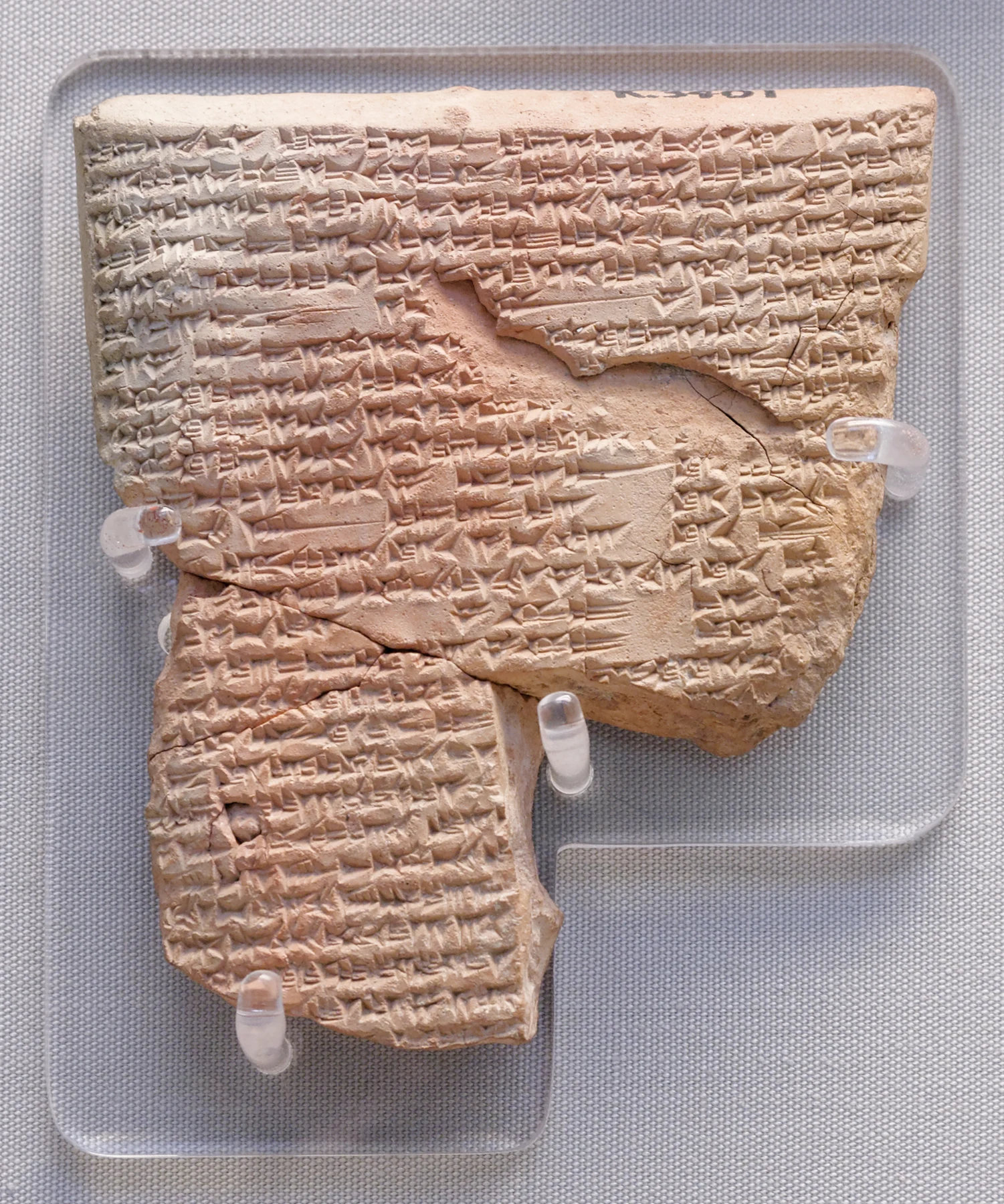
In Sargon’s voice the legend recounts secret birth, a bitumen-sealed basket and river transport to AqqiAqqi in Sargon’s birth storyAqqi is the irrigator who finds the child in the river and adopts him in Sargon of Akkad’s birth storyGlossary · Click to read the explanation, who adopts the child and makes him a gardener. The human rescuer must be distinguished from IshtarInanna / IshtarProminent Mesopotamian goddess with a major centre at Uruk, whose parentage and cult traditions vary rather than forming one fixed genealogy.Glossary · Click to read the explanation’s later favour in his ascent. [2][4]
K.3401 from NinevehNineveh and KuyunjikNineveh is an ancient Assyrian city near Mosul in northern Iraq; Kuyunjik is one of its archaeological moundsGlossary · Click to read the explanation preserves a Neo-Assyrian witness. The king’s third-millennium BCE setting does not automatically date this account’s composition. AssociationShirkAssociating others with God in Quranic discourse; not equivalent to denying God’s existence.Glossary · Click to read the explanation with Sargon IISargon IISargon II was an Assyrian king of the late eighth century BCE; ORACC dates his reign about 721–705 BCEGlossary · Click to read the explanation is possible, not conclusive. [3][6]
References and notes
- Historical translation read in full and checked against newer readings. The page’s 2300 BCE label concerns the king, not the witness; its old rendering of the mother and reign length are not adopted. George A. Barton, Archaeology and the Bible, 3rd ed. (1920), p. 310; reproduced by Fordham Return to the text ↑
- Artifact, language, period and findspot metadata consulted. These describe a surviving witness, not a certain original composition date. The direct Museum page was inaccessible and is not claimed as read. CDLI P365306; K.3401 + Sm.2118; CT 13, pl. 42 Return to the text ↑
- Specified section on exposure and adoption read, including Akkadian lines 5–11 and their translation. Used to check the account and distinguish an individual case from social attitudes; the full article was not read. Jonathan Valk, JESHO 59 (2016), pp. 735–739, §3.5; Sargon Birth Legend 5–11 on p. 738 Return to the text ↑
- Dating and ideology paragraph read at the specified page. It states that assigning the legend to Sargon II’s reign is not conclusive. No claim to reading the complete inscriptions volume. Grant Frame, RINAP 2 (2021), Introduction p. 21; PDF p. 71 Return to the text ↑
Research history
Substantive changes are retained here. Minor copy edits remain in the internal operational log.
-
Substantive record update
Archive records may be reviewed and refined as better evidence or sources become available. Suggest a correction
Suggest a correction · Suggest a source for this record
Cite this record
IL Archive, «Sargon Birth Legend», Edition 2, https://ilarchive.com/en/texts/sargon-birth-legend