Entity
Potiphar’s Wife Motif
A reference page linking a name, group, or concept to the materials that discuss it.
A comparative label for a rejected advance, then false accusation and punishment or vindication. It covers the Egyptian tale, Genesis, the Iliad, Hippolytus and Sūrat Yūsuf, and the limits of transmission hypotheses.
Estimated reading time: 9 min Published Last reviewed:
Share article

Text
Introduction
“Potiphar’s wife motif” is a modern term in comparative literature for a narrative pattern in which rejected sexual advances are followed by a retaliatory accusation, and an authority’s intervention changes the accused person’s fate. The name derives from JosephJoseph in Genesis and the Qur’anFigure whose story in Genesis and Sūrat Yūsuf combines enslavement, accusation, prison and advancement in Egypt.Glossary · Click to read the explanation and the wife of PotipharPotiphar in GenesisEgyptian official who buys Joseph and places him over his household in Genesis 39.Glossary · Click to read the explanation in Genesis, but is neither an ancient designation nor evidence that every version was borrowed from the Bible. Egyptian, Greek, biblical and Qur’anic accounts offer related yet significantly different configurations. [12]
The pattern and its limits
A useful minimum definition requires a sexual initiative that is refused, a false or retaliatory charge reversing the roles of pursuer and victim, and an authority capable of imposing consequences. The initiative may be direct or mediated; the charge may allege assault or attempted coercion; and the authority may initially accept it or quickly uncover the deception. The mere presence of desire, or an accusation of adultery without a prior refusal, does not by itself identify the motif. Shared narrative structure cannot erase differences of genre, setting and literary function. [12]
Ancient Egypt: Bata and his brother’s wife
Papyrus D’OrbineyPapyrus D’Orbiney: Tale of the Two BrothersNineteenth-Dynasty hieratic papyrus (c. 1215 BCE), British Museum EA10183; the sole known manuscript of the Tale of the Two Brothers, copied by Inena.Glossary · Click to read the explanation in the British Museum (EA10183) preserves the sole known manuscript of the Tale of the Two Brothers. The scribe Inena copied it in hieratic during the Nineteenth Dynasty, around 1215 BCE. This dates a physical witness, not the events depicted or necessarily the invention of every element. The museum suggests that the manuscript may be approximately contemporary with the composition, without ruling out older narrative material. [1]
At the start of the tale, BataBata in the Tale of the Two BrothersYounger brother in the Egyptian tale preserved by D’Orbiney, accused and later transformed before attaining kingship.Glossary · Click to read the explanation works for his elder brother AnubisAnubis, Bata’s elder brotherElder brother called Anub or Anubis in the tale, initially believing his wife’s charge, then recognizing her deception.Glossary · Click to read the explanation (also called Anub or Anpu in modern accounts; this linked literary character should not be confused with the homonymous Egyptian deity). When Bata enters the house for seed, the elder brother’s wife approaches him with a sexual proposition. He refuses, saying that she stands to him as a mother and that her husband stands as a father. Susan Tower Hollis’s 1990 English translation gives the telling expression below; the hieratic itself has not been read for this review. [3][2]
The refusal occurs at papyrus (3,10)–(4,1), following the advance at (3,6–8). Fearing disclosure, the wife makes herself appear beaten and tells her husband that Bata propositioned and attacked her. Anubis initially believes her and waits with a spear to kill his brother. Bata escapes after his cattle warn him, and the brothers are separated by crocodile-filled water. Bata explains what happened and castrates himself as an extreme assertion of innocence within the story. Anubis regrets his action, returns home, kills his wife and throws her body to dogs. Reporting this violence describes the tale; it does not endorse it. Bata’s subsequent transformations and eventual kingship form much of the rest of the narrative, which cannot be reduced to the seduction episode. The references (3,6)–(8,8) designate papyrus column/page-and-line positions as rendered by Hollis, not PDF page numbers. [2]
Genesis: a garment used against the accused
In Genesis 39, Joseph is enslaved in the household of Potiphar, an Egyptian official who has entrusted him with the management of his house. Potiphar’s wife repeatedly seeks a sexual encounter. Joseph invokes both loyalty to his master and wrongdoing before God. Her demand in the HebrewHebrewA Northwest Semitic language of the Canaanite group, encompassing Iron Age epigraphy, Biblical, Rabbinic, medieval and Modern Hebrew; its scripts and pronunciations changed over time.Glossary · Click to read the explanation of Genesis 39:7 reads: [4]
Joseph refuses and avoids her. When she seizes his garment, he leaves it in her hand and runs away. The garment that results from his escape is repurposed as evidence against him: she first calls the household, claims he tried to assault her, and repeats the charge to her husband while displaying the garment. The husband becomes angry and imprisons Joseph. The text narrates his action without independently disclosing his inner certainty. Genesis does not name the wife or call her “Zuleikha.” Joseph’s imprisonment belongs to a much larger story that continues with his rise in Egypt. [4]
The Iliad: Anteia, Bellerophon and a lethal message
In Book 6 of the IliadIliadGreek epic attributed to Homer, narrating a phase of the Trojan War.Glossary · Click to read the explanation, attributed to HomerHomerThe name to which Greek tradition attributes the Iliad and Odyssey.Glossary · Click to read the explanation, Glaucus relates his genealogy while meeting Diomedes; the episode of BellerophonBellerophonGreek hero whose refusal of Anteia and accusation lead to Lycia and dangers including the Chimaera in the Iliad.Glossary · Click to read the explanation is an inset narrative. AnteiaAnteia in the IliadProetus’s wife in the Iliad, accusing Bellerophon after he refuses her overture.Glossary · Click to read the explanation, wife of King ProetusProetus in the IliadKing hearing Anteia’s accusation and sending Bellerophon to Lycia with a message threatening his life.Glossary · Click to read the explanation, desires a secret union with the hero. After his refusal, she falsely claims that he sought intercourse against her will. Her accusation in Iliad 6.165, with our English rendering, includes: [6][5]
Proetus is enraged but shrinks from killing Bellerophon himself; instead he sends him to Lycia carrying a folded tablet inscribed with deadly signs. The Lycian king assigns dangers including the Chimera, the Solymi and the Amazons, all of which Bellerophon survives. The inscribed tablet exists inside the poem, not as a recovered archaeological artifact. The episode also advances the epic’s discussion of descent and guest-friendship. The wife is “Anteia” in these Homeric lines; “Stheneboea” belongs to other versions and is not the wording of this passage. [6][5]
Euripides’ Hippolytus: mediation and a posthumous letter
EuripidesEuripidesFifth-century BCE Greek tragedian, died 406 BCE. In his Iphigenia among the Taurians, the heroine recounts a deer substituted for her.Glossary · Click to read the explanation’ tragedy Hippolytus, produced in 428 BCE, offers another Greek variant, not an identical sequence. Phaedra, wife of Theseus, falls in love with her stepson Hippolytus. Crucially, the Nurse tells Hippolytus of the desire and intervenes on Phaedra’s behalf; Phaedra does not initially confront him in the manner of Potiphar’s wife. Hippolytus reacts with rejection. Fearing disgrace, Phaedra hangs herself and leaves a letter falsely accusing him of assault. Theseus believes the writing of his dead wife and curses his son; ArtemisArtemisGoddess of hunting in Greek traditions and Apollo’s sister, named among the divine company in the Iliad.Glossary · Click to read the explanation reveals the truth only when Hippolytus is dying. The action turns on love, shame, divine antagonism and paternal power, and it changes the mechanics of accusation through mediation, a letter and the accuser’s absence. The relevant sequence runs through approximately lines 581–731, 848–1089 and 1325–1388. [7]
Sūrat Yūsuf: the torn shirt exposes the charge
Sūrat YūsufThe QuranThe central scripture of Islam, consisting of 114 Arabic surahs; its study distinguishes Quranic discourse from manuscript history, reading traditions, and historical inference.Glossary · Click to read the explanation in the Qur’an, whose proclamation and early collection belong to the seventh century CE, develops the incident differently. The wife of al-ʿAzīz seeks Joseph while he is in her house; he flees towards the door and she tears his shirt from behind. Encountering her husband, she accuses Joseph of wrongdoing, while Joseph says she sought him. A witness from her family proposes an assessment of the tear: the front would support her claim, the back his. The Arabic text states the latter test in Qur’an 12:27; the English rendering is ours: [8]
Seeing the tear, the husband confronts her and urges Joseph to keep the matter quiet (12:28–29). Yet even after the signs have been seen, Joseph is later imprisoned for a time (12:35); the wife eventually admits that she pursued him and that he spoke truthfully (12:51). Clothing thus serves opposite functions in Genesis and the Qur’an: material marshalled against Joseph in the former, a test against the charge in the latter, without preventing subsequent imprisonment. The Qur’an itself calls neither husband “Potiphar” nor wife “Zuleikha”; these names belong to distinct textual and interpretive contexts. [8][9]
Dates of witnesses are not dates of events
- Around 1215 BCE: the copying of Papyrus D’Orbiney under Egypt’s Nineteenth Dynasty, not necessarily the beginning of the tale or its oral antecedents. [1]
- Eighth or seventh century BCE: a common broad horizon for the Iliad’s development. Martin West, for example, argues for extended composition in the seventh century, perhaps around 680–640 BCE. This cannot be used to date the mythical life of Bellerophon. [10]
- 428 BCE: the known performance date of Hippolytus, not the time of the drama’s mythical action. [7]
- First millennium BCE, with disputed layers: scholars disagree over the composition and redaction of the Joseph narrative in Genesis. Schipper stresses a Persian-period Egyptian-diaspora setting; Rezetko argues for a complex production history crossing the exile; Shupak instead proposes earlier Egyptian oral roots and an early-first-millennium written stage with later redaction. These are competing reconstructions, not dates established by a surviving autograph. The relevant scholarly abstracts, not their complete studies, were examined here. [11][13][14]
- Seventh century CE: the emergence of Qur’anic discourse, not the automatic date of every surviving Qur’anic copy. The famous BirminghamBirmingham, United KingdomBirmingham is a city in England whose university preserves early Qur’anic parchment leavesGlossary · Click to read the explanation leaves preserve portions of sūras 18–20, not the cited verses of sūra 12. [15]
Likewise, the Greek quoted here comes from a modern edited text, not an isolated papyrus reading: British Library P.Oxy. III 445, from the second or third century CE, preserves Iliad 6.173–199 and therefore does not preserve Anteia’s charge at 6.163–165. Witnesses and reconstructed literary texts must not be conflated. [16][5]
What comparison can—and cannot—establish
All these narratives turn a refused sexual initiative into an accusation, but the authority and outcome vary: an elder brother initially plans murder in Egypt; a master imprisons his slave in Genesis; a king dispatches his guest on fatal errands in the Iliad; a father curses his son in tragedy; and in the Qur’an a garment test exposes the lie without finally averting imprisonment. The salient objects also differ: feigned injuries, an abandoned garment, a narrative writing tablet, a posthumous letter, and a shirt torn at the back. They are not interchangeable instances of a single event or demonstrably consecutive borrowings. [2][4][5][7][8]
The Egyptian manuscript’s early date makes cultural diffusion worth testing, but cannot prove it. A convincing proposal of literary dependenceLiterary dependenceA historical relation in which a text was composed using another text or version; similarity alone cannot establish its direction.Glossary · Click to read the explanation would need a plausible direction and medium of transmission, chronologically defensible compositions, and distinctive verbal or structural correspondences; independent narrative development remains possible. The Egyptian story’s larger interests in kinship, transformation and kingship, and the Joseph narrative’s movement from ordeal to advancement, explain why the same apparent pattern serves different works. [3][11][12][13][14]
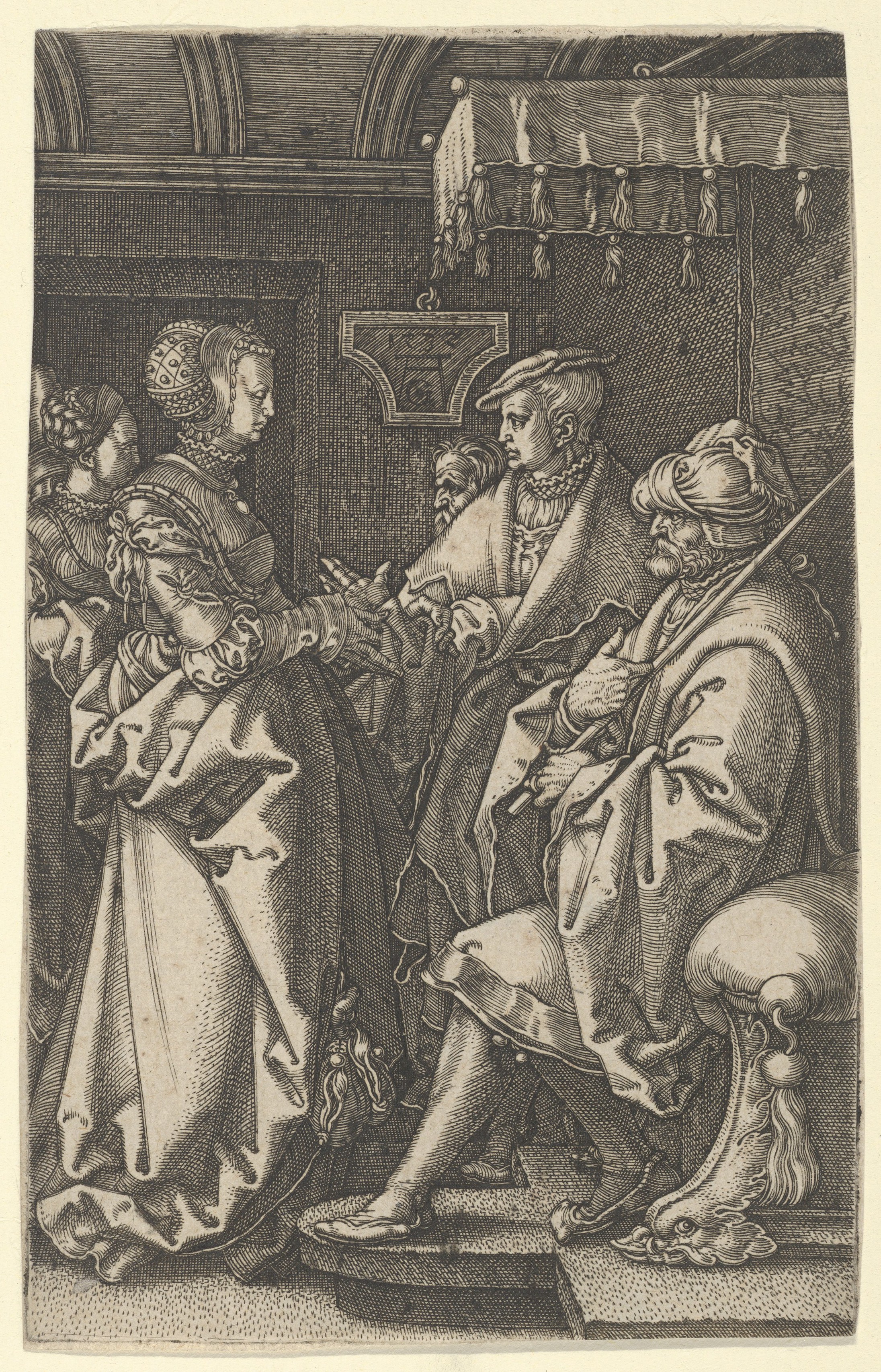
Nor is a literary false accusation evidence that women historically accused men falsely as a class, or a justification for violence in the stories. These works allow examination of unequal power between an enslaved man and the woman of the household, reputation, testimony and the reach of familial or royal authority. The accompanying artwork is a modern interpretive illustration according to the export metadata—not a photograph of the papyrus or a documented reconstruction of an Egyptian home or Joseph’s clothing. [2][4][7][8]
References and notes (16)
- British Museum, Papyrus D’Orbiney catalogue record EA10183,1: institutional catalogue information on Inena, Nineteenth Dynasty, c. 1215 BCE, and the sole known copy was read from the indexed record. The full object page returned 403; the manuscript image was not read. British Museum, Collection Online, EA10183,1, object catalogue (indexed institution entry) Return to the text ↑
- Susan Tower Hollis, The Ancient Egyptian “Tale of Two Brothers” (University of Oklahoma Press, 1990), pp. 5–15, translated text reproduced in a George Mason University learning PDF. Its attribution page and papyrus positions (3,6)–(8,8) were read, with relevant PDF pages visually checked. This is an English translation using Gardiner’s edited transcription, not a fresh reading of hieratic. Hollis 1990, pp. 5–15 as reproduced in GMU PDF pp. 5–8; Papyrus d’Orbiney (3,6)–(8,8) Return to the text ↑
- Inherited record reports an earlier reading of Lichtheim’s translation, introduction and notes, pp. 203–211, from a PDF with damaged OCR. The file was not re-accessed for this review; the hieratic was not read. The cited passage is independently supported by Hollis [2]. Miriam Lichtheim, “The Two Brothers,” Ancient Egyptian Literature II, pp. 203–211 Return to the text ↑
- All of Genesis 39:1–23 read in Hebrew and facing translation, especially 6–20. Genesis 39:1–23, vocalized Hebrew and facing English Return to the text ↑
- Homer, Iliad 6.156–190, edited Greek text and local commentary at Dickinson College Commentaries (Thomas Van Nortwick and Geoffrey Steadman): Greek lines 156–190 and relevant annotations read; not an individual manuscript. Iliad 6.156–190, esp. 160–170; Dickinson College Commentaries edited Greek text and notes Return to the text ↑
- A. T. Murray’s translation of Iliad 6.156–190 was checked, and the corresponding edited Greek was separately read via Dickinson [5]; neither the whole epic nor a papyrus of this passage was read. Iliad 6:156–190, A. T. Murray English translation, Scaife ATLAS Return to the text ↑
- Euripides, Hippolytus: E. P. Coleridge’s 1891 English version at MIT Classics and the passage index of Murray’s 1902 Greek edition; the Nurse’s disclosure, posthumous letter, Theseus’s reaction and Artemis’s disclosure were consulted. No ancient manuscript was examined. Euripides, Hippolytus 581–731, 848–1089, 1325–1388; English version Coleridge (1891) Return to the text ↑
- Sūrat Yūsuf 12:23–29, Arabic Qur’anic text and facing English on Quran.com, including the back-of-shirt test, family witness and husband’s response. The article’s English renderings are original paraphrases, not copied from the site’s modern translator. Qur’an 12:23–29, especially 12:25–29, Arabic text and contextual reading Return to the text ↑
- Sūrat Yūsuf 12:35 and 12:51, Arabic text, facing English and immediately adjacent context were read for the later imprisonment and the wife’s confession. Qur’an 12:35, 12:51, Quran.com (two verse pages) Return to the text ↑
- M. L. West, The Making of the Iliad (Oxford University Press, 2011), “The Poet: When and Where?”, pp. 15–27: publisher’s chapter abstract only, including a seventh-century proposal and approximate 680–640 BCE range; chapter not read. West 2011, ch. 2, pp. 15–27, publisher chapter abstract only Return to the text ↑
- Bernd U. Schipper, “The Egyptian Background of the Joseph Story” (2019): publisher’s entry and abstract only, concerning Egyptian narrative setting and a later compositional context; full paper not accessed. Schipper 2019, Hebrew Bible and Ancient Israel; publisher abstract only Return to the text ↑
- University publication entry and abstract read, not the full paper. Maleki, Nazemi and Laguna Mariscal, “The scheme of Potiphar’s wife” (2020), university abstract Return to the text ↑
- Robert Carl Rezetko, “A Coat of Many Colors and a Range of Many Dates” (Brill, 2022), pp. 3–39: University of Copenhagen research-portal abstract only, on a long, complex history of Joseph narrative production; chapter not read. Rezetko 2022, pp. 3–39, university research portal abstract only Return to the text ↑
- Nili Shupak, “The Joseph Story (Genesis 37–50) from an Egyptological Perspective” (2025), pp. 349–368: journal abstract only, arguing for earlier Egyptian oral/written phases and later redaction. The paywalled full paper was not read. Shupak 2025, JAOS 145/2, pp. 349–368; journal abstract only Return to the text ↑
- University of Birmingham, FAQ for Qur’an manuscript Mingana Islamic Arabic 1572a: institutional description read; surviving leaves contain parts of sūras 18, 19 and 20 (not 12), and the parchment is radiocarbon-dated 568–645 CE. University of Birmingham, Birmingham Qur’an manuscript FAQ, MS Mingana Islamic Arabic 1572a Return to the text ↑
- British Library, catalogue entry for P.Oxy. III 445: catalogue description read, dating the fragment to the second or third century CE and identifying Iliad 6.173–199. It does not witness verses 163–165 quoted from an edited text [5]. British Library, P.Oxy. III 445, Iliad 6.173–199, catalogue description Return to the text ↑
Suggest a correction · Suggest a source for this record
Cite this record
IL Archive, «Potiphar’s Wife Motif», https://ilarchive.com/en/entities/potiphars-wife-motif
Continue reading