Entity
Greek Additions to Esther
A reference page linking a name, group, or concept to the materials that discuss it.
- Names
- Additions to Esther
Six Greek units (A–F) in Esther: Mordecai’s dream and its meaning, two edicts, two prayers and Esther’s entrance scene. Comparing the Greek with the Hebrew shows variant forms and the limits of historical inference.
Estimated reading time: 9 min Published Last reviewed:
Share article
Text
Introduction
The “Greek Additions to Esther” are not an independent book circulating beside the Book of EstherBook of EstherA book narrating Jewish communal survival at a Persian court and connecting its ending with Purim, preserved in differing Hebrew and Greek forms.Glossary · Click to read the explanation. The name designates six passages—narratives, prayers and letters—preserved in Greek forms of the book without corresponding passages in the Masoretic HebrewHebrewA Northwest Semitic language of the Canaanite group, encompassing Iron Age epigraphy, Biblical, Rabbinic, medieval and Modern Hebrew; its scripts and pronunciations changed over time.Glossary · Click to read the explanation text. Their importance lies in what they reveal about the retelling of danger and deliverance at the Persian court: prayer and divine action become explicit where the Hebrew narrative is terse or silent.
This entry locates Additions A–F, explains their narrative functions, and distinguishes the Old Greek from the Alpha-Text, as well as the time depicted in the story from the history of its transmission. It is a critical account using published translations and specified scholarship, not a fresh translation from Greek manuscripts.
Contents
- What is an “addition”?
- Literary setting and historical claims
- Where the six units belong
- Mordecai's dream and its explanation: A and F
- The two royal decrees: B and E
- The prayers of Mordecai and Esther: C
- Esther before the king: D
- There was no single Greek Esther
- Composition, dates and the closing notice
- Canons, reception and the cover image
What is an “addition”?
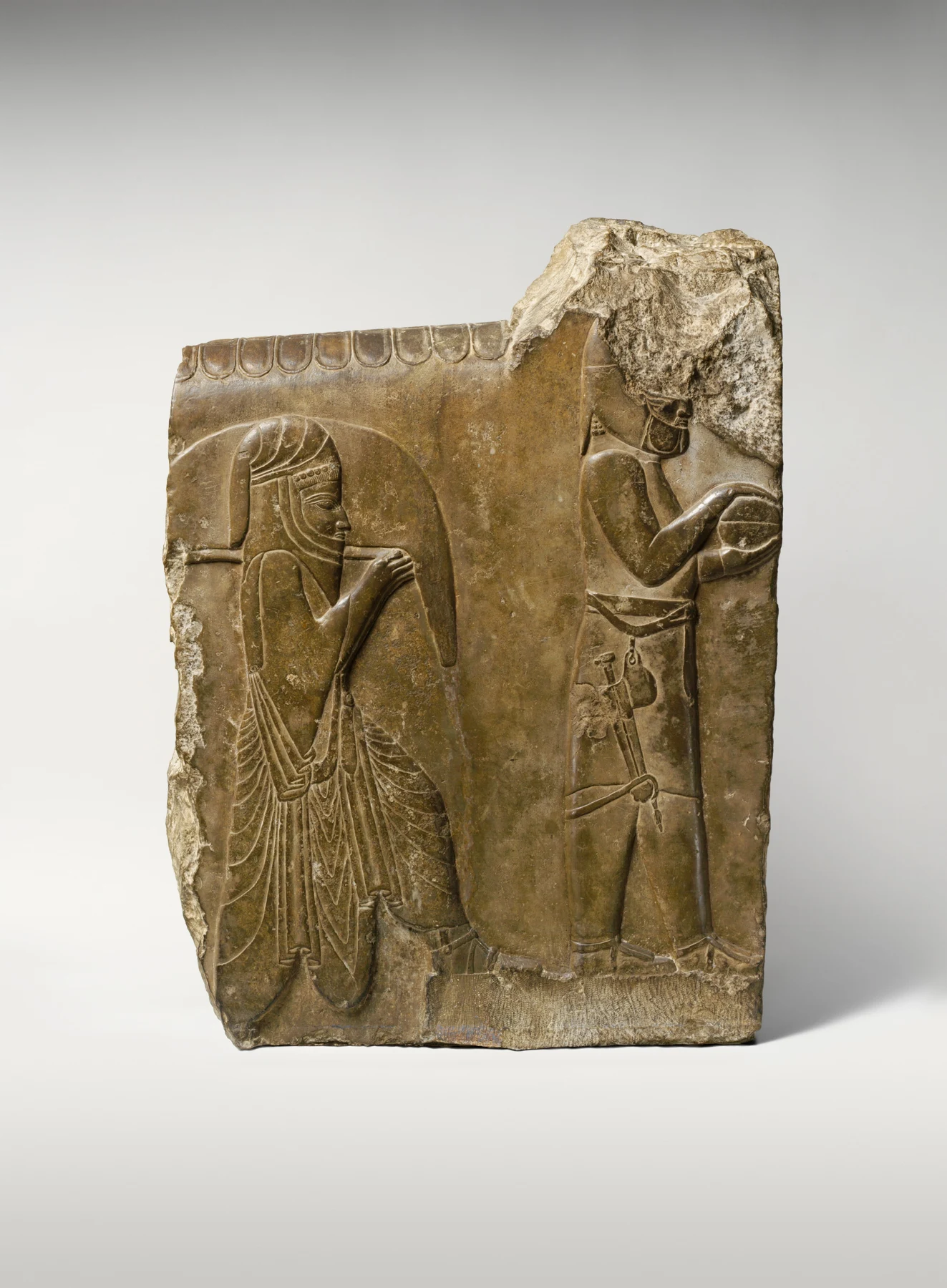
The work belongs to the transmission history of Esther in the SeptuagintSeptuagintA name for the varied ancient Greek translations and writings associated with Jewish scripture; beginning with the Torah, the texts differ across books and manuscripts.Glossary · Click to read the explanation and related textual traditions. The Masoretic Hebrew version is the usual point of comparison, but it is not a draft from which every Greek textual layer can simply be reconstructed. Editors distinguish two main Greek forms: the Old Greek (OG) and the Alpha-Text (AT). Both preserve the six units, although the underlying narratives, details and wording differ. Karen H. Jobes prints English translations of both texts in facing columns in NETS, following Robert Hanhart's critical edition; that edition's full critical apparatus has not been examined independently here. [13]
Calling the units “additions” is a comparative convention, not proof that one author composed them all at one time. The OG calls the monarch “Artaxerxes” where the Hebrew tradition speaks of Ahasuerus, whereas AT retains a form closer to “Assyeros.” That variance does not identify a different historical king by itself; in particular, it does not license equating the Greek king with Artaxerxes IIIArtaxerxes IIIFourth-century BCE Achaemenid king, more than a century after Xerxes I; the museum assigns the servants relief to his reign.Glossary · Click to read the explanation, whose much later reign is associated with the relief used on this page's cover.
Literary setting and historical claims
The story is situated at SusaSusa, ancient ShushSusa is an archaeological city at Shush in southwestern present-day IranGlossary · Click to read the explanation in the Persian Empire. A narrative set in a known court, however, does not thereby establish that every reported conversation, edict or battle occurred. One must also distinguish the text's claim that deliverance comes from God from a scholar's inference that a passage represents a new stage of retelling. Jill Middlemas reads Esther's violence, within the plot, as a state-sanctioned defensive response to an extermination order. That is a debatable interpretation of the literary narrative, not independent documentation that the decrees or battles happened as described. [14]
The shift in perspective matters. Is salvation primarily the political achievement of EstherEsther, the biblical queenThe Jewish heroine of Esther, portrayed as becoming queen and intervening to save her community at the Persian court.Glossary · Click to read the explanation and MordecaiMordecai in EstherEsther’s relative and guardian in the story, who uncovers a plot, confronts Haman and rises at court.Glossary · Click to read the explanation, a divine answer to communal prayer, or an interaction between the two? The Greek passages do not erase human choices or responsibility. Rather, they bring the language of supplication and trust to the foreground of the explanation.
Where the six units belong
In Greek narrative order, A precedes chapter 1: Mordecai's dream and his discovery of a palace conspiracy. B comes after Esther 3:13 and provides an extended decree against the Jews. C, following 4:17, consists of Mordecai's and Esther's prayers. D then develops Esther's unsummoned appearance before the king. E follows 8:12 with the counter-edict, while F follows 10:3, interpreting the dream and closing with the festival and a transmission notice. These are the positions in the Greek narrative, not the sequence of chapters 10–16 found in some Latin-derived arrangements. [15]
The order does interpretive work. A dream at the beginning and its explanation at the end frame the entire book; opposed royal edicts on either side of the reversal highlight changes in power and justice. Extracting them into an appendix obscures those connections.
Mordecai's dream and its explanation: A and F
In A, noise, an earthquake and two dragons poised to fight introduce a crisis. A threatened people cry to God; a little spring becomes a great river and light follows darkness. The dream does not initially name its symbolic figures. The same addition recounts Mordecai's exposure of a conspiracy by two royal attendants, duplicating or relocating material also known from the central Esther narrative. [16]
In F, Mordecai identifies the dragons as himself and HamanHaman in EstherThe powerful court official opposing Esther and Mordecai, whose scheme to kill the Jews turns against him.Glossary · Click to read the explanation and the river as Esther. The community's rescue is then described as fulfillment of the dream, and the close connects the event to PurimPurimJewish festival connected in Esther with rescue and lots; the book’s explanation alone does not establish the first historical origin of every element.Glossary · Click to read the explanation. The dream is a literary frame, not an independently attested Achaemenid prophecy. The strong pairing of A and F reveals a coherent narrative design, but neither proves when each passage was written nor who brought the Greek versions together.
The two royal decrees: B and E
B expands the order threatening the Jews. Instead of merely reporting that letters were dispatched, it supplies a royal voice invoking the stability of the realm, order and differing laws. Within the story, Haman urges a policy against an entire population, while the decree adopts the rhetoric of imperial administration. After the reversal, E supplies an opposing edict granting the Jews the right to protect themselves. Its description of Haman is severe, and in some versions associates him with Macedonian identity or ties. [17]
These are literary representations of a ruler's voice and ideology, not two recovered documents from a Persian royal archive. Their wording must be read beside chapters 3 and 8, not entered uncritically into a catalogue of authentic Achaemenid law. Jobes sees the decrees' elaborate self-presentation as satire of the king's pretensions; other scholars ask how surrounding chapters were rewritten to accommodate them. Disagreement over purpose does not put their presence in the Greek witnesses in doubt.
The prayers of Mordecai and Esther: C
The Hebrew story stresses fasting and the decision to accept risk. C adds lengthy prayers by Mordecai and Esther. Mordecai explains that his refusal to bow before Haman was not personal pride but his refusal to place a human above God. Esther's prayer articulates the people's danger and culpability, her distress and her estrangement from courtly religious practice. She exchanges ornaments for the signs of mourning before asking for help. [18]
These speeches cannot be treated as evidence that a historical Esther, if any historical model existed, uttered these exact words. They are components of the Greek narrative. Nor are they incidental commentary: the ensuing deliverance is made intelligible as an answer to the prayers that precede it. Scholars have also noted verbal echoes of other biblical prayers; confirming the precise linguistic relationships would require comparison of the original Greek wording, which is not claimed here.
Esther before the king: D
D turns Esther's unsummoned entrance into an extended dramatic encounter of majesty, fear and bodily vulnerability. She faints, or nearly does, and God changes the king's disposition within the story; he rushes to support and reassure her. The pace and force of the episode differ from the briefer Hebrew account at the start of chapter 5. [19]
The episode foregrounds a woman's courage when facing a power capable of killing her, while attributing the reversal to divine action as well. Variant wording in OG and AT rules out speaking of one unchanging Greek scene preserved uniformly by all witnesses. Later paintings of Esther's audience are artistic receptions, not photographs of an episode at an ancient Persian court.
There was no single Greek Esther
OG and AT differ in names, passages and the relative prominence of their characters. In Jobes's assessment AT is shorter than both Hebrew Esther and OG and gives Esther less space in parts of chapters 8–10 while emphasizing Mordecai. It may preserve an older form of five of the additional units than OG does. That is an argument about the shape of transmitted passages; it does not prove that AT was necessarily the first version into which they were inserted. [20]
Natia Mirotadze broadens the evidence: an Old Georgian translation combines material inherited from several Greek textual forms, while the Old Latin provides evidence of an otherwise largely lost Greek strand. She proposes a chronology for these forms, but the relative and absolute dating of the textual traditions remains disputed. It is consequently misleading either to say that all six additions have identical wording in every manuscript or to assume that all Greek witnesses simply reproduced today's Hebrew text without editorial interventions.
Composition, dates and the closing notice
A notice near the end of the Old Greek speaks of a Purim letter brought to Egypt in the “fourth year” of a Ptolemy and Cleopatra, and mentions Dositheus and Lysimachus son of Ptolemy of JerusalemJerusalemJerusalem is a city of religious importance in Judaism, Christianity and IslamGlossary · Click to read the explanation. This Lysimachus must not be identified with the famous Hellenistic ruler of the same name, and the notice alone is not an independently verified translator's biography. Because ruling names recur, Jobes discusses three possible dates—114/113, 78/77 or 48 BCE—if the colophon is historically reliable. It does not fix one date for the composition of all six additions. [21]
No surviving Hebrew or Aramaic manuscript of these six units establishes their translation from a Semitic original. Jobes favors Greek composition for most, while allowing that D may be an exception; other studies reconstruct different sources or editorial stages for some passages. In their published abstract, Tyler Smith and Kristin de Troyer stress that a comprehensive theory still has to account for the way B and E fit their surrounding chapters and for the reshaping of Esther's audience scene. This is a real research limitation, not a gap to be filled with undocumented certainty. [22]
Canons, reception and the cover image
A number of Christian traditions receive the passages within Greek Esther or as deuterocanonical parts of the book; the Masoretic Jewish Bible does not contain them, and Protestant editions vary between printing them separately among the Apocrypha and omitting them. In his Latin transmission Jerome placed material absent from the Hebrew after the story's ending, producing a later chapter-numbering system that does not follow Greek narrative sequence. Comparison is therefore clearest when it gives both A–F and the narrative position. [23]
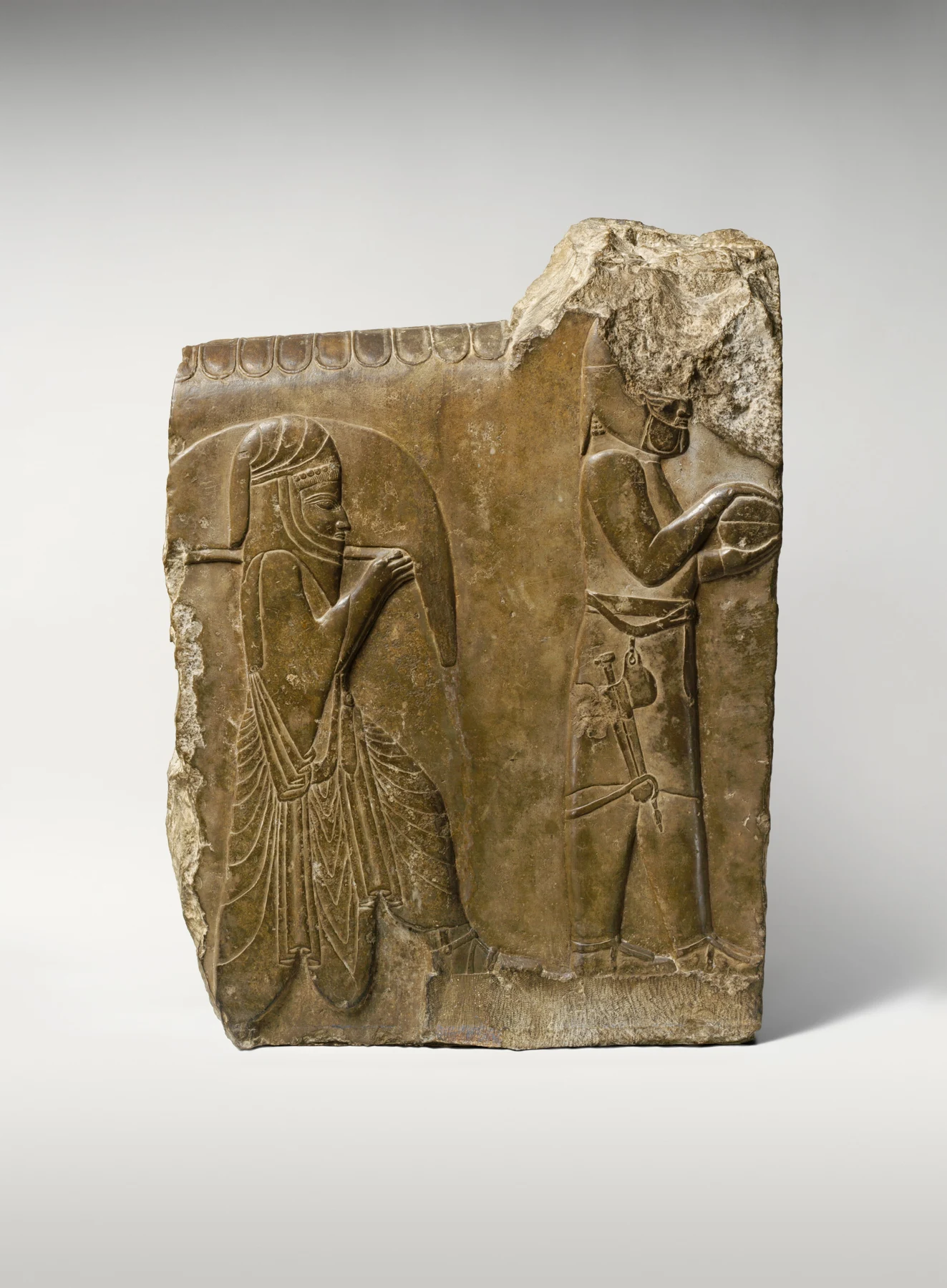
This entry's cover is a genuine photograph of an Achaemenid limestone relief from Persepolis showing two servants bearing food and drink, Metropolitan Museum of Art accession 34.158, dated circa 358–338 BCE. It illustrates how courtly service could be represented in Persian art. It is not an Esther manuscript or an illustration of the Additions and is not necessarily contemporary with the king imagined in the story. The evidence for the wording of A–F lies in their manuscript witnesses and critical editions, not in the pictured relief.
References and notes (11)
- Karen H. Jobes, “Esther,” in A New English Translation of the Septuagint (NETS), the translator’s introduction and parallel OG/AT columns; read from an accessible mirror. Hanhart’s critical apparatus was not independently read. Printed pp. 424–425, the A–F units in both columns, pp. 426, 430–433, 436–441; only selected portions of chapters 8–10. Return to the text ↑
- Jill Middlemas, “Esther in the eye of the beholder: Interpretation in antiquity and modern times,” Journal for the Study of the Old Testament (2026). Her account of defensive violence is an interpretation, not independent historical evidence. Introduction, §1.1 and selected passages discussing violence and reception; not the whole article. Return to the text ↑
- NRSVUE, Greek Esther, editors’ placement note for Additions A–F, checked against the NETS introduction. Placement notice: before 1:1; after 3:13, 4:17, 8:12 and 10:3. Return to the text ↑
- Jobes, NETS Esther, Mordecai’s dream (A) and its interpretation (F) in the parallel Greek versions; cf. Aaron Koller on their literary framing. Units A and F, printed pp. 426 and 440–441; Jobes introduction p. 425. Return to the text ↑
- Jobes, NETS Esther, the hostile royal edict (B) and counter-edict (E) in OG and AT; these embedded letters are not independently verified Persian state archives. B on p. 430, E on pp. 436–438; introduction pp. 424–425. Return to the text ↑
- Jobes, NETS Esther, Mordecai’s and Esther’s prayers (C), parallel columns; no independent Greek-language collation is claimed. Unit C, printed pp. 431–433, with fasting context in Esther 4:15–17. Return to the text ↑
- Jobes, NETS Esther, Esther’s audience and divine intervention (D), compared with the shorter Hebrew narrative. Unit D, printed pp. 433–434; compare Esther 5:1–2 in the Hebrew-based narrative. Return to the text ↑
- Natia Mirotadze, “An Old Georgian Translation of Esther Incorporates Three Greek Versions,” TheTorah.com (2023; updated 2026); her chronology is a scholarly model, not an agreed final sequence. Sections “Hebrew and Greek Versions,” “Old Greek Esther,” “An Old Georgian Translation,” and “A Conservative yet Creative Compiler,” plus selected examples. Return to the text ↑
- Jobes, NETS Esther, the three alternative dates implied by the colophon and the Purim-letter transmission notice; no independent prosopography or manuscript collation was carried out. Printed pp. 424–425 (dating alternatives) and 440–441 (unit F and transmission notice). Return to the text ↑
- Tyler Smith and Kristin de Troyer, “The Additions of the Greek Book(s) of Esther,” The Oxford Handbook of the Apocrypha (2021), pp. 387–396. Only the publisher’s abstract was read. Published abstract only: B/E placement and the rewriting of the D audience; chapter pp. 387–396 not accessed. Return to the text ↑
- Jerome’s notices about the Additions to Esther, English translation by Kevin P. Edgecomb, “Jerome, Notes on the Additions to Esther” (2006); a modern translation, not our own reading of Latin, checked against NETS. Full short translation page, especially notes introducing A–F; cf. NETS introduction p. 425. Return to the text ↑
Suggest a correction · Suggest a source for this record
Cite this record
IL Archive, «Greek Additions to Esther», https://ilarchive.com/en/entities/esther-greek-additions
Continue reading