Ancient text
Book of Esther
A text for line-by-line reading, with transliteration, translation, and resources.
The Book of Esther follows a Jewish queen and her cousin Mordecai at the Persian court in Susa. The story links their people’s deliverance from a royal decree to Purim. Its Greek witnesses also preserve prayers and scenes beyond the Hebrew narrative.
Estimated reading time: 3 min Published Last reviewed:
Share article
Text
Introduction
In the book, Esther becomes queen at the Persian court and keeps her Jewish identity private. When Haman obtains an order against the Jews, she uses her position, as the text tells it, to speak for her people. The Book of Esther tells the story through banquets, a night of sleeplessness and letters sent in the king’s name. The book presents the story as the origin of the annual days of PurimPurimJewish festival connected in Esther with rescue and lots; the book’s explanation alone does not establish the first historical origin of every element.Glossary · Click to read the explanation. [1][3][4]
Esther and Mordecai at Susa
In the book, the story opens at the court of Ahasuerus in SusaSusa, ancient ShushSusa is an archaeological city at Shush in southwestern present-day IranGlossary · Click to read the explanation, called Shushan in the HebrewHebrewA Northwest Semitic language of the Canaanite group, encompassing Iron Age epigraphy, Biblical, Rabbinic, medieval and Modern Hebrew; its scripts and pronunciations changed over time.Glossary · Click to read the explanation text. Esther, also called Hadassah, is an orphan whom her cousin Mordecai has raised as his daughter. The king makes her queen in place of Vashti. At Mordecai’s instruction, Esther keeps her family background and people secret. When Mordecai learns of a plot against the king, Esther reports it in Mordecai’s name. The incident is entered in the royal chronicles. [1]
The text tells that Haman rises to power and expects the king’s servants to bow to him. Mordecai refuses. When Haman learns that Mordecai is Jewish, he seeks the destruction of all Jews in the kingdom. A lot is cast to set the date. The resulting decree goes out under the king’s seal in each province’s script and each people’s language. Mordecai asks Esther to intervene. She explains that appearing before the king without a summons carries a death sentence unless he extends his golden scepter. She asks the Jews of Susa to fast before she approaches him. [1][2]
The banquets and the second decree
In the story, Esther invites the king and Haman to a banquet and invites them back the following day. In the interval, the king cannot sleep and has the chronicles read to him. When he learns Mordecai has received no reward for reporting the plot, he has Haman confer the public honors Haman had imagined for himself. At the second banquet, Esther identifies her own life and the lives of her people as the subject of her appeal. She names Haman as the man behind the threat. In the book, after Haman’s fall a second decree allows the Jews to assemble and defend themselves. The first decree remains in force. The same royal seal authenticates both orders. [1]
Purim and the forms of the text
The book (Esther 9) explains the name Purim from pur, the lot cast to fix the date of the attack. Mordecai’s letters call for annual observance on the fourteenth and fifteenth of Adar. They set out feasting, sending portions of food to one another and gifts to the poor. Esther and Mordecai confirm the observance in writing. [3]
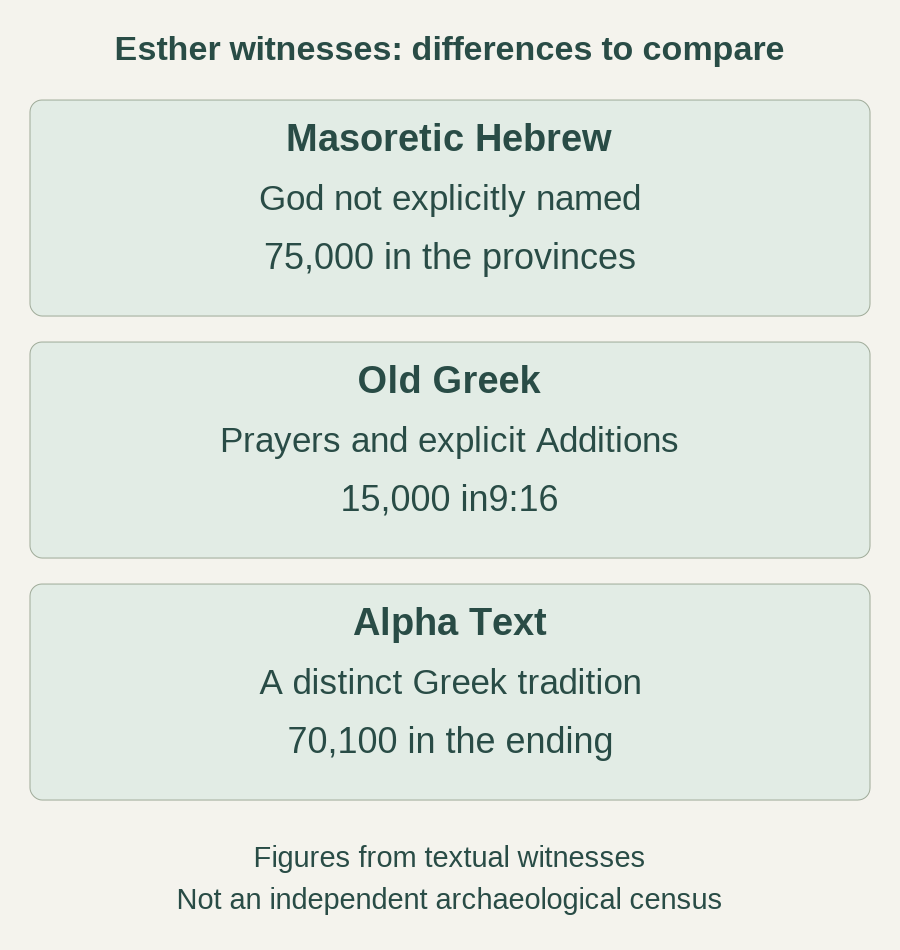
In the Hebrew narrative, fasting and deliverance carry the religious meaning and God’s role remains implicit. The Greek form adds material with explicit references to God, printed in the New American Bible, Revised Edition as Additions A to F, among them Addition C (C:1–D:16), placed after Esther 4:17. It also opens with material before the royal feast of the Hebrew text. In Papyrus 967, which the University of Cologne dates to around 200 CE (De Troyer gives the third century CE), the leaf P. Köln Theol. 38 recto preserves part of this opening. Kristin De Troyer also identifies fragments of the account of the plot against the king, placed near the beginning of the Greek form. In the Hebrew text Esther relays the report after becoming queen. [1][4][5][6]
Quick answers
Where is Esther in the Hebrew Bible? It is one of the Writings. In its liturgical use, the book is called the Megillah. [7][8]
When is the Megillah read at Purim? The Book of Esther is read aloud once at night and again during the day. [8]
References and notes
- Mechon-Mamre, “Esther,” Hebrew–English Bible Esther 1:1–3, 2:5–10, 2:15–23, 3:1–15, 5:1–8, 6:1–12, 7:1–10 and 8:7–14. Court setting, concealed identity, the recorded plot, banquets and both sealed decrees. Return to the text ↑
- Mechon-Mamre, “Esther Chapter 4,” Hebrew Bible in English Esther 4:8–17. Mordecai’s appeal, the rule on entering the inner court and Esther’s request for a fast. Return to the text ↑
- Mechon-Mamre, “Esther Chapter 9,” Hebrew Bible in English Esther 9:20–32. The dates in Adar, food portions, gifts to the poor, the name Purim and confirmation in writing. Return to the text ↑
- United States Conference of Catholic Bishops, “The Book of Esther,” New American Bible, Revised Edition Introduction and division “Esther and Mordecai Plead for Help.” The religious character of the Hebrew narrative, the Greek additions, and the location of the prayers in Addition C. Return to the text ↑
- Kölner Papyri, University of Cologne, “Ein theologischer Papyrus-Kodex (P 967 Rahlfs)” Introduction and Esther entry P. Köln Theol. 38 recto. Dating to around 200 CE and manuscript page 197, lines 1–23, catalogued as Esther 1:1a–1:1f. Return to the text ↑
- Kristin De Troyer, “The Papyri and the Septuagint: Chester Beatty Papyrus 967 and the Greek Texts of the Book of Esther,” in The Chester Beatty Biblical Papyri at Ninety: Literature, Papyrology, Ethics (De Gruyter, 2023), 155–160 Section 3, “The text of the Chester Beatty papyrus 967 and the Greek texts of Esther: some examples,” pp. 156–157. Comparison of the plot against the king in Esther 2:21–23 and Addition A:12–17. Return to the text ↑
- Mechon-Mamre, “Hebrew–English Bible by Books” Contents under Writings. Esther is listed between Lamentations and Daniel in this edition. Return to the text ↑
- Eliezer Wenger, “The Laws of Reading the Megillah,” Chabad.org Opening rules on hearing the Book of Esther, or Megillah, on Purim, once at night and once during the day. Return to the text ↑
Archive records may be reviewed and refined as better evidence or sources become available. Suggest a correction
Suggest a correction · Suggest a source for this record
Cite this record
IL Archive, «Book of Esther», https://ilarchive.com/en/texts/book-of-esther
Continue reading