Study
Esther and Persian Court Traditions: What Does Comparison Establish?
An extended study of a topic, with evidence and references.
Royal letters, banquets and reversals place Esther within court storytelling, but names do not prove a Babylonian mythic origin; Greek witnesses reveal directly examinable reinterpretation.
Share article
Text
Esther is a story about living within an empire whose decisions its protagonists do not control. A queen conceals her ancestry, her relative stands at the palace gate, and an official can turn a personal grievance into an order to destroy an entire community. Survival requires access to the court, carefully timed speech, and one royal message countering another.
Comparison with ancient court talesCourt TaleA scholarly label for stories of a sage or outsider tested or endangered by a ruler; the label alone does not prove textual borrowing.Glossary · Click to read the explanation is therefore useful. It does not begin by declaring that Esther was IshtarInanna / IshtarProminent Mesopotamian goddess with a major centre at Uruk, whose parentage and cult traditions vary rather than forming one fixed genealogy.Glossary · Click to read the explanation or that Mordecai was MardukMardukBabylon’s god, elevated with the city’s history. Enuma Elish celebrates his rise and cosmic ordering; sources associate him with Nibiru and Jupiter. Earliest origins and functions remain uncertain.Glossary · Click to read the explanation under another name. It begins with a testable question: what does the book share with the ancient political and narrative world, and what do the witnesses actually establish about the story’s transmission?
Three times and three witnesses
The time depicted in the story, its composition, and its surviving textual witnesses must be distinguished. HebrewHebrewA Northwest Semitic language in the Canaanite group, with ancient and modern forms.Glossary · Click to read the explanation Esther is set under Ahasuerus, whose name is generally associated with Khshayarsha, known in Greek as Xerxes. Identifying the royal name neither dates the narrative’s composition nor verifies all its events. Composition remains uncertain; Shaul Shaked discusses a third- or second-century BCE possibility, not a date established by an author’s manuscript. [9]
Nor is there one unvarying Esther. The Masoretic Hebrew form and two important Greek traditions, the Old Greek and the Alpha Text, survive. NETS presents the Greek versions in parallel columns; their details must not be merged and attributed to the Hebrew. The Old Greek names the king Artaxerxes, whereas the Alpha Text uses another form of the name. The versions’ relationships and editorial stages remain subjects of research. Calling them all one literal translation is inadequate. [13]
Distinguishing these times and witnesses prevents two mistakes: automatically dating composition to Xerxes’ reign, and using a relatively later Greek addition to establish an explicit meaning in the Hebrew form.
The palace constructed by the narrative
The book opens with a banquet and a display of wealth. When Vashti refuses to appear, the king’s advisers make the dispute a threat to women’s obedience throughout the kingdom, and letters go out to the provinces. The text does not say that she appeared naked or narrate her execution. Such details should not be supplied to Esther 1 without evidence. [1]
Hadassah, also called Esther, enters the women’s quarters and becomes queen. Esther 2:7 identifies her as Mordecai’s cousin, whom he adopted after her parents died; describing him as her relative and guardian is therefore more accurate than invariably calling him her uncle. She conceals her ancestry at his instruction, while Mordecai exposes a conspiracy against the king that is entered in the record. Concealed identity and unrewarded loyalty are established from the beginning. [2]
In chapter 3 Mordecai refuses to bow to Haman. The text mentions his Jewish identity but does not contain the prayer that later explains the refusal in Greek Addition C. Haman extends hostility from one person to a community, accusing it of different laws and disobedience to the king. The accusation becomes a decree including young and old and women, with a date chosen by lot. Administration itself becomes an instrument of danger: a signet, scribes, copies in provincial languages, and messengers. [3]
Esther cannot safely enter the royal presence uninvited. She calls for a fast and chooses to risk her life, then arranges two banquets before identifying the aggressor. Between them, a sleepless night and the reading of an old service record produce an ironic reversal: Haman must honor the man he wanted killed. Once exposed, Haman falls victim to the device prepared for Mordecai. These are conspicuous techniques of suspense, delay, and exchanged positions, rather than merely a sequence of administrative facts. [4][5][6]
What does Persian history support?
Achaemenid monuments and documents preserve an imperial world of many peoples, concerned with hierarchy, provisioning, and communication. Muhammad Dandamaev’s court study brings inscriptions and documents together with Greek authors, while warning that Esther contains legendary material requiring caution. This permits comparison of the setting; it does not turn the story into a royal archive. [10]
An independent ancient witness is particularly useful: in Histories 8.98 Herodotus describes messages relayed by men and horses stationed along a route. Its function resembles the courier network in Esther. It does not mention Haman’s letter or Esther’s rescue. It establishes an ancient description of a communication system, not the narrative event employing it. [12]
In 3.84 Herodotus recounts palace-access privileges for an elite group and restrictions on royal marriage. This can be compared with the king’s intimates in Esther 1:14, but it does not match every condition in Esther 4. It also creates tension with a story in which a queen is selected from outside the relevant families. Herodotus’ own account is a Greek narrative requiring criticism, not a contemporary Persian legal text copied verbatim. [11]
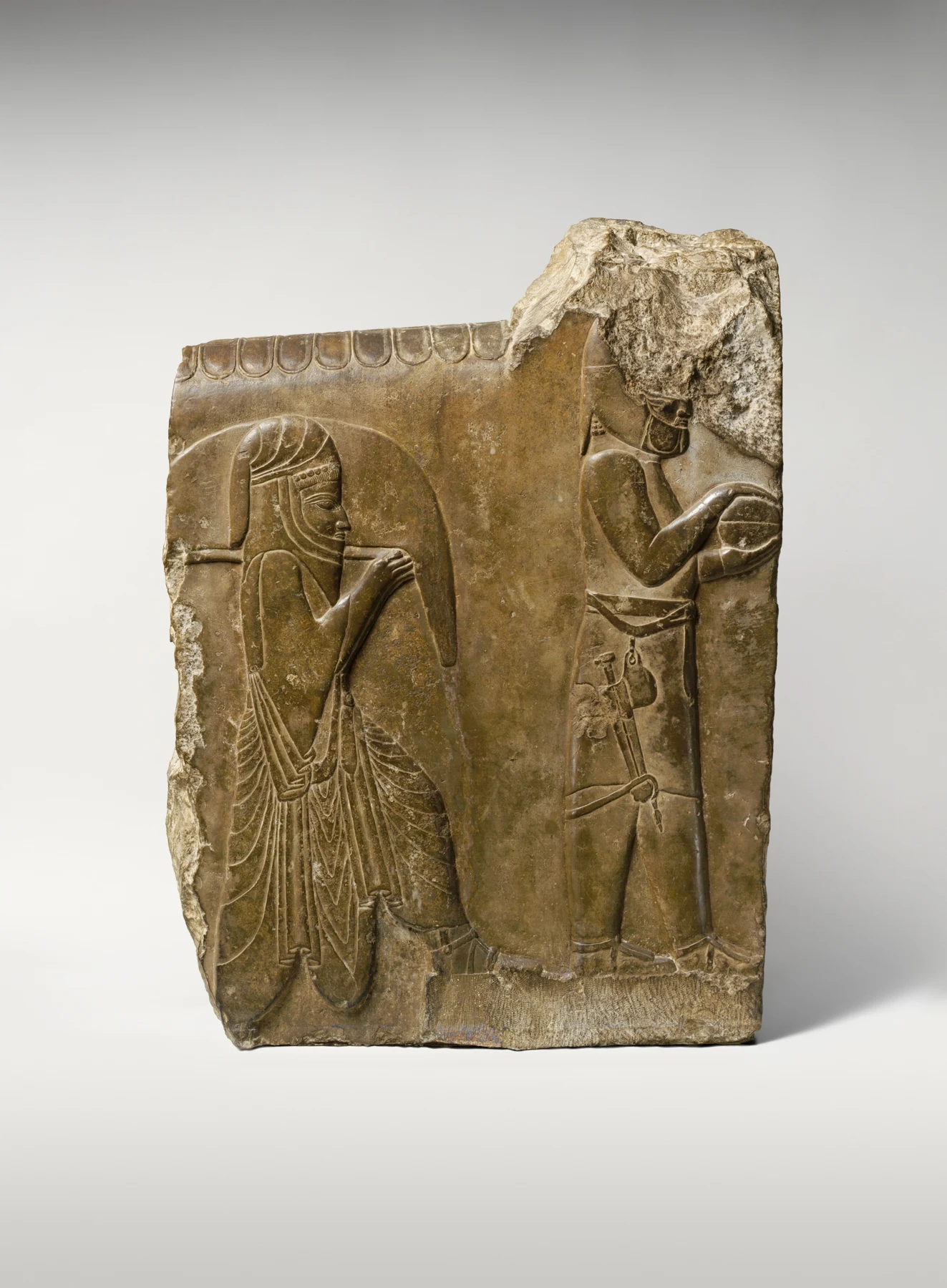
The accompanying image is a genuine relief of two servants carrying food and drink from Persepolis. The Metropolitan Museum dates it to approximately 358–338 BCE, under Artaxerxes III. It documents the representation of banquet service at an Achaemenid court; it depicts neither Esther nor Haman nor a banquet of Xerxes. Its different date is part of its identification, not something to conceal. [15]
A detail’s suitability to a Persian setting therefore differs from proof of the narrative’s characters and actions. Familiarity with signets, letters, and ranks cannot by itself establish a major event. Likewise, Esther 8:8’s rule that a sealed royal writ cannot be revoked operates within the narrative. Without independent evidence it should not become a universal law for every Achaemenid period. [7]
Joseph, Daniel, and Ahiqar: comparison and its limits
The archive’s Daniel and Ahiqar study and Joseph and the Two Brothers study help place Esther among tales of an outsider or sage at a foreign court. A shared form does not establish that Esther’s author copied one of them.
- Accusation: Becomes a threat to an entire community. To test borrowing, examine Its content and sequence, not merely an antagonist’s presence.
- Royal favor: Changes and is sought through mediationIntercessionMediation subject in the cited Quranic texts to permission and approval, not divine independence.Glossary · Click to read the explanation and banquets. To test borrowing, examine Unusual shared details.
- Knowledge and rescue: Disclosure of identity, management of an audience, and a forgotten record. To test borrowing, examine Differences from interpreting dreams or teaching wisdom.
- Reversal of fortune: The enemy honors his opponent and then loses his position. To test borrowing, examine The order, wording, and earlier witness of the reversals.
- Ending: A community survives and establishes an annual memorial. To test borrowing, examine Differences from one person’s promotion or punishment of a treacherous relative.
This is an editorial comparison of narrative functions. We do not have here an earlier Persian text containing Esther, Mordecai, and the same sequence of events, or a statement acknowledging a particular source. Jewish presence within the Babylonian and Persian worlds makes cultural contact possible; it does not identify this story’s transmission route. Confidently saying “borrowing” cannot supply a missing link.
Do the names conceal a Babylonian myth?
Scholarship discusses Mordecai’s connection with Marduk, and sometimes relates Esther to Ishtar. Shaked nevertheless finds reconstructions of the story as a Babylonian or Elamite myth unconvincing; the derivation of Haman’s and his father’s names is also disputed. [9][16]
The methodological reason is straightforward. Someone can bear a name with a religious history without being the divine figure itself. Demonstrating the transformation of a myth into a tale requires more than two similar names: a specified earlier text, a comparable plot, distinctive sequence or wording, and a plausible means of transmission. A name’s connection with Marduk does not itself supply the Marduk–Ishtar story that the book supposedly rewrote.
How did Greek Esther make God’s presence explicit?
The Hebrew form does not explicitly name God. It contains fasting, Mordecai’s expectation of rescue from elsewhere, human decisions, and coincidences that reverse the outcome. Religious readers may understand these within divine providence, but the absent name alone does not establish that the author denied God. [4]
The Greek Additions to EstherGreek Additions to EstherSix blocks conventionally labeled A–F, adding a dream, letters, prayers and an audience scene to Greek witnesses of Esther.Glossary · Click to read the explanation provide a directly checkable difference. Additions A and F frame the story with a dream and its interpretation; B and E expand royal letters; C contains Mordecai’s and Esther’s prayers; D enlarges the audience scene and attributes the king’s changed disposition to God. In C Mordecai explains his refusal to bow by the priority of divine glory. This explicit explanation is absent in that form from Hebrew chapter 3. [13]
Jill Middlemas discusses these additions within the narrative’s reception and reinterpretation by later communities. The evidence here is clearer than a hypothetical Babylonian origin: actual witnesses allow comparison of religious discourse, while the two Greek traditions’ precise relationship and history remain debated. [14]
Purim and the violence that must not be omitted
The book explains PurimPurimJewish festival connected in Esther with rescue and lots; the book’s explanation alone does not establish the first historical origin of every element.Glossary · Click to read the explanation’s name through Haman’s casting of lots. Esther 9:20–32 describes preserving the memory through feasting, joy, gifts of food, and giving to the poor. This is the festival’s explanation within the story. It differs from demonstrating the first historical origin of all its elements. Comparisons with Iranian festivals alone cannot prove the transfer of a particular ritualRitualAn organised or distinguished practice meaningful to a community; it may leave traces, but its form alone does not reveal an associated doctrine.Glossary · Click to read the explanation. [8]
Yet the ending cannot be summarized as celebration alone. The counter-decree in 8:11 authorizes killing and destruction and includes children and women. Chapter 9 then narrates the killing of the Jews’ enemies, reports 75,000 in the provinces besides those killed in Susa, and repeatedly says that plunder was not taken. These statements must be considered together. The narrative’s rescue and self-defense framework does not erase the decree’s broad language or Esther’s request for another fighting day in Susa. [7][8]
Different witnesses matter here too. The Old Greek as presented in NETS gives another number in 9:16; its wording on plunder in 9:10 differs from Hebrew, and the Alpha Text’s ending also differs. A number from one version and an interpretation from another cannot be combined into one supposedly fixed conclusion. [13]
Historical reading describes the narrative’s discourse of fear, retaliation, and power while preserving these differences. It does not turn the numbers into a confirmed archaeological count or a description of present-day believers. Nor does it select only comfortable passages and omit those that raise questions.
What is established, and what remains open?
It is certain that Esther constructs a court story with a communal and festive conclusion, and that its Hebrew and Greek witnesses differ in divine presence and some details of the ending. It is also certain that Achaemenid courts and imperial communication provide points of comparison with the story.
Placing the book within court storytelling and diaspora life plausibly improves its interpretation. Precisely dating composition, identifying a historical core, or proving borrowing from a specific tale or festival remain open questions to varying degrees.
This study does not establish that Esther was Ishtar renamed. More clearly visible is a Jewish story of survival within an empire using the court’s instruments and receiving fresh interpretations in later textual witnesses. Similar settings do not establish the same plot; the witnesses’ differences are themselves part of the history being investigated.
Sources and limits of reading
Esther 1–9 were read in Hebrew and facing English; Esther 10:1–3 in English. Karen Jobes’ NETS introduction, pp. 424–425, Additions A–F in both columns, and selected passages of chapters 8–10 were consulted. Neither complete Greek translation nor the original Göttingen critical apparatus was read. Herodotus 3.84 and 8.98 were read in Macaulay’s translation, not the complete Histories.
Shaked’s Esther and Haman entries were read in full. Selected sections on the royal household, officials, and court organization in Dandamaev, and Middlemas’ introduction, section 1.1, and selected violence discussions were consulted, not the scholars’ entire works or the books in their bibliographies. The museum relief record, photograph, and public-domain statement were checked. The narrative comparisons and evidence assessments above are editorial inferences, not an ancient tablet’s declaration that one story borrowed another.
Further reading: Similarity Does Not Mean Borrowing and Qumran and Textual Plurality, alongside the Joseph and Daniel studies linked above.
References and notes
- Complete chapter 1 read in Hebrew and facing English. Esther 1:1–22 Return to the text ↑
- Complete chapter 2 read in Hebrew and facing English. Esther 2:1–23 Return to the text ↑
- Complete chapter 3 read in Hebrew and facing English. Esther 3:1–15 Return to the text ↑
- Complete chapter 4 read in Hebrew and facing English. Esther 4:1–17 Return to the text ↑
- Complete chapter 5 read in Hebrew and facing English. Esther 5:1–14 Return to the text ↑
- Complete chapter 6 read in Hebrew and facing English. Chapter 7 also read in full; execution on wood distinguished from a conjecture about the precise method. Esther 6:1–14; also 7:1–10 Return to the text ↑
- Complete chapter 8 read in Hebrew and facing English. Esther 8:1–17 Return to the text ↑
- Complete chapter 9 read in Hebrew and facing English. Esther 9:1–32 Return to the text ↑
- Complete short entry read, not its cited books; dating attributed to the scholar and its narrative summary checked against Hebrew. Shaul Shaked, Encyclopaedia Iranica VIII/6, 655–657, published 1998; updated 2017 Return to the text ↑
- Specified source, household, courtiers and organization sections consulted; the referenced documentary editions were not read. M. A. Dandamaev, “Courts and Courtiers i,” selected royal-household, courtiers and court-organization sections Return to the text ↑
- Complete 3.84 read in Macaulay; a Greek account requiring criticism, not a verbatim Persian law. Herodotus, Histories 3.84; G. C. Macaulay translation Return to the text ↑
- Complete section and brief note read; describes courier relays, not Esther’s events. Herodotus, Histories 8.98; G. C. Macaulay translation Return to the text ↑
- Introduction, Additions A–F in both columns and selected 8–10 passages read; neither complete translation nor Göttingen apparatus read. Lettered numbering preserves edition differences. Karen H. Jobes, NETS Esther, introduction pp. 424–425; Additions A–F; selected 8–10, pp. 426, 430–433, 436–440 Return to the text ↑
- Introduction, §1.1 and selected violence passages read, not the complete article or cited books. Jill Middlemas, “Esther in the eye of the beholder,” 2026, introduction and §1.1; selected violence discussion Return to the text ↑
- Object 34.158 description, dating and public-domain notice checked against API metadata and photograph; not an image of Esther’s characters. Metropolitan Museum of Art, 34.158, relief of two servants; Persepolis, ca. 358–338 BCE Return to the text ↑
- Entire short entry read; multiple etymologies noted. Its bibliography was not read and its Qur’anic comparison is outside this study’s scope. Shaul Shaked, Encyclopaedia Iranica XI/6, 629, “Haman,” 2003; updated 2017 Return to the text ↑
Suggest a correction · Suggest a source for this record
Cite this record
IL Archive, «Esther and Persian Court Traditions: What Does Comparison Establish?», Edition 1, https://ilarchive.com/en/studies/esther-and-ancient-court-narratives
Continue reading